Introduction
Artificial intelligence has entered a completely new phase. For years, businesses relied on AI tools to generate content, analyze data, automate repetitive tasks, and assist employees with daily operations. While these tools significantly improved productivity, they still depended on human direction for most decisions. In 2026, however, organizations are moving beyond simple AI assistants toward something much more powerful: AI employees.
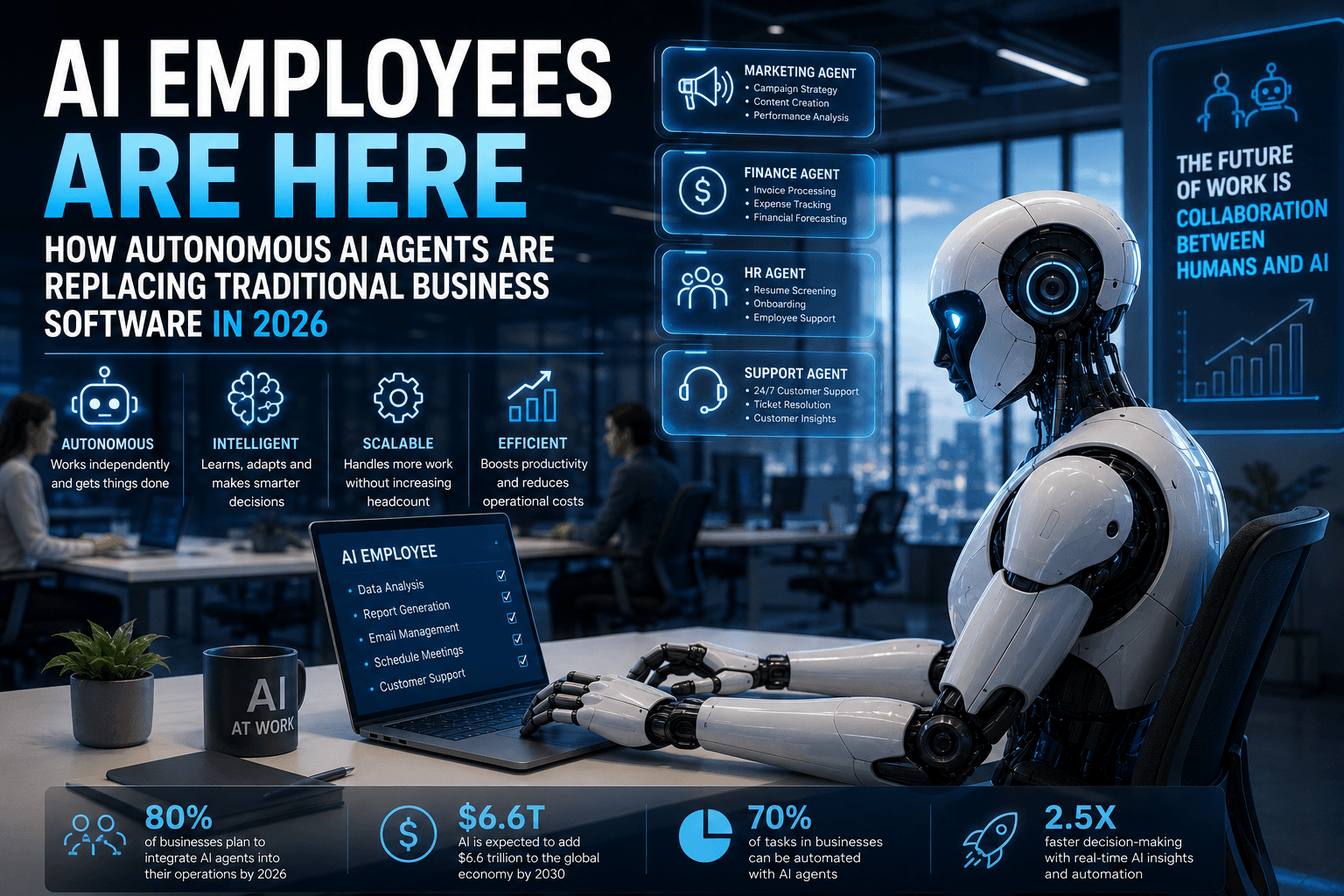
AI employees are autonomous digital workers capable of planning tasks, making informed decisions, collaborating with other AI systems, and completing complex workflows with minimal human supervision. Unlike traditional chatbots or automation software, these intelligent agents can understand business objectives, adapt to changing conditions, learn from previous interactions, and execute multi-step processes independently. As a result, companies are increasingly deploying AI employees across departments including finance, customer service, marketing, human resources, cybersecurity, operations, and software development.
This shift represents one of the biggest changes in enterprise technology since the adoption of cloud computing. Instead of purchasing multiple software applications to perform separate tasks, businesses are investing in intelligent AI agents that can integrate with existing systems and perform many of those tasks on their own. AI employees can manage emails, generate reports, analyze market trends, schedule meetings, monitor cybersecurity threats, create marketing campaigns, and even collaborate with human teams to solve business challenges.
The rapid advancement of large language models, multimodal AI, agentic AI frameworks, and enterprise AI infrastructure has made autonomous AI employees more reliable and practical than ever before. Organizations are recognizing that AI is no longer just a productivity tool—it is becoming a strategic workforce capable of delivering measurable business value. Companies that successfully adopt AI employees are seeing faster decision-making, lower operational costs, improved customer experiences, and greater scalability across their operations.
As global competition intensifies and businesses seek new ways to improve efficiency, AI employees are quickly becoming a critical component of digital transformation strategies. Rather than replacing human workers entirely, the future workplace will be built around collaboration between people and intelligent AI agents, enabling organizations to innovate faster, respond more effectively to market changes, and unlock new opportunities for sustainable growth..
Why Businesses Are Moving Beyond Traditional Software
For decades, enterprise software has helped businesses manage operations. Customer relationship management (CRM) platforms, enterprise resource planning (ERP) systems, project management tools, and accounting software have become essential components of modern organizations.
However, traditional software has one significant limitation—it requires humans to operate it.
Employees must manually enter data, switch between applications, generate reports, review information, and make decisions before completing many business processes. These repetitive tasks consume valuable time and increase operational costs.
AI employees change this model entirely.
Rather than simply providing software, organizations now deploy AI agents capable of completing work themselves. These systems can:
Analyze incoming information
Make recommendations
Execute business workflows
Coordinate with multiple software platforms
Learn from previous interactions
Improve performance over time
This represents a major shift from software-as-a-tool to AI-as-a-worker.
What Makes AI Employees Different?
AI employees are far more advanced than traditional automation tools.
Older automation systems followed predefined rules. If something unexpected occurred, the workflow stopped and required human intervention.
Modern AI agents can reason through problems, interpret natural language, adapt to changing conditions, and collaborate with both humans and other AI systems.
For example, an AI sales employee can:
Identify new leads
Research companies
Write personalized outreach emails
Schedule meetings
Update CRM records
Generate weekly sales reports
Recommend next actions
All of these tasks can happen with minimal supervision.
Similarly, AI finance agents can reconcile invoices, detect unusual spending, forecast budgets, and prepare financial summaries automatically.
This ability to combine reasoning with execution makes AI employees dramatically more valuable than previous automation technologies.
Industries Experiencing the Biggest AI Transformation
Nearly every industry is adopting AI employees, but several sectors are seeing particularly rapid transformation.
Customer Support
AI customer service agents now resolve many inquiries without human intervention. They understand customer intent, retrieve account information, process refunds, schedule appointments, and escalate complex issues only when necessary.
This allows human support teams to focus on higher-value interactions while reducing response times and operational costs.
Marketing
Marketing teams increasingly rely on AI employees to:
Research competitors
Generate content ideas
Create campaign drafts
Analyze performance metrics
Optimize advertising budgets
Monitor brand reputation
Instead of spending hours collecting information, marketers receive strategic recommendations almost instantly.
Human Resources
HR departments are using AI agents to screen resumes, schedule interviews, answer employee questions, prepare onboarding materials, and monitor compliance documentation.
Recruiters can spend more time evaluating candidates rather than handling repetitive administrative work.
Finance
Finance teams deploy AI employees to automate bookkeeping, detect fraud, forecast cash flow, generate reports, and improve financial planning.
These capabilities reduce manual errors while accelerating decision-making.
Software Development
AI coding assistants have evolved into autonomous development agents capable of writing code, identifying bugs, reviewing pull requests, generating documentation, and testing applications.
Development teams are becoming more productive by collaborating with AI throughout the software lifecycle.
The Rise of Multi-Agent AI Systems
One of the biggest trends in 2026 is the emergence of multi-agent AI systems.
Rather than relying on a single AI assistant, businesses deploy teams of specialized AI employees that collaborate on larger projects.
For example, launching a new product might involve:
A market research AI gathering competitive insights
A financial AI estimating profitability
A legal AI reviewing compliance requirements
A marketing AI creating promotional campaigns
A customer support AI preparing knowledge bases
A project management AI coordinating timelines
Together, these AI employees complete work that previously required multiple departments.
This collaborative approach enables organizations to operate faster while maintaining consistency across business functions.
Why Enterprises Are Investing Billions in AI Employees
Several factors are driving enterprise investment.
Increased Productivity
AI employees operate continuously without breaks, allowing organizations to complete more work in less time.
Routine administrative tasks that once required hours can now be completed within minutes.
Lower Operational Costs
Businesses face rising labor expenses, software licensing fees, and operational overhead.
AI employees reduce these costs by automating repetitive workflows while allowing existing employees to focus on strategic initiatives.
Faster Decision-Making
AI agents continuously analyze real-time business data.
Instead of waiting days for reports, executives receive immediate insights that support faster business decisions.
Improved Accuracy
Unlike manual processes, AI employees consistently follow defined procedures while reducing human errors.
This improves compliance, reporting quality, and operational reliability.
Conclusion
The rise of AI employees marks one of the most significant transformations in modern business technology. In 2026, organizations are no longer viewing artificial intelligence as just another software tool—they are embracing autonomous AI agents as digital coworkers capable of managing complex tasks, improving productivity, and supporting faster decision-making. From customer service and marketing to finance, HR, and software development, AI employees are helping businesses reduce operational costs while increasing efficiency and innovation. However, successful adoption requires more than simply deploying AI technology. Companies must invest in secure infrastructure, establish strong AI governance policies, protect sensitive data, and ensure human oversight remains part of critical decision-making processes. Businesses that combine the strengths of human expertise with autonomous AI will be better positioned to adapt to changing market demands and maintain a competitive advantage.
As AI capabilities continue to evolve, organizations that delay adoption risk falling behind competitors who are already benefiting from intelligent automation. The future workplace will not be defined by humans versus AI, but by humans working alongside AI employees to achieve greater productivity, creativity, and business growth. Companies that prepare today by building responsible, scalable, and secure AI strategies will be the ones leading the next generation of digital transformation and setting new standards for innovation in the years ahead.