

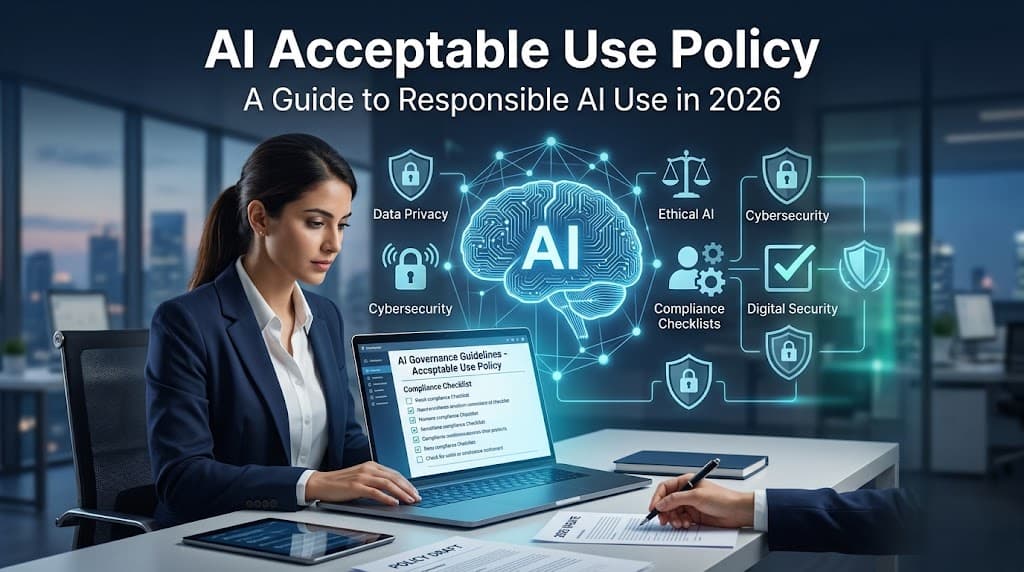
Artificial intelligence has rapidly evolved from a productivity tool into the core operating system of modern enterprises. Across industries, organizations now rely on AI agents to automate workflows, assist customers, analyze business intelligence, generate software code, and support executive decision-making. While these capabilities drive remarkable efficiency, they also introduce an entirely new category of cybersecurity risks.
In 2026, AI security has become one of the highest priorities for enterprise leaders. Businesses are no longer asking whether they should adopt AI—they are asking how they can protect it.
Unlike traditional software, AI systems continuously learn, interact with sensitive information, and communicate with external services. This expanded functionality creates new attack surfaces that cybercriminals are actively targeting. As AI adoption accelerates, organizations must rethink cybersecurity strategies to safeguard their data, operations, and reputation.
Why AI Security Matters More Than Ever
Enterprise AI has expanded far beyond simple chatbots. Modern AI agents can:
Analyze confidential company documents
Access internal databases
Manage customer interactions
Generate financial reports
Execute business workflows
Assist software development
Connect with multiple enterprise applications
Each new integration increases the potential attack surface. If compromised, an AI agent can expose confidential information, execute unauthorized actions, or become a gateway into the broader enterprise network.
Organizations that fail to secure AI systems risk financial losses, regulatory penalties, and significant reputational damage.
The Rise of AI Agents in Business
Businesses increasingly deploy autonomous AI agents capable of completing complex tasks with minimal human supervision. These agents can:
Schedule meetings
Generate legal documents
Process invoices
Perform customer support
Analyze contracts
Monitor cybersecurity events
Optimize supply chains
While autonomous AI improves efficiency, it also requires stronger security controls. Every AI agent effectively becomes another digital employee that must be authenticated, monitored, and governed.
New Cybersecurity Risks Introduced by AI
Prompt Injection Attacks
Attackers manipulate AI models using specially crafted prompts designed to bypass security restrictions or reveal confidential information.
These attacks can trick AI into ignoring previous instructions or exposing internal business data.
Data Leakage
AI systems often process sensitive customer records, financial reports, proprietary research, and confidential communications.
Without proper safeguards, confidential information may unintentionally appear in AI-generated responses.
Model Poisoning
Cybercriminals may manipulate training data to influence AI behavior.
Poisoned datasets can produce biased recommendations, inaccurate decisions, or hidden vulnerabilities that remain undetected for long periods.
Identity Abuse
If attackers gain access to enterprise AI accounts, they may impersonate employees, retrieve confidential documents, or automate malicious activities.
Strong identity verification becomes increasingly important as AI gains broader system access.
API Exploitation
Modern AI platforms connect with numerous business applications through APIs.
Poorly secured APIs allow attackers to access AI services without authorization or manipulate business workflows.
Why Traditional Cybersecurity Is No Longer Enough
Traditional security focuses primarily on protecting servers, networks, endpoints, and user accounts.
AI introduces entirely different challenges:
Dynamic decision-making
Continuous learning
Third-party AI integrations
External model providers
Large-scale data processing
Autonomous task execution
Protecting AI requires dedicated security strategies that extend beyond conventional cybersecurity frameworks.
Essential AI Security Strategies for Enterprises
Implement Zero Trust Architecture
Organizations should never assume that any AI system, user, or application is automatically trustworthy.
Every request should be verified using:
Multi-factor authentication
Device verification
User identity validation
Continuous monitoring
Zero Trust minimizes unauthorized access across AI environments.
Secure AI Training Data
Training datasets should be:
Encrypted
Access-controlled
Regularly audited
Protected against tampering
Maintaining data integrity is essential for reliable AI performance.
Monitor AI Behavior
Continuous monitoring helps identify unusual AI activities such as:
Unexpected responses
Unauthorized data access
Excessive API usage
Suspicious workflow execution
Real-time monitoring enables faster incident response.
Apply Role-Based Access Control
Not every employee requires full AI access.
Organizations should grant permissions based on job responsibilities, reducing the risk of insider threats and accidental data exposure.
Encrypt Sensitive Data
Encryption protects information:
At rest
In transit
During backups
Strong encryption significantly limits the impact of data breaches.
AI Governance Is Becoming a Business Requirement
Security alone is insufficient.
Organizations also require governance policies that define:
Acceptable AI usage
Data handling procedures
Compliance standards
Human oversight requirements
Risk assessment processes
Audit responsibilities
AI governance ensures responsible deployment while maintaining regulatory compliance.
Regulatory Compliance Is Expanding
Governments worldwide are introducing AI regulations that emphasize:
Transparency
Data privacy
Bias mitigation
Security controls
Accountability
Risk management
Businesses should prepare for increasingly stringent compliance requirements by documenting AI processes and conducting regular security assessments.
Building Secure AI Infrastructure
Modern AI workloads require infrastructure designed specifically for security.
Key components include:
Secure Cloud Architecture
Cloud platforms should provide:
Identity management
Network segmentation
Encryption
Threat detection
Secure storage
AI Workload Isolation
Separating AI workloads from other business systems reduces the impact of potential security incidents.
Isolation limits lateral movement within enterprise networks.
Continuous Vulnerability Management
Organizations should regularly:
Scan AI environments
Patch vulnerabilities
Update software dependencies
Review configurations
Proactive maintenance reduces exploitable weaknesses.
Employee Training Remains Critical
Human error continues to be a leading cause of cybersecurity incidents.
Employees should understand:
Safe AI usage
Prompt security
Data privacy
Phishing awareness
AI-generated misinformation
Secure document handling
A security-conscious workforce strengthens enterprise resilience.
The Role of AI in Cyber Defense
Interestingly, AI is also improving cybersecurity.
Security teams increasingly use AI for:
Threat detection
Malware analysis
Behavioral analytics
Incident response
Fraud detection
Automated investigations
AI-powered cybersecurity solutions enable faster responses to sophisticated attacks.
Future Trends in AI Security
Several developments are expected to shape AI security over the coming years:
Autonomous Security Agents
AI will increasingly monitor and defend enterprise environments without constant human intervention.
Explainable AI
Organizations will demand greater transparency into AI decision-making, particularly in regulated industries.
Confidential AI Computing
Hardware-based security technologies will protect AI workloads during processing.
Secure Multi-Agent Systems
As businesses deploy multiple collaborating AI agents, securing communications between them will become increasingly important.
AI Risk Scoring
Organizations will evaluate AI systems using standardized security risk scores before deployment.
Best Practices for Protecting Enterprise AI
To strengthen AI security, businesses should:
Conduct regular AI security assessments.
Enforce Zero Trust principles.
Encrypt all sensitive data.
Monitor AI behavior continuously.
Secure APIs and integrations.
Apply least-privilege access controls.
Train employees on AI security risks.
Establish clear AI governance policies.
Keep AI software and models updated.
Develop an AI incident response plan.
Frequently Asked Questions
What is AI security?
AI security refers to the technologies, policies, and practices used to protect artificial intelligence systems, data, and models from cyber threats, unauthorized access, and misuse.
Why are AI agents considered a security risk?
AI agents often access sensitive business systems and automate important tasks. If compromised, they can expose confidential data or execute unauthorized actions.
How can businesses secure AI systems?
Businesses should implement Zero Trust architecture, encrypt sensitive data, monitor AI behavior, secure APIs, establish governance policies, and train employees on AI security best practices.
Is AI replacing traditional cybersecurity?
No. AI enhances cybersecurity by improving threat detection and response, but it complements rather than replaces traditional security measures.
Conclusion
As enterprises increasingly rely on AI agents to power critical operations, protecting these systems has become a strategic business imperative. AI introduces powerful capabilities, but it also creates new attack vectors that require modern security practices, robust governance, and continuous monitoring.
Organizations that invest in AI security today will be better positioned to innovate confidently, maintain customer trust, and meet evolving regulatory expectations. In 2026 and beyond, securing AI is no longer optional—it is a foundational requirement for resilient, future-ready businesses.