
Introduction
The way people search for information online is changing faster than ever before. For more than two decades, traditional search engines have relied on keyword matching, backlinks, and web page rankings to determine which websites appear in search results. Businesses invested heavily in search engine optimization (SEO), content marketing, and link-building strategies to improve visibility and attract organic traffic. While these methods remain important, the rapid rise of artificial intelligence is fundamentally reshaping how search works in 2026.
Today's users increasingly rely on AI-powered search experiences that provide direct answers instead of long lists of website links. AI assistants, generative search engines, intelligent browsers, and enterprise AI tools can summarize information, compare products, answer complex questions, and even complete tasks without requiring users to visit multiple websites. This shift is giving rise to AI Search Optimization (AISO)—a new approach focused on helping AI systems understand, trust, and recommend business content.
For organizations, this transformation presents both opportunities and challenges. Businesses that continue relying solely on traditional SEO strategies risk losing visibility as AI-generated answers become the primary source of information for users. On the other hand, companies that optimize their content for AI search engines can strengthen their digital presence, increase brand authority, and reach customers in entirely new ways.
As AI search continues to evolve, businesses must rethink how they create content, structure websites, and measure success. The future of online visibility is no longer just about ranking first on a search results page—it is about becoming the trusted source that AI systems choose to reference, summarize, and recommend.
The Evolution of Search
Search technology has undergone several major transformations over the past twenty years.
Initially, search engines focused on matching keywords with web pages. Businesses optimized title tags, meta descriptions, and backlinks to improve rankings.
Later, search engines became more intelligent by understanding search intent rather than simply matching keywords. Semantic search, machine learning, and natural language processing improved result quality.
Today, AI is taking another significant leap.
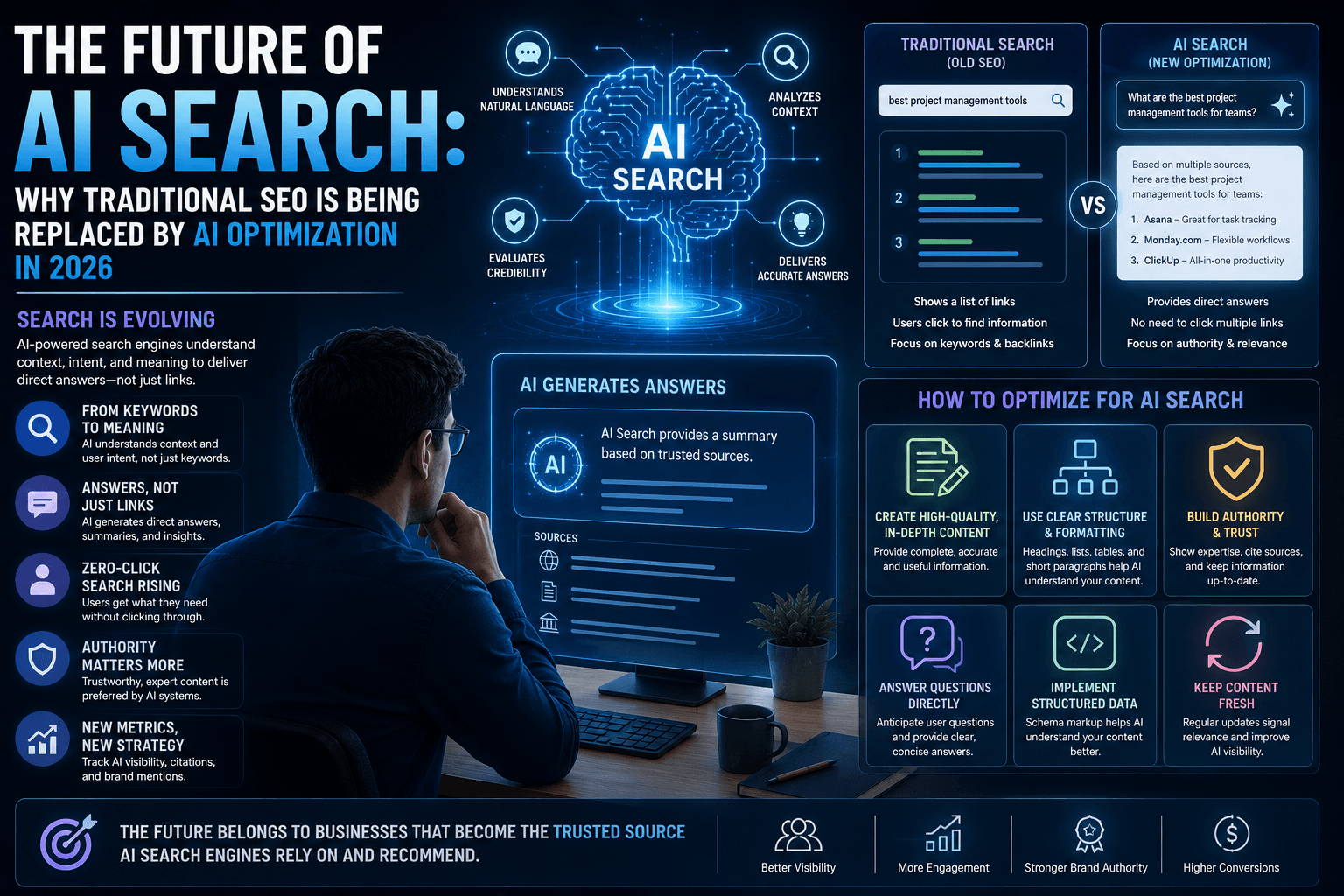
Instead of showing ten blue links, AI search engines generate complete answers by analyzing information from multiple trusted sources. Users receive summarized responses, comparisons, recommendations, and explanations within seconds.
This dramatically changes how businesses earn online visibility.
What Is AI Search Optimization?
AI Search Optimization (AISO) is the process of creating content that AI-powered search engines, large language models, and intelligent assistants can easily understand, verify, and recommend.
Unlike traditional SEO, AI optimization focuses on:
Creating highly authoritative content
Publishing accurate and trustworthy information
Structuring articles for machine readability
Using clear headings and logical organization
Answering user questions directly
Demonstrating expertise and credibility
Keeping content regularly updated
Rather than optimizing only for Google's ranking algorithm, businesses now optimize for AI systems that summarize information before presenting it to users.
Why Traditional SEO Alone Is No Longer Enough
SEO remains valuable, but user behavior is changing rapidly.
When someone asks an AI assistant, "What is the best CRM software for small businesses?" they often receive a complete comparison instead of a list of search results.
Similarly, business professionals increasingly use AI tools to research markets, compare products, generate reports, and make purchasing decisions.
As AI-generated answers become more common, websites may experience fewer clicks despite maintaining strong rankings.
This phenomenon is known as zero-click search, where users obtain the information they need without visiting individual websites.
Businesses must therefore focus on becoming the trusted source that AI systems reference rather than relying solely on traditional website traffic.
The Rise of Answer Engines
Answer engines represent the next evolution of online search.
Instead of helping users find information, they deliver information immediately.
Modern AI-powered search platforms can:
Summarize lengthy reports
Compare competing products
Explain technical concepts
Recommend business solutions
Generate purchasing advice
Provide step-by-step guidance
Analyze market trends
These capabilities significantly improve user experience while reducing the need to browse multiple websites.
For businesses, success increasingly depends on publishing content that AI can confidently understand and cite.
How Businesses Should Adapt Their Content Strategy
Content quality has become more important than content quantity.
Organizations should prioritize:
Create Comprehensive Articles
Long-form, well-researched content is more likely to be referenced by AI search engines because it provides complete answers.
Demonstrate Expertise
Businesses should publish content written by subject matter experts, include real-world examples, statistics, and actionable insights to build authority.
Answer User Questions Clearly
Each article should address common customer questions using concise, well-structured answers that AI models can easily summarize.
Improve Content Structure
Using descriptive headings, bullet points, tables, FAQs, and logical formatting helps AI systems interpret content more accurately.
Keep Information Updated
AI search engines prioritize current, relevant, and accurate information. Regularly updating articles improves credibility and long-term visibility.
How AI Search Engines Understand Content
Unlike traditional search engines that primarily rank pages based on keywords and backlinks, AI search engines analyze the overall meaning, context, and reliability of content. They use advanced natural language processing (NLP) and large language models (LLMs) to understand relationships between concepts, identify authoritative sources, and generate accurate responses for users. This means businesses must focus on creating content that is informative, well-structured, and factually accurate rather than simply repeating keywords. Articles that explain topics clearly, provide expert insights, and answer user questions comprehensively are more likely to be referenced by AI-powered search systems.
The Growing Importance of Structured Data
Structured data has become one of the most valuable technical SEO practices in the AI era. Schema markup helps search engines and AI systems understand the purpose of web pages, identify important information, and display rich search results. Businesses should implement structured data for articles, products, organizations, FAQs, authors, and reviews whenever appropriate. Well-implemented schema improves content discoverability, enhances search visibility, and increases the chances of appearing in AI-generated responses and knowledge panels.
Why E-E-A-T Matters More Than Ever
Google's E-E-A-T framework—Experience, Expertise, Authoritativeness, and Trustworthiness—continues to play a critical role in AI search. AI systems are designed to prioritize reliable information from credible sources. Businesses should clearly identify authors, cite reputable references, maintain accurate company information, and regularly update content to establish authority. Demonstrating real-world experience and industry expertise not only improves traditional search rankings but also increases the likelihood that AI platforms will trust and recommend your content.
Optimizing Content for Conversational Search
People are interacting with AI assistants using natural language instead of short keyword phrases. Instead of searching for "best CRM software," users now ask questions like, "Which CRM software is best for a growing startup with a limited budget?" Businesses should optimize their content for these conversational queries by writing in a natural, question-and-answer format. Including FAQs, detailed explanations, and long-tail keywords helps AI systems understand the intent behind user queries and provide more relevant responses.
Building Brand Authority in the AI Era
As AI search becomes more prevalent, strong brand authority is becoming a competitive advantage. AI models are more likely to reference organizations that consistently publish high-quality, accurate, and insightful content across multiple channels. Businesses should invest in thought leadership, publish original research, share case studies, and maintain an active presence on trusted industry websites and social platforms. A recognized and credible brand has a greater chance of being featured in AI-generated answers.
The Role of Fresh Content in AI Search
AI search engines favor content that reflects the latest developments, technologies, and market trends. Regularly updating articles with new statistics, examples, product releases, and industry insights signals that your content remains relevant. Businesses should perform periodic content audits, refresh outdated information, and expand existing articles to ensure they continue meeting user expectations. Fresh, high-quality content improves both traditional SEO performance and AI search visibility.
How Businesses Can Measure AI Search Success
Traditional SEO metrics such as rankings and organic traffic remain important, but businesses should also monitor new performance indicators. These include AI-generated referrals, branded search growth, engagement metrics, time on page, content citations, and visibility across AI-powered platforms. Monitoring these metrics provides valuable insights into how AI systems interact with your content and helps organizations refine their optimization strategies over time.
Preparing for the Future of AI Search
AI-powered search is still evolving, and businesses that adapt early will gain a significant competitive advantage. Organizations should invest in high-quality content creation, technical SEO improvements, structured data, authoritative backlinks, and AI-friendly website architecture. Rather than focusing solely on ranking in traditional search engines, businesses must aim to become trusted knowledge sources that AI assistants confidently recommend. Companies that embrace this shift today will be better positioned to attract customers, strengthen their digital presence, and remain competitive in the rapidly changing search landscape of the future.