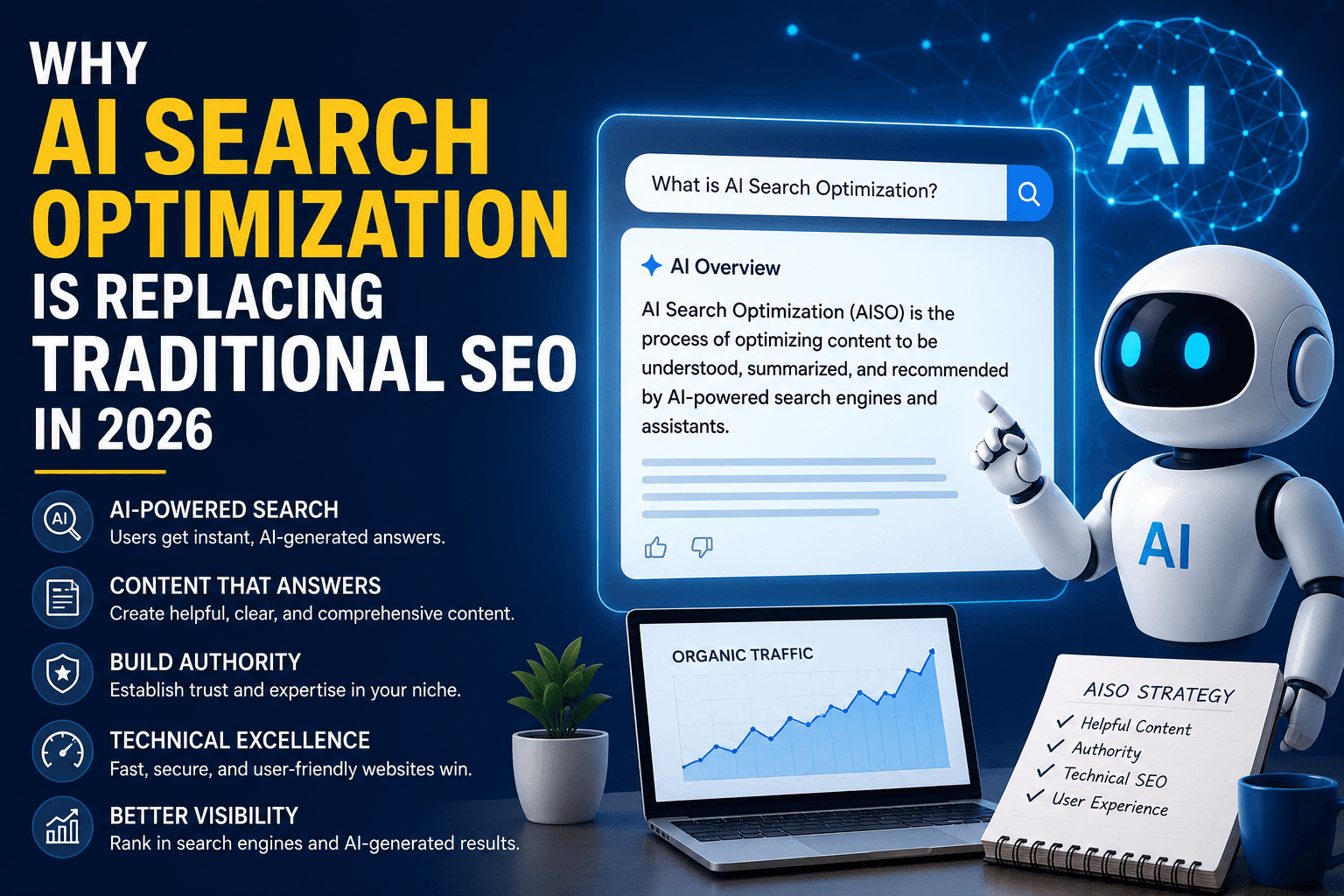
Artificial intelligence is changing the way people search online. Instead of typing keywords into traditional search engines, millions of users now ask AI assistants direct questions and expect complete, conversational answers. This shift is creating a new digital marketing strategy known as AI Search Optimization (AISO), which many experts believe will become just as important as traditional SEO.
What Is AI Search Optimization?
AI Search Optimization focuses on creating content that AI-powered search engines and assistants can easily understand, summarize, and recommend. Unlike traditional SEO, which emphasizes keyword rankings, AISO prioritizes context, expertise, and helpful information.
Businesses that adapt early can increase their visibility not only in search engine results but also in AI-generated answers.
Why Traditional SEO Alone Is No Longer Enough
Search engines are increasingly integrating AI into their results. Instead of showing ten blue links, AI often provides a direct answer, pulling information from trusted and well-structured websites.
This means businesses need content that:
Clearly answers user questions
Demonstrates expertise
Includes updated and accurate information
Uses logical headings and structure
Provides real value rather than keyword stuffing
Key Strategies for AI Search Optimization
1. Write for People First
Content should solve real problems. AI systems prioritize articles that provide comprehensive and trustworthy answers.
2. Use Question-Based Headings
Headings such as "What Is AI Search Optimization?" or "How Can Businesses Prepare?" help AI understand your content.
3. Keep Content Updated
AI systems often favor recently updated articles, especially in technology, finance, healthcare, and business.
4. Build Authority
Publishing consistent, high-quality articles helps establish your website as a reliable source.
5. Improve Technical Performance
Fast-loading pages, mobile optimization, structured data, and secure websites remain essential for AI visibility.
Benefits for Businesses
Companies investing in AI Search Optimization can gain:
Higher organic visibility
Increased website traffic
Better brand authority
More qualified leads
Stronger long-term search performance
Businesses that combine SEO with AISO strategies will be better positioned as AI continues transforming online search.
Common Mistakes to Avoid
Many websites still rely on outdated SEO tactics, including excessive keyword repetition and low-quality AI-generated content. These approaches may reduce trust and visibility over time.
Instead, businesses should focus on originality, research, and user experience.
The Future of Search
As AI assistants become a primary source of information, businesses that optimize their content for both humans and AI will have a significant competitive advantage.
The future of digital marketing is no longer just about ranking on search engines—it's about becoming the trusted source AI chooses to recommend.
FAQs: Why AI Search Optimization (AISO) Is Replacing Traditional SEO in 2026
1. What is AI Search Optimization (AISO)?
AI Search Optimization (AISO) is the practice of optimizing digital content so it can be accurately discovered, understood, summarized, and referenced by AI-powered search systems. Unlike traditional SEO, which has historically focused heavily on ranking webpages in conventional search results, AISO considers how generative AI systems interpret information and formulate answers. It emphasizes clear content structure, factual accuracy, contextual relevance, entity understanding, trustworthy sources, and content that directly answers user questions. As AI-generated answers become more prominent in search experiences, businesses are increasingly adapting their optimization strategies to make their information easier for AI systems to understand and use.
2. Why is AISO becoming more important in 2026?
AISO is becoming more important because users are increasingly interacting with search through AI-generated answers, conversational interfaces, and AI assistants rather than relying exclusively on traditional lists of blue links. These systems can synthesize information from multiple sources and provide direct responses to complex questions. This changes how businesses need to think about visibility. Instead of optimizing exclusively for a webpage's position on a search results page, brands increasingly need to ensure their information is clear, credible, structured, and relevant enough to be recognized within AI-generated responses and recommendations.
3. Is AISO replacing traditional SEO completely?
No. AISO is not necessarily eliminating traditional SEO; instead, it is expanding the scope of search optimization. Traditional SEO fundamentals such as technical performance, crawlability, quality content, internal linking, relevant keywords, authoritative backlinks, and strong user experience remain important. However, businesses now also need to consider how AI systems interpret entities, context, intent, and factual relationships. In 2026, an effective strategy is increasingly a combination of traditional SEO and AI-search optimization rather than treating the two approaches as completely separate disciplines.
4. How is AI search different from traditional Google search?
Traditional search engines generally return a ranked collection of webpages based on factors related to relevance, authority, quality, and other signals. AI search experiences can instead synthesize information from multiple sources and generate a conversational response. Users may ask longer, more specific questions and receive an answer rather than having to open several websites. This means businesses need to create content that provides comprehensive answers and establishes clear topical authority. Content should be structured so that important facts, explanations, definitions, comparisons, and supporting evidence can be easily interpreted by both users and AI systems.
5. What types of content perform well for AISO?
Content that directly answers specific questions and provides useful, well-organized information can be particularly suitable for AI search environments. Detailed guides, expert explanations, original research, comparison articles, FAQs, case studies, tutorials, industry reports, and data-driven content can all contribute to AI-search visibility. Strong content should avoid unnecessary filler and clearly communicate important information. Using descriptive headings, concise definitions, logical sections, supporting evidence, and consistent terminology can make content easier for search engines and AI systems to interpret.
6. How important are keywords in AI Search Optimization?
Keywords remain useful, but their role is changing. Traditional SEO often emphasized targeting specific keyword phrases and variations, while AISO places greater emphasis on search intent, context, entities, and natural language. Users can ask AI systems highly conversational questions that may not match a conventional keyword exactly. Businesses should therefore focus on covering the broader topic and answering related questions instead of repeatedly inserting the same keyword. A strong content strategy can incorporate important terminology naturally while addressing the different ways users may express the same information need.
7. Does E-E-A-T matter for AISO?
Yes. Experience, expertise, authoritativeness, and trustworthiness remain important concepts for creating credible content, particularly in areas where inaccurate information could cause significant harm. AI systems need reliable information to produce useful answers, so businesses should demonstrate who created their content, why they are qualified to discuss the subject, and where important claims come from. Author bios, credible references, original research, transparent business information, accurate claims, and regularly updated content can all strengthen a website's credibility. AISO therefore involves more than technical optimization; it also requires building genuine authority.
8. How can businesses optimize their websites for AI search?
Businesses can begin by creating comprehensive content around the topics and questions their target audiences actually care about. They should use clear headings, descriptive page titles, structured information, consistent terminology, strong internal linking, and accurate factual statements. Organization information, author details, product or service information, and other important entities should be presented clearly. Websites should also maintain strong technical SEO foundations, including crawlability, mobile usability, performance, indexing, and structured data where appropriate. Most importantly, businesses should prioritize useful original information rather than producing large quantities of repetitive AI-generated content.
9. Can structured data improve AISO?
Structured data can help search engines better understand certain types of information on a webpage by providing machine-readable context about entities and content. Depending on the page, relevant schema types may communicate information such as articles, organizations, products, events, authors, or other entities. Structured data does not guarantee that a website will appear in an AI-generated answer, but accurate implementation can contribute to clearer machine understanding. Businesses should use supported schema types appropriately and ensure that structured information accurately represents visible page content.
10. Will backlinks still matter in an AI-search environment?
Backlinks are likely to remain useful because links can contribute to authority, discovery, and the broader credibility ecosystem surrounding a website. However, businesses should focus less on acquiring large numbers of low-quality links and more on earning relevant mentions and links from credible sources. Original research, expert commentary, useful resources, industry data, and genuinely valuable content can naturally attract references. In an AI-driven search environment, being recognized as a reliable source within a topic may become increasingly important, making overall brand authority and reputation just as important as traditional link-building metrics.
11. How does AISO affect content marketing strategies in 2026?
AISO encourages content marketers to move from simple keyword-focused publishing toward deeper topic coverage and information usefulness. Instead of producing dozens of short articles targeting nearly identical phrases, companies can build authoritative content ecosystems around important subjects. A single topic can be supported by detailed guides, FAQs, research, case studies, expert commentary, statistics, and related educational resources. Content should also be updated as facts, technologies, and user expectations change. This approach can improve visibility across traditional search engines while simultaneously giving AI systems more high-quality information to understand and potentially reference.
12. What should companies do now to prepare for the future of AI search?
Companies should treat AI search as an evolution of their existing search strategy rather than abandoning SEO completely. The first step is to audit existing content and identify pages that provide weak, outdated, repetitive, or incomplete answers. Next, businesses should strengthen topical authority, improve technical SEO, clearly identify important entities, publish original and trustworthy information, and develop content around real user questions. They should also monitor how their brand and key topics appear across emerging AI search experiences. In 2026, the strongest strategy is likely to combine technical SEO, high-quality content, digital authority, structured information, and optimization for conversational AI-driven discovery.
Final Thoughts
AI Search Optimization is quickly becoming one of the most important digital marketing trends of 2026. Businesses that invest in creating authoritative, helpful, and well-structured content today will be better prepared for the future of online search.