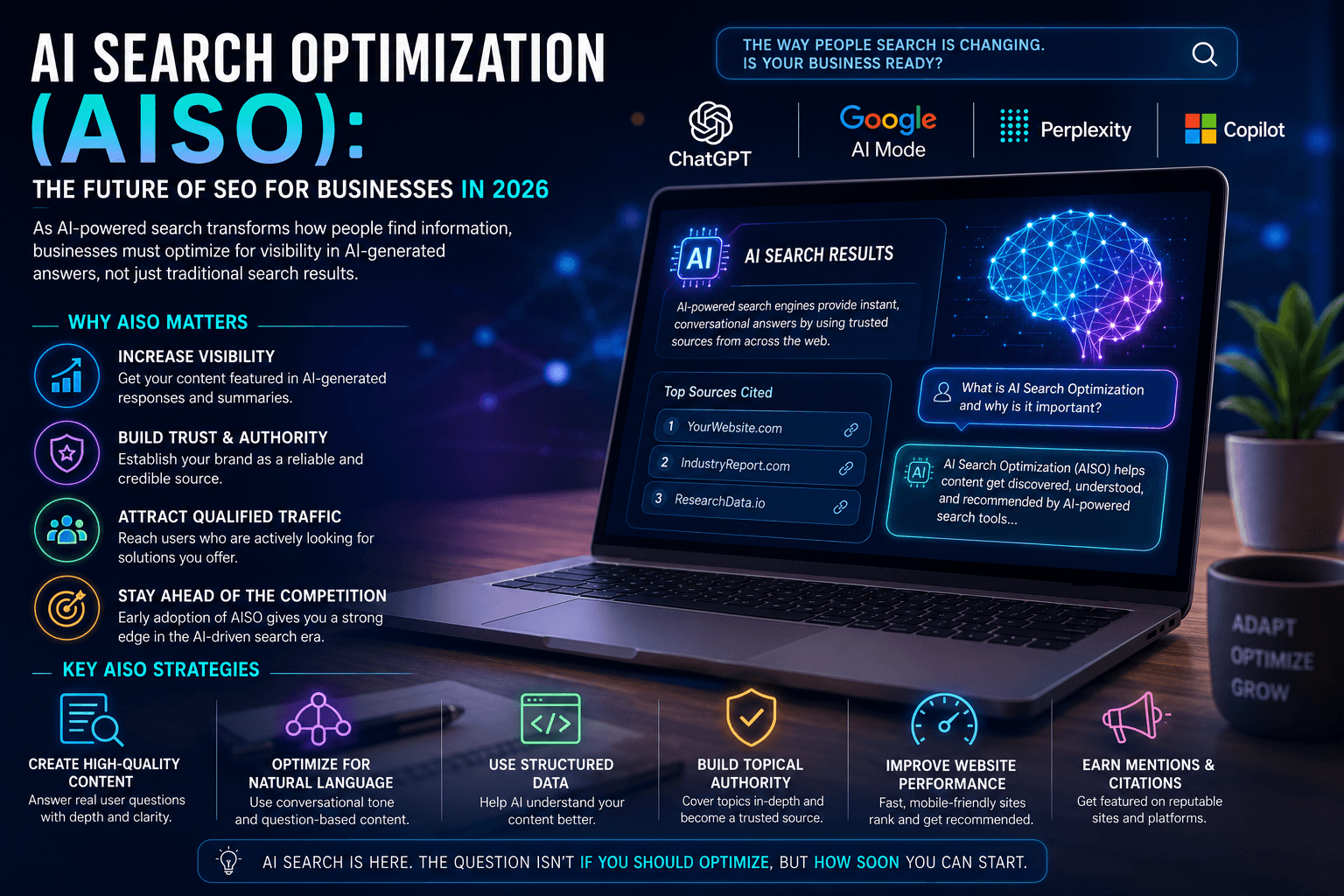

The search landscape has undergone one of its biggest transformations since the launch of traditional search engines. In 2026, users are increasingly relying on AI-powered platforms such as ChatGPT, Google AI Mode, Perplexity, Microsoft Copilot, and other generative AI tools to find answers quickly and efficiently. Instead of clicking through multiple websites, people now expect direct, conversational responses that summarize information from trusted sources.
This shift has given rise to AI Search Optimization (AISO), a modern approach to improving content visibility in AI-generated search results. While traditional SEO remains important, businesses must now optimize their websites and content for AI systems that evaluate authority, relevance, context, and trustworthiness differently than conventional search algorithms.
Organizations that embrace AISO are more likely to appear in AI-generated responses, build brand authority, and attract high-quality traffic. Those that rely solely on outdated SEO techniques risk losing visibility as AI becomes the primary way people discover information online.
This article explores what AI Search Optimization is, why it matters, and how businesses can prepare for the future of search.
What Is AI Search Optimization (AISO)?
AI Search Optimization is the process of creating, structuring, and publishing content that AI-powered search platforms can easily understand, evaluate, and reference when generating answers.
Unlike traditional SEO, which focuses heavily on ranking web pages for keywords, AISO emphasizes:
Contextual relevance
Content authority
Structured information
Natural language optimization
Topical expertise
User intent
Trustworthy sources
The goal is not only to rank on search engines but also to become a trusted source that AI assistants cite or reference in their responses.
Why Search Is Changing in 2026
Consumers are shifting away from the traditional "search and click" experience. Instead, they ask AI tools complete questions and receive instant, summarized answers.
For example, instead of searching:
"Best CRM software 2026"
Users now ask:
"Which CRM is best for a small business with fewer than 20 employees?"
AI systems provide personalized responses by combining information from multiple trusted sources.
This change reduces the number of clicks users make before finding information and places greater emphasis on content quality rather than keyword density.
Traditional SEO vs. AI Search Optimization
Although SEO and AISO share common principles, they differ in several important ways.
Traditional SEO
Optimizes for search engine rankings.
Focuses on keywords and backlinks.
Measures success through organic traffic.
Encourages users to click website links.
AI Search Optimization
Optimizes for AI-generated answers.
Prioritizes expertise, context, and credibility.
Focuses on becoming a trusted source.
Aims to earn mentions, citations, and brand visibility within AI responses.
Businesses should not replace SEO with AISO. Instead, they should integrate both into a comprehensive digital marketing strategy.
Why AISO Matters for Businesses
AI-powered search is rapidly influencing how customers discover brands, products, and services.
Businesses that optimize for AI search can benefit from:
Increased brand visibility
Higher trust among users
More qualified traffic
Better engagement
Improved authority in competitive industries
Greater long-term resilience against search algorithm changes
As AI assistants become more popular, appearing in their responses can be as valuable as ranking on the first page of a traditional search engine.
Creating High-Quality, AI-Friendly Content
Content remains the foundation of successful AISO.
AI systems favor content that is:
Accurate
Well-structured
Comprehensive
Easy to understand
Regularly updated
Written for users rather than search engines
Instead of publishing many short articles targeting similar keywords, businesses should create in-depth resources that thoroughly answer users' questions.
Well-organized headings, bullet points, concise paragraphs, and logical formatting also help AI models interpret information more effectively.
Build Topical Authority
AI search platforms evaluate whether a website demonstrates consistent expertise in a subject area.
Rather than covering unrelated topics, businesses should publish clusters of content around their core areas of expertise.
For example, a technology website might consistently publish articles on:
Artificial intelligence
Cloud computing
Cybersecurity
Enterprise software
Digital transformation
This consistency strengthens the site's authority and increases the likelihood of being referenced by AI systems.
Optimize for Natural Language
People interact with AI differently than they interact with traditional search engines.
Instead of typing fragmented keywords, they ask complete questions.
Content should therefore include conversational language and directly answer common user queries.
For example:
Question: How does AI Search Optimization work?
Answer: AI Search Optimization helps websites create trustworthy, structured content that AI-powered search platforms can understand and reference when generating answers.
This format aligns with how AI systems retrieve and summarize information.
Use Structured Data
Structured data helps search engines and AI systems understand website content more accurately.
Businesses should implement schema markup for:
Articles
FAQs
Products
Organizations
Reviews
Authors
Breadcrumbs
Clear metadata improves content interpretation and increases the chances of appearing in rich search experiences.
Demonstrate Expertise and Trust
AI platforms increasingly prioritize trustworthy information.
Businesses should clearly display:
Author names
Professional credentials
Publication dates
Updated dates
Company information
Contact details
Editorial standards
Transparent publishing practices help establish credibility with both users and AI systems.
Improve Website Performance
Technical optimization remains essential.
Fast-loading websites with excellent user experiences are easier for search engines to crawl and evaluate.
Businesses should focus on:
Mobile responsiveness
Secure HTTPS connections
Fast page speed
Accessible design
Clean navigation
Proper internal linking
A technically sound website supports both SEO and AISO efforts.
Publish Original Research
One of the most effective ways to increase AI visibility is by publishing unique information.
Examples include:
Industry surveys
Market reports
Customer case studies
Original statistics
White papers
Trend analysis
Original research provides valuable information that AI systems are more likely to reference than duplicated content.
Strengthen Your Brand Across the Web
AI systems evaluate information from multiple trusted sources rather than relying on a single website.
Businesses should strengthen their online presence through:
Industry publications
Guest articles
Press releases
Professional directories
Social media engagement
Expert interviews
A strong digital footprint reinforces brand credibility and authority.
Optimize for Zero-Click Search
Many users now receive answers directly within AI interfaces without visiting websites.
Instead of viewing this solely as a challenge, businesses should optimize content to increase brand recognition.
When AI assistants reference your company as a trusted source, users become familiar with your expertise and are more likely to visit your website when they need deeper information or services.
Common AISO Mistakes
Businesses often make mistakes that reduce their visibility in AI-powered search.
These include:
Publishing thin or repetitive content
Overusing keywords unnaturally
Ignoring content updates
Lacking author information
Poor website structure
Weak topical authority
Relying on AI-generated content without human review
Successful AISO requires a balance between AI assistance and human expertise.
The Future of AI Search
AI-powered search will continue to evolve, becoming more personalized, conversational, and context-aware. Future systems will better understand user intent, integrate multimedia content, and provide more accurate recommendations based on trusted sources. Businesses that consistently invest in high-quality content, technical optimization, and industry expertise will be best positioned to benefit from these advancements.
As AI becomes the primary interface for information discovery, success will depend less on manipulating search algorithms and more on delivering genuine value to users.
Conclusion
AI Search Optimization is reshaping digital marketing by changing how businesses earn visibility online. While traditional SEO remains important, optimizing content for AI-powered platforms such as ChatGPT, Google AI Mode, Perplexity, and Microsoft Copilot is becoming essential. Businesses that focus on topical authority, trustworthy content, structured data, and exceptional user experiences will be better positioned to appear in AI-generated answers and build long-term credibility. Rather than chasing algorithm updates, organizations should prioritize creating valuable, accurate, and original content that addresses real user needs. Those who embrace AISO today will not only improve their search visibility but also strengthen their competitive advantage as AI-driven search becomes the standard for information discovery.
Frequently Asked Questions (FAQs)
1. What is AI Search Optimization (AISO)?
AI Search Optimization (AISO) is the process of optimizing content so AI-powered search platforms like ChatGPT, Google AI Mode, and Perplexity can understand, reference, and recommend it in their responses.
2. Is AISO replacing traditional SEO?
No. AISO complements traditional SEO. Businesses should combine both strategies to maximize visibility across search engines and AI-driven search platforms.
3. Why is AISO important in 2026?
As more users rely on AI assistants for answers instead of traditional search results, businesses need AISO to remain visible, competitive, and discoverable.
4. How can I optimize my website for AI search?
Focus on publishing authoritative content, using structured data, improving website performance, demonstrating expertise, building topical authority, and answering user questions clearly.
5. Does structured data help AI search?
Yes. Schema markup helps AI systems and search engines better understand your content, increasing the chances of appearing in rich search results and AI-generated responses.
6. What types of content perform best in AI search?
Comprehensive guides, original research, case studies, tutorials, FAQs, expert insights, and well-structured articles typically perform best because they provide reliable and valuable information.
7. Can small businesses benefit from AISO?
Absolutely. By creating high-quality niche content and establishing topical authority, small businesses can compete effectively and earn visibility in AI-generated search results.
8. What is the future of AI Search Optimization?
AISO will become a core component of digital marketing as AI-powered search continues to grow. Businesses that consistently produce trustworthy, user-focused content will gain a significant long-term advantage.AI Search Optimization (AISO): The New SEO Strategy Every Business Needs in 2026
SEO Title
AI Search Optimization (AISO): The Future of SEO for Businesses in 2026
SEO Description
Discover how AI Search Optimization (AISO) is changing digital marketing in 2026. Learn proven strategies to improve visibility in ChatGPT, Google AI Mode, Perplexity, and other AI-powered search platforms.
SEO Keywords
AI Search Optimization, AISO, AI SEO, ChatGPT SEO, Google AI Mode SEO, Perplexity SEO, AI search ranking, AI-powered search, zero-click search, AI content optimization, future of SEO, enterprise SEO, digital marketing 2026
AI Search Optimization (AISO): The New SEO Strategy Every Business Needs in 2026
The search landscape has undergone one of its biggest transformations since the launch of traditional search engines. In 2026, users are increasingly relying on AI-powered platforms such as ChatGPT, Google AI Mode, Perplexity, Microsoft Copilot, and other generative AI tools to find answers quickly and efficiently. Instead of clicking through multiple websites, people now expect direct, conversational responses that summarize information from trusted sources.
This shift has given rise to AI Search Optimization (AISO), a modern approach to improving content visibility in AI-generated search results. While traditional SEO remains important, businesses must now optimize their websites and content for AI systems that evaluate authority, relevance, context, and trustworthiness differently than conventional search algorithms.
Organizations that embrace AISO are more likely to appear in AI-generated responses, build brand authority, and attract high-quality traffic. Those that rely solely on outdated SEO techniques risk losing visibility as AI becomes the primary way people discover information online.
This article explores what AI Search Optimization is, why it matters, and how businesses can prepare for the future of search.
What Is AI Search Optimization (AISO)?
AI Search Optimization is the process of creating, structuring, and publishing content that AI-powered search platforms can easily understand, evaluate, and reference when generating answers.
Unlike traditional SEO, which focuses heavily on ranking web pages for keywords, AISO emphasizes:
Contextual relevance
Content authority
Structured information
Natural language optimization
Topical expertise
User intent
Trustworthy sources
The goal is not only to rank on search engines but also to become a trusted source that AI assistants cite or reference in their responses.
Why Search Is Changing in 2026
Consumers are shifting away from the traditional "search and click" experience. Instead, they ask AI tools complete questions and receive instant, summarized answers.
For example, instead of searching:
"Best CRM software 2026"
Users now ask:
"Which CRM is best for a small business with fewer than 20 employees?"
AI systems provide personalized responses by combining information from multiple trusted sources.
This change reduces the number of clicks users make before finding information and places greater emphasis on content quality rather than keyword density.
Traditional SEO vs. AI Search Optimization
Although SEO and AISO share common principles, they differ in several important ways.
Traditional SEO
Optimizes for search engine rankings.
Focuses on keywords and backlinks.
Measures success through organic traffic.
Encourages users to click website links.
AI Search Optimization
Optimizes for AI-generated answers.
Prioritizes expertise, context, and credibility.
Focuses on becoming a trusted source.
Aims to earn mentions, citations, and brand visibility within AI responses.
Businesses should not replace SEO with AISO. Instead, they should integrate both into a comprehensive digital marketing strategy.
Why AISO Matters for Businesses
AI-powered search is rapidly influencing how customers discover brands, products, and services.
Businesses that optimize for AI search can benefit from:
Increased brand visibility
Higher trust among users
More qualified traffic
Better engagement
Improved authority in competitive industries
Greater long-term resilience against search algorithm changes
As AI assistants become more popular, appearing in their responses can be as valuable as ranking on the first page of a traditional search engine.
Creating High-Quality, AI-Friendly Content
Content remains the foundation of successful AISO.
AI systems favor content that is:
Accurate
Well-structured
Comprehensive
Easy to understand
Regularly updated
Written for users rather than search engines
Instead of publishing many short articles targeting similar keywords, businesses should create in-depth resources that thoroughly answer users' questions.
Well-organized headings, bullet points, concise paragraphs, and logical formatting also help AI models interpret information more effectively.
Build Topical Authority
AI search platforms evaluate whether a website demonstrates consistent expertise in a subject area.
Rather than covering unrelated topics, businesses should publish clusters of content around their core areas of expertise.
For example, a technology website might consistently publish articles on:
Artificial intelligence
Cloud computing
Cybersecurity
Enterprise software
Digital transformation
This consistency strengthens the site's authority and increases the likelihood of being referenced by AI systems.
Optimize for Natural Language
People interact with AI differently than they interact with traditional search engines.
Instead of typing fragmented keywords, they ask complete questions.
Content should therefore include conversational language and directly answer common user queries.
For example:
Question: How does AI Search Optimization work?
Answer: AI Search Optimization helps websites create trustworthy, structured content that AI-powered search platforms can understand and reference when generating answers.
This format aligns with how AI systems retrieve and summarize information.
Use Structured Data
Structured data helps search engines and AI systems understand website content more accurately.
Businesses should implement schema markup for:
Articles
FAQs
Products
Organizations
Reviews
Authors
Breadcrumbs
Clear metadata improves content interpretation and increases the chances of appearing in rich search experiences.
Demonstrate Expertise and Trust
AI platforms increasingly prioritize trustworthy information.
Businesses should clearly display:
Author names
Professional credentials
Publication dates
Updated dates
Company information
Contact details
Editorial standards
Transparent publishing practices help establish credibility with both users and AI systems.
Improve Website Performance
Technical optimization remains essential.
Fast-loading websites with excellent user experiences are easier for search engines to crawl and evaluate.
Businesses should focus on:
Mobile responsiveness
Secure HTTPS connections
Fast page speed
Accessible design
Clean navigation
Proper internal linking
A technically sound website supports both SEO and AISO efforts.
Publish Original Research
One of the most effective ways to increase AI visibility is by publishing unique information.
Examples include:
Industry surveys
Market reports
Customer case studies
Original statistics
White papers
Trend analysis
Original research provides valuable information that AI systems are more likely to reference than duplicated content.
Strengthen Your Brand Across the Web
AI systems evaluate information from multiple trusted sources rather than relying on a single website.
Businesses should strengthen their online presence through:
Industry publications
Guest articles
Press releases
Professional directories
Social media engagement
Expert interviews
A strong digital footprint reinforces brand credibility and authority.
Optimize for Zero-Click Search
Many users now receive answers directly within AI interfaces without visiting websites.
Instead of viewing this solely as a challenge, businesses should optimize content to increase brand recognition.
When AI assistants reference your company as a trusted source, users become familiar with your expertise and are more likely to visit your website when they need deeper information or services.
Common AISO Mistakes
Businesses often make mistakes that reduce their visibility in AI-powered search.
These include:
Publishing thin or repetitive content
Overusing keywords unnaturally
Ignoring content updates
Lacking author information
Poor website structure
Weak topical authority
Relying on AI-generated content without human review
Successful AISO requires a balance between AI assistance and human expertise.
The Future of AI Search
AI-powered search will continue to evolve, becoming more personalized, conversational, and context-aware. Future systems will better understand user intent, integrate multimedia content, and provide more accurate recommendations based on trusted sources. Businesses that consistently invest in high-quality content, technical optimization, and industry expertise will be best positioned to benefit from these advancements.
As AI becomes the primary interface for information discovery, success will depend less on manipulating search algorithms and more on delivering genuine value to users.
Conclusion
AI Search Optimization is reshaping digital marketing by changing how businesses earn visibility online. While traditional SEO remains important, optimizing content for AI-powered platforms such as ChatGPT, Google AI Mode, Perplexity, and Microsoft Copilot is becoming essential. Businesses that focus on topical authority, trustworthy content, structured data, and exceptional user experiences will be better positioned to appear in AI-generated answers and build long-term credibility. Rather than chasing algorithm updates, organizations should prioritize creating valuable, accurate, and original content that addresses real user needs. Those who embrace AISO today will not only improve their search visibility but also strengthen their competitive advantage as AI-driven search becomes the standard for information discovery.
Frequently Asked Questions (FAQs)
1. What is AI Search Optimization (AISO)?
AI Search Optimization (AISO) is the process of optimizing content so AI-powered search platforms like ChatGPT, Google AI Mode, and Perplexity can understand, reference, and recommend it in their responses.
2. Is AISO replacing traditional SEO?
No. AISO complements traditional SEO. Businesses should combine both strategies to maximize visibility across search engines and AI-driven search platforms.
3. Why is AISO important in 2026?
As more users rely on AI assistants for answers instead of traditional search results, businesses need AISO to remain visible, competitive, and discoverable.
4. How can I optimize my website for AI search?
Focus on publishing authoritative content, using structured data, improving website performance, demonstrating expertise, building topical authority, and answering user questions clearly.
5. Does structured data help AI search?
Yes. Schema markup helps AI systems and search engines better understand your content, increasing the chances of appearing in rich search results and AI-generated responses.
6. What types of content perform best in AI search?
Comprehensive guides, original research, case studies, tutorials, FAQs, expert insights, and well-structured articles typically perform best because they provide reliable and valuable information.
7. Can small businesses benefit from AISO?
Absolutely. By creating high-quality niche content and establishing topical authority, small businesses can compete effectively and earn visibility in AI-generated search results.
8. What is the future of AI Search Optimization?
AISO will become a core component of digital marketing as AI-powered search continues to grow. Businesses that consistently produce trustworthy, user-focused content will gain a significant long-term advantage.