The way people work has changed dramatically over the past few years, and in 2026, remote and hybrid work environments have become an essential part of modern business strategy. What began as a temporary response to global disruptions has evolved into a permanent shift in how organizations operate, collaborate, and grow. Today, businesses are embracing flexible work models not only to meet employee expectations but also to improve productivity, reduce operational costs, and attract top talent from around the world.
Companies that successfully adapt to remote and hybrid work are finding new opportunities to innovate, improve employee satisfaction, and remain competitive in an increasingly digital economy. Supported by cloud computing, artificial intelligence, collaboration platforms, and advanced cybersecurity, the workplace is no longer limited by geography or traditional office hours.
This article explores how remote and hybrid work environments are shaping the future of business in 2026, the technologies driving this transformation, the challenges organizations face, and the strategies businesses can adopt to build resilient, high-performing teams.
Why Hybrid Work Has Become the Preferred Business Model
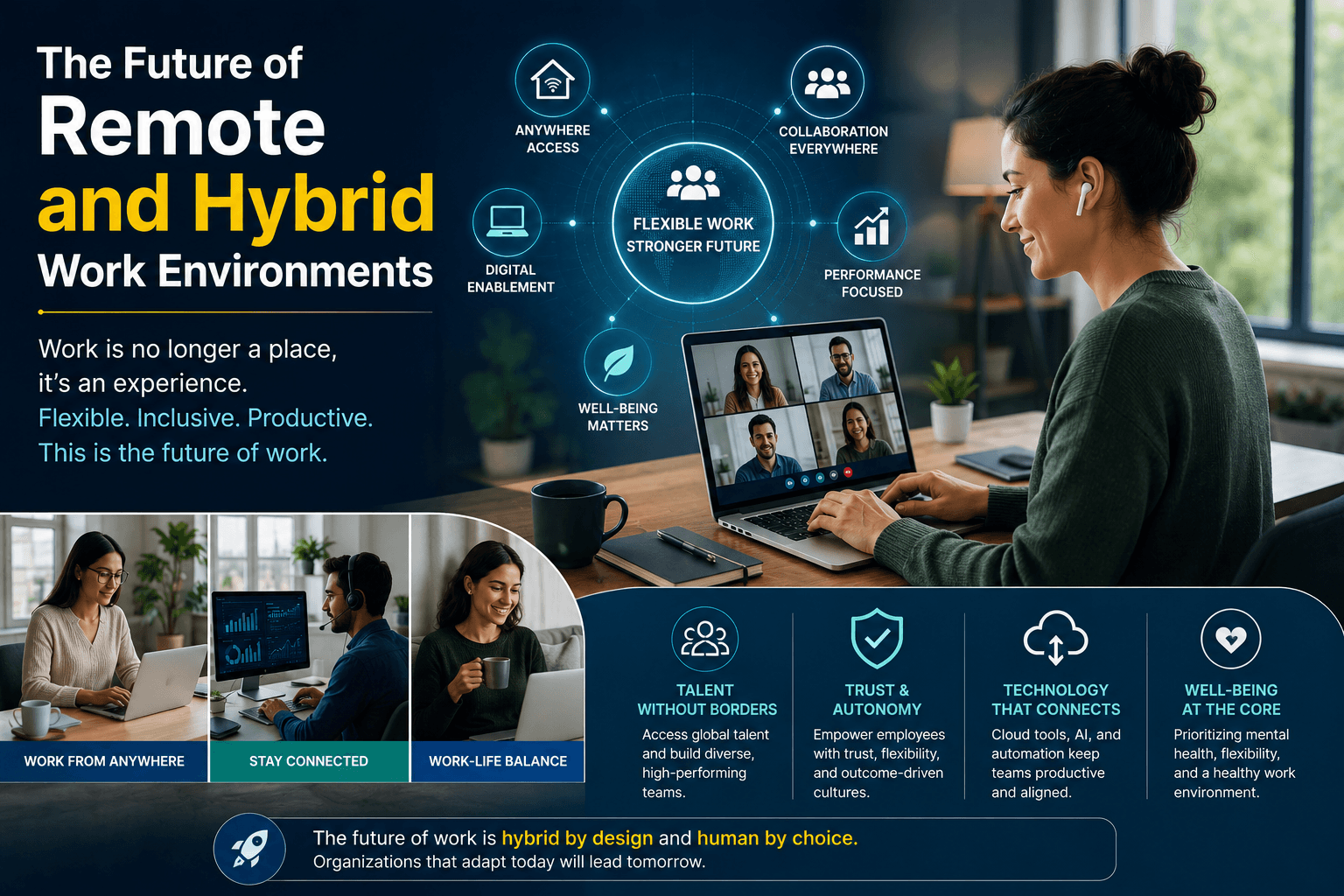
Hybrid work has emerged as the preferred model for organizations seeking the right balance between flexibility and collaboration. Instead of requiring employees to work exclusively from home or the office, hybrid workplaces allow teams to divide their time based on business needs and individual responsibilities.
Businesses benefit from hybrid work in several ways:
Lower office and facility costs
Increased employee retention
Improved work-life balance
Greater operational flexibility
Better access to skilled professionals worldwide
Rather than serving as daily workplaces, offices are increasingly being redesigned as collaborative spaces where employees meet for brainstorming sessions, client meetings, innovation workshops, and team-building activities.
This balanced approach enables organizations to maintain company culture while supporting the flexibility today's workforce expects.
Technology Powers the Modern Workplace
Technology is the foundation of every successful remote and hybrid work environment. Businesses rely on integrated digital solutions that allow employees to collaborate seamlessly regardless of location.
Cloud Computing
Cloud platforms provide secure access to business applications, documents, and data from virtually anywhere. Employees can collaborate in real time while organizations benefit from improved scalability, reliability, and reduced infrastructure costs.
Collaboration Platforms
Video conferencing, instant messaging, shared workspaces, project management software, and collaborative document editing have become essential tools for distributed teams. These technologies help maintain communication, improve transparency, and keep projects moving efficiently.
Artificial Intelligence
Artificial intelligence is transforming workplace productivity by automating repetitive administrative tasks and enhancing decision-making. AI now assists organizations by:
Scheduling meetings automatically
Summarizing virtual meetings
Organizing project workflows
Generating reports
Supporting customer service operations
Assisting employees with everyday tasks
By reducing manual work, AI allows teams to focus on innovation and higher-value business activities.
Stronger Cybersecurity
As employees access company systems from multiple locations and devices, cybersecurity has become more important than ever. Organizations are investing heavily in secure authentication, encrypted communications, endpoint protection, and continuous monitoring to protect sensitive business information.
Productivity Is Now Measured by Results
One of the most significant changes brought by remote work is the shift from measuring employee performance by hours spent in the office to evaluating outcomes and productivity.
Modern organizations increasingly focus on:
Project completion
Business results
Goal achievement
Quality of work
Customer satisfaction
This results-oriented approach gives employees greater flexibility while encouraging accountability. Workers gain more control over their schedules, allowing them to perform when they are most productive.
Businesses that embrace performance-based management often experience higher employee engagement and improved operational efficiency.
Access to Global Talent Is Expanding
Remote work has removed many of the geographical barriers that once limited hiring. Organizations can now recruit skilled professionals from virtually anywhere, creating more diverse and capable teams.
Benefits of hiring globally include:
Access to specialized expertise
Faster recruitment
Greater workforce diversity
Around-the-clock business operations across different time zones
Competitive hiring costs in certain regions
Global hiring also enables businesses to scale more efficiently while building teams with broader perspectives and stronger innovation capabilities.
However, companies must also navigate employment laws, payroll regulations, taxation requirements, and cultural differences to manage international teams successfully.
Employee Expectations Continue to Evolve
The modern workforce values flexibility as much as compensation. Employees increasingly prioritize work environments that support personal well-being, professional development, and work-life balance.
Flexible work arrangements offer numerous benefits, including:
Less commuting
Improved time management
Better family-work balance
Increased autonomy
Higher job satisfaction
At the same time, organizations must address potential challenges such as employee isolation, burnout, and maintaining healthy boundaries between work and personal life.
Forward-thinking companies are investing in wellness initiatives, mental health support, flexible schedules, and regular team engagement activities to create healthier work environments.
Offices Are Being Reimagined
Traditional office spaces are undergoing a major transformation. Instead of assigning permanent desks for daily work, many companies are redesigning offices to encourage collaboration and innovation.
Modern workplaces now focus on:
Team meetings
Strategic planning sessions
Client presentations
Employee training
Creative workshops
Company events
Flexible office layouts, shared workspaces, and co-working environments are becoming increasingly common as businesses optimize real estate costs while supporting hybrid work models.
Cybersecurity Remains a Top Priority
With employees working from home, co-working spaces, and while traveling, organizations face growing cybersecurity challenges.
Common security risks include:
Phishing attacks
Weak home network security
Unauthorized device access
Data breaches
Identity theft
To strengthen digital security, businesses are implementing:
Multi-factor authentication
Zero-trust security frameworks
Endpoint detection and response
Secure VPN access
Continuous employee cybersecurity training
Protecting sensitive information has become a strategic business priority rather than simply an IT responsibility.
Artificial Intelligence Is Transforming Daily Work
AI continues to reshape the workplace by making routine processes faster and more efficient. Instead of replacing employees, artificial intelligence increasingly acts as a productivity assistant.
Businesses now use AI to:
Automate repetitive workflows
Generate business insights
Improve customer support
Analyze large datasets
Create reports
Optimize resource allocation
Enhance communication across distributed teams
As AI technologies continue to mature, organizations will rely even more on intelligent automation to improve efficiency while allowing employees to concentrate on creative problem-solving and strategic decision-making.
Challenges of Remote and Hybrid Work
Although remote work offers many advantages, organizations must also address several ongoing challenges.
Some of the most common issues include:
Maintaining a strong company culture
Communication breakdowns
Employee isolation
Managing distributed teams
Coordinating across multiple time zones
Ensuring consistent productivity
Successful businesses overcome these challenges by establishing clear communication guidelines, investing in leadership development, encouraging regular team interactions, and using digital collaboration tools effectively.
A strong organizational culture remains essential regardless of where employees are located.
What the Future of Work Looks Like
Looking beyond 2026, remote and hybrid work environments will continue evolving alongside emerging technologies.
Future workplace trends include:
AI-powered virtual assistants
Smart digital workspaces
Virtual and augmented reality collaboration
Increased automation
Global decentralized teams
Data-driven workforce management
Greater emphasis on employee well-being
Sustainable office strategies
Organizations that remain adaptable and invest in modern workplace technologies will be better positioned to respond to changing market demands and maintain long-term competitiveness.
Rather than viewing flexibility as an employee benefit, successful companies now recognize it as a strategic advantage that supports innovation, resilience, and business growth.
Conclusion
Remote and hybrid work environments have permanently reshaped the modern workplace. In 2026, businesses are embracing flexible work strategies supported by cloud technology, artificial intelligence, cybersecurity, and digital collaboration tools to improve productivity and employee satisfaction.
The organizations leading this transformation understand that success depends on balancing flexibility with accountability, investing in secure technology, fostering strong communication, and prioritizing employee well-being. As global hiring expands and digital workplaces become increasingly intelligent, businesses that adapt to these evolving work models will be better equipped to innovate, attract top talent, and remain competitive.
The future of work is no longer defined by where employees sit each day. Instead, it is built on connected digital ecosystems that enable people, technology, and businesses to collaborate seamlessly across borders, time zones, and industries, creating a more agile and resilient global workforce.
Frequently Asked Questions (FAQs)
1. What is the difference between remote work and hybrid work?
Remote work allows employees to work entirely outside a traditional office, typically from home or any location with internet access. Hybrid work combines remote work with in-office attendance, giving employees flexibility while maintaining opportunities for face-to-face collaboration.
2. Why are hybrid work models becoming more popular in 2026?
Hybrid work models offer the best of both worlds by balancing flexibility with collaboration. They help businesses reduce operational costs, improve employee satisfaction, attract global talent, and maintain strong company culture through periodic in-person interactions.
3. How does artificial intelligence improve remote and hybrid work?
Artificial intelligence enhances workplace productivity by automating repetitive tasks, scheduling meetings, summarizing discussions, analyzing business data, improving customer support, and assisting employees with daily workflows. AI allows teams to focus on strategic and creative work instead of administrative tasks.
4. What technologies are essential for successful remote work?
Modern remote work relies on cloud computing, video conferencing platforms, project management software, collaboration tools, secure file sharing, cybersecurity solutions, virtual private networks (VPNs), and AI-powered productivity applications to keep teams connected and efficient.
5. What are the biggest challenges of remote and hybrid work?
Some of the most common challenges include maintaining company culture, preventing employee isolation, ensuring effective communication, managing teams across different time zones, protecting sensitive data, and maintaining work-life balance. Businesses can overcome these challenges through strong leadership, clear communication, and the right digital tools.
6. How can businesses protect data in remote work environments?
Organizations can strengthen cybersecurity by implementing multi-factor authentication (MFA), zero-trust security frameworks, secure VPN access, endpoint protection, regular software updates, encrypted communications, and ongoing cybersecurity awareness training for employees.
7. Will remote and hybrid work continue to grow in the future?
Yes. Industry trends indicate that remote and hybrid work will continue expanding as businesses invest in AI, cloud technology, digital collaboration platforms, and flexible workplace strategies. These models are expected to remain a permanent part of the global business landscape.
8. How does hybrid work improve employee productivity?
Hybrid work enables employees to work in environments where they are most productive while reducing commuting time and offering greater flexibility. Many organizations now measure performance based on outcomes rather than hours worked, leading to higher efficiency and increased job satisfaction.