
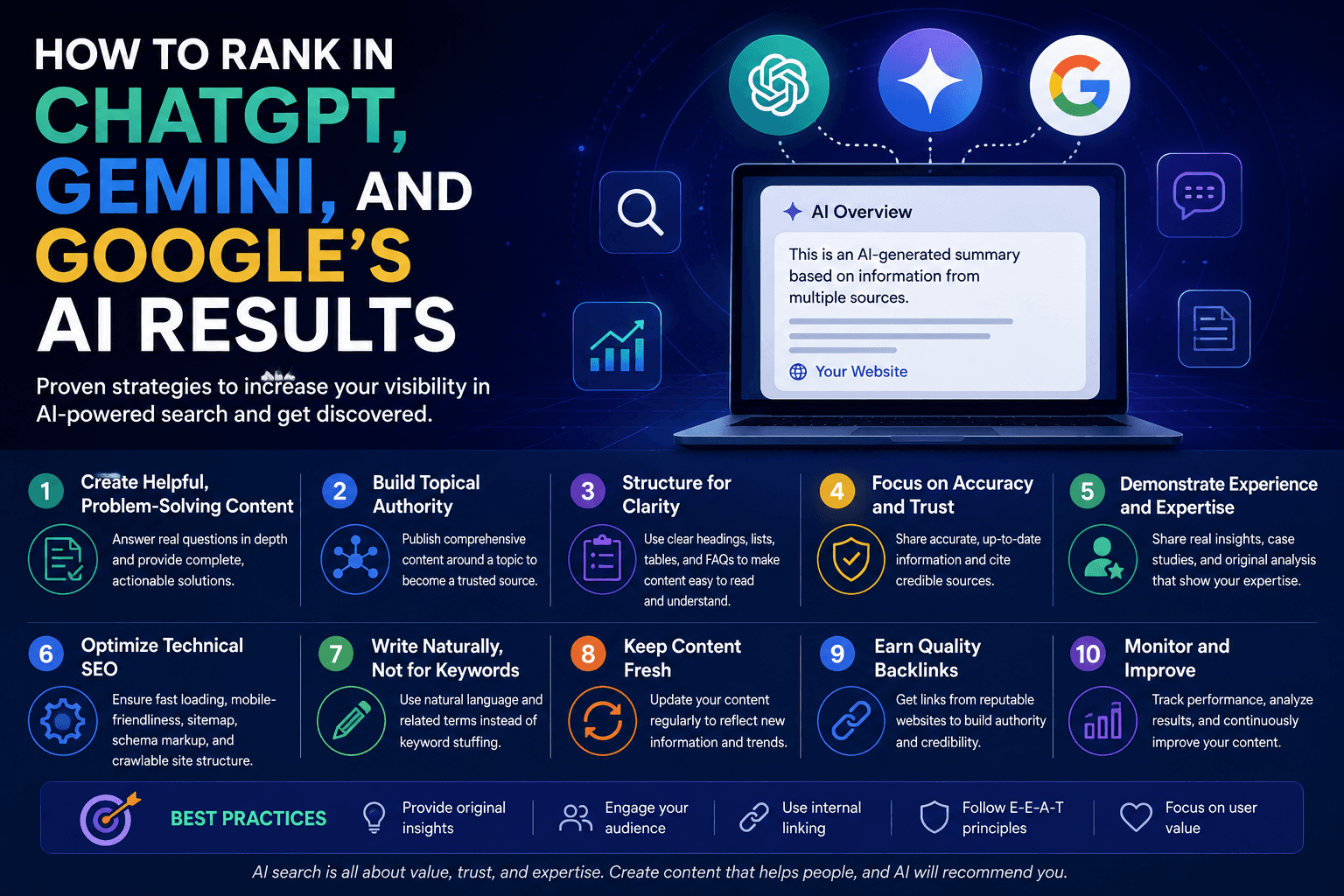

How to Rank in ChatGPT, Gemini, and Google’s AI Results
Search is changing faster than at any point in the history of digital marketing. For years, businesses focused on ranking pages in traditional search results by optimizing keywords, backlinks, technical SEO, and content quality. Today, users are increasingly asking AI systems for direct answers instead of browsing through a long list of links.
ChatGPT, Google’s AI-powered search experiences, and Gemini are changing how people discover businesses, products, services, research, and information.
This creates a new challenge for marketers: How do you make your website and brand visible when an AI system answers the user's question instead of simply displaying ten blue links?
The answer is not to abandon traditional SEO. Instead, businesses need to build on established SEO principles while optimizing content for AI-driven discovery, retrieval, understanding, and citation.
What Is AI Search Visibility?
AI search visibility refers to how frequently a website, brand, product, or organization appears in answers generated by AI-powered search systems.
Traditional SEO focuses heavily on rankings for specific keywords. AI search is broader.
A user might ask:
"What are the best CRM platforms for small businesses?"
Instead of receiving only traditional search results, the user may receive an AI-generated comparison containing several companies.
For a business, being mentioned or cited in that response can become a valuable source of visibility.
AI search therefore introduces a new objective: become a trusted source that AI systems can understand, retrieve, reference, and recommend.
Why Traditional SEO Still Matters
One of the biggest misconceptions about AI search optimization is that traditional SEO is no longer important.
It is.
AI systems still need reliable information to understand websites and identify useful sources. Search engines and AI-powered experiences continue to rely on crawling, indexing, content relevance, authority, technical accessibility, and other signals.
A website with poor technical SEO, unclear content, weak authority, or inaccessible pages will have difficulty establishing visibility regardless of whether the target is a traditional search result or an AI-generated answer.
The strategy should therefore be viewed as an evolution of SEO rather than a complete replacement.
Create Content That Directly Answers Questions
AI systems are designed to answer questions.
Businesses should therefore create content around the questions their target audience actually asks.
Instead of creating an article simply around a keyword such as "enterprise AI," build content around questions like:
What is enterprise AI?
How does enterprise AI reduce operational costs?
What are the best enterprise AI use cases?
How can companies implement enterprise AI securely?
What challenges do businesses face when adopting AI?
Question-focused content gives search engines and AI systems clear concepts to interpret.
Build Topic Authority Instead of Publishing Random Articles
Publishing hundreds of unrelated articles is unlikely to create strong topical authority.
A better strategy is to build comprehensive content clusters around important subjects.
For example, a company targeting enterprise AI could create:
Pillar page:
Enterprise AI: Complete Guide for Businesses
Supporting content:
Enterprise AI use cases
AI governance
AI security
AI agents
AI automation
AI implementation strategies
Enterprise AI ROI
AI infrastructure
AI workforce transformation
These articles can be internally linked so that search engines and users can understand how the topics relate to one another.
This approach also creates a deeper body of expertise around a subject.
Write for Humans First
AI optimization should not turn content into robotic writing.
The most valuable content should be useful to humans before it is optimized for machines.
Use clear explanations, practical examples, original research, relevant statistics, expert perspectives, comparisons, and actionable recommendations.
Avoid repeatedly inserting keywords simply because you believe an AI system will notice them.
Modern search systems are increasingly capable of understanding concepts and relationships rather than relying only on exact keyword matches.
Make Your Content Easy to Extract
AI systems need to process information efficiently.
Content structure therefore matters.
Use:
Clear headings
Short paragraphs
Descriptive subheadings
Bullet points
Numbered lists
Comparison tables
Definitions
Step-by-step explanations
FAQ sections
Specific examples
For example, instead of writing a long paragraph explaining what enterprise AI search is, provide a clear definition near the beginning of the article.
This makes the information easier for both users and automated systems to understand.
Answer Questions With Specificity
Generic statements rarely demonstrate expertise.
Compare:
Weak:
"AI can help businesses improve productivity."
Stronger:
"AI can improve productivity by automating repetitive tasks such as document processing, customer-support triage, meeting summaries, and internal information retrieval."
The second statement gives AI systems a clearer concept to interpret and gives users more useful information.
Specificity also helps establish topical depth.
Strengthen Your Brand's Entity Signals
AI systems do not only understand individual webpages. They increasingly need to understand entities such as companies, organizations, people, products, and brands.
Make sure your business information is consistent across the web.
Your company name, description, services, location, leadership information, and other important details should be accurate wherever they appear.
A strong digital presence can help establish a clearer understanding of what your organization represents.
Build Reputation Beyond Your Website
Your website should not be the only place where your brand exists.
Third-party references can help establish credibility and context.
Depending on your industry, valuable sources may include:
Industry publications
News websites
Professional organizations
Business directories
Review platforms
Expert interviews
Research publications
Relevant communities
Partner websites
The objective is not simply to accumulate backlinks.
The objective is to build a credible web presence that consistently associates your organization with the topics you want to be known for.
Earn High-Quality Mentions
Brand mentions can be particularly valuable for businesses competing in crowded industries.
For example, if several respected publications independently describe a company as a provider of enterprise cybersecurity services, that creates a stronger external context around the brand than the company's own website description alone.
Businesses can build these signals through:
Original research
Expert commentary
Industry reports
Digital PR
Thought leadership
Interviews
Data studies
Newsworthy announcements
The emphasis should be on genuine relevance and credibility rather than artificial mention-building.
Use Structured Data Correctly
Structured data helps search engines understand the content and entities represented on a webpage.
Depending on the page, relevant schema types may include:
Article
Organization
Person
Product
FAQ
Breadcrumb
LocalBusiness
Review
Structured data should accurately represent visible and relevant information on the page.
It is not a shortcut for ranking, but it can help search systems interpret page content and relationships more effectively.
Improve Internal Linking
Internal links help create connections between related content.
Suppose you publish an article about AI agents. You could link it to related content about:
Enterprise AI
AI automation
AI governance
AI security
AI workforce transformation
This creates a connected knowledge structure.
A strong internal-linking strategy can help search engines discover pages and understand how different pieces of content relate to one another.
Create Original Information
One of the strongest ways to differentiate your content is to publish information that cannot easily be found elsewhere.
Examples include:
Original surveys
Proprietary research
Industry statistics
Case studies
Customer insights
Expert interviews
Experiments
First-hand analysis
Original datasets
If your website publishes genuinely useful information that other websites reference, it can become a source rather than simply another page repeating information from existing sources.
Keep Important Information Current
AI search is particularly sensitive to information that can change over time.
Business information, product specifications, pricing, regulations, software capabilities, market trends, and technology developments can become outdated quickly.
Review important content periodically.
Update outdated statistics, remove obsolete claims, improve explanations, and clearly communicate important changes.
Freshness should not mean changing publication dates without meaningful updates. The content itself should become more accurate and useful.
Optimize for Conversational Search
Users increasingly interact with search engines through natural-language questions.
Traditional keyword research remains useful, but businesses should also consider conversational queries.
Instead of targeting only:
"AI cybersecurity"
consider questions such as:
"How does AI improve cybersecurity for small businesses?"
Then create a comprehensive answer addressing the question and its related subtopics.
Longer conversational queries can reveal user intent more clearly than isolated keywords.
Create Comparison and Decision-Making Content
AI search is often used when users are trying to make decisions.
This makes comparison content particularly valuable.
Examples include:
Cloud vs. edge computing
AI search vs. traditional enterprise search
CRM A vs. CRM B
SaaS vs. custom software
AI agents vs. traditional automation
High-quality comparison content should be balanced and explain the advantages, limitations, costs, use cases, and appropriate scenarios for each option.
Avoid making unsupported claims simply to promote your own product.
Make Your Website Technically Accessible
AI visibility begins with accessibility.
Make sure important pages can be crawled and indexed appropriately.
Pay attention to:
Robots.txt
XML sitemaps
Canonical URLs
HTTP status codes
Mobile usability
Page speed
JavaScript rendering
Internal links
Metadata
Indexing controls
HTTPS
A technically strong website provides a better foundation for both traditional and AI-driven search visibility.
Build Strong Author and Publisher Signals
People increasingly want to know who created information.
Clearly identify authors where appropriate and provide useful author information for content that benefits from demonstrated expertise.
For businesses, establish a clear publisher identity with consistent company information.
Author and organization pages can help create stronger connections between content and the entities responsible for producing it.
Don't Try to "Hack" AI Rankings
There is no guaranteed formula for forcing ChatGPT, Gemini, or Google's AI systems to mention a particular website.
Avoid tactics promising guaranteed AI citations or guaranteed inclusion in AI answers.
AI systems can change their models, retrieval systems, ranking signals, and source selection processes.
The more sustainable strategy is to build a website that deserves to be referenced.
That means focusing on:
Useful content + authority + technical accessibility + trustworthy information + strong brand signals.
Measure AI Search Visibility
Traditional analytics can tell you where traffic comes from, but AI-driven discovery can be more difficult to measure.
Businesses should monitor:
Brand mentions
Referral traffic
Organic search visibility
Search impressions
Important query rankings
Third-party mentions
Content citations where observable
Branded searches
Conversion rates
Engagement from informational content
It is also useful to periodically test important questions manually across relevant AI search experiences to see how your brand is represented.
However, manual observations should be treated as snapshots rather than permanent rankings.
The Future of SEO Is Becoming More Answer-Oriented
Search is moving from a simple document-discovery model toward an answer-oriented experience.
This does not mean traditional search engines are disappearing. Instead, search interfaces are becoming more capable of understanding questions, combining information, and presenting synthesized answers.
Businesses that succeed in this environment will need to think beyond individual keywords.
They will need to become recognized authorities within specific topics.
The central question is no longer only:
"How do I rank this webpage?"
It is increasingly:
"How do I make my brand and information useful enough that search and AI systems can confidently surface it?"
Conclusion
Ranking in ChatGPT, Gemini, and Google's AI-powered results requires a broader approach to search visibility.
Businesses should continue investing in technical SEO, high-quality content, internal linking, structured data, and authoritative backlinks while also focusing on conversational questions, topical authority, entity recognition, original information, and trustworthy brand signals.
There is no single optimization trick that guarantees AI visibility.
The strongest long-term strategy is to become a reliable source of information within your industry.
As AI search continues to evolve, the brands that consistently provide accurate, useful, original, and well-structured information will be in the strongest position to earn visibility across the next generation of search.
FAQs
1. Can you actually rank in ChatGPT?
ChatGPT does not operate like a traditional search engine with one fixed ranking system. Depending on the experience and whether web search or other retrieval features are involved, websites may be discovered, referenced, or cited. The best approach is to create authoritative, accessible, relevant information that AI systems can understand and retrieve.
2. How can I make my website appear in Google AI results?
Continue following strong SEO fundamentals while creating authoritative, well-structured content that directly answers users' questions. Build topical authority, improve technical accessibility, earn reputable references, use appropriate structured data, maintain accurate information, and demonstrate clear expertise.
3. How do I optimize content for Gemini?
Focus on high-quality information, clear organization, natural-language questions, strong topical coverage, reliable sources, and an authoritative website. Avoid writing specifically for a particular AI model because AI systems and their retrieval mechanisms can change over time.
4. Is traditional SEO still important for AI search?
Yes. Technical accessibility, crawlability, indexing, relevant content, internal linking, authority, and other SEO fundamentals remain important foundations. AI search should generally be treated as an additional visibility layer rather than a complete replacement for SEO.
5. Do backlinks help with AI search visibility?
Quality backlinks can contribute to a website's broader authority and discoverability. However, businesses should prioritize relevant, trustworthy links rather than purchasing large quantities of low-quality links. The goal should be to earn references from credible websites within the relevant industry.
6. Does FAQ content help with AI search?
Well-written FAQs can help because they directly address common questions in a clear format. However, simply adding large numbers of questions will not guarantee AI visibility. The answers should be accurate, useful, specific, and supported by the broader expertise demonstrated across the website.
7. Should I use schema markup to rank in AI results?
Structured data can help search engines understand entities and page content, but it is not a guaranteed AI-ranking mechanism. Use appropriate schema accurately and ensure that it represents information actually available on the page.
8. How important are brand mentions for AI visibility?
A strong brand presence across credible websites can help establish context and reputation around an organization. Relevant third-party coverage, expert interviews, industry publications, research, and genuine mentions can strengthen a brand's overall digital footprint.
9. How can I track whether ChatGPT or Gemini is mentioning my brand?
There is no universal dashboard that provides a complete, permanent ranking report across all AI systems. Businesses can monitor available referral and analytics data, track brand mentions, and periodically test important industry questions across relevant AI experiences. Results should be treated as variable snapshots because AI responses can differ by query, user, location, context, and system configuration.
10. What is the most important strategy for winning AI search visibility?
The strongest strategy is to become a trusted source within a specific subject area. Publish original and useful information, answer real customer questions, maintain strong technical SEO, demonstrate expertise, earn credible external references, connect related content, and keep important information accurate and current. AI visibility is best approached as the result of building genuine authority rather than trying to manipulate an AI system.