
BABest AI Apps in 2026: 15 Smart Tools Everyone Should Try
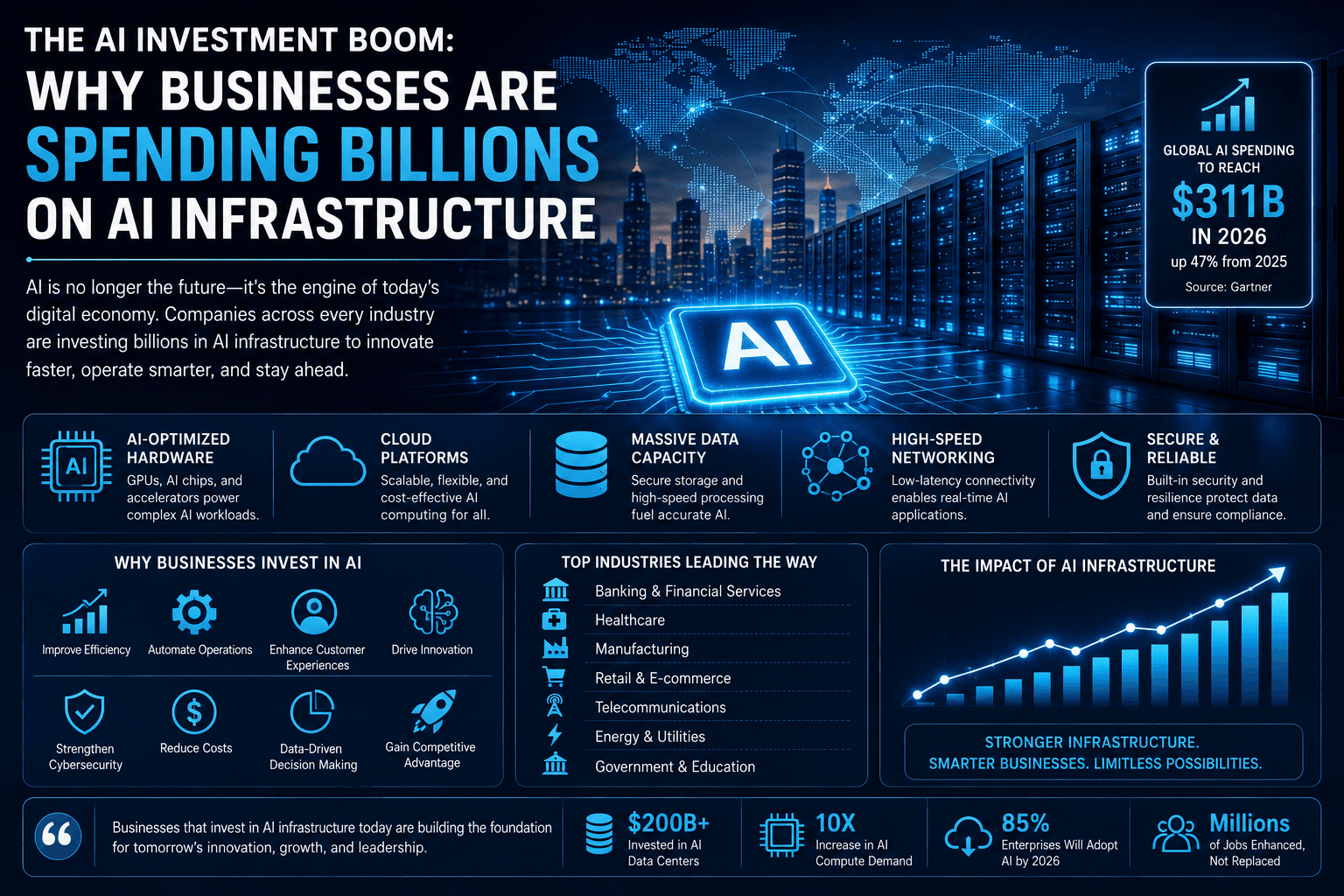
Artificial intelligence has become one of the biggest investment priorities for businesses worldwide. In 2026, organizations are investing billions of dollars in AI infrastructure to support intelligent automation, generative AI, advanced analytics, and enterprise-scale digital transformation. From cloud providers and technology giants to financial institutions and manufacturers, companies are expanding their AI capabilities to remain competitive in a rapidly evolving digital economy.
Industry analysts forecast global AI spending to grow dramatically, with AI infrastructure—including AI-optimized servers, cloud platforms, networking, and specialized chips—representing the largest share of investment. (Gartner)
What Is AI Infrastructure?
AI infrastructure is the foundation that enables businesses to build, train, deploy, and manage artificial intelligence applications. It combines powerful computing resources with modern software and data systems.
Core components include:
AI-optimized data centers
Graphics Processing Units (GPUs)
AI accelerators and custom chips
Cloud computing platforms
High-speed networking
Data storage solutions
Machine learning platforms
Together, these technologies provide the computing power needed to support enterprise AI workloads.
Why Businesses Are Increasing AI Investments
Organizations recognize that AI is no longer an experimental technology. It has become a strategic asset capable of improving productivity, reducing costs, and driving innovation.
Businesses are investing in AI infrastructure to:
Automate business operations
Improve decision-making
Deliver personalized customer experiences
Enhance cybersecurity
Accelerate product development
Increase operational efficiency
Gain competitive advantages
Analysts expect AI spending to continue rising as enterprises move from pilot projects to organization-wide deployment. (Gartner)
Data Centers Are the Backbone of AI
Modern AI models require enormous computing capacity. To meet this demand, companies are building new AI-ready data centers equipped with high-performance processors, advanced cooling systems, and massive storage capabilities.
These facilities support:
Generative AI applications
Enterprise AI assistants
Predictive analytics
Large language models (LLMs)
AI-powered cloud services
Real-time business intelligence
The rapid expansion of AI data centers is one of the biggest drivers of global technology investment. (TechCrunch)
Cloud Computing Accelerates AI Adoption
Cloud platforms make AI more accessible by allowing organizations to use advanced AI capabilities without building their own infrastructure.
Benefits include:
Faster deployment
Lower upfront costs
Flexible scalability
Secure data management
Continuous software updates
Global accessibility
This enables businesses of all sizes to adopt AI more quickly.
AI Infrastructure Improves Business Performance
Companies investing in AI infrastructure are seeing measurable business benefits.
AI enables organizations to:
Analyze large datasets in seconds
Optimize supply chains
Improve customer service
Detect fraud
Forecast market demand
Automate repetitive workflows
Support faster executive decision-making
These improvements contribute to stronger productivity and long-term business growth.
Industries Leading AI Investment
AI infrastructure investment is expanding across numerous industries, including:
Banking and financial services
Healthcare
Manufacturing
Retail and e-commerce
Logistics
Telecommunications
Energy
Insurance
Education
Government
Organizations that invest early are positioning themselves for greater innovation and operational resilience.
Challenges of AI Infrastructure Investment
Despite significant opportunities, businesses must overcome several challenges when expanding AI infrastructure.
Common obstacles include:
High capital investment
Energy consumption
Data privacy concerns
Cybersecurity risks
AI talent shortages
Integration with existing systems
Regulatory compliance
Addressing these challenges requires careful planning, governance, and long-term investment strategies.
The Future of AI Infrastructure
As artificial intelligence continues to evolve, investment in AI infrastructure is expected to remain strong. Organizations are adopting next-generation technologies such as AI-native cloud platforms, edge AI, intelligent automation, and autonomous AI agents.
Businesses that build scalable AI infrastructure today will be better prepared to innovate, improve efficiency, and compete in the digital economy.
Conclusion
The AI investment boom represents one of the largest technology transformations in modern business. As enterprises spend billions on data centers, cloud platforms, AI chips, and intelligent software, artificial intelligence is becoming a core driver of business growth and innovation.
Organizations that invest strategically in AI infrastructure will be well-positioned to improve productivity, enhance customer experiences, and maintain a competitive advantage in 2026 and beyond. Global forecasts and recent industry investments indicate that AI infrastructure spending will continue to accelerate, making it one of the defining business trends of the decade. (Gartner)
20 FAQs: The AI Investment Boom: Why Businesses Are Spending Billions on AI Infrastructure
1. What is AI infrastructure?
AI infrastructure is the combination of hardware, software, cloud platforms, networking, and data systems that enable businesses to develop, train, deploy, and manage artificial intelligence applications.
2. Why are businesses investing heavily in AI infrastructure?
Businesses are investing in AI infrastructure to improve productivity, automate operations, reduce costs, enhance customer experiences, and gain a competitive advantage in the digital economy.
3. What technologies are included in AI infrastructure?
AI infrastructure includes GPUs, AI chips, cloud computing, data centers, machine learning platforms, high-speed networking, data storage, and AI software frameworks.
4. How does AI infrastructure support business growth?
It enables faster data processing, intelligent automation, predictive analytics, real-time decision-making, and scalable AI applications that improve operational efficiency and innovation.
5. Why are AI data centers becoming more important?
AI data centers provide the massive computing power and storage required to train and run advanced AI models, including generative AI and large language models.
6. How does cloud computing support AI adoption?
Cloud computing allows businesses to access AI tools and computing resources on demand, reducing infrastructure costs while improving scalability and flexibility.
7. Which industries are investing the most in AI infrastructure?
Banking, healthcare, manufacturing, retail, logistics, telecommunications, insurance, education, energy, and government organizations are among the largest AI investors.
8. What role do GPUs play in AI infrastructure?
Graphics Processing Units (GPUs) accelerate AI model training and inference by processing large volumes of data much faster than traditional processors.
9. How does AI infrastructure improve decision-making?
AI infrastructure processes large datasets in real time, identifies patterns, predicts outcomes, and delivers actionable insights that help businesses make smarter decisions.
10. Is AI infrastructure only for large enterprises?
No. Small and medium-sized businesses can also benefit from AI infrastructure through cloud-based AI services and subscription platforms without building expensive on-premises systems.
11. What are the biggest benefits of investing in AI infrastructure?
Benefits include improved efficiency, lower operating costs, faster innovation, enhanced security, better customer experiences, increased productivity, and stronger business resilience.
12. What challenges come with AI infrastructure investment?
Common challenges include high implementation costs, cybersecurity risks, energy consumption, data privacy concerns, talent shortages, and integration with legacy systems.
13. How does AI infrastructure support generative AI?
It provides the computing power, storage, and networking required to train, deploy, and scale generative AI models for business applications.
14. Why is AI infrastructure important for digital transformation?
AI infrastructure enables organizations to automate processes, modernize operations, improve analytics, and accelerate enterprise-wide digital transformation initiatives.
15. How does AI infrastructure improve cybersecurity?
AI infrastructure supports intelligent threat detection, automated incident response, predictive risk analysis, and continuous monitoring to strengthen cybersecurity defenses.
16. What is edge AI, and how does it relate to AI infrastructure?
Edge AI processes data closer to where it is generated, reducing latency and improving performance for applications like smart manufacturing, autonomous vehicles, and IoT devices.
17. Can AI infrastructure reduce operational costs?
Yes. By automating repetitive tasks, optimizing resource allocation, improving forecasting, and reducing downtime, AI infrastructure can significantly lower business operating costs.
18. How should businesses prepare for AI infrastructure adoption?
Businesses should assess their technology needs, invest in scalable cloud platforms, strengthen cybersecurity, train employees, and develop a long-term AI strategy.
19. What trends will shape AI infrastructure in the coming years?
Key trends include AI-native cloud platforms, advanced AI chips, edge computing, autonomous AI agents, sustainable data centers, intelligent automation, and enterprise AI platforms.
20. Why is AI infrastructure considered a long-term investment?
AI infrastructure provides the foundation for future innovation, business growth, operational efficiency, and competitive advantage, making it one of the most valuable technology investments for organizations in the AI era.