
Introduction
Artificial intelligence has become one of the most important technologies shaping modern business. In 2026, companies across industries are using Ai to automate repetitive tasks, analyze information, improve customer experiences, support employees, and develop new products and services.
The role of AI in business is also changing. Instead of being limited to simple chatbots or recommendation systems, AI can now support more complex workflows involving research, content creation, data analysis, customer service, software development, and business operations.
However, successful AI adoption requires more than simply purchasing an AI tool. Companies also need to consider data quality, cybersecurity, employee training, privacy, costs, and appropriate human oversight.
1. AI Is Changing Business Operations
Businesses generate large amounts of information every day. AI can help organizations process and analyze this information more efficiently.
Companies can use AI-powered software to summarize documents, identify patterns, organize information, assist with reporting, and support decision-making.
By automating certain repetitive processes, employees can potentially spend more time on tasks requiring creativity, communication, judgment, and problem-solving.
2. AI Agents and Business Workflows
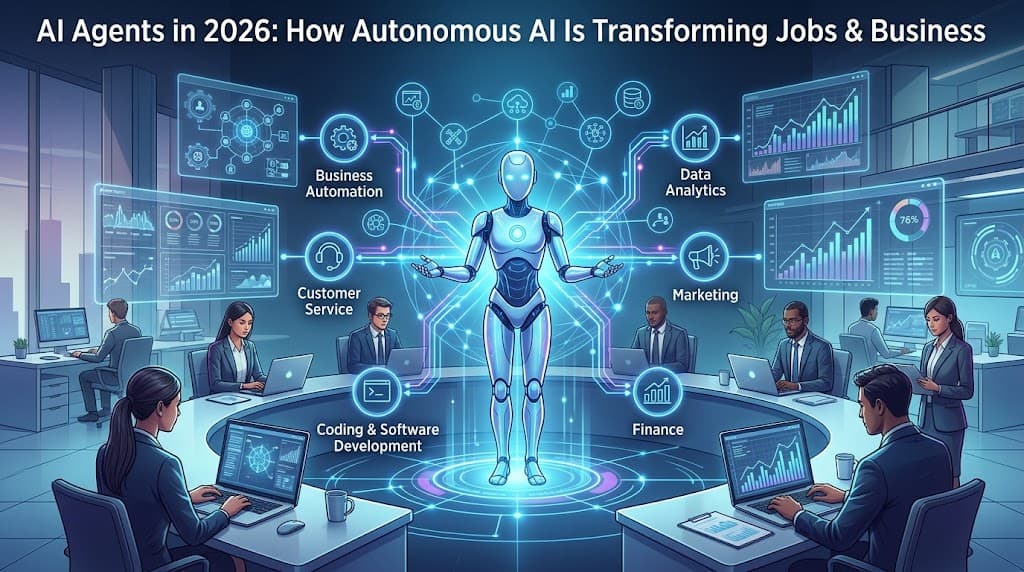
AI agents are becoming an important area of business technology. Unlike basic AI tools that simply respond to individual prompts, agents can be designed to perform multiple steps within a workflow.
For example, an AI agent could assist with gathering information, organizing results, preparing a report, or moving information between compatible business systems.
The level of autonomy varies significantly between products, so businesses need appropriate permissions, monitoring, and human review for important processes.
3. AI-Powered Customer Service
Customer service is another major area where companies are adopting AI. AI assistants can answer frequently asked questions, provide information, summarize conversations, and help customer-service representatives find relevant information.
Businesses can use AI to provide support outside traditional working hours, while complex or sensitive cases can still be transferred to human employees.
The goal is increasingly to combine automation with human support rather than necessarily replacing every customer-service interaction.
4. AI in Marketing
Marketing teams are using AI for tasks such as content ideation, audience analysis, personalization, campaign optimization, and customer research.
AI can help marketers process large datasets and identify patterns that may be difficult to detect manually.
However, human review remains important because automatically generated marketing content can contain inaccurate information, repetitive language, or messaging that does not fit a company's brand.
5. AI and Business Data Analysis
Data is one of the most valuable resources for many organizations. AI tools can help businesses analyze large datasets and identify trends, anomalies, and relationships.
For example, companies can use AI-assisted analytics to examine sales data, customer behavior, operational performance, or inventory information.
The quality of the results depends heavily on the quality and relevance of the underlying data.
6. AI in Sales
Sales teams can use AI to organize customer information, summarize interactions, identify potential leads, assist with communications, and support forecasting.
AI can also help sales professionals prepare for customer meetings by bringing together relevant information from approved business systems.
These tools are generally most useful when they support sales professionals rather than removing human relationships from the process entirely.
7. AI for Small Businesses
AI is not limited to large corporations. Small businesses can use accessible AI tools for administrative work, customer communication, marketing, research, scheduling, and content production.
For a small company with limited staff, automating certain repetitive tasks can free up time for customer service and business development.
However, small businesses should evaluate the cost, privacy implications, security practices, and actual productivity benefits of each tool before adopting it.
8. AI in Human Resources
Human-resources teams can use AI for tasks such as organizing documents, creating job descriptions, answering routine employee questions, and analyzing workforce information.
Because employment decisions can have significant consequences for individuals, organizations need strong oversight when using AI in recruitment, evaluation, or other sensitive HR processes.
Companies should also consider fairness, transparency, privacy, and applicable employment laws.
9. AI and Cybersecurity
AI is playing an increasing role in cybersecurity. Security teams can use AI-assisted systems to analyze large quantities of security information, identify unusual behavior, and support threat detection.
At the same time, cybercriminals may also use AI to improve certain attack techniques.
This creates an ongoing technology race in which organizations need to combine AI-based tools with secure infrastructure, employee training, access controls, software updates, and incident-response procedures.
10. AI in Financial Management
Businesses can use AI to assist with financial analysis, forecasting, expense categorization, fraud detection, reporting, and other accounting-related workflows.
Automated systems can process large quantities of financial information quickly, but financial decisions still require appropriate controls and professional oversight.
Organizations should carefully validate AI-generated financial information before using it for important decisions.
11. AI and Supply Chain Management
Supply chains involve complex relationships between suppliers, manufacturers, warehouses, transportation providers, and customers.
AI can help businesses analyze demand patterns, monitor inventory, identify potential disruptions, and improve planning.
Better forecasting can help companies make more informed decisions about stock levels and resource allocation.
12. AI in Product Development
Companies are also using AI during product research and development. AI can help teams analyze customer feedback, generate ideas, explore designs, and process research materials.
In technology and software companies, AI-assisted coding tools can also support developers with tasks such as generating code, explaining existing code, and identifying potential issues.
Human expertise remains important for testing, validation, security, and final product decisions.
13. The Importance of AI Skills
As businesses adopt more AI tools, employees need to understand how to work effectively with these technologies.
Important skills can include AI literacy, data analysis, critical thinking, cybersecurity awareness, communication, and the ability to evaluate AI-generated information.
Companies may therefore invest more in employee training so workers can use AI responsibly and effectively.
14. AI and Business Productivity
One of the major reasons companies are exploring AI is productivity. Automating repetitive work can reduce the time employees spend on routine activities.
Examples include summarizing meetings, drafting documents, organizing information, processing customer inquiries, and assisting with research.
However, productivity gains vary by company, workflow, and technology. Businesses should measure actual results instead of assuming that implementing AI automatically increases productivity.
15. AI Costs and Business Investment
AI adoption involves more than software subscription fees. Companies may also need to invest in data infrastructure, cybersecurity, employee training, integration, governance, and ongoing monitoring.
Businesses should consider the total cost of implementation and compare it with measurable benefits.
A focused approach can involve starting with specific workflows where automation provides a clear potential benefit before expanding across the organization.
16. Privacy and Responsible AI
AI systems can process large amounts of information, making privacy an important consideration for businesses.
Organizations should establish clear policies about what information employees can provide to AI systems and how sensitive business or customer data is handled.
Responsible AI also involves transparency, appropriate human oversight, security, and regular evaluation of AI systems.
17. The Future of AI in Business
AI is likely to become increasingly integrated into everyday business software. Instead of being a separate application, AI functionality may become a standard feature within productivity, finance, marketing, customer-service, and enterprise platforms.
AI agents may also support increasingly complex workflows, while humans continue to oversee important decisions and business relationships.
The future will likely involve collaboration between people and AI systems rather than a single technology replacing every business function.
Conclusion
AI is transforming business in 2026 by changing how companies operate, analyze information, communicate with customers, develop products, and manage workflows.
From AI agents and customer-service assistants to data analytics, cybersecurity, marketing, finance, and supply-chain management, businesses have many opportunities to apply artificial intelligence.
At the same time, successful adoption requires careful planning. Companies need to consider data quality, privacy, cybersecurity, employee skills, costs, accuracy, and human oversight.
The businesses that gain meaningful value from AI will not necessarily be those that use the most AI tools. A more practical approach is to identify specific business problems, choose appropriate technologies, measure their results, and continuously improve how humans and AI work together.