Cybersecurity is becoming more important as businesses increasingly depend on digital technology and artificial intelligence. In 2026, cybercriminals are also using advanced tools, automation, and AI to make attacks faster and more sophisticated.
Businesses of every size need to understand the latest cybersecurity trends and take steps to protect their data, employees, and customers.
How AI Is Changing Cybersecurity
Artificial intelligence has created both opportunities and risks in cybersecurity.
Security teams can use AI to:
Detect suspicious activity
Analyze large amounts of data
Identify potential threats
Automate security responses
Monitor networks
However, cybercriminals can also misuse AI to create more convincing attacks.
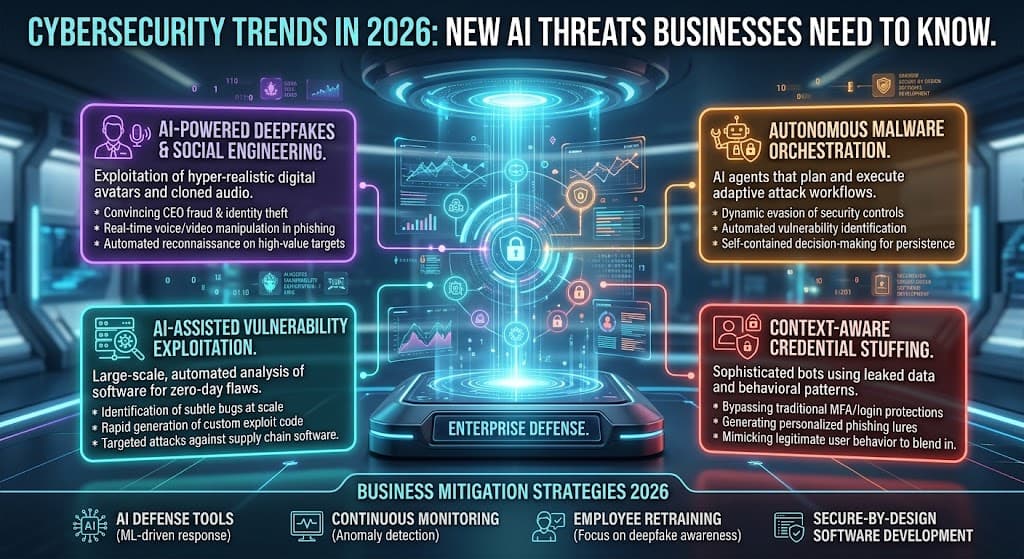
1. AI-Powered Cyberattacks
One of the biggest cybersecurity concerns is the use of AI by attackers.
AI can potentially help criminals create:
More convincing phishing messages
Fake content
Automated attacks
Sophisticated scams
Social engineering campaigns
Businesses need to improve employee awareness and strengthen security systems.
2. Deepfake Scams
Deepfake technology can create realistic fake audio and video.
Cybercriminals may use deepfakes to impersonate:
Company executives
Employees
Family members
Business partners
For example, a criminal could attempt to imitate the voice of a manager and request an urgent money transfer.
Businesses should establish verification procedures for sensitive requests.
3. Advanced Phishing Attacks
Phishing attacks continue to be one of the most common cybersecurity threats.
AI can make phishing emails appear more realistic and personalized.
Employees should be trained to:
Check suspicious email addresses
Avoid unknown links
Verify unusual requests
Report suspicious messages
4. Ransomware Attacks
Ransomware remains a serious threat for businesses.
Attackers can encrypt important files and demand payment to restore access.
Organizations can reduce the impact of ransomware by:
Creating regular backups
Updating software
Using strong security tools
Limiting unnecessary access
Developing an incident response plan
5. Attacks on AI Systems
As businesses adopt AI systems, those systems themselves may become targets.
Potential risks include:
Data poisoning
Prompt manipulation
Unauthorized access
Data leakage
Model misuse
Companies using AI should establish clear security policies and carefully control access to sensitive information.
6. Cloud Security Risks
More businesses are storing information in cloud platforms.
While cloud services can provide strong security features, incorrect configurations can create vulnerabilities.
Companies should regularly review:
User permissions
Access controls
Cloud configurations
Security logs
7. Identity and Access Security
Passwords alone are no longer enough to protect important systems.
Businesses are increasingly using:
Multi-factor authentication
Biometric security
Passkeys
Zero-trust security models
Strong identity verification can significantly reduce the risk of unauthorized access.
8. Supply Chain Cybersecurity Risks
Businesses often depend on software, services, and vendors from other companies.
A security problem affecting one supplier can potentially impact many organizations.
Companies should evaluate the security practices of important third-party providers.
How Businesses Can Prepare
Businesses should take a proactive approach to cybersecurity.
Important steps include:
Train Employees
Employees are often the first line of defense. Regular cybersecurity training can help reduce human errors.
Keep Systems Updated
Software updates often fix important security vulnerabilities.
Use Multi-Factor Authentication
MFA adds an additional layer of protection to important accounts.
Create Regular Backups
Regular backups can help businesses recover from ransomware and other incidents.
Develop an Incident Response Plan
Companies should know exactly what to do when a cybersecurity incident occurs.
The Future of Cybersecurity
Cybersecurity in 2026 is becoming a continuous battle between defenders and attackers.
AI will play an increasingly important role on both sides.
The businesses that invest in security, employee training, and modern technology will be better prepared to face emerging threats.
Conclusion
The cybersecurity landscape is changing rapidly. AI-powered attacks, deepfake scams, ransomware, and attacks on AI systems are creating new challenges.
Businesses should not wait until an attack happens. By improving security practices, training employees, and preparing for potential incidents, organizations can better protect themselves in the digital age.
FAQs
1. What are the biggest cybersecurity threats in 2026?
Major threats include AI-powered attacks, phishing, ransomware, deepfake scams, cloud security risks, and attacks targeting AI systems.
2. How is AI being used in cyberattacks?
AI can potentially be used to automate attacks and create more convincing phishing or social engineering content.
3. What is a deepfake scam?
A deepfake scam uses artificially generated or manipulated audio or video to impersonate a real person.
4. How can businesses protect against phishing?
Businesses should train employees, use email security tools, and encourage verification of suspicious messages.
5. What is ransomware?
Ransomware is malicious software that can block access to data or systems and demand payment.
6. Why is multi-factor authentication important?
MFA adds additional security by requiring more than one method of verification.
7. Can small businesses be targeted by cybercriminals?
Yes. Small businesses can also be targeted and should implement strong cybersecurity practices.
8. What is zero-trust security?
Zero-trust is a security approach that requires continuous verification rather than automatically trusting users or devices.
9. How often should businesses back up their data?
The appropriate frequency depends on how important and frequently changing the data is, but regular automated backups are generally recommended.
10. What should a business do after a cyberattack?
The business should follow its incident response plan, contain the threat, assess the damage, and seek appropriate cybersecurity assistance when necessary.
Of course.
11. What is AI-powered cybersecurity?
AI-powered cybersecurity uses artificial intelligence to detect suspicious behavior, analyze threats, and help security teams respond more quickly.
12. Can AI completely prevent cyberattacks?
No. AI can improve threat detection and response, but no security system can guarantee complete protection against every attack.
13. Why are businesses worried about AI cybersecurity threats?
AI can make certain attacks more scalable, convincing, and automated, increasing the potential risk to businesses.
14. How can employees help prevent cyberattacks?
Employees can help by using strong authentication, recognizing phishing attempts, avoiding suspicious links, and reporting unusual activity.
15. What is social engineering?
Social engineering involves manipulating people into revealing information, granting access, or performing actions that benefit an attacker.
16. Are passwords still secure?
Passwords remain widely used, but organizations should strengthen account security with measures such as multi-factor authentication and passkeys.
17. What is a zero-day vulnerability?
A zero-day vulnerability is a security flaw that is unknown or has not yet been patched by the software developer, potentially allowing attackers to exploit it.
18. How does cloud computing affect cybersecurity?
Cloud services can improve scalability and security, but poor configurations, weak access controls, or compromised accounts can create risks.
19. What is endpoint security?
Endpoint security protects devices such as computers, smartphones, and other devices that connect to an organization's network.
20. Why are software updates important for cybersecurity?
Updates can fix known security vulnerabilities and improve the overall security of applications and operating systems.
21. What is a data breach?
A data breach occurs when unauthorized individuals gain access to protected or sensitive information.
22. How can companies protect customer data?
Companies can use encryption, access controls, secure authentication, monitoring, regular security testing, and employee training.
23. What is cybersecurity awareness training?
It is training that teaches employees how to recognize and avoid common security threats such as phishing, scams, and unsafe downloads.
24. Can deepfakes be used for financial fraud?
Yes. Attackers may use fake audio or video to impersonate trusted individuals and attempt to persuade victims to transfer money or reveal sensitive information.
25. What is the biggest cybersecurity lesson for businesses in 2026?
Businesses should treat cybersecurity as an ongoing process rather than a one-time project, combining technology, employee awareness, strong policies, and continuous monitoring.