
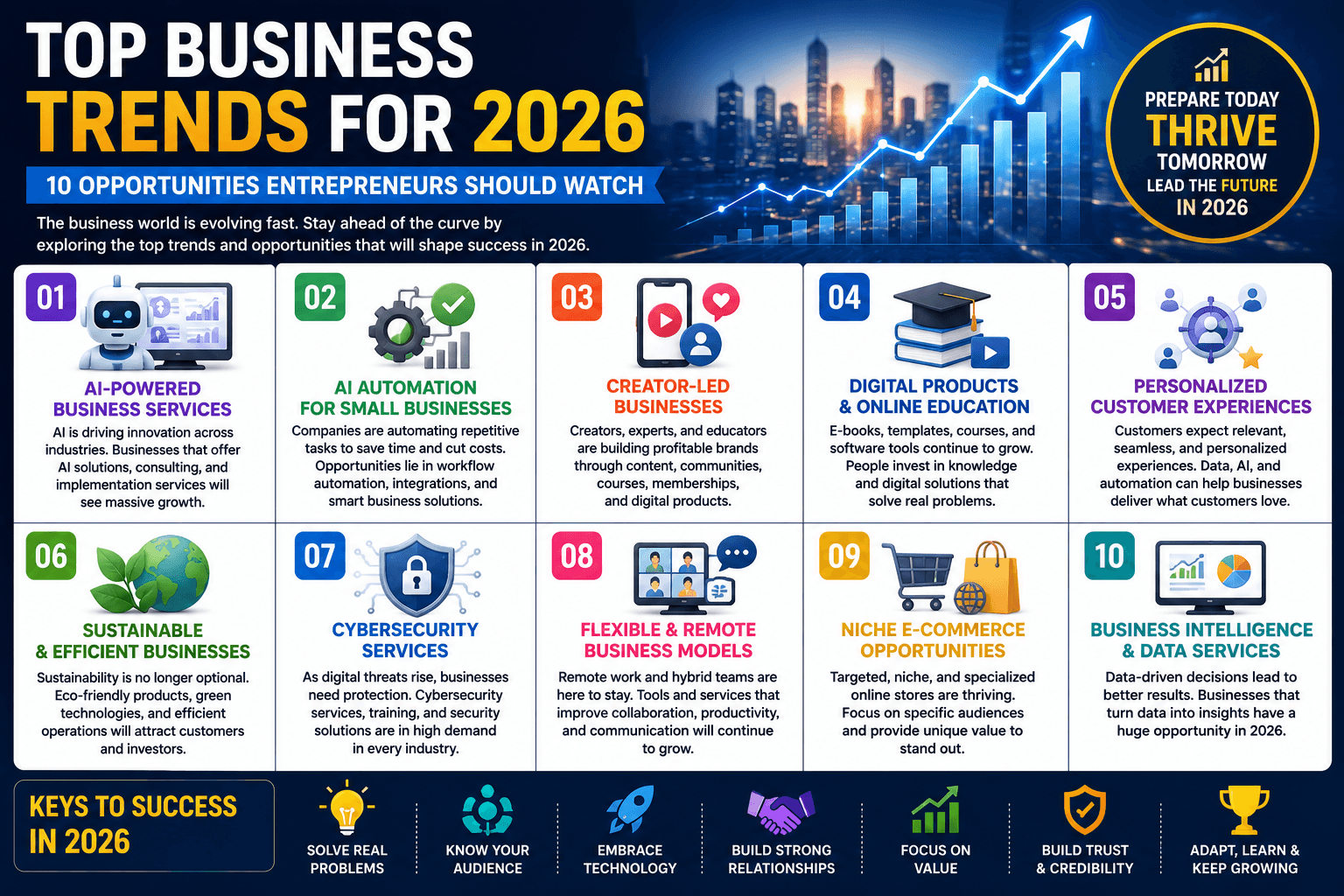

The business world is changing rapidly in 2026. Artificial intelligence, digital transformation, changing customer expectations, and new ways of working are creating opportunities for entrepreneurs and established companies alike.
Businesses that understand these changes early can identify new markets, improve efficiency, and develop products and services that match what customers need.
Here are 10 important business trends and opportunities entrepreneurs should watch in 2026.
1. AI-Powered Business Services
Artificial intelligence has moved from experimentation to practical business use.
Entrepreneurs can build businesses around AI-powered services such as content creation, customer support, marketing automation, data analysis, research, and workflow automation.
Small businesses in particular may need help choosing and implementing AI tools.
This creates opportunities for AI consultants, automation specialists, trainers, and service providers who can help companies use AI effectively.
2. AI Automation for Small Businesses
Many small businesses still rely on repetitive manual processes.
AI and automation can help streamline tasks such as lead management, appointment scheduling, customer follow-ups, reporting, document processing, and email communication.
Entrepreneurs who learn how to connect AI tools with existing business software can create valuable automation solutions.
The opportunity is not simply selling an AI tool—it is solving a specific business problem.
3. Creator-Led Businesses
The creator economy continues to expand beyond traditional influencers.
Experts, educators, consultants, designers, and entrepreneurs can build audiences around their knowledge and turn that audience into a business.
Potential revenue sources include:
Digital products
Online courses
Memberships
Sponsorships
Consulting
Affiliate marketing
Paid communities
Services
The combination of expertise, content, and a loyal audience can create a powerful business model.
4. Digital Products and Online Education
Digital products can be attractive because they can be distributed online without traditional inventory or physical storefronts.
Entrepreneurs can create e-books, templates, online courses, software tools, guides, educational resources, and specialized training.
AI can make research, content planning, and production more efficient, but valuable digital products still require useful knowledge and thoughtful design.
Businesses that solve specific customer problems are more likely to stand out than generic products.
5. Personalized Customer Experiences
Customers increasingly expect businesses to understand their needs.
AI and data analytics allow companies to personalize recommendations, marketing messages, product suggestions, and customer interactions.
For example, an online store can recommend products based on browsing or purchasing behavior.
Entrepreneurs can build services and technologies that help businesses deliver more relevant customer experiences while respecting privacy and data protection requirements.
6. Sustainable and Efficient Businesses
Sustainability is becoming increasingly connected with business efficiency.
Companies are looking for ways to reduce energy consumption, minimize waste, optimize supply chains, and use resources more efficiently.
This creates opportunities in areas such as sustainable packaging, energy management, recycling, green technology, and environmentally focused consulting.
Entrepreneurs who can combine sustainability with measurable cost savings may have a strong value proposition.
7. Cybersecurity Services
As more businesses move their operations online and adopt AI, cybersecurity becomes increasingly important.
Small and medium-sized businesses may need help protecting customer information, employee accounts, websites, devices, and cloud systems.
Entrepreneurs with cybersecurity expertise can offer services such as security assessments, employee training, monitoring, risk management, and cybersecurity consulting.
The growing importance of digital security makes this an area worth watching.
8. Flexible and Remote Business Models
Remote and hybrid work have changed how many companies operate.
Businesses increasingly need tools and services that support distributed teams, online collaboration, virtual meetings, employee communication, and productivity.
This creates opportunities for entrepreneurs developing remote-work software, virtual services, online training, collaboration solutions, and specialized business support.
The future workplace is likely to combine physical and digital environments rather than relying entirely on one model.
9. Niche E-Commerce
E-commerce remains competitive, but entrepreneurs can still find opportunities by targeting specific customer groups.
Instead of attempting to compete with massive online marketplaces, small businesses can focus on specialized niches.
Examples include:
Personalized products
Hobby-related products
Eco-friendly goods
Specialized professional equipment
Local products
Customized gifts
Products for specific lifestyles
A strong niche can help a business understand its customers more deeply and develop a recognizable brand.
10. Business Intelligence and Data Services
Businesses collect more data than ever, but many struggle to turn that information into useful decisions.
Entrepreneurs can provide services that help companies organize, analyze, and understand business data.
AI-powered analytics can assist with sales forecasting, customer analysis, inventory management, marketing performance, and operational reporting.
Businesses that can transform complicated information into simple, actionable insights may have significant opportunities in 2026.
How Entrepreneurs Can Find the Right Opportunity
Following every trend is not a good business strategy.
Instead, entrepreneurs should look for the intersection of customer demand, personal expertise, and business opportunity.
Ask yourself:
What problems are customers currently experiencing?
Which tasks are businesses struggling to complete efficiently?
What skills do I already have?
What industries are growing?
Can technology help solve a real problem?
Will customers actually pay for the solution?
A strong business opportunity usually starts with a problem rather than a technology.
Technology Is Changing Competitive Advantage
Technology is making it easier for small businesses to compete with larger organizations.
AI can help small teams create content, analyze data, communicate with customers, automate workflows, and conduct research.
However, technology alone does not create a successful business.
Entrepreneurs still need strong branding, customer service, market knowledge, sales skills, and a clear understanding of their target audience.
The companies that combine technology with human expertise may have the strongest advantage.
Why Niche Markets Matter
One of the biggest opportunities for entrepreneurs is specialization.
A business that serves a clearly defined audience can develop products and services specifically for that group's needs.
For example, instead of offering generic marketing services, an entrepreneur could specialize in marketing for dentists, restaurants, real estate companies, or online stores.
Specialization can make it easier to communicate value and differentiate from competitors.
The Importance of Building Trust
Technology can make it easier to launch a business, but trust remains difficult to automate.
Customers want reliable companies that communicate clearly, protect their information, deliver quality products, and solve problems effectively.
Entrepreneurs should therefore focus on building credibility through:
Consistent customer service
Transparent pricing
Quality content
Reviews and testimonials
Strong security
Reliable products
Clear communication
Trust can become a major competitive advantage as more businesses adopt automated technologies.
How AI Will Affect Entrepreneurship in 2026
AI is lowering the barrier to entry for many businesses.
An entrepreneur can use AI to brainstorm ideas, research markets, create initial marketing materials, analyze information, automate workflows, and support customer service.
This means individuals and small teams can potentially accomplish more with fewer resources.
At the same time, competition may increase because more people have access to similar tools.
As a result, entrepreneurs will need to differentiate through expertise, creativity, customer relationships, original ideas, and execution.
Conclusion
The business landscape of 2026 offers opportunities across AI, automation, e-commerce, cybersecurity, digital education, sustainability, data analytics, and personalized customer experiences.
Entrepreneurs do not need to pursue every trend. The best opportunity is often found by identifying a specific problem and creating a practical solution.
AI and other technologies can make businesses faster and more efficient, but long-term success still depends on delivering real value to customers.
The entrepreneurs most likely to succeed in 2026 will be those who combine emerging technology with human creativity, specialized knowledge, and a deep understanding of customer needs.
FAQs
1. What are the biggest business trends in 2026?
Major trends include AI adoption, automation, personalized customer experiences, cybersecurity, digital products, niche e-commerce, sustainability, remote work, and data-driven decision-making.
2. What is a good business opportunity in 2026?
AI services, automation, digital products, cybersecurity, niche e-commerce, online education, and specialized consulting are among the areas entrepreneurs can explore.
3. Is AI a good business opportunity?
Yes. AI can support businesses in many industries, particularly when it is used to solve specific problems such as automation, customer service, marketing, and data analysis.
4. Can small businesses compete with large companies in 2026?
Technology can help small businesses compete by reducing costs, improving productivity, reaching customers online, and providing personalized services.
5. What online businesses are growing in 2026?
Potential areas include digital products, online education, AI-powered services, niche e-commerce, consulting, content businesses, and specialized software.
6. Why is cybersecurity important for businesses?
As companies store more information online and use more digital tools, protecting systems and customer data becomes increasingly important.
7. How can entrepreneurs use AI?
Entrepreneurs can use AI for research, content creation, customer support, marketing, data analysis, workflow automation, and business planning.
8. Should entrepreneurs focus on a niche?
A niche can make it easier to understand customers, differentiate from competitors, and develop specialized products or services.
9. Is sustainability a business opportunity?
Yes. Businesses are increasingly looking for ways to reduce waste, improve resource efficiency, and develop more sustainable products and services.
10. What is the most important business trend to watch?
AI is one of the most influential trends because it is affecting productivity, marketing, customer service, software, data analysis, and many other areas of business.
11. How can a new entrepreneur choose a business idea?
Start by identifying a real customer problem, researching demand, evaluating your skills, studying competitors, and testing the idea on a small scale.
12. Will AI increase business competition?
AI can lower barriers to entry, allowing more people to create products and services. This may increase competition, making differentiation and customer value even more important.