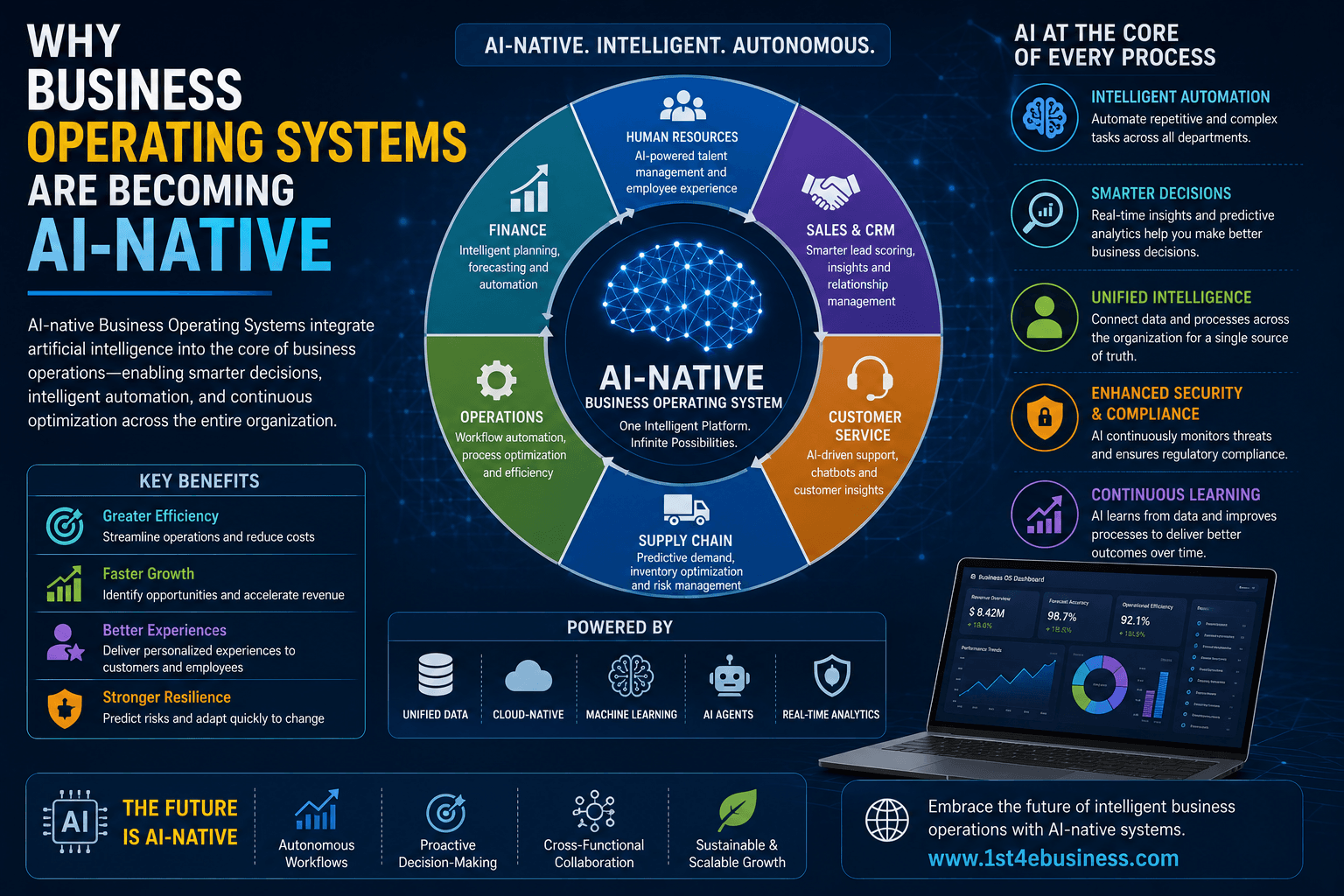
Businesses are entering a new era in which artificial intelligence is becoming part of the core operating layer of organizations. Instead of using AI as a separate tool for isolated tasks, companies are increasingly building AI into the systems that manage workflows, data, employees, customers, operations, and decision-making.
This shift is giving rise to AI-native business operating systems—platforms designed from the ground up to use AI as a central component of how work gets done.
Traditional business software primarily helps employees record information, follow processes, and retrieve data. AI-native systems can go further by understanding business context, recommending actions, automating workflows, and coordinating tasks across different applications.
What Is an AI-Native Business Operating System?
An AI-native business operating system is a technology layer that integrates artificial intelligence into core business operations.
Rather than adding an AI chatbot to existing software, an AI-native operating system can connect business data, applications, workflows, AI agents, and employees within a unified environment.
It may include:
AI agents
Business workflow automation
Data intelligence
Decision-support tools
Enterprise integrations
Predictive analytics
Natural-language interfaces
Process orchestration
Security and governance
The goal is to make AI part of the organization's operational infrastructure.
From Systems of Record to Systems of Intelligence
Traditional enterprise software has largely been built around systems of record.
CRM platforms store customer information. ERP systems manage financial and operational data. HR platforms manage employee records.
AI-native systems are evolving these platforms into systems of intelligence.
Instead of simply storing information, they can analyze it and provide recommendations.
For example, a traditional CRM might show that a customer has not purchased anything for six months.
An AI-native CRM could identify the customer as a potential churn risk, analyze previous interactions, recommend an offer, draft personalized outreach, and assign the task to the appropriate sales representative.
The software becomes proactive rather than passive.
Why Businesses Are Moving Toward AI-Native Operations
Several factors are driving the transition.
Increasing Data Volumes
Organizations generate enormous amounts of information from customers, transactions, employees, suppliers, applications, devices, and digital channels.
Humans cannot manually analyze all of this information efficiently.
AI can process large datasets and identify patterns that may otherwise be missed.
Growing Operational Complexity
Businesses operate across increasingly complex ecosystems of cloud platforms, vendors, applications, regulations, and global markets.
AI can help coordinate these moving parts and reduce manual administrative work.
Demand for Faster Decisions
Markets change quickly. Businesses need to respond to customer behavior, operational problems, competitive activity, and emerging risks in real time.
AI can provide faster analysis and recommendations.
Pressure to Improve Productivity
Organizations are looking for ways to increase output without simply increasing headcount.
AI-native workflows can automate repetitive processes and allow employees to focus on higher-value work.
AI Agents Are Becoming a Core Component
One of the most important developments is the rise of AI agents.
Unlike traditional chatbots, AI agents can be designed to perform tasks, use tools, access approved business data, and coordinate workflows.
For example, an AI-native procurement system could use agents to:
Monitor inventory.
Identify purchasing requirements.
Research suppliers.
Compare prices.
Evaluate vendor risk.
Prepare a purchase recommendation.
Request human approval.
Update the procurement system.
This transforms software from a tool employees operate into a system that can actively participate in business processes.
Natural Language Becomes a Business Interface
AI-native operating systems can make natural language a more important interface for business software.
Instead of navigating multiple menus, an employee might ask:
“Show me the customers most likely to churn this quarter and prepare recommended retention actions.”
The system could retrieve relevant data, analyze it, and produce an actionable response.
Natural-language interfaces do not necessarily eliminate traditional dashboards. Instead, they provide another way to interact with complex enterprise systems.
AI-Native Decision-Making
AI can also become part of organizational decision-making.
Business leaders may use AI systems to evaluate scenarios, identify trends, and simulate potential outcomes.
For example, a company considering a new market could ask an AI system to analyze:
Market size
Competitor activity
Customer demand
Pricing
Operational costs
Regulatory considerations
Supply chain requirements
The AI could then generate scenarios and highlight potential risks.
Human leaders would still make the final decision, but they could do so with richer analysis.
Cross-Department Intelligence
Traditional enterprise software often creates information silos.
Sales may use one platform, finance another, HR another, and operations another.
An AI-native business operating system can potentially connect these systems and create a broader organizational intelligence layer.
For example, AI could connect sales forecasts with inventory planning and financial projections.
If demand increases unexpectedly, the system could identify potential inventory constraints, estimate financial implications, and notify relevant teams.
This creates a more connected organization.
Automation Across Entire Workflows
AI-native systems can automate workflows that previously required multiple employees and applications.
Consider a customer complaint.
A traditional workflow may require an employee to read the complaint, identify the issue, search the customer record, review the policy, contact another department, and prepare a response.
An AI-native workflow could analyze the complaint, retrieve customer information, determine the relevant policy, investigate the issue, draft a response, and route complex cases to a human.
The result is not simply automated communication—it is automated workflow orchestration.
AI-Native Business Operations Across Industries
Finance
AI can support forecasting, fraud detection, financial analysis, reconciliation, and compliance monitoring.
Healthcare
AI-native systems can assist with scheduling, documentation, operational analysis, and patient-service workflows.
Retail
Retailers can use AI to personalize customer experiences, forecast demand, optimize inventory, and automate customer support.
Manufacturing
AI can monitor production, predict equipment failures, identify quality problems, and optimize supply chains.
Professional Services
AI can assist with research, document analysis, project management, reporting, and client communications.
Security and Governance Become Essential
Giving AI access to business systems introduces new risks.
AI-native organizations need strong controls around:
Data access
Identity management
Agent permissions
Human approvals
Audit trails
Model monitoring
Privacy
Compliance
Security testing
AI agents should not automatically receive unrestricted access to business systems.
Organizations need clear boundaries defining what an AI system can view, what it can change, and which actions require human approval.
The Importance of Human Oversight
AI-native does not mean human-free.
Businesses still need people to provide strategy, accountability, judgment, creativity, and oversight.
AI should support decision-making rather than remove responsibility from decision-makers.
A useful model is:
AI analyzes → AI recommends → Human reviews → AI executes approved actions
The appropriate balance will depend on the risk and importance of each workflow.
Challenges of Becoming AI-Native
The transition will not be simple.
Legacy Systems
Many organizations rely on decades-old software that was not designed for AI integration.
Data Silos
AI systems need access to reliable and well-structured information.
Organizational Change
Employees may need to learn new ways of working with AI systems.
Security Risks
Greater AI access can increase the potential impact of security incidents.
Cost
AI infrastructure, models, integrations, and governance can require significant investment.
Trust
Employees and executives need confidence that AI recommendations are reliable and explainable.
How Businesses Can Become AI-Native
Organizations should not attempt to replace every system at once.
A practical approach is to:
Identify high-value business workflows.
Connect relevant data sources.
Introduce AI assistants and agents gradually.
Automate repetitive processes.
Establish permissions and governance.
Measure business outcomes.
Expand successful use cases across departments.
The focus should remain on solving business problems rather than simply deploying AI technology.
The Future of AI-Native Businesses
The AI-native organization will likely look different from the traditional enterprise.
Instead of employees manually moving information between systems, AI agents may coordinate many of these processes automatically.
Instead of waiting for monthly reports, leaders may receive continuously updated intelligence.
Instead of searching through applications for information, employees may interact with an intelligent business layer using natural language.
And instead of software simply recording what happened, business systems may increasingly predict what is likely to happen and recommend what should happen next.
Conclusion
Business operating systems are becoming AI-native because organizations need software that can do more than store information and execute predefined processes.
AI-native systems can connect data, understand business context, automate workflows, support decisions, and coordinate intelligent agents across departments.
The transition will require more than new software. Businesses will need strong data foundations, security, governance, employee training, and clear strategies for human-AI collaboration.
The companies that successfully integrate AI into their operational foundations may gain a significant advantage through faster decision-making, greater automation, improved productivity, and more responsive customer experiences.
The future of business software is therefore not simply about adding AI features. It is about redesigning how organizations operate around intelligent, connected, and increasingly autonomous systems.
FAQs
1. What is an AI-native business operating system?
It is a business technology platform designed with AI as a core part of its architecture, allowing it to analyze data, automate workflows, support decisions, and coordinate AI agents.
2. How is AI-native software different from traditional business software?
Traditional software primarily records information and executes predefined workflows. AI-native software can interpret information, make recommendations, adapt to context, and automate more complex processes.
3. What role do AI agents play in business operating systems?
AI agents can perform specialized tasks, use approved business tools, analyze information, coordinate workflows, and take authorized actions on behalf of employees.
4. Will AI-native systems replace enterprise software?
AI-native systems are more likely to transform and extend enterprise software. Existing CRM, ERP, HR, and financial platforms may increasingly integrate AI capabilities rather than disappear completely.
5. What are the benefits of becoming AI-native?
Benefits can include greater automation, faster decision-making, improved productivity, better data utilization, personalized customer experiences, and more efficient business operations.
6. What challenges do AI-native businesses face?
Common challenges include legacy systems, data silos, security risks, governance requirements, implementation costs, employee adoption, and concerns about AI accuracy.
7. Does AI-native mean that humans are no longer needed?
No. Humans remain essential for strategy, accountability, creativity, judgment, and high-impact decisions. AI is primarily changing how humans perform and supervise work.
8. How can businesses begin becoming AI-native?
Businesses can start by identifying repetitive, high-value workflows, connecting reliable data sources, introducing AI agents gradually, establishing governance controls, and measuring results.
9. Why are natural-language interfaces important?
Natural-language interfaces make complex business systems easier to interact with by allowing employees to ask questions, request analysis, and initiate workflows using everyday language.
10. What is the future of AI-native business operations?
Businesses are likely to become increasingly intelligent, automated, connected, and proactive, with AI systems continuously analyzing information, recommending actions, and coordinating approved workflows.