
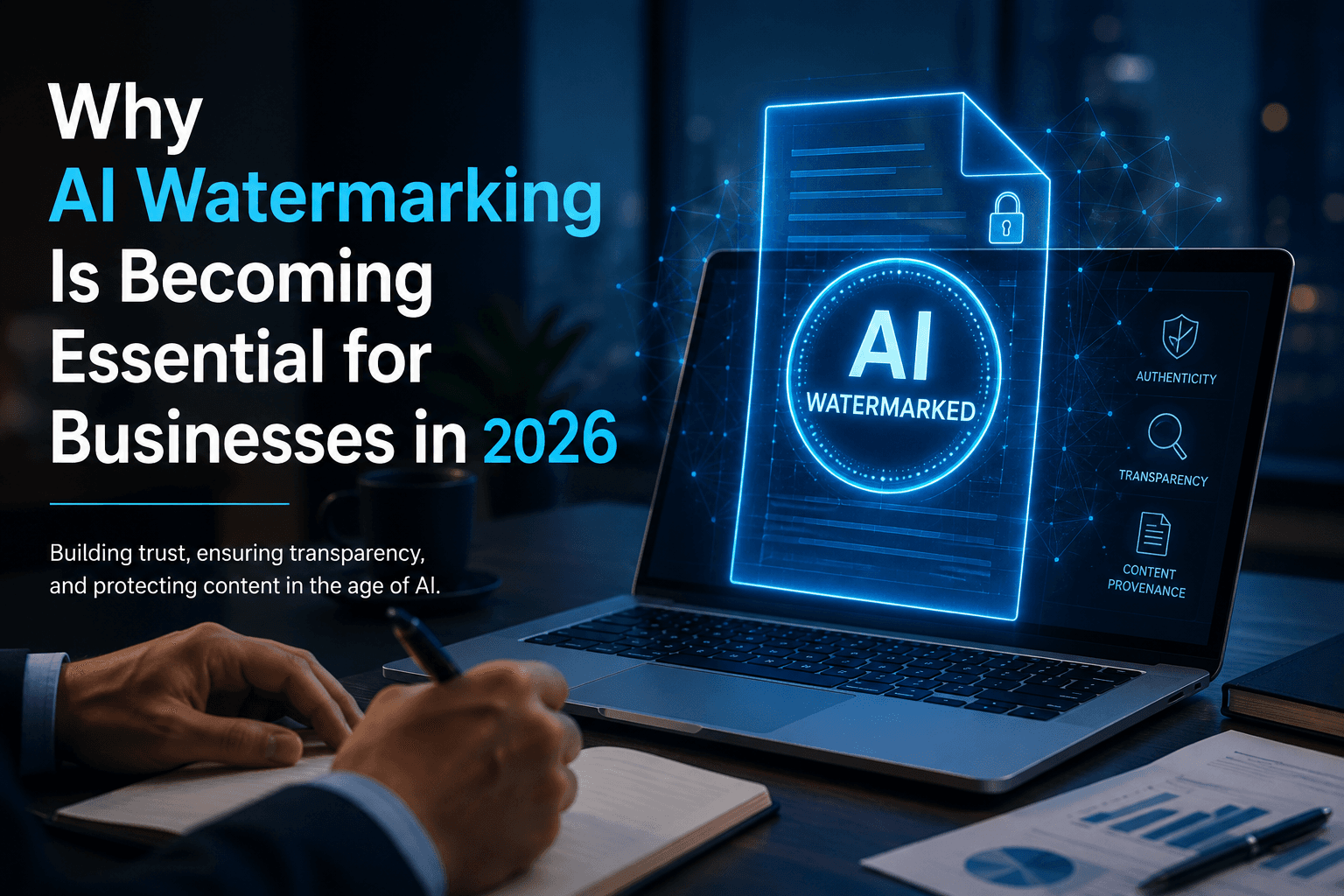

Anthropic is taking a significant step toward answering that question. The company has announced that it will add machine-readable watermarking to text generated by its AI models, including Claude. According to reporting on the announcement, the watermark is designed to travel with copied text and may survive some forms of editing. (TechCrunch)
The development could accelerate a broader industry shift toward AI transparency, content provenance, and verification.
What Is AI Watermarking?
AI watermarking is a technique that embeds an identifiable signal into AI-generated content.
Unlike a visible label stating that something was produced by artificial intelligence, a machine-readable watermark can be difficult for ordinary users to notice. Specialized systems can potentially use the embedded signal to determine whether content originated from an AI model.
For businesses, this creates a possible way to establish the origin of digital material without placing an obvious visual warning across every piece of content.
Anthropic's approach is particularly notable because the company says the watermark is incorporated at the model level. That means the signal can remain associated with generated text regardless of which Claude product or interface produced it. (TechCrunch)
Why Anthropic's Move Matters
The AI industry has spent years discussing how to distinguish human-created content from AI-generated material.
Traditional AI detectors have often struggled because generated text can be edited, rewritten, translated, or combined with human writing. A watermark embedded during generation takes a different approach: instead of trying to determine afterward whether text looks like AI writing, the system can provide information about its origin.
Anthropic's announcement therefore represents an important development in the broader conversation about digital provenance.
The company has also positioned transparency and responsible AI development as important parts of its approach to increasingly capable AI systems. (Anthropic)
How Could AI Watermarking Affect Businesses?
The implications extend well beyond AI companies.
Businesses increasingly rely on generative AI for content creation. Marketing departments may use AI to produce social media posts, product descriptions, newsletters, advertisements, and website content. Employees may use AI assistants to prepare internal documents, summaries, presentations, and emails.
Watermarking could give organizations another mechanism for tracking the origin of this material.
For example, a company could potentially distinguish between:
Human-written material
AI-generated material
AI-assisted material
Content that has been substantially edited by humans
This distinction could become increasingly important as organizations develop formal AI-use policies.
AI Transparency Is Becoming a Business Issue
AI transparency is no longer simply a technical discussion.
Customers, regulators, publishers, employers, and business partners increasingly want to understand how AI is being used. In some situations, organizations may need to disclose or document the use of synthetic content.
This makes provenance valuable.
Imagine a company publishes a financial report containing AI-generated analysis. If questions later arise about the origin of certain passages, an organization with appropriate provenance systems could potentially provide stronger evidence about how that material was created.
The same principle could apply to advertising, education, journalism, corporate communications, and customer support.
Watermarking Could Help Publishers
Publishers are facing a particularly complicated AI environment.
Generative AI has made it possible to produce thousands of articles, summaries, product descriptions, and social posts at extremely low cost. At the same time, search engines and online platforms are increasingly concerned about low-quality or mass-produced content.
AI watermarking could provide publishers with another way to maintain internal records of how content was created.
However, watermarking should not automatically be treated as a quality score.
AI-generated does not necessarily mean low quality, and human-written does not automatically mean high quality.
The more useful purpose of provenance is understanding content origin rather than making assumptions about whether a piece of content is good or bad.
AI Detection and Watermarking Are Not the Same
One important distinction is the difference between AI detection and AI watermarking.
AI detectors generally analyze existing text and attempt to estimate whether an AI system produced it. Watermarking works differently because the AI system embeds information into the output during generation.
That difference could make watermarking useful for organizations that want stronger provenance signals.
However, it is important not to assume that watermarking will solve every AI-authorship problem. Content can be substantially rewritten, transformed, translated, or combined with other material. As a result, businesses will still need broader content-governance systems.
What This Means for AI Content Creators
For writers, marketers, and SEO professionals, the development is especially relevant.
AI-assisted content creation has become a normal part of many digital workflows. Businesses can use AI for brainstorming, research organization, drafting, editing, and content optimization.
Rather than viewing watermarking as something that automatically makes AI content unacceptable, companies should focus on responsible AI-assisted publishing.
A strong workflow could involve:
Using AI for research and drafting.
Reviewing factual claims.
Adding original analysis and expertise.
Editing the content for the intended audience.
Checking sources and statistics.
Maintaining internal records of AI involvement.
Following applicable disclosure and regulatory requirements.
This approach treats AI as a productivity tool while maintaining human oversight.
The Regulatory Pressure Behind AI Transparency
The timing of the development is also significant because governments and regulators are increasingly addressing transparency around artificial intelligence.
The European Union has established extensive AI-related rules, while companies operating internationally increasingly need to understand how transparency obligations could affect their products and workflows.
Anthropic has publicly emphasized responsible AI governance and transparency, including its work around model safety and reporting. (Anthropic)
As AI adoption expands, businesses should expect compliance requirements and industry standards around AI-generated content to continue developing.
Could AI Watermarks Become an Industry Standard?
Anthropic's decision could encourage other AI companies to explore similar technologies.
If multiple major AI providers eventually implement compatible watermarking or provenance standards, businesses could have a more consistent way to determine where AI-generated content originated.
That could eventually lead to a broader digital provenance ecosystem.
Such a system could help organizations answer questions such as:
Was this content generated by an AI model?
Which AI system created it?
Has the content been modified?
Was AI involved in its production?
Can the origin of the content be verified?
The industry is still far from having universal answers to these questions, but developments like Anthropic's watermarking initiative could move the technology closer to that goal.
Challenges Remain
Despite its potential benefits, AI watermarking is not a perfect solution.
Businesses should not assume that a watermark can provide absolute proof of authorship in every situation. Content can pass through multiple systems and undergo significant modification.
There are also questions about interoperability. A watermarking system created by one AI company may not necessarily work with tools developed by another provider.
Privacy, security, transparency, and false-positive concerns will also need consideration as these technologies become more widely adopted.
For that reason, watermarking should be viewed as one component of a broader AI governance strategy, rather than a complete replacement for human review.
The Future of AI Content Is Moving Toward Provenance
Anthropic's latest move reflects a larger transformation taking place across the AI industry.
The first phase of generative AI focused heavily on creation: generating text, images, code, audio, and video faster than ever before.
The next phase is increasingly focused on trust.
Businesses will need to know where digital content came from, how it was produced, whether it was modified, and whether its creation complied with internal policies and external regulations.
AI watermarking could become an important part of that transition.
For companies adopting generative AI in 2026, the message is straightforward: AI-generated content is becoming easier to create, but proving and managing its origin may become just as important as creating it.
As Anthropic expands watermarking across supported models, the technology could become an important reference point for the wider AI industry. (TechCrunch)
The future of business content may therefore not simply be about human versus AI. Instead, successful organizations may focus on transparency, provenance, responsible AI use, and clear human oversight.
And as generative AI becomes embedded in virtually every part of the digital economy, knowing where content came from could become one of the most valuable pieces of information businesses have.
FAQs
1. What is AI watermarking?
AI watermarking is a technology that embeds a machine-readable signal into content generated by an artificial intelligence system. It can help identify the content's AI origin without necessarily displaying an obvious label to readers.
2. Why is Anthropic watermarking Claude-generated text?
Anthropic is introducing watermarking as part of a broader effort around AI transparency and content provenance. Its watermark is designed to remain associated with generated text when it is copied and may survive some editing. (TechCrunch)
3. Does an AI watermark mean the content is low quality?
No. A watermark indicates information about content origin; it does not automatically determine whether the content is accurate, useful, original, or high quality.
4. Will AI watermarking replace AI detectors?
Not necessarily. Watermarking and AI detection use different approaches and could potentially complement each other.
5. Why should businesses care about AI content provenance?
Provenance can help businesses understand how content was produced, establish internal accountability, support transparency policies, and prepare for evolving AI governance requirements.
6. Can AI watermarks survive editing?
Anthropic says its watermark can travel when text is copied and pasted and may persist through some editing, although the ability to preserve a watermark can depend on how substantially content is changed. (TechCrunch)
7. Will every AI company use watermarks?
It is too early to say. Anthropic's move could encourage broader adoption, but different AI companies may use different provenance technologies and standards.
8. Does AI watermarking affect SEO?
A watermark itself should not be confused with a search-engine ranking factor. Businesses should continue focusing on useful, original, accurate, well-structured content rather than assuming that AI-generated or human-generated status alone determines search performance.
9. Should companies stop using AI for content creation?
No. Companies can continue using AI as a productivity tool while maintaining human review, fact-checking, originality, and appropriate disclosure policies.
10. What is the bigger trend behind AI watermarking?
The bigger trend is the movement from simply generating AI content toward establishing trust, transparency, and digital provenance for content created with artificial intelligence.