
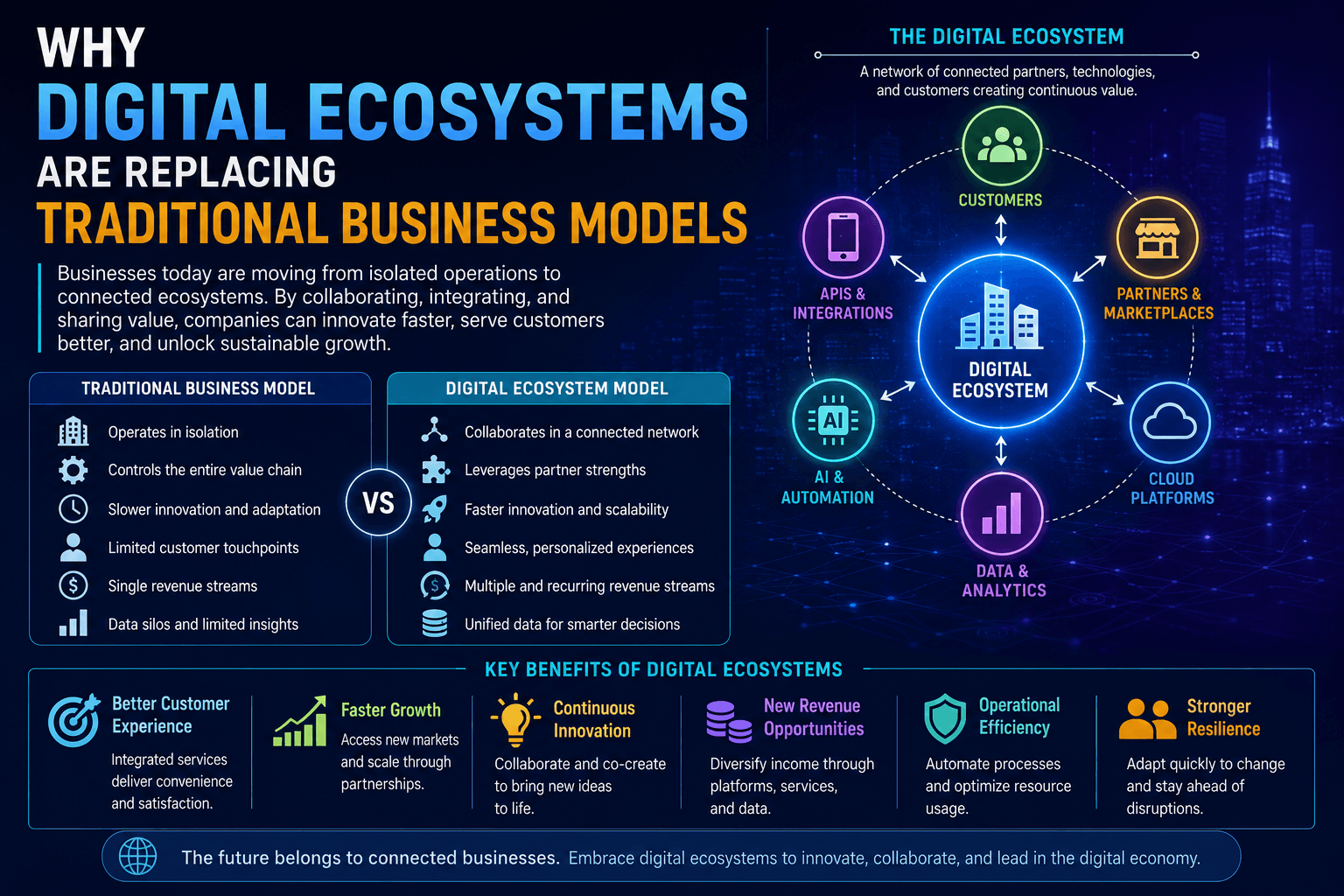

The way companies create, deliver, and capture value is changing rapidly. For decades, traditional business models were built around a relatively simple structure: a company developed a product or service, sold it to customers, and competed with other businesses offering similar solutions. Today, digital technologies are creating a different approach.
Digital ecosystems are emerging as a powerful alternative to traditional business models. Instead of operating independently, businesses connect customers, partners, suppliers, developers, platforms, and service providers through digital infrastructure. This interconnected approach allows organizations to create value collaboratively while responding faster to changing customer expectations.
From marketplaces and financial platforms to cloud services, artificial intelligence, and connected devices, digital ecosystems are becoming central to modern business strategy. Companies that understand how to participate in or build these ecosystems can unlock new revenue opportunities, improve customer experiences, and strengthen their competitive position.
What Is a Digital Ecosystem?
A digital ecosystem is a network of interconnected businesses, technologies, customers, partners, and platforms that work together to create and exchange value.
Unlike a traditional business model where a company often controls most stages of the customer journey, an ecosystem distributes value creation across multiple participants. A digital platform may connect buyers with sellers, businesses with software developers, or customers with financial and logistics providers.
Examples include online marketplaces, app stores, cloud computing platforms, fintech networks, and business-to-business technology ecosystems.
The strength of an ecosystem comes from its connections. As more participants join, the platform can become more useful and valuable, creating network effects that encourage additional adoption.
Why Traditional Business Models Are Changing
Traditional businesses often depend on linear value chains. A manufacturer produces a product, distributors move it through the market, retailers sell it, and customers purchase it.
Digital technology has disrupted this structure.
Cloud computing, artificial intelligence, mobile applications, APIs, automation, and data analytics allow companies to connect participants directly and coordinate activities at unprecedented speed.
Customers also expect more personalized and convenient experiences. They increasingly want services that work together rather than isolated products requiring separate accounts, applications, and processes.
As a result, businesses are moving from product-centered strategies toward connected experiences.
The Role of Platforms in Digital Ecosystems
Platforms are one of the most important components of digital ecosystems. A platform provides the infrastructure that allows different participants to interact.
For example, a digital marketplace can connect customers with independent sellers. A cloud platform can provide businesses with computing resources, databases, analytics, and AI services. An app ecosystem can allow developers to create products that extend the platform's capabilities.
This creates a business model in which the platform owner does not necessarily need to provide every product or service itself.
Instead, it enables other participants to contribute.
Network Effects Create Competitive Advantages
One of the biggest advantages of digital ecosystems is the network effect.
A network effect occurs when a product or platform becomes more valuable as more people participate. A marketplace with thousands of sellers can attract more customers because it offers greater variety. More customers can then attract additional sellers.
This creates a self-reinforcing cycle.
Traditional businesses may need to continuously increase production, distribution, and physical infrastructure to grow. Digital ecosystems can often scale more efficiently because software and digital infrastructure can support large numbers of users without requiring equivalent increases in physical resources.
Artificial Intelligence Is Accelerating Ecosystem Growth
Artificial intelligence is becoming another major driver of digital ecosystems.
AI can analyze large amounts of data, automate workflows, personalize customer experiences, detect fraud, optimize operations, and support decision-making.
When AI is integrated into an ecosystem, its capabilities can extend across multiple participants.
For example, an ecosystem could combine customer data, supply-chain information, payment activity, and operational data to identify demand patterns and improve forecasting.
AI can therefore make digital ecosystems more intelligent and responsive.
Data Has Become a Strategic Asset
Data is another major reason businesses are moving toward ecosystem models.
Traditional businesses often viewed customer information primarily as an internal resource. Modern ecosystems can generate data across multiple interactions and touchpoints.
Companies can use this information to understand customer behavior, identify trends, improve products, and develop new services.
However, collecting and using data also creates responsibilities. Organizations must prioritize privacy, security, transparency, and regulatory compliance.
A successful ecosystem cannot depend only on data collection. It must establish trust around how information is handled.
Digital Ecosystems Improve Customer Experience
Customers increasingly expect businesses to provide fast, seamless, and personalized experiences.
Digital ecosystems can connect multiple services into a single customer journey.
For example, a customer might discover a product through a digital platform, purchase it online, receive automated payment confirmation, track delivery through an integrated logistics system, and receive personalized recommendations afterward.
Instead of interacting with several disconnected businesses, the customer experiences a connected digital journey.
This convenience can become a significant competitive advantage.
Ecosystems Enable Faster Innovation
Innovation can be difficult when every product or service must be developed internally.
Digital ecosystems allow companies to collaborate with external developers, startups, technology providers, research organizations, and business partners.
APIs and cloud infrastructure make it easier to integrate external capabilities into existing products.
This means companies can experiment with new technologies without building everything from scratch.
Open innovation can also help organizations identify opportunities that internal teams might overlook.
New Revenue Opportunities
Digital ecosystems can create revenue streams beyond traditional product sales.
Companies can generate revenue through subscriptions, transaction fees, marketplace commissions, premium features, advertising, data-driven services, APIs, and partnerships.
For example, a company that initially sells software might build an ecosystem around its platform and allow third-party developers to offer complementary applications.
The company can then benefit from a broader range of economic activity occurring within its ecosystem.
Small Businesses Can Participate Too
Digital ecosystems are not limited to large technology companies.
Small and medium-sized businesses can participate through e-commerce platforms, cloud services, payment networks, digital marketplaces, social commerce, SaaS platforms, and partner networks.
These tools allow smaller companies to access customers and infrastructure that would previously have required significant investment.
A small business can use cloud-based accounting, digital payments, marketing automation, AI customer support, and online marketplaces without developing these systems internally.
This lowers barriers to entry and expands access to digital capabilities.
Ecosystems Are Changing Competition
Digital ecosystems can change the definition of competition.
A company may compete with another organization in one area while partnering with it in another.
For example, two businesses might compete for customers while integrating their services through a shared technology platform.
This creates a more complex competitive environment based on both cooperation and competition.
Companies increasingly need to determine not only who their competitors are but also which organizations could become strategic ecosystem partners.
The Importance of Interoperability
An ecosystem is only as effective as its ability to connect different systems.
Interoperability allows applications, platforms, devices, and databases to communicate with one another.
APIs play a major role in enabling this connectivity.
Businesses that build flexible technology architectures can integrate new partners and services more easily. Organizations relying on isolated legacy systems may struggle to participate effectively in rapidly evolving ecosystems.
Modernization is therefore becoming an important part of ecosystem strategy.
Cybersecurity and Trust Are Critical
Greater connectivity also creates greater risk.
A digital ecosystem may involve dozens or thousands of connected businesses and systems. A vulnerability in one participant could potentially affect others.
Cybersecurity therefore needs to extend beyond individual organizations.
Companies must evaluate partners, secure APIs, protect customer information, monitor systems, and establish clear security standards.
Trust is equally important. Customers and partners are unlikely to remain within an ecosystem if they believe their data or transactions are unsafe.
The Future of Digital Ecosystems
The transition toward ecosystem-based business models is likely to continue as technologies become more integrated.
Artificial intelligence, cloud computing, Internet of Things devices, blockchain, automation, edge computing, and digital payments can all contribute to increasingly connected business environments.
Future ecosystems may operate with greater automation. AI agents could potentially coordinate purchases, manage workflows, negotiate services, analyze markets, and connect businesses with appropriate partners.
This could further reduce the importance of traditional organizational boundaries.
How Businesses Can Prepare
Companies do not necessarily need to transform into massive platforms to benefit from ecosystem models.
They can begin by identifying the partners, technologies, and customer relationships that create the most value.
Businesses should evaluate their existing technology infrastructure, identify opportunities for integration, develop API capabilities where appropriate, strengthen cybersecurity, and explore strategic partnerships.
Most importantly, companies should focus on the customer journey.
The goal should not simply be to connect more systems. The goal should be to create better value through those connections.
Conclusion
Digital ecosystems are reshaping the foundations of modern business. Traditional linear models are increasingly being supplemented or replaced by interconnected networks where companies, customers, platforms, developers, and partners collaborate to create value.
The shift is being driven by cloud computing, artificial intelligence, data, automation, mobile technology, and changing customer expectations.
Companies that successfully participate in digital ecosystems can gain access to new markets, accelerate innovation, create additional revenue streams, and deliver more seamless customer experiences.
The future of business may therefore be less about owning every part of the value chain and more about building the right connections.
Frequently Asked Questions
1. What is a digital ecosystem in business?
A digital ecosystem is a connected network of businesses, customers, platforms, technologies, developers, and service providers that interact digitally to create and exchange value. Instead of operating independently, participants collaborate through shared infrastructure, data, applications, and services.
2. Why are digital ecosystems replacing traditional business models?
Digital ecosystems can provide greater scalability, flexibility, innovation, and customer convenience than many traditional linear models. They allow organizations to collaborate with external partners, integrate technologies, access new markets, and create multiple revenue opportunities without controlling every stage of the value chain.
3. What is the difference between a traditional business model and a digital ecosystem?
A traditional business model generally follows a linear structure in which a company creates a product or service and sells it to customers. A digital ecosystem is more interconnected, allowing multiple businesses and participants to contribute value through a shared platform or network.
4. How do digital ecosystems benefit customers?
Digital ecosystems can make customer experiences faster and more convenient by connecting multiple products and services. Customers may receive personalized recommendations, integrated payments, automated support, seamless purchasing experiences, and connected services through fewer platforms.
5. How does artificial intelligence support digital ecosystems?
AI can analyze ecosystem data, automate processes, personalize services, detect unusual activity, improve forecasting, and support decision-making. AI can also help different participants coordinate their activities more efficiently across a connected digital environment.
6. What role does data play in a digital ecosystem?
Data helps ecosystem participants understand customer behavior, operational performance, market trends, and emerging opportunities. When used responsibly, data can support personalization, forecasting, automation, product development, and better decision-making.
7. Can small businesses benefit from digital ecosystems?
Yes. Small businesses can use marketplaces, cloud platforms, payment systems, SaaS applications, social commerce tools, and digital marketing platforms to access technologies and customers that would otherwise require substantial investment.
8. What are network effects in digital ecosystems?
Network effects occur when a platform becomes more valuable as more participants join it. For example, more sellers can attract more buyers to a marketplace, while more buyers can encourage additional sellers to participate.
9. Are digital ecosystems only relevant to technology companies?
No. Digital ecosystems can be used across industries including finance, healthcare, retail, manufacturing, logistics, education, travel, telecommunications, and professional services. Any industry with multiple connected participants can potentially benefit from an ecosystem approach.
10. How do digital ecosystems create new revenue streams?
They can generate revenue through subscriptions, transaction fees, commissions, premium services, advertising, APIs, partnerships, software services, and other digital offerings. Companies can monetize not only their own products but also activity occurring across their platforms.
11. Why are APIs important for digital ecosystems?
APIs allow different software applications and systems to communicate with one another. They make it easier for companies to integrate external services, connect partners, share selected capabilities, and build new digital products.
12. What challenges do digital ecosystems create?
Major challenges include cybersecurity threats, data privacy concerns, regulatory requirements, integration difficulties, partner management, technology complexity, and dependence on platforms or external providers. Successful ecosystems require strong governance and clear standards.
13. How do digital ecosystems encourage innovation?
They allow companies to collaborate with external developers, startups, technology providers, and partners. Instead of relying entirely on internal teams, organizations can combine external capabilities with their own resources to develop new products and services more quickly.
14. Can digital ecosystems reduce business costs?
They can reduce certain costs by using cloud infrastructure, automation, shared platforms, and external digital services. However, creating and managing an ecosystem also requires investment in technology, cybersecurity, integration, governance, and partner relationships.
15. How do digital ecosystems change competition?
They can blur the traditional distinction between competitors and partners. A company may compete with another organization in one market while collaborating with it through technology integration or a shared platform in another area.
16. Why is cybersecurity especially important for digital ecosystems?
Digital ecosystems connect multiple organizations and systems, creating more potential entry points for cyberattacks. A security weakness in one connected component can potentially affect other participants, making security standards, monitoring, access controls, and partner risk management essential.
17. What industries are adopting digital ecosystems?
Industries such as financial services, retail, healthcare, manufacturing, logistics, telecommunications, transportation, entertainment, and technology are increasingly adopting ecosystem strategies. The approach is particularly useful where multiple participants need to exchange information or services.
18. Will digital ecosystems completely eliminate traditional businesses?
Not necessarily. Traditional business models will continue to exist, especially in industries where physical products, infrastructure, regulation, or specialized operations remain important. However, many traditional companies are adding digital ecosystem capabilities to remain competitive.
19. How can a company start building a digital ecosystem?
A company can begin by identifying important customer needs, potential strategic partners, integration opportunities, and technology gaps. It can then introduce APIs, cloud services, data-sharing capabilities, partnerships, and digital platforms gradually rather than attempting a complete transformation immediately.
20. What is the future of digital ecosystems?
The future will likely involve increasingly intelligent and automated ecosystems powered by AI, cloud computing, connected devices, data analytics, and digital platforms. Businesses may increasingly compete based on the strength of their networks, partnerships, integrations, and customer experiences rather than products alone.