
Financial forecasting has always been an important part of business planning. Companies need to estimate revenue, expenses, cash flow, demand, profitability, and future financial requirements to make informed decisions. Traditionally, these forecasts have relied heavily on spreadsheets, historical financial statements, economic assumptions, and the experience of finance professionals.
However, today's business environment is becoming increasingly complex. Changing consumer behavior, supply-chain disruptions, inflation, interest rates, geopolitical uncertainty, and rapidly evolving technologies can make traditional forecasting difficult.
AI-powered financial forecasting is emerging as a powerful solution.
By combining artificial intelligence, machine learning, advanced analytics, and real-time data, businesses can develop more dynamic financial forecasts and identify potential opportunities and risks earlier.
What Is AI-Powered Financial Forecasting?
AI-powered financial forecasting uses artificial intelligence and machine learning algorithms to analyze financial and operational data and generate predictions about future business performance.
Traditional forecasting may rely primarily on historical trends and manually selected assumptions. AI-powered systems can analyze much larger datasets and identify relationships that may be difficult to detect manually.
Depending on the system, AI can analyze:
Historical revenue
Expenses
Cash flow
Sales performance
Customer behavior
Market conditions
Pricing data
Inventory levels
Economic indicators
Seasonal patterns
Operational performance
The goal is not simply to predict one future outcome. Advanced forecasting systems can generate multiple scenarios and help businesses understand how different conditions could affect their financial performance.
Why Traditional Financial Forecasting Is Becoming Challenging
Traditional financial forecasting remains useful, but it has several limitations.
Dependence on Historical Data
Historical performance can provide valuable insights, but the past does not always accurately predict the future.
Markets can change quickly, and businesses may experience conditions that have never occurred before.
Manual Spreadsheet Processes
Many organizations still depend heavily on spreadsheets for forecasting.
Manual processes can take significant time and create opportunities for formula errors, outdated assumptions, and inconsistent data.
Limited Real-Time Information
Traditional forecasts may be updated periodically rather than continuously.
As market conditions change, forecasts can quickly become outdated.
Increasing Business Complexity
Companies now operate across multiple markets, channels, suppliers, and technologies.
Analyzing all these factors manually can be difficult.
How AI Is Transforming Financial Forecasting
AI can make forecasting more dynamic by continuously analyzing data and identifying emerging patterns.
Machine learning models can detect relationships between financial performance and operational variables.
For example, an AI system might identify that changes in website traffic, customer engagement, advertising spending, and product availability consistently influence sales.
The system can incorporate these relationships into future forecasts.
This creates a more comprehensive view of business performance.
Real-Time Financial Insights
One of the biggest advantages of AI-powered forecasting is the ability to work with frequently updated information.
Instead of waiting until the end of a month or quarter, businesses can monitor financial indicators continuously.
An AI forecasting system could analyze:
Current sales
New orders
Customer demand
Cash balances
Inventory
Expenses
Market information
This allows finance teams to identify changes earlier.
For example, if revenue begins declining faster than expected, an AI system can potentially identify the trend and update projections before the next scheduled reporting cycle.
AI and Revenue Forecasting
Revenue forecasting is one of the most important applications of AI.
Companies need to understand how much revenue they may generate in upcoming weeks, months, or quarters.
AI models can analyze historical sales patterns alongside variables such as:
Seasonality
Pricing
Promotions
Customer demand
Product availability
Marketing activity
Regional performance
This can help businesses develop more detailed revenue projections.
AI-Powered Cash Flow Forecasting
Cash flow management is essential for business stability.
A profitable company can still face financial difficulties if it does not have enough cash available to meet short-term obligations.
AI-powered cash flow forecasting can analyze expected income, expenses, payment schedules, customer behavior, and historical patterns.
This can help businesses identify potential cash shortages earlier.
For example, an AI model might identify that delayed customer payments combined with higher upcoming supplier expenses could create a temporary cash-flow gap.
Management can then explore financing, cost adjustments, or collection strategies before the problem becomes critical.
Expense Forecasting
AI can also help businesses predict future expenses.
By analyzing historical spending and operational data, AI systems can identify recurring costs and changing spending patterns.
Companies can use these insights to improve budgeting and identify areas where expenses may be increasing unexpectedly.
For example, an organization might discover that certain operating costs are consistently rising faster than revenue.
That information can support earlier cost-control decisions.
Scenario Planning
One of the most valuable capabilities of AI-powered forecasting is scenario analysis.
Instead of creating one forecast, businesses can evaluate multiple potential outcomes.
For example:
Scenario A: Revenue increases by 10%.
Scenario B: Revenue remains stable.
Scenario C: Revenue decreases by 10%.
AI systems can help estimate how each scenario might affect cash flow, profitability, staffing, inventory, and investment decisions.
This allows executives to prepare for uncertainty rather than relying on a single prediction.
Predictive Analytics for Business Growth
AI forecasting is not only about avoiding financial problems.
It can also help companies identify opportunities.
An AI system may detect that a particular customer segment is growing faster than expected or that a specific product is generating stronger margins.
Management can use these insights to decide where additional resources may create the greatest return.
This transforms forecasting from a defensive activity into a growth strategy.
Improving Budgeting and Planning
Annual budgets can become outdated quickly when business conditions change.
AI-powered forecasting allows companies to update financial expectations more frequently.
Instead of treating a budget as a fixed document, businesses can use rolling forecasts that adjust as new information becomes available.
This creates a more flexible approach to financial planning.
AI and Inventory Decisions
Financial forecasting is closely connected to inventory management.
Too much inventory can tie up capital and increase storage costs. Too little inventory can lead to stockouts and lost sales.
AI can analyze demand patterns, sales trends, seasonality, and other operational data to support inventory planning.
Better inventory forecasting can improve both financial performance and customer satisfaction.
Supporting Investment Decisions
Businesses regularly need to decide where to invest their capital.
Possible investments include:
New equipment
Technology
Marketing
Hiring
New locations
Product development
Market expansion
AI-powered financial models can help companies evaluate how different investment scenarios could affect future cash flow and profitability.
Human decision-makers can then combine these projections with strategic and qualitative considerations.
AI Forecasting for Small Businesses
AI-powered financial forecasting is no longer limited to large corporations.
Cloud-based financial software and AI tools are increasingly making advanced analytics accessible to smaller businesses.
Small companies can use forecasting tools to monitor cash flow, revenue trends, expenses, and financial scenarios without maintaining large internal analytics teams.
This can help smaller organizations make decisions based on data rather than intuition alone.
The Role of Generative AI
Generative AI is adding another layer to financial forecasting.
Instead of simply presenting numbers on a dashboard, AI systems can explain what may be driving changes.
For example, a finance manager could ask:
"Why is our projected cash flow lower next quarter?"
A generative AI system could analyze relevant data and provide an explanation based on factors such as increased expenses, slower collections, seasonal revenue changes, or inventory investment.
This makes financial analytics more accessible to nontechnical users.
AI Forecasting and Financial Risk Management
Financial forecasting can also support risk management.
AI models can help identify patterns associated with potential financial risks, including declining revenue, increasing costs, liquidity pressure, or changing customer behavior.
Companies can use these signals to investigate potential problems before they become more serious.
However, AI predictions should be treated as decision-support information rather than guaranteed outcomes.
Challenges of AI-Powered Financial Forecasting
Despite its benefits, AI forecasting has limitations.
Data Quality
AI models depend on reliable data. Incomplete or inaccurate financial information can produce unreliable forecasts.
Model Bias
Historical data can contain biases or unusual patterns that may affect predictions.
Unexpected Events
AI cannot perfectly predict unprecedented events such as sudden geopolitical disruptions, natural disasters, or unexpected regulatory changes.
Explainability
Finance professionals may need to understand why a model produced a particular prediction, especially when forecasts influence major decisions.
Security and Privacy
Financial information is highly sensitive. Businesses must protect forecasting systems and the data they process.
The Importance of Human Oversight
AI should complement financial expertise rather than completely replace it.
Finance professionals understand business strategy, market conditions, customer relationships, regulatory environments, and other factors that may not be fully represented in historical data.
The strongest forecasting approach combines:
AI predictions + financial expertise + business judgment.
AI can identify patterns and scenarios, while humans determine how those insights should influence strategic decisions.
The Future of AI Financial Forecasting
Financial forecasting is likely to become increasingly automated and continuous.
Future systems may automatically update forecasts as new sales, expenses, market information, and operational data become available.
AI agents could potentially identify financial anomalies, generate scenario analyses, recommend actions, and prepare management reports.
Financial teams may spend less time collecting and manipulating data and more time interpreting insights and advising business leaders.
The result could be a shift from periodic financial forecasting to continuous financial intelligence.
Conclusion
AI-powered financial forecasting is changing how businesses plan for the future.
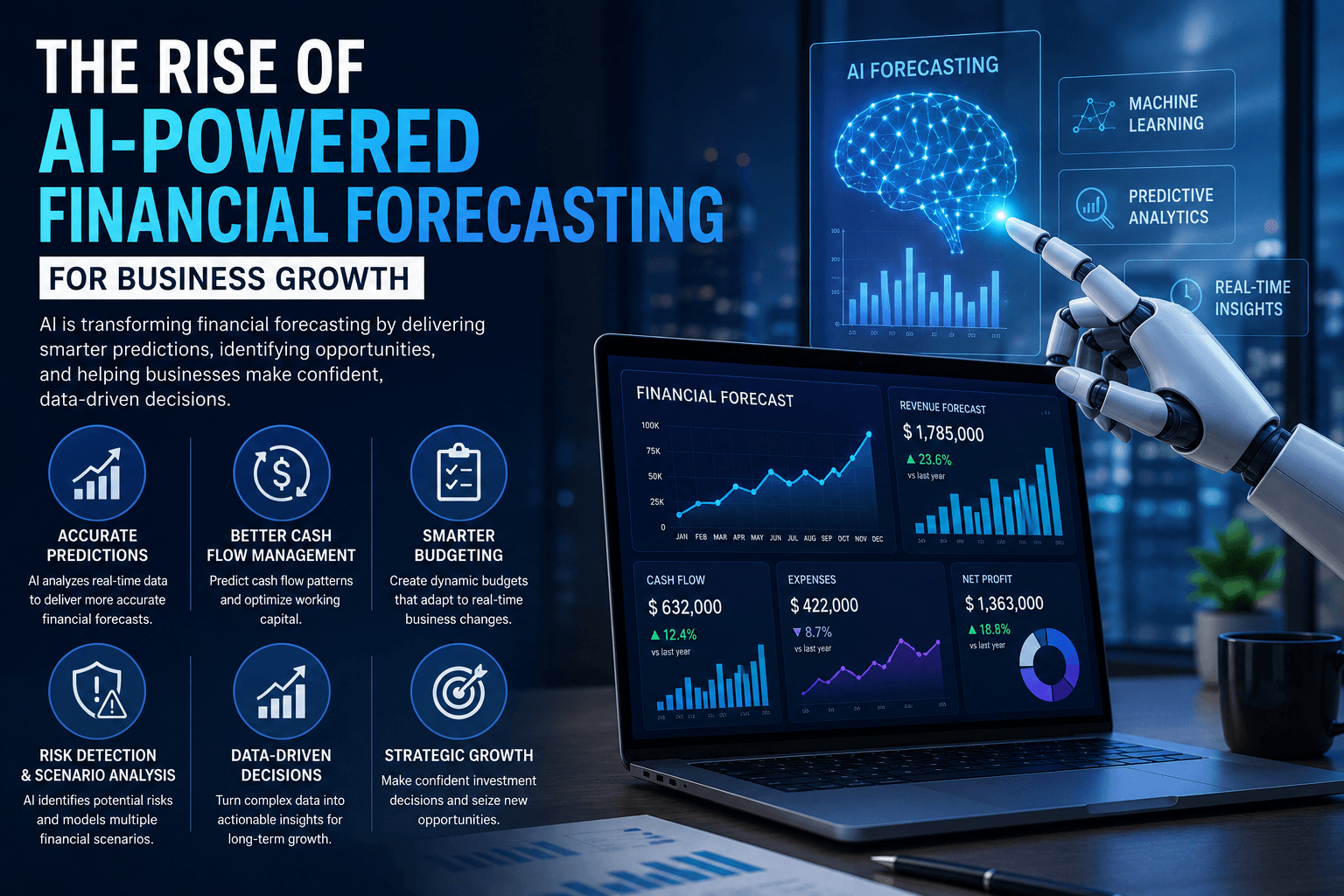
By analyzing large amounts of financial and operational data, AI can help companies generate more dynamic forecasts, identify risks, evaluate scenarios, manage cash flow, optimize resources, and discover potential growth opportunities.
The technology does not eliminate uncertainty, nor does it guarantee accurate predictions. Its greatest value comes from helping decision-makers respond to changing conditions with better information.
As businesses become increasingly data-driven, AI-powered financial forecasting is likely to become an important component of modern financial planning and long-term growth strategies.
Frequently Asked Questions
1. What is AI-powered financial forecasting?
AI-powered financial forecasting uses artificial intelligence, machine learning, and data analytics to analyze financial and operational information and predict future business outcomes. It can forecast areas such as revenue, expenses, cash flow, demand, profitability, and financial risks.
2. How does AI improve traditional financial forecasting?
AI can analyze larger and more diverse datasets than traditional manual forecasting processes. It can identify complex patterns, update forecasts when new information becomes available, perform scenario analysis, and detect relationships between financial and operational variables.
3. Can AI accurately predict business revenue?
AI can improve revenue forecasting by identifying historical patterns, seasonality, customer behavior, pricing changes, and other factors. However, no forecasting model can guarantee future revenue because unexpected market events and business changes can affect actual results.
4. How can AI help businesses manage cash flow?
AI can analyze expected income, expenses, customer payments, supplier obligations, and historical cash-flow patterns. This can help businesses identify potential cash shortages earlier and give management more time to take corrective action.
5. Can small businesses use AI-powered financial forecasting?
Yes. Cloud-based financial software is making AI forecasting more accessible to small and medium-sized businesses. Smaller companies can use these tools to monitor revenue, expenses, cash flow, and financial scenarios without requiring a large data science team.
6. What data does AI need for financial forecasting?
Depending on the forecasting objective, AI can use historical revenue, expenses, cash flow, sales transactions, customer behavior, inventory levels, pricing information, marketing activity, operational data, and relevant external economic indicators.
7. How does AI forecasting help with business growth?
AI forecasting can help businesses identify growth opportunities by analyzing demand, customer segments, product performance, margins, and investment scenarios. These insights can help management determine where resources may produce the greatest potential return.
8. Can AI forecasting replace financial analysts?
AI is more likely to change the role of financial analysts than completely replace them. Analysts can use AI to automate data preparation and forecasting while focusing more on interpreting results, evaluating assumptions, communicating insights, and making strategic recommendations.
9. What is scenario planning in AI-powered forecasting?
Scenario planning involves creating multiple possible financial outcomes based on different assumptions. AI can help businesses model scenarios such as increased demand, declining sales, rising costs, or changes in pricing and then estimate their potential financial effects.
10. How does AI help companies forecast expenses?
AI can analyze historical spending, recurring expenses, operational activity, supplier costs, and other financial variables to identify spending patterns. Businesses can use these insights to create more responsive expense forecasts and identify unusual cost increases.
11. Can AI improve budgeting?
Yes. AI can support more dynamic budgeting by continuously analyzing actual performance against expectations. Instead of relying exclusively on an annual fixed budget, companies can use rolling forecasts that are updated as business conditions change.
12. How can AI forecasting support inventory management?
AI can analyze sales trends, demand patterns, seasonality, product performance, and inventory levels to help businesses estimate future demand. Better forecasting can reduce the risk of excessive inventory while also helping companies avoid stock shortages.
13. What are the main benefits of AI-powered financial forecasting?
Major benefits include faster analysis, more frequent forecast updates, scenario modeling, improved cash-flow visibility, better resource planning, automated reporting, risk identification, and greater access to financial insights.
14. What are the risks of relying on AI financial forecasts?
Risks include inaccurate source data, model errors, historical bias, unexpected market events, cybersecurity threats, and overconfidence in automated predictions. Businesses should treat AI forecasts as decision-support tools rather than guaranteed outcomes.
15. How does generative AI help financial forecasting?
Generative AI can make financial insights easier to understand by explaining changes in forecasts, summarizing financial trends, answering questions about business data, and generating reports. It can provide a conversational interface for interacting with financial analytics.
16. Can AI predict financial risks?
AI can identify patterns that may indicate potential risks, such as declining revenue, increasing costs, delayed payments, or liquidity pressure. However, AI cannot foresee every future event, so financial risk management should combine predictive analytics with professional judgment.
17. How often should an AI-powered financial forecast be updated?
There is no universal schedule. The appropriate frequency depends on the industry, business size, volatility, and purpose of the forecast. Businesses operating in rapidly changing environments may benefit from frequent or continuous updates, while others may use weekly, monthly, or quarterly forecasting.
18. Is AI-powered financial forecasting expensive?
Costs vary based on the software, data infrastructure, number of users, integrations, and complexity of the forecasting models. Cloud-based tools can reduce infrastructure requirements, while larger organizations may require customized systems and advanced integrations.
19. How can companies implement AI financial forecasting successfully?
Companies should begin with reliable financial data and a clearly defined forecasting objective. They should select appropriate tools, integrate relevant data sources, test model performance, establish human review processes, and continuously monitor forecast accuracy. Starting with a specific use case can make implementation easier to manage.
20. What is the future of AI-powered financial forecasting?
The future is likely to involve continuous forecasting, real-time financial intelligence, automated scenario analysis, AI-generated management reports, predictive risk detection, and AI agents capable of supporting financial planning workflows. Human financial expertise will remain important for interpreting predictions and making strategic decisions.