
Enterprise knowledge management has traditionally depended on shared drives, intranets, document repositories, wikis, databases, and internal search tools. These systems helped organizations store information, but finding the right answer often remained a challenge.
Employees might know that a document exists without knowing where it is stored. Important information can be distributed across departments, applications, emails, and cloud platforms.
Enterprise AI search is changing this model.
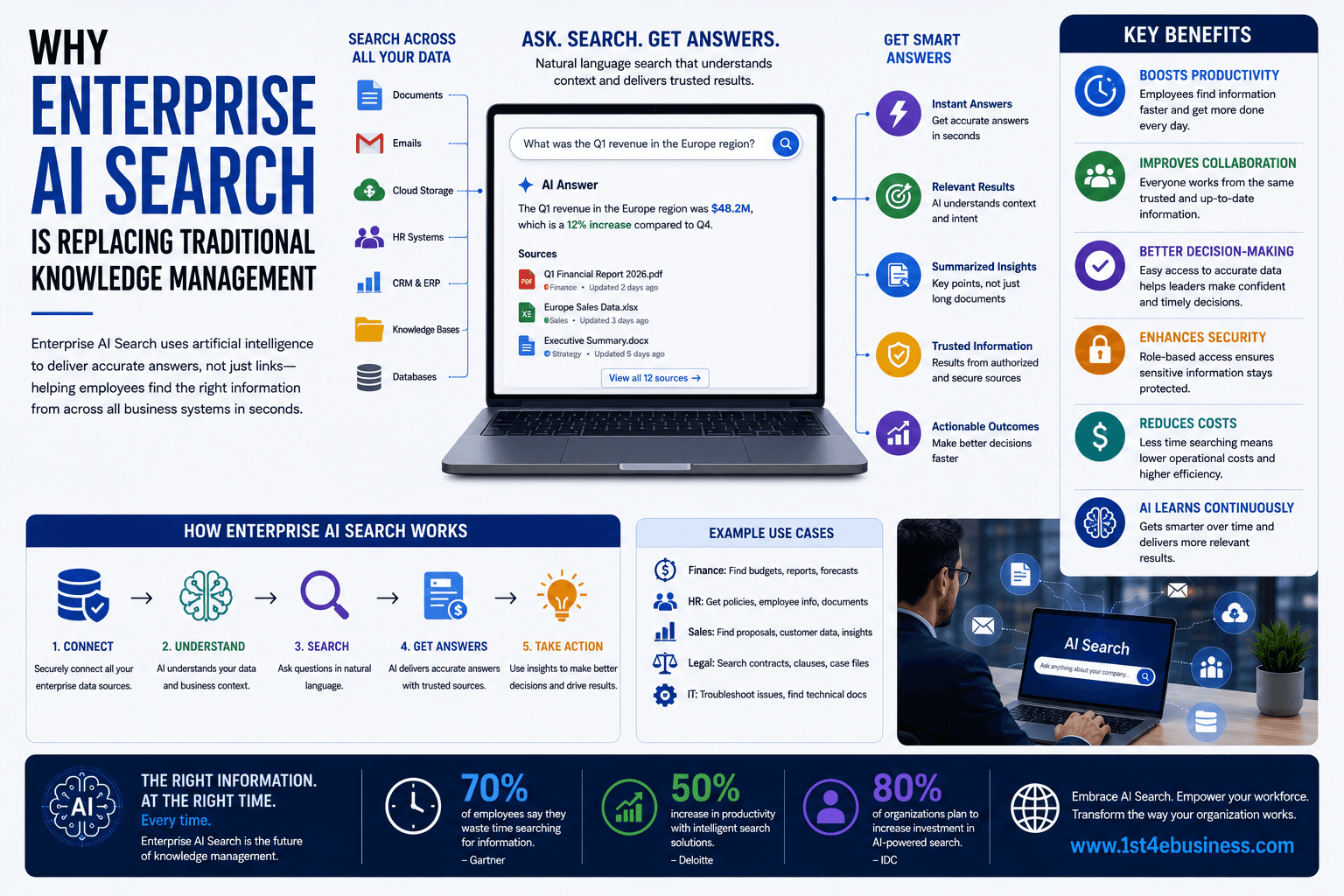
By combining large language models, semantic search, retrieval-augmented generation (RAG), enterprise data connectors, and natural-language interfaces, AI search can help employees find and understand organizational knowledge without manually navigating multiple systems.
The result is a shift from storing knowledge toward making knowledge immediately accessible and actionable.
What Is Enterprise AI Search?
Enterprise AI search is an intelligent search capability designed specifically for organizational information.
Traditional enterprise search generally matches keywords against documents and returns a list of results.
AI search can understand the intent behind a question, retrieve relevant information from authorized sources, and generate a contextual response.
For example, instead of searching for:
“employee travel reimbursement policy”
an employee could ask:
“How much can I claim for international business travel, and what receipts do I need?”
An AI search system can retrieve the relevant policy and provide a concise answer based on the organization's approved information sources.
The Limitations of Traditional Knowledge Management
Traditional knowledge management systems are primarily designed around information storage.
Organizations may have:
Intranets
SharePoint sites
Wikis
Document management platforms
Internal databases
Shared folders
Corporate portals
The challenge is that information becomes fragmented over time.
Different departments may create their own repositories, naming conventions, and documentation practices. Employees then have to search across multiple systems to find what they need.
This creates what is often called knowledge friction.
Employees spend time looking for information instead of using it.
AI Search Makes Knowledge Conversational
One of the biggest changes introduced by enterprise AI search is the conversational interface.
Employees can ask questions in natural language instead of learning complicated search syntax or navigating complex internal websites.
For example:
“What is the process for onboarding a new enterprise customer?”
The system can retrieve information from relevant sales documentation, onboarding procedures, CRM knowledge, and approved internal resources.
This makes organizational knowledge accessible to employees who may not know where the information is stored.
Semantic Search Goes Beyond Keywords
Traditional search relies heavily on matching words.
AI search uses semantic understanding to identify the meaning behind a query.
For example, an employee might search:
“What do I do if a customer wants to cancel?”
Even if the relevant document uses the term customer retention procedure, an AI-powered system can recognize the relationship between the question and the document.
This makes search more useful when employees do not know the exact terminology used in internal documentation.
Retrieval-Augmented Generation Improves Accuracy
Many enterprise AI search platforms use retrieval-augmented generation, commonly known as RAG.
Instead of relying solely on information learned during model training, a RAG system retrieves relevant organizational information before generating an answer.
This approach can help provide answers grounded in current enterprise documents.
For businesses, this is particularly valuable because internal policies, procedures, product information, and organizational structures can change frequently.
AI search can retrieve updated information from connected enterprise sources rather than relying exclusively on static model knowledge.
Connecting Knowledge Across Business Systems
Enterprise AI search becomes especially powerful when it can connect multiple information sources.
Depending on permissions and integrations, an organization may connect:
Cloud storage
Corporate documents
CRM platforms
Project management systems
HR systems
Customer support platforms
Internal wikis
Databases
Collaboration applications
Instead of requiring employees to search each system independently, AI search can provide a unified discovery layer.
This creates a more connected organizational knowledge environment.
AI Search Can Reduce Employee Productivity Loss
Employees can spend significant amounts of time searching for information.
Consider a customer service representative trying to answer a technical question. They may need to search product documentation, previous support tickets, internal knowledge bases, and team messages.
An enterprise AI search system can potentially retrieve relevant information within seconds.
This can reduce repetitive research and help employees resolve questions faster.
The productivity benefit becomes particularly significant in large organizations where information is distributed across hundreds or thousands of employees and systems.
Enterprise AI Search and Employee Onboarding
New employees often struggle to understand where information is located.
Traditional onboarding may require employees to read numerous documents and learn different internal systems.
AI search can provide a conversational layer over organizational knowledge.
A new employee could ask:
“What are the steps for submitting a project expense?”
or:
“Who approves enterprise customer contracts?”
Instead of navigating multiple portals, the employee can receive a direct answer based on authorized company information.
This can shorten the learning curve and improve employee productivity.
Knowledge Discovery Becomes More Proactive
Traditional knowledge management generally requires employees to actively search for information.
AI systems can potentially make knowledge discovery more proactive.
For example, an AI assistant integrated into a workflow could identify relevant policies, previous projects, or documentation while an employee is completing a task.
This creates a shift from:
Search when you need information
to:
Receive relevant knowledge when it becomes useful.
Security and Access Controls Remain Critical
Enterprise AI search introduces an important security requirement: employees should only receive information they are authorized to access.
An AI system connected to multiple corporate repositories must respect existing permissions and access controls.
For example, an employee without access to confidential financial documents should not receive information from those documents simply because they asked an AI assistant a question.
Organizations therefore need strong identity management, permission controls, audit logs, data governance, and security policies.
AI Search Can Help Preserve Institutional Knowledge
Employee turnover can result in the loss of valuable organizational knowledge.
Important information may exist primarily in employees' experience, project documentation, emails, or internal discussions.
AI-powered knowledge systems can help organizations make existing documented knowledge easier to discover and reuse.
This does not eliminate the need for employees to document their expertise, but it can make institutional knowledge more accessible across the organization.
Improving Customer Service
Enterprise AI search can also improve external customer experiences.
Customer support teams can use AI to retrieve relevant product documentation, previous cases, troubleshooting procedures, and approved responses.
An AI system can help representatives find answers faster and provide more consistent information.
This can potentially reduce resolution times while improving service quality.
Challenges of Enterprise AI Search
Despite its benefits, enterprise AI search has several challenges.
Data Quality
AI search cannot reliably provide useful answers if enterprise documentation is outdated, contradictory, or poorly organized.
Hallucinations
Generative AI systems can sometimes produce incorrect information. Organizations should use grounding, citations, validation, and appropriate human oversight.
Security
Connecting more corporate data to an AI system increases the importance of access controls and governance.
Integration
Organizations may need to connect AI search with numerous legacy and modern business systems.
Change Management
Employees need training and clear guidance on how to use AI search responsibly.
The Future of Enterprise Knowledge Management
Traditional knowledge management is not disappearing completely. Document repositories, wikis, databases, and structured systems will continue to store important information.
However, the interface through which employees access that knowledge is changing.
Instead of asking employees to remember where information lives, enterprise AI search allows them to focus on what they need to know.
The future of knowledge management is therefore likely to combine structured information systems with intelligent AI interfaces.
AI search will increasingly become a universal knowledge layer connecting employees with the information they need to make decisions and complete tasks.
Conclusion
Enterprise AI search is transforming knowledge management from a document-storage challenge into an intelligent information-access experience.
By combining semantic search, generative AI, RAG, enterprise integrations, and permission-aware access, businesses can make organizational knowledge easier to discover and use.
The competitive advantage comes from reducing knowledge friction.
When employees can find accurate information quickly, organizations can make faster decisions, improve productivity, accelerate onboarding, and preserve institutional knowledge.
Traditional knowledge management built the information infrastructure.
Enterprise AI search is building the intelligence layer on top of it.
FAQs
1. What is enterprise AI search?
Enterprise AI search is an AI-powered system that helps employees find and understand information across authorized organizational data sources using natural-language queries.
2. How is AI search different from traditional enterprise search?
Traditional search primarily returns documents based on keywords. AI search can understand intent, retrieve relevant information, summarize it, and answer questions conversationally.
3. What is RAG in enterprise AI search?
Retrieval-augmented generation allows an AI system to retrieve relevant information from enterprise sources and use that information to generate grounded responses.
4. Can enterprise AI search access confidential information?
It can connect to confidential data when authorized, but properly designed systems should enforce existing permissions so users only receive information they are allowed to access.
5. Can AI search replace knowledge management systems?
AI search is more likely to become an intelligent access layer over existing knowledge management systems rather than completely replacing document repositories and databases.
6. What are the main benefits of enterprise AI search?
Key benefits include faster information discovery, improved employee productivity, better onboarding, reduced knowledge friction, stronger customer support, and easier access to institutional knowledge.