Corporate crises can emerge with little warning. Cyberattacks, supply-chain disruptions, product failures, regulatory issues, reputational threats, and economic shocks can quickly affect an organization's operations and finances.
In the past, crisis management largely depended on human teams collecting information, assessing risks, and coordinating responses. Today, artificial intelligence is becoming an important part of that process.
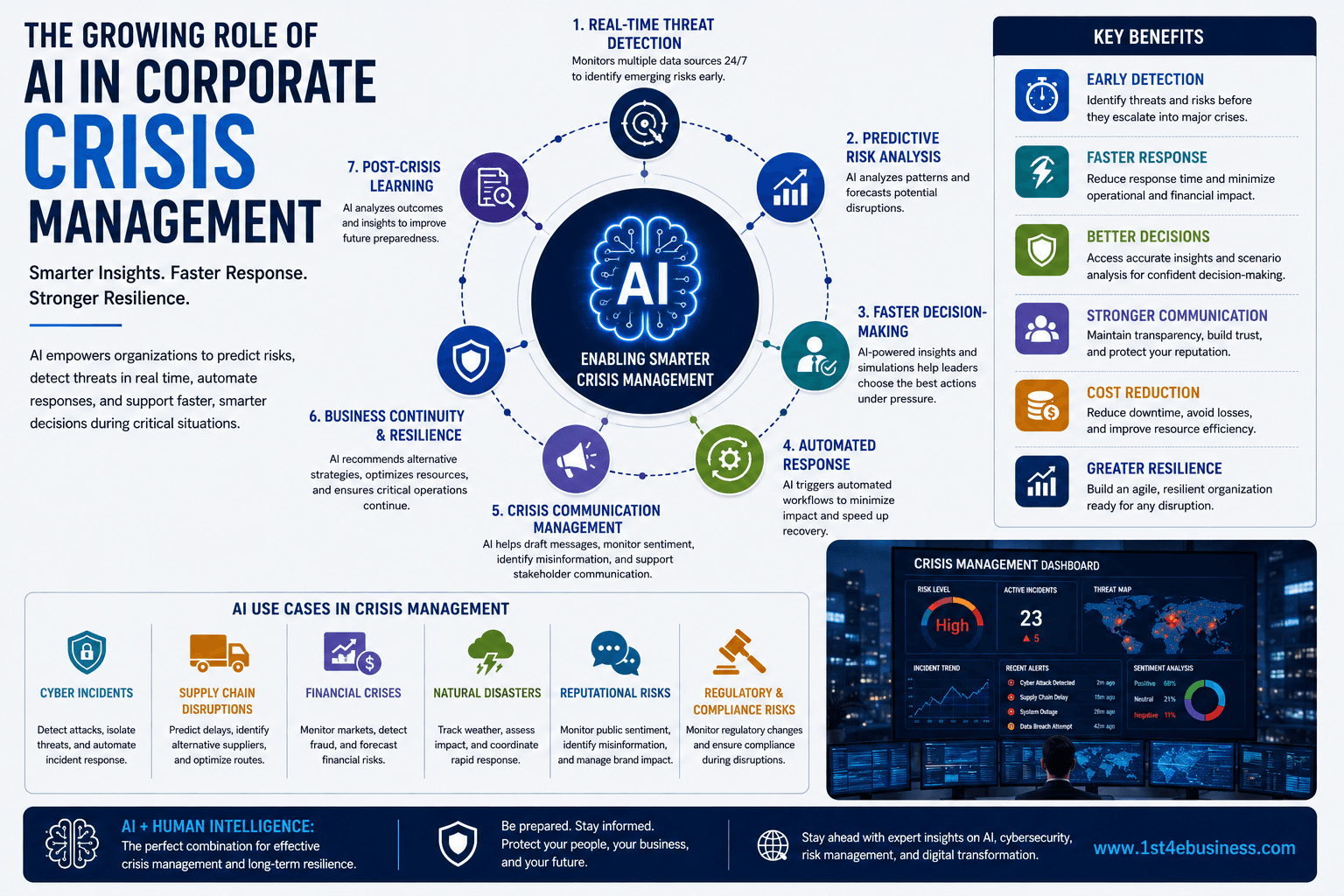
AI can monitor large volumes of information, identify emerging threats, predict potential impacts, support decision-making, and automate parts of the response process. As businesses become more interconnected, these capabilities are making AI an increasingly valuable tool for corporate crisis management.
How AI Is Changing Crisis Management
Traditional crisis management is often reactive. Organizations respond after an incident has already occurred.
AI enables a more proactive approach.
AI systems can continuously monitor internal and external signals, including:
Customer complaints
Social media activity
Cybersecurity alerts
Supply-chain data
Market movements
Operational metrics
Regulatory developments
News reports
By analyzing these signals in real time, AI can identify unusual patterns that may indicate an emerging crisis.
Instead of discovering a problem after it becomes widespread, companies can potentially detect warning signs earlier.
Early Detection of Corporate Risks
Early detection is one of AI's most valuable applications in crisis management.
Machine learning models can analyze historical patterns and compare them with current events. If unusual behavior appears, the system can alert risk teams.
For example, an AI system monitoring a company's supply chain might detect:
Increasing supplier delays
Unusual inventory shortages
Transportation disruptions
Sudden price increases
Geographic risks
Individually, these signals may not appear significant. Together, however, they could indicate a developing supply-chain crisis.
AI can connect these signals much faster than manual monitoring.
AI-Powered Crisis Prediction
AI can also help companies estimate how a developing situation could evolve.
Predictive models can analyze historical incidents, current operational data, market conditions, and external events to generate possible scenarios.
For example, during a major supply disruption, an organization could use AI to estimate:
How long inventory may last
Which customers could be affected
Which suppliers offer alternatives
Potential financial losses
Which operations should be prioritized
This allows executives to prepare before the situation becomes more severe.
Faster Decision-Making During Crises
Crisis situations often involve incomplete information and intense time pressure.
Executives may need to make decisions within minutes or hours rather than days.
AI can quickly process large amounts of information and summarize the most important factors.
An AI-powered crisis platform could provide executives with a concise overview of:
What happened → What is affected → What could happen next → What options are available
This can reduce the time required to understand complex situations.
AI does not eliminate the need for human judgment, but it can give decision-makers better information at critical moments.
AI in Cybersecurity Crisis Management
Cybersecurity is one of the areas where AI is already playing a major role.
Organizations generate enormous amounts of security data from networks, applications, devices, and cloud infrastructure.
AI can analyze this information to detect suspicious behavior and identify potential attacks.
During a cybersecurity incident, AI can help security teams:
Identify unusual activity
Prioritize alerts
Detect potential threats
Analyze attack patterns
Identify affected systems
Support incident response
Recommend containment actions
This can help organizations reduce the time between detecting an attack and responding to it.
Managing Reputation Crises
Reputational crises can spread rapidly through social media and digital news platforms.
A single customer complaint or negative event can potentially reach thousands or millions of people.
AI-powered sentiment analysis can monitor conversations across multiple channels and identify sudden changes in public perception.
For example, a company could use AI to detect an unusual increase in negative discussions related to a product.
Crisis teams could then investigate the issue and respond before the situation escalates.
AI can also help communication teams analyze public reactions to different messages and identify emerging concerns.
AI and Crisis Communication
Communication is one of the most important components of crisis management.
Customers, employees, investors, regulators, and the media often need timely and accurate information during a crisis.
AI can assist communication teams by:
Summarizing developing situations
Drafting internal updates
Preparing customer communications
Translating messages
Identifying frequently asked questions
Monitoring audience reactions
However, organizations should maintain human oversight over public crisis communications. AI-generated statements can contain inaccurate or inappropriate information, particularly when facts are still developing.
Supply-Chain Crisis Management
Global supply chains are vulnerable to transportation disruptions, geopolitical events, natural disasters, supplier failures, and sudden changes in demand.
AI can analyze supply-chain information and identify vulnerabilities before they become major problems.
Organizations can use predictive models to estimate demand, evaluate suppliers, optimize inventory, and identify alternative routes.
During a crisis, AI can simulate different options and help organizations determine which response is likely to minimize disruption.
This can make supply chains more resilient.
Scenario Planning With AI
Another important capability is AI-assisted scenario planning.
Companies can create hypothetical crisis situations and use AI to evaluate possible outcomes.
For example:
Scenario: A major supplier suddenly becomes unavailable.
AI could help analyze:
Which business operations depend on that supplier?
How long can current inventory support operations?
Which alternative suppliers are available?
What would each option cost?
Which customers would be affected?
What response would minimize business disruption?
This turns crisis management from a reactive process into a continuous preparedness exercise.
AI Agents and Autonomous Crisis Response
The rise of AI agents is creating another important development.
AI agents can monitor systems, interpret information, coordinate tasks, and interact with other software platforms.
In controlled environments, an AI agent could potentially detect a predefined crisis condition and automatically initiate approved response procedures.
For example, a cybersecurity agent could detect suspicious activity and temporarily isolate an affected system while notifying security personnel.
Human approval can remain necessary for high-impact decisions.
The goal is not unrestricted automation but controlled, intelligent response.
The Importance of Human Oversight
AI can provide valuable recommendations, but crisis decisions often involve ethical, legal, financial, and reputational consequences.
AI systems can also make mistakes because of incomplete data, biased models, inaccurate assumptions, or unexpected situations.
Organizations should therefore establish clear rules defining:
Which decisions AI can make independently
Which decisions require human approval
What information AI can access
How recommendations are validated
How decisions are documented
Who remains accountable
Human oversight is particularly important for high-risk crisis decisions.
Data Quality and AI Reliability
The effectiveness of AI-driven crisis management depends heavily on data quality.
If an organization's information is incomplete, outdated, inconsistent, or fragmented across different systems, AI may produce unreliable conclusions.
Businesses should therefore invest in:
Data governance
Data integration
Real-time monitoring
Secure information infrastructure
Model validation
Continuous testing
AI should be viewed as part of a broader crisis-management architecture rather than a standalone solution.
Building an AI-Enabled Crisis Management Strategy
Organizations can begin by identifying the areas where AI can provide the greatest value.
A practical strategy may include:
1. Identify Critical Risks
Determine which crises could have the greatest operational, financial, or reputational impact.
2. Connect Relevant Data
Bring together internal and external information needed for risk monitoring.
3. Deploy AI Monitoring
Use AI to detect anomalies, emerging threats, and changes in risk indicators.
4. Develop Response Playbooks
Define what actions should be taken when specific crisis conditions occur.
5. Introduce Human Oversight
Establish approval requirements for sensitive decisions.
6. Test Through Simulations
Use AI-assisted simulations to evaluate how the organization would respond to different scenarios.
The Future of AI in Corporate Crisis Management
AI is moving crisis management toward a more predictive and intelligent model.
Instead of waiting for a crisis and then gathering information manually, businesses can continuously monitor risks, identify early warning signals, simulate possible outcomes, and prepare response strategies in advance.
As AI agents and real-time analytics become more capable, organizations may increasingly operate with intelligent crisis-management systems that monitor risks around the clock.
The most successful companies will not necessarily be those that experience fewer disruptions. They may be the ones that can detect problems earlier, respond faster, and recover more effectively.
Conclusion
AI is becoming an important component of modern corporate crisis management. Its ability to analyze large volumes of data, detect emerging risks, predict potential outcomes, and support rapid decision-making can significantly strengthen organizational resilience.
However, AI should complement—not replace—human leadership.
The strongest crisis-management strategies will combine AI-powered monitoring and analysis with experienced professionals, clear governance, reliable data, and well-designed response procedures.
As corporate risks become increasingly complex and interconnected, AI will likely become a core capability for organizations seeking to prepare for, manage, and recover from crises.