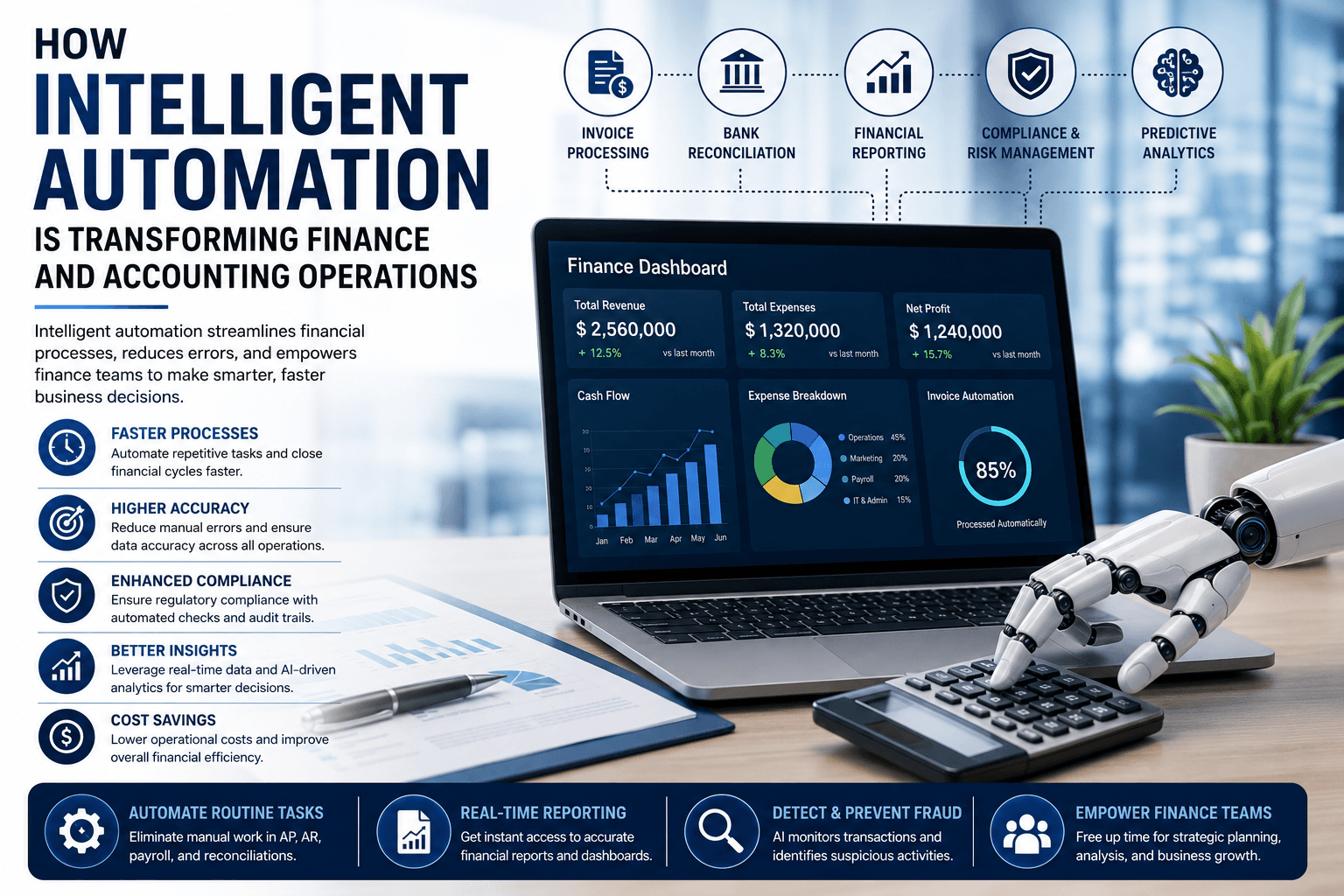

Finance and accounting departments are undergoing a major transformation as businesses adopt intelligent automation to improve efficiency, accuracy, and decision-making. Traditional finance operations often depend on repetitive manual tasks such as data entry, invoice processing, account reconciliation, reporting, and expense management. These activities consume valuable time and can increase the risk of human error.
Intelligent automation combines artificial intelligence, machine learning, robotic process automation, optical character recognition, and advanced analytics to automate these processes while making them more adaptable and intelligent.
In 2026, businesses are increasingly moving beyond basic automation. They are using intelligent systems that can analyze information, recognize patterns, make recommendations, and support finance professionals in more strategic activities.
What Is Intelligent Automation in Finance?
Intelligent automation refers to the use of advanced technologies to automate business processes that traditionally require significant human involvement.
In finance and accounting, intelligent automation can help systems process documents, extract information, classify transactions, detect unusual activity, reconcile accounts, prepare reports, and support forecasting.
Unlike traditional automation, which generally follows predefined rules, intelligent automation can use AI and machine learning to handle more complex and variable tasks.
This allows finance teams to automate not only repetitive activities but also parts of analytical and decision-support processes.
Automating Accounts Payable
Accounts payable is one of the areas where intelligent automation can create immediate benefits.
Finance departments often receive invoices in different formats through email, portals, paper documents, and other channels. Manually entering invoice information can be slow and error-prone.
AI-powered systems can extract information such as:
Vendor names
Invoice numbers
Dates
Tax information
Payment amounts
Purchase order details
The system can then compare invoices against purchase orders and other records before sending them through the appropriate approval workflow.
This can reduce manual data entry and help finance teams process invoices more quickly.
Improving Accounts Receivable
Intelligent automation can also transform accounts receivable.
AI-powered systems can monitor outstanding invoices, identify payment patterns, generate reminders, and help prioritize collection activities.
Businesses can potentially use predictive analytics to identify customers who may be more likely to pay late and take proactive action.
Automated payment matching can also help organizations connect incoming payments with the correct invoices, reducing manual reconciliation work.
Faster Account Reconciliation
Account reconciliation is another repetitive process that can consume substantial amounts of finance-team time.
Intelligent automation can compare transactions across different financial systems and identify matching records automatically.
Instead of manually reviewing every transaction, accountants can focus their attention on exceptions and discrepancies.
This changes the role of the finance professional from manually checking large volumes of information to investigating the transactions that actually require human judgment.
Reducing Errors
Manual data entry and repetitive processes can create accounting errors.
Intelligent automation can standardize processes and reduce the number of manual steps involved in financial operations.
Automated validation can also identify missing information, duplicate transactions, unusual amounts, or inconsistencies before they become larger problems.
However, automation does not eliminate the need for human review. Financial systems should include appropriate controls and approval processes, particularly for high-value or sensitive transactions.
AI-Powered Financial Reporting
Financial reporting often requires teams to gather information from multiple systems before preparing reports.
Intelligent automation can streamline this process by collecting data, organizing information, and generating standardized reports.
AI can also help identify important trends within financial data.
For example, a system might detect unusual changes in expenses, revenue, cash flow, or operating costs and highlight them for finance professionals.
This allows teams to spend less time preparing reports and more time interpreting them.
Improving Financial Forecasting
Forecasting is becoming another important application of AI in finance.
Traditional forecasting often relies heavily on historical data and manually created assumptions.
AI-powered forecasting systems can analyze larger datasets and identify patterns that may not be immediately obvious to humans.
Businesses can use these systems to support forecasts related to:
Revenue
Cash flow
Expenses
Demand
Working capital
Customer payments
AI-generated forecasts should still be reviewed by finance professionals because unexpected market conditions and business changes can affect predictions.
Intelligent Expense Management
Expense management can also benefit from automation.
Employees can submit receipts digitally while AI-powered systems extract relevant information and categorize expenses.
Automated systems can compare expenses with company policies and flag transactions that require additional review.
This can reduce administrative work while improving visibility into corporate spending.
Fraud Detection and Financial Risk Management
AI can help finance teams identify potentially suspicious transactions.
Machine-learning systems can analyze transaction patterns and identify unusual behavior that differs from normal activity.
Potential warning signs can include unusual payment amounts, unexpected transaction locations, duplicate payments, or abnormal account activity.
Rather than manually checking every transaction, finance professionals can investigate high-risk cases identified by intelligent systems.
This can strengthen financial controls and improve fraud detection capabilities.
Intelligent Automation Is Changing the Role of Accountants
Automation does not necessarily mean that accountants will become less important.
Instead, the role of finance professionals is evolving.
As repetitive administrative activities become increasingly automated, accountants can spend more time on:
Financial analysis
Strategic planning
Risk management
Business advisory
Forecasting
Compliance
Decision support
The accountant of the future may increasingly function as a strategic business partner rather than primarily as a processor of financial transactions.
Better Data for Better Decisions
One of the biggest advantages of intelligent automation is the ability to make financial information available more quickly.
When financial data is processed manually, there can be delays between an event occurring and management seeing its impact.
Automated systems can shorten this gap.
Faster access to accurate information allows executives to make more informed decisions about spending, investments, hiring, pricing, and growth.
Integration With Enterprise Systems
The value of intelligent automation increases when financial systems can communicate with other business applications.
Finance automation can connect with:
Enterprise resource planning systems
Customer relationship management platforms
Payroll systems
Procurement platforms
Banking systems
Expense management applications
Integration creates a more connected financial environment and reduces the need to manually transfer information between systems.
Challenges Businesses Need to Consider
Despite its benefits, intelligent automation comes with challenges.
Companies need to consider data security, privacy, integration costs, system reliability, employee training, regulatory requirements, and vendor management.
Poor-quality data can also reduce the effectiveness of AI systems.
Organizations should therefore establish strong data governance and regularly evaluate automated processes.
Human oversight is especially important when automation is involved in financial decisions or regulatory reporting.
Preparing Finance Teams for the Future
Successful automation requires more than purchasing technology.
Businesses need to prepare employees for new responsibilities.
Finance professionals may need training in AI tools, data analysis, automation workflows, cybersecurity, and AI-assisted decision-making.
Organizations should also identify which processes should be automated and which should remain under direct human control.
A phased implementation can allow companies to test automation, measure results, and improve processes before expanding deployment.
The Future of Finance Is Intelligent and Automated
Intelligent automation is changing finance and accounting from a primarily transaction-focused function into a more strategic and data-driven operation.
Routine processes can increasingly be handled by software, while finance professionals focus on interpreting information, managing risk, and supporting business strategy.
The most successful organizations will not simply automate as many tasks as possible. They will identify where intelligent automation can create measurable value while maintaining strong controls and human oversight.
Conclusion
Intelligent automation is becoming an important part of modern finance and accounting operations.
From invoice processing and reconciliation to forecasting, reporting, fraud detection, and expense management, AI-powered automation can help businesses improve efficiency and gain faster access to financial insights.
The transformation is ultimately about more than reducing manual work. It is about giving finance teams the tools to operate faster, improve accuracy, and contribute more strategically to business growth.
As AI and automation technologies continue to advance in 2026 and beyond, finance departments that combine intelligent technology with skilled human professionals will be better positioned to build efficient, responsive, and future-ready financial operations.