PFPersonal Finance in 2026: Smart Ways to Save Money & Build Wealth
Revenue operations (RevOps) has become one of the most important functions in modern enterprises because it connects sales, marketing, customer success, and increasingly finance around shared revenue goals. But the traditional RevOps model is changing rapidly as artificial intelligence moves from simple automation and analytics toward autonomous AI agents capable of taking action.
In 2026, enterprises are increasingly exploring a new model: autonomous revenue operations, where AI agents can monitor revenue workflows, identify opportunities, execute routine actions, and coordinate processes across business systems with limited human intervention.
The shift is significant because traditional RevOps teams have often spent substantial time collecting data, updating CRM records, preparing reports, qualifying leads, managing workflows, and resolving operational bottlenecks. AI agents can increasingly perform many of these activities continuously. Salesforce reported in 2026 that 54% of surveyed sellers had already used AI agents, while nearly nine in ten expected to use them by 2027.
What Is Autonomous Revenue Operations
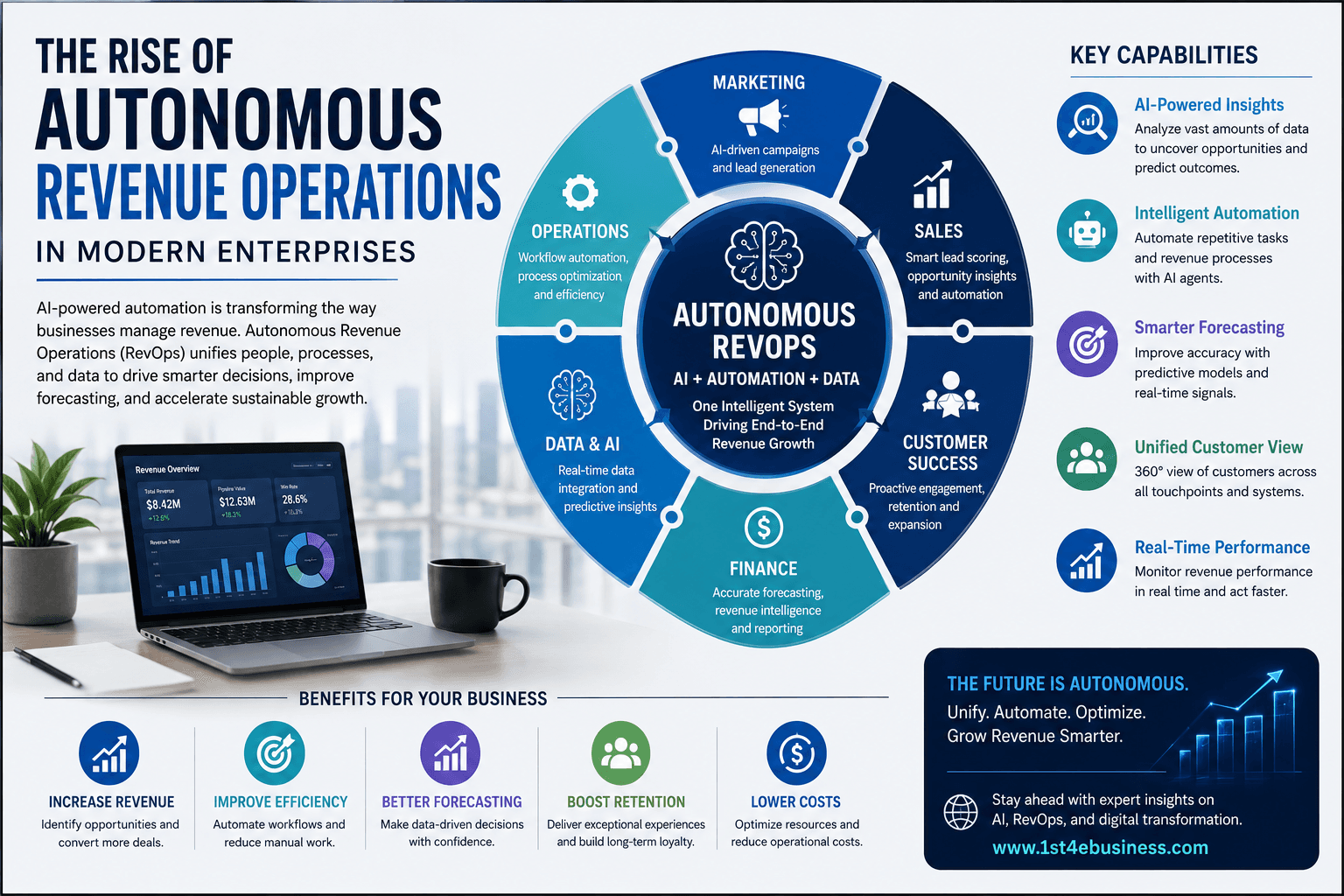
Autonomous Revenue Operations refers to the use of AI agents and connected business systems to manage revenue-related processes with a high degree of independence.
Traditional automation generally follows predefined rules. For example, when a new lead enters a CRM, an automated workflow might send an email or assign the lead to a salesperson.
Autonomous systems go further.
An AI agent can potentially analyze the lead, research the company, assess buying signals, determine the appropriate next action, update the CRM, personalize communication, schedule follow-ups, and escalate the opportunity to a human when a decision requires judgment.
This moves RevOps from rule-based automation toward intelligent orchestration.
Apollo describes AI agents in sales and revenue operations as systems that can move beyond generating recommendations to actually executing decisions across the revenue stack.
Why Enterprises Are Moving Toward Autonomous RevOps
Modern revenue organizations are dealing with increasingly complex customer journeys and larger volumes of commercial data.
A typical enterprise may use separate systems for:
Customer relationship management
Marketing automation
Sales engagement
Customer support
Billing
Contract management
Business intelligence
Data enrichment
Communication
Forecasting
When these systems are poorly connected, revenue teams spend significant time moving information between platforms.
Autonomous RevOps aims to reduce that friction.
Instead of employees manually coordinating every step, AI agents can potentially operate across connected systems and keep revenue workflows moving continuously.
From Reporting to Real-Time Action
One of the biggest changes is the shift in the role of RevOps itself.
Traditional RevOps often focuses heavily on reporting: What happened last month? Which opportunities moved? Which campaigns generated leads? Where did revenue fall short?
AI-powered RevOps can move toward a more proactive model.
An autonomous system could monitor pipeline activity in real time and identify issues such as stalled opportunities, declining engagement, unusual conversion patterns, or accounts showing new buying signals.
The system could then recommend or execute appropriate actions according to company policies.
This changes RevOps from a function that primarily reports on business performance into one that increasingly helps influence business performance in real time.
Autonomous Prospecting and Lead Management
Sales prospecting is one of the areas where autonomous AI agents are gaining significant attention.
Agents can research companies, identify potential decision-makers, enrich contact records, analyze public information, and prepare personalized outreach.
Salesforce's 2026 sales research found that sales professionals expect AI agents to reduce research time by 34% and email-drafting time by 36%.
For enterprises, the advantage is not simply saving individual minutes.
The larger opportunity is scale.
An AI system can potentially research thousands of accounts continuously while sales representatives focus on qualified opportunities and relationship-building.
AI-Powered Pipeline Management
Pipeline management is another area where autonomous RevOps can have a major impact.
Traditional pipeline reviews often require managers and RevOps specialists to manually inspect opportunities and identify risks.
AI agents can continuously examine signals such as:
Deal age
Customer engagement
Email activity
Meeting frequency
CRM updates
Product usage
Contract activity
Historical win patterns
When these signals indicate that a deal may be at risk, an agent can flag the opportunity or initiate a predefined intervention.
This could help organizations identify pipeline problems earlier instead of discovering them during a weekly or monthly review.
Autonomous Forecasting
Revenue forecasting has traditionally depended heavily on historical data, spreadsheets, CRM information, and human judgment.
AI can introduce a more dynamic approach.
Instead of producing a forecast at a fixed interval, autonomous systems can continuously evaluate new information and adjust predictions.
For example, an AI system could detect that several high-value opportunities have become less active and immediately update its assessment of expected revenue.
This does not eliminate human judgment. Instead, it can give revenue leaders more timely information when making strategic decisions.
Revenue Operations Beyond Sales
Autonomous RevOps is not limited to sales.
The broader opportunity involves connecting the entire revenue lifecycle.
Marketing agents could identify high-value accounts and adjust campaigns.
Sales agents could research prospects and manage follow-ups.
Customer-success agents could identify expansion opportunities or churn risks.
Finance-related systems could monitor contracts, pricing, billing, and revenue processes.
The result is a more connected revenue ecosystem in which specialized AI agents coordinate activities across departments.
WNS describes this shift as moving beyond isolated automation toward agentic orchestration across contracts, pricing, and revenue workflows.
The Importance of CRM Data Quality
There is, however, an important limitation: autonomous AI is only as reliable as the information and rules surrounding it.
If an organization's CRM contains outdated customer information, inconsistent definitions, duplicate records, or incomplete opportunity data, autonomous agents can make poor decisions at scale.
This creates a new priority for RevOps teams.
Data governance becomes just as important as automation.
Companies need clear definitions for metrics such as qualified leads, pipeline value, customer lifetime value, churn, expansion revenue, and sales stages.
AI agents need access to reliable sources of truth before they can be trusted to make operational decisions.
Human Oversight Still Matters
Autonomous does not mean completely unsupervised.
Some revenue decisions involve relationships, negotiation, pricing exceptions, legal considerations, or strategic accounts. These areas may require human judgment.
A strong autonomous RevOps model therefore uses human-in-the-loop governance.
AI can handle repetitive and data-intensive decisions while humans retain authority over sensitive or high-impact actions.
For example, an agent might identify a discount opportunity but require a manager's approval before changing pricing.
This approach can provide the benefits of automation without allowing an AI system to operate without meaningful controls.
Security and Governance Become Critical
As AI agents gain the ability to interact with CRM, email, financial, and customer systems, security becomes increasingly important.
An autonomous agent with excessive permissions could potentially create serious operational problems.
Enterprises therefore need:
Role-based permissions
Approval workflows
Audit logs
Data-access controls
Monitoring
Clear escalation procedures
Human approval for high-risk actions
Regular testing of agent behavior
Research into enterprise AI-agent automation also highlights how difficult cross-application workflows can be when agents must discover APIs, follow business rules, and coordinate multiple systems.
The challenge is therefore not simply building an intelligent agent. It is building one that can operate reliably inside a complex enterprise environment.
How Autonomous RevOps Could Change Enterprise Teams
The rise of autonomous RevOps does not necessarily mean eliminating revenue teams.
Instead, job responsibilities are likely to shift.
Employees may spend less time on:
Manual CRM updates
Basic data collection
Routine reporting
Lead research
Repetitive follow-ups
Spreadsheet management
And more time on:
Strategy
Customer relationships
Complex negotiations
Revenue planning
AI governance
Process design
Data quality
Business analysis
The role of the RevOps professional could therefore evolve from workflow administrator to AI-enabled revenue strategist.
A New Revenue Operating Model
The most advanced enterprises may eventually operate with teams of specialized AI agents.
One agent could focus on prospect research.
Another could monitor pipeline health.
Another could manage customer expansion signals.
Another could support forecasting.
A central orchestration layer could coordinate these agents and ensure that their actions follow company policies.
This resembles an AI-native revenue organization in which humans establish goals, policies, and strategic direction while software agents execute large portions of operational work.
A 2026 framework published on autonomous revenue operations similarly proposes an architecture that connects unstructured commercial inputs with downstream activities such as quoting, order entry, ERP reconciliation, and sales intelligence.
The Competitive Advantage
The biggest advantage of autonomous RevOps may ultimately be speed.
A traditional organization might identify a revenue problem during a weekly meeting and take several days to respond.
An autonomous system could potentially detect the same issue immediately.
That difference matters in markets where customer expectations change quickly and sales cycles are becoming increasingly data-driven.
Companies that can identify opportunities, respond to customers, and adjust revenue strategies faster may gain a significant competitive advantage.
What Enterprises Should Do Next
Companies should not attempt to automate their entire revenue organization overnight.
A better approach is to identify processes that are repetitive, measurable, and relatively low risk.
Good starting points include:
CRM data enrichment
Lead research
Pipeline monitoring
Meeting summaries
Follow-up recommendations
Forecast analysis
Customer expansion signals
Routine reporting
Once these workflows are reliable, organizations can gradually give AI agents more responsibility.
The goal should be controlled autonomy, not automation for its own sake.
The Future of Revenue Operations
Autonomous Revenue Operations represents a major evolution in how enterprises manage growth.
Traditional RevOps brought sales, marketing, and customer success closer together by creating shared processes and data. AI agents are now adding another layer: the ability to continuously analyze information and take action across those processes.
The transition will not happen overnight. Data quality, security, governance, integration, and human oversight remain significant challenges.
Nevertheless, the direction is clear.
Revenue organizations are moving from manual workflows and static reporting toward real-time, AI-powered, increasingly autonomous execution.
For modern enterprises, the competitive question may soon change from “How can we use AI in RevOps?” to “Which parts of our revenue operation should AI be allowed to run?”
Companies that answer that question carefully—and build the necessary governance around it—could create revenue organizations that are faster, more scalable, and more responsive than traditional operating models.
FAQs
1. What is Autonomous Revenue Operations?
Autonomous Revenue Operations uses AI agents and connected business systems to monitor, analyze, and execute revenue-related workflows with limited human intervention.
2. How is autonomous RevOps different from traditional automation?
Traditional automation generally follows predefined rules. Autonomous AI agents can interpret information, make context-based decisions, and execute multi-step actions across connected systems.
3. Can AI agents replace RevOps teams?
AI agents are more likely to change RevOps roles than completely replace them. Humans remain important for strategy, governance, complex decisions, relationships, and oversight.
4. How can autonomous RevOps improve sales?
AI agents can automate prospect research, lead qualification, CRM updates, follow-ups, pipeline monitoring, and other repetitive activities, allowing sales professionals to focus more on high-value customer interactions.
5. Why is data quality important for autonomous RevOps?
AI agents depend on reliable information. Incorrect or outdated CRM data can lead to poor recommendations and automated mistakes, making data governance essential.
6. What are the biggest risks of autonomous RevOps?
Major risks include incorrect decisions, poor data quality, excessive system permissions, security problems, compliance issues, and insufficient human oversight.
7. Can autonomous RevOps help with revenue forecasting?
Yes. AI agents can continuously analyze pipeline activity, customer behavior, historical performance, and other signals to support dynamic revenue forecasting.
8. What should businesses automate first?
Businesses should generally begin with repetitive, measurable, low-risk processes such as data enrichment, reporting, lead research, meeting summaries, and pipeline monitoring.
9. Will autonomous RevOps become common in enterprises?
Adoption is likely to increase as AI agents become more capable and businesses gain experience integrating them into core workflows. Salesforce's 2026 research already shows significant adoption and strong expectations for further agent use.
10. What is the future of RevOps?
The future of RevOps is likely to combine human strategic leadership with AI-driven operational execution. Revenue teams may increasingly manage networks of specialized agents that continuously monitor and optimize the customer and revenue lifecycle.