
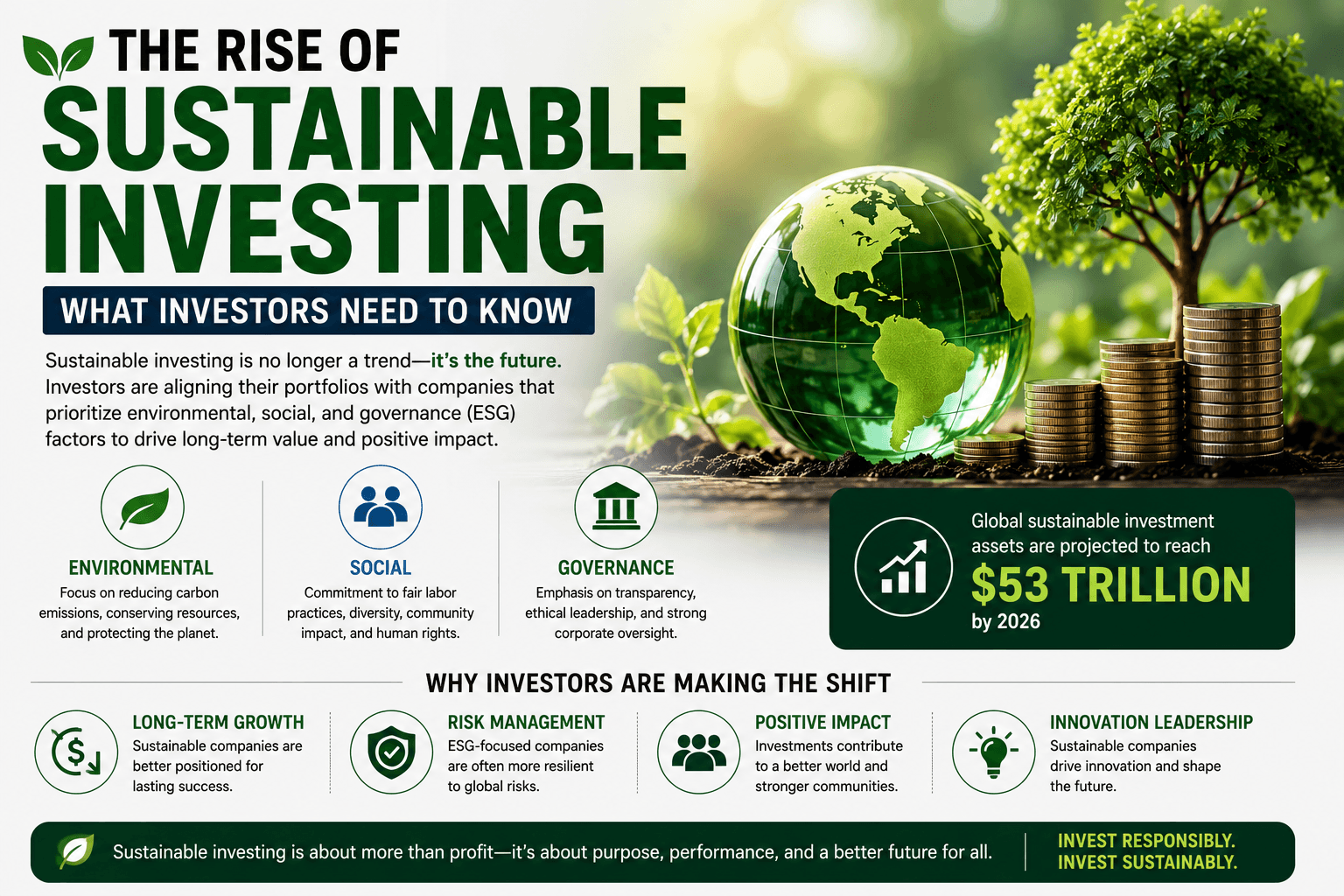

Sustainable investing has moved from a niche strategy to a mainstream investment approach. In 2026, investors are increasingly considering environmental, social, and governance (ESG) factors alongside traditional financial metrics when evaluating investment opportunities. While profitability remains a key objective, many investors also want to support companies that demonstrate responsible business practices, strong corporate governance, and long-term resilience.
As governments introduce new sustainability initiatives and businesses adapt to changing consumer expectations, sustainable investing continues to gain momentum across global financial markets.
What Is Sustainable Investing?
Sustainable investing is an investment strategy that considers both financial performance and broader environmental, social, and governance factors. Rather than focusing solely on short-term profits, investors evaluate how companies manage issues such as climate risks, workplace practices, corporate ethics, diversity, resource efficiency, and board accountability.
The goal is to identify businesses that are well-positioned for long-term success while managing risks associated with changing regulations, consumer preferences, and environmental challenges.
Why Sustainable Investing Is Growing
Several factors are driving the rapid growth of sustainable investment
Consumers are becoming more environmentally conscious and increasingly support companies that demonstrate responsible business practices. Governments around the world are introducing policies encouraging cleaner technologies, renewable energy, and greater corporate transparency.
Institutional investors, pension funds, and asset managers are also integrating sustainability into their investment strategies as they seek businesses capable of delivering stable long-term performance.
This combination of market demand, regulatory changes, and evolving investor expectations has accelerated interest in sustainable investing.
Environmental Factors Matter More Than Ever
Environmental considerations remain one of the most visible aspects of sustainable investing.
Companies investing in renewable energy, energy efficiency, waste reduction, water conservation, and lower carbon emissions are attracting increased attention from investors.
Many organizations are adopting cleaner production methods and improving resource management to reduce environmental impact while strengthening long-term competitiveness.
Investors often view companies with proactive environmental strategies as better prepared for future regulatory and market changes.
Social Responsibility Influences Business Performance
Social factors are becoming increasingly important when evaluating investment opportunities.
Businesses that prioritize employee well-being, workplace safety, diversity, customer satisfaction, and community engagement often build stronger reputations and improve stakeholder trust.
Responsible labor practices and positive corporate culture can also contribute to employee retention, productivity, and long-term operational stability.
Companies that invest in people as well as profits may strengthen their competitive position over time.
Strong Corporate Governance Reduces Risk
Corporate governance refers to how companies are managed and supervised.
Transparent financial reporting, ethical leadership, independent boards, shareholder rights, and effective risk management help build investor confidence.
Organizations with strong governance practices are often better equipped to navigate economic uncertainty while maintaining accountability and long-term strategic focus.
Good governance reduces operational risks and supports sustainable business growth.
Opportunities Across Multiple Industries
Sustainable investing extends across many sectors of the global economy.
Renewable energy companies continue attracting attention as countries invest in cleaner power generation.
Technology businesses developing energy-efficient solutions, electric transportation, smart infrastructure, recycling technologies, and sustainable manufacturing processes also present growing opportunities.
Healthcare, agriculture, water management, and green construction are additional sectors benefiting from long-term sustainability trends.
Diversifying investments across multiple industries can help reduce risk while providing exposure to emerging growth opportunities.
Managing Risks
Like every investment strategy, sustainable investing involves risks.
Economic slowdowns, changing government policies, market volatility, and technological developments can influence company performance regardless of sustainability initiatives.
Investors should conduct thorough research, evaluate financial fundamentals, diversify portfolios, and avoid relying solely on sustainability claims when making investment decisions.
A balanced investment strategy considers both financial strength and long-term business resilience.
Technology Is Supporting Sustainable Investing
Digital technologies are making sustainable investing more accessible.
Artificial intelligence, big data analytics, and advanced reporting platforms allow investors to evaluate corporate performance more efficiently.
Improved access to company disclosures, sustainability reports, and financial information helps investors compare businesses using a broader range of performance indicators.
Technology is improving transparency while supporting more informed investment decisions.
Looking Ahead
Industry experts expect sustainable investing to continue expanding throughout the coming decade.
Businesses are increasingly integrating sustainability into long-term strategies, while investors continue seeking companies capable of adapting to changing economic, environmental, and social expectations.
As innovation accelerates in renewable energy, clean technology, sustainable infrastructure, and responsible manufacturing, additional investment opportunities are likely to emerge.
Conclusion
Sustainable investing has become an important part of modern portfolio management. By considering environmental, social, and governance factors alongside traditional financial analysis, investors can gain a broader understanding of long-term business performance and potential risks.
While no investment strategy guarantees success, companies with responsible business practices, strong governance, and a focus on innovation may be better positioned to adapt to future challenges.
As financial markets continue evolving, sustainable investing is expected to remain a key trend for investors seeking both long-term value and resilient business opportunities.
FAQs: The Rise of Sustainable Investing: What Investors Need to Know
1. What is sustainable investing?
Sustainable investing is an investment strategy that considers environmental, social, and governance (ESG) factors alongside financial performance. It aims to generate long-term returns while supporting responsible business practices and sustainable development.
2. Why is sustainable investing becoming more popular?
Growing awareness of climate change, corporate responsibility, ethical business practices, and long-term financial risks has encouraged more investors to include sustainability in their investment decisions.
3. What does ESG stand for?
ESG stands for Environmental, Social, and Governance:
Environmental: Climate change, carbon emissions, renewable energy, waste management.
Social: Employee welfare, diversity, human rights, customer relations.
Governance: Corporate leadership, ethics, transparency, executive compensation, shareholder rights.
4. How does sustainable investing differ from traditional investing?
Traditional investing focuses primarily on financial returns, while sustainable investing evaluates both financial performance and a company's environmental, social, and governance impact.
5. Can sustainable investing deliver competitive financial returns?
Yes. Many studies suggest that companies with strong ESG practices can perform competitively over the long term due to better risk management, operational efficiency, and corporate governance.
6. What are ESG funds?
ESG funds are mutual funds or exchange-traded funds (ETFs) that invest in companies meeting specific environmental, social, and governance criteria while seeking long-term financial growth.
7. What industries benefit most from sustainable investing?
Industries such as renewable energy, clean technology, electric vehicles, energy efficiency, sustainable agriculture, healthcare, green infrastructure, and water management often attract sustainable investment.
8. What are green investments?
Green investments focus specifically on projects and companies that help protect the environment, including renewable energy, clean transportation, recycling, pollution reduction, and sustainable construction.
9. How do investors evaluate ESG performance?
Investors review ESG ratings, sustainability reports, carbon emissions data, governance policies, workforce diversity, regulatory compliance, and independent research from ESG rating agencies.
10. What are green bonds?
Green bonds are fixed-income securities issued to finance environmentally beneficial projects such as renewable energy facilities, clean transportation systems, sustainable buildings, and climate adaptation initiatives.
11. Are sustainable investments risk-free?
No. Like all investments, sustainable investments are subject to market risk, economic conditions, interest rate changes, and company-specific performance. ESG factors help assess risk but do not eliminate it.
12. How does climate change influence investment decisions?
Climate change creates financial risks through extreme weather events, changing regulations, supply chain disruptions, and shifting consumer preferences. Investors increasingly evaluate how companies manage these risks.
13. What is impact investing?
Impact investing targets investments that generate measurable positive social or environmental outcomes alongside financial returns, such as affordable housing, clean energy, healthcare, or education.
14. Can individual investors participate in sustainable investing?
Yes. Individual investors can access ESG mutual funds, sustainable ETFs, green bonds, socially responsible investment portfolios, and companies with strong sustainability practices through most investment platforms.
15. How do governments support sustainable investing?
Governments encourage sustainable investing through climate policies, renewable energy incentives, carbon reduction targets, ESG disclosure requirements, tax benefits, and sustainable finance regulations.
16. What challenges does sustainable investing face?
Challenges include inconsistent ESG reporting standards, greenwashing, varying ESG rating methodologies, limited data transparency, and balancing sustainability goals with financial performance.
17. What is greenwashing?
Greenwashing occurs when companies exaggerate or falsely claim environmental or sustainability achievements to attract investors or customers without making meaningful improvements.
18. Why is corporate governance important in ESG investing?
Strong governance promotes ethical leadership, transparent financial reporting, accountability, effective risk management, and responsible decision-making, all of which contribute to long-term business stability.
19. What trends are shaping sustainable investing in 2026?
Key trends include increased investment in renewable energy, AI-powered ESG analytics, sustainable infrastructure, carbon-neutral technologies, climate-focused funds, biodiversity investing, and stricter ESG disclosure regulations.
20. What should investors consider before making sustainable investments?
Investors should evaluate their financial goals, risk tolerance, investment horizon, ESG ratings, fund strategy, management fees, portfolio diversification, company fundamentals, and the credibility of sustainability claims before investing.FAQs: The Rise of Sustainable Investing: What Investors Need to Know