As climate change, resource scarcity, and environmental regulations continue to reshape the global economy, businesses are increasingly investing in green technology and sustainable practices. What was once considered a corporate social responsibility initiative has now become a critical business strategy that drives innovation, strengthens brand reputation, reduces costs, and creates long-term value.
In 2026, sustainability is no longer optional. Consumers, investors, governments, and business partners expect organizations to operate responsibly while minimizing their environmental impact. Companies that embrace green technology are not only helping protect the planet but are also positioning themselves for stronger growth in an increasingly competitive marketplace.
Sustainability Has Become a Business Priority
Modern businesses recognize that long-term success depends on balancing profitability with environmental responsibility.
Organizations are integrating sustainability into:
Corporate strategy
Product development
Manufacturing
Supply chain management
Energy consumption
Transportation
Waste reduction
Sustainability is now viewed as a driver of innovation rather than simply a compliance requirement.
What Is Green Technology?
Green technology refers to products, services, and systems designed to reduce environmental impact while improving efficiency and conserving natural resources.
Examples include:
Renewable energy
Electric vehicles
Smart energy management
Green buildings
Sustainable manufacturing
Water conservation systems
Carbon capture technologies
Energy-efficient equipment
These technologies help businesses operate more efficiently while lowering emissions and operating costs.
Renewable Energy Adoption Is Accelerating
Many businesses are investing in renewable energy sources to reduce dependence on fossil fuels.
Popular solutions include:
Solar power
Wind energy
Hydroelectric power
Battery energy storage
Smart energy grids
Renewable energy helps organizations reduce electricity costs while supporting long-term sustainability goals.
Energy Efficiency Reduces Costs
Improving energy efficiency is often one of the fastest ways businesses can reduce operating expenses.
Companies are upgrading to:
LED lighting
Smart HVAC systems
Energy-efficient machinery
Intelligent building automation
AI-powered energy monitoring
Lower energy consumption benefits both the environment and the company's bottom line.
Sustainable Supply Chains
Businesses are increasingly evaluating the environmental impact of their supply chains.
Sustainable supply chain strategies include:
Local sourcing
Eco-friendly packaging
Low-emission transportation
Ethical supplier selection
Waste reduction
Circular economy initiatives
These practices improve operational resilience while meeting growing customer expectations.
Artificial Intelligence Supports Sustainability
Artificial Intelligence is playing an important role in helping businesses achieve sustainability goals.
AI helps organizations:
Monitor energy usage
Predict equipment maintenance
Optimize logistics
Reduce waste
Improve resource allocation
Measure carbon emissions
Smart analytics allow businesses to make environmentally responsible decisions based on real-time data.
Electric Vehicles and Green Transportation
Transportation remains a significant source of global carbon emissions.
Many organizations are adopting:
Electric delivery vehicles
Hybrid fleets
Route optimization software
Sustainable logistics solutions
Charging infrastructure
These investments reduce fuel costs while lowering environmental impact.
Consumer Demand Is Driving Change
Today's consumers increasingly support businesses that demonstrate environmental responsibility.
Customers often prefer brands that:
Use sustainable materials
Reduce plastic waste
Support renewable energy
Publish sustainability goals
Operate transparently
Strong sustainability practices can strengthen customer loyalty and improve brand reputation.
Investors Are Prioritizing Sustainable Companies
Investors increasingly evaluate businesses based on environmental, social, and governance (ESG) performance.
Companies with strong sustainability strategies may benefit from:
Greater investor confidence
Improved access to capital
Lower long-term risk
Enhanced corporate reputation
Responsible business practices are becoming an important factor in investment decisions.
The Circular Economy
Traditional business models often follow a "produce, use, and dispose" approach.
The circular economy focuses on:
Recycling
Reusing materials
Product repair
Waste reduction
Resource recovery
This approach extends product lifecycles while reducing environmental impact and creating new business opportunities.
Challenges Businesses Must Address
Despite growing momentum, organizations still face several challenges.
These include:
High initial investment costs
Technology adoption
Regulatory compliance
Supply chain complexity
Workforce training
Measuring sustainability performance
Long-term planning and continuous innovation are essential for overcoming these obstacles.
The Competitive Advantage of Sustainability
Businesses investing in green technology often gain significant advantages, including:
Lower operating costs
Stronger customer trust
Improved regulatory compliance
Greater operational efficiency
Enhanced innovation
Better risk management
Increased brand value
Sustainability is increasingly becoming a source of competitive differentiation.
Preparing for the Future
Organizations should continue investing in:
Renewable energy
Digital transformation
Artificial Intelligence
Sustainable product design
Green manufacturing
Employee sustainability training
Transparent ESG reporting
Businesses that act today will be better prepared for evolving regulations and changing consumer expectations.
Conclusion
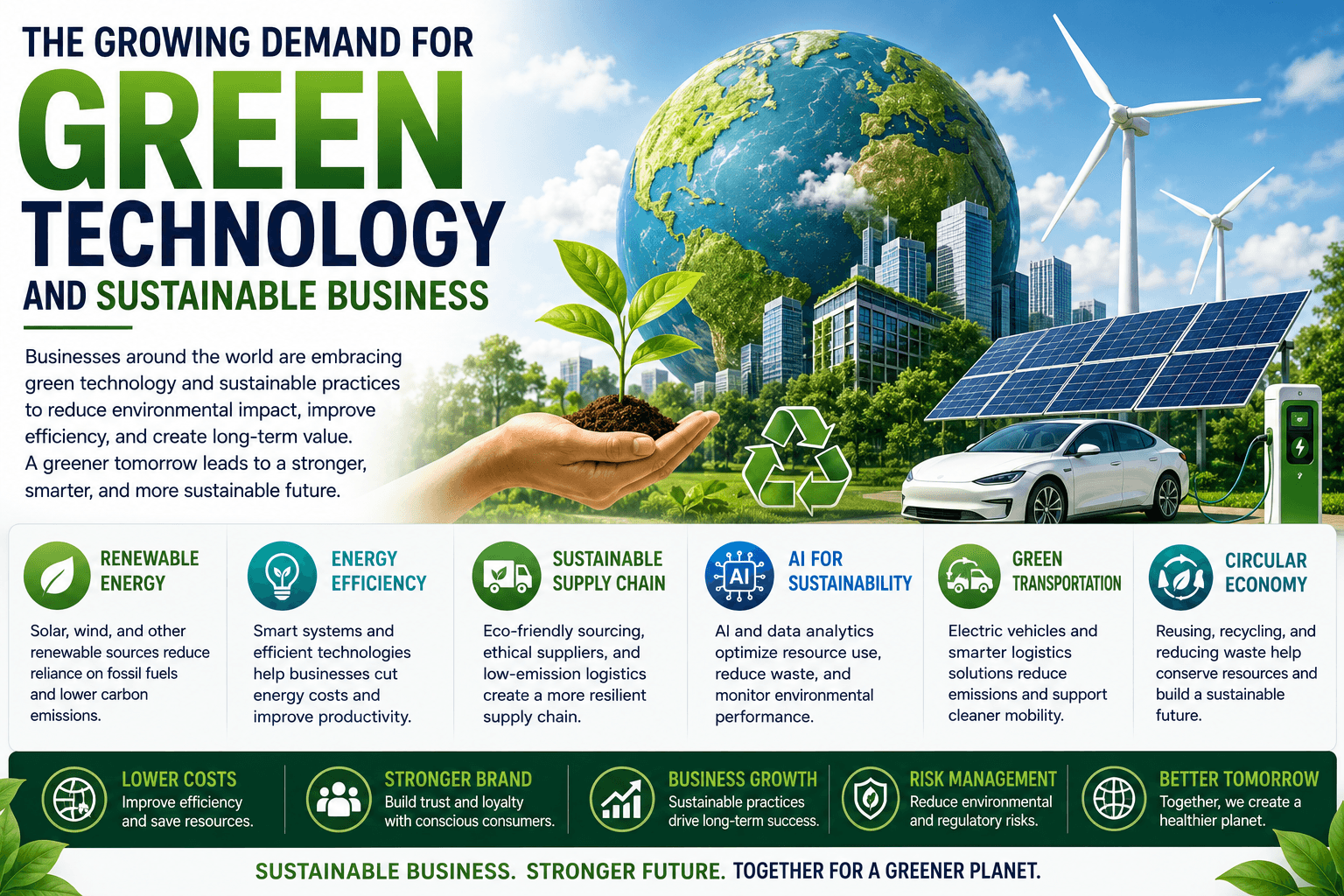
The growing demand for green technology and sustainable business is transforming industries across the world. Organizations are embracing renewable energy, energy-efficient operations, sustainable supply chains, AI-powered resource management, and environmentally responsible business practices to remain competitive in a rapidly changing global economy.
Sustainability is no longer simply about reducing environmental impact—it is a powerful driver of innovation, operational efficiency, customer loyalty, and long-term business growth. Companies that invest in green technology today will be better positioned to lead tomorrow's economy while creating lasting value for customers, shareholders, employees, and society.
FAQs (20)
1. What is green technology?
Green technology refers to environmentally friendly innovations that reduce pollution, conserve natural resources, and promote sustainable development.
2. Why is green technology important?
It helps combat climate change, reduces carbon emissions, improves energy efficiency, and supports long-term economic growth.
3. What is a sustainable business?
A sustainable business balances profitability with environmental and social responsibility while minimizing its environmental impact.
4. Why are businesses investing in green technology?
Companies invest to lower operating costs, meet regulations, improve brand reputation, and achieve sustainability goals.
5. What industries benefit most from green technology?
Energy, manufacturing, transportation, agriculture, construction, healthcare, retail, and technology sectors all benefit.
6. What are examples of green technology?
Solar panels, wind turbines, electric vehicles, smart grids, energy-efficient buildings, carbon capture systems, and sustainable packaging.
7. How does renewable energy support sustainability?
Renewable energy reduces dependence on fossil fuels and lowers greenhouse gas emissions.
8. What is ESG?
ESG stands for Environmental, Social, and Governance, a framework used to evaluate a company's sustainability and ethical practices.
9. How can small businesses adopt sustainable practices?
By reducing waste, improving energy efficiency, using eco-friendly materials, and implementing recycling programs.
10. What is the circular economy?
A circular economy minimizes waste by reusing, repairing, recycling, and repurposing materials.
11. How does AI support green technology?
AI optimizes energy usage, predicts equipment maintenance, reduces waste, and improves resource management.
12. What are the benefits of sustainable business practices?
Lower operational costs, stronger customer trust, regulatory compliance, improved efficiency, and long-term resilience.
13. What challenges do companies face when adopting green technology?
Initial investment costs, infrastructure upgrades, regulatory compliance, and employee training.
14. What is carbon neutrality?
Carbon neutrality means balancing carbon emissions by reducing emissions and offsetting the remainder.
15. How does green technology improve energy efficiency?
It uses advanced systems and smart technologies to reduce energy consumption while maintaining performance.
16. Why is sustainable supply chain management important?
It reduces environmental impact, improves transparency, and enhances operational efficiency.
17. How do consumers influence sustainable business?
Consumers increasingly prefer environmentally responsible brands, encouraging companies to adopt greener practices.
18. What role do governments play in promoting green technology?
Governments support sustainability through regulations, incentives, grants, tax credits, and clean energy policies.
19. What are the future trends in green technology?
AI-powered energy management, green hydrogen, battery innovation, carbon capture, smart cities, and circular manufacturing.
20. Why should businesses prioritize sustainability in 2026?
Sustainability helps companies remain competitive, reduce risks, attract investors, meet customer expectations, and support long-term growth.