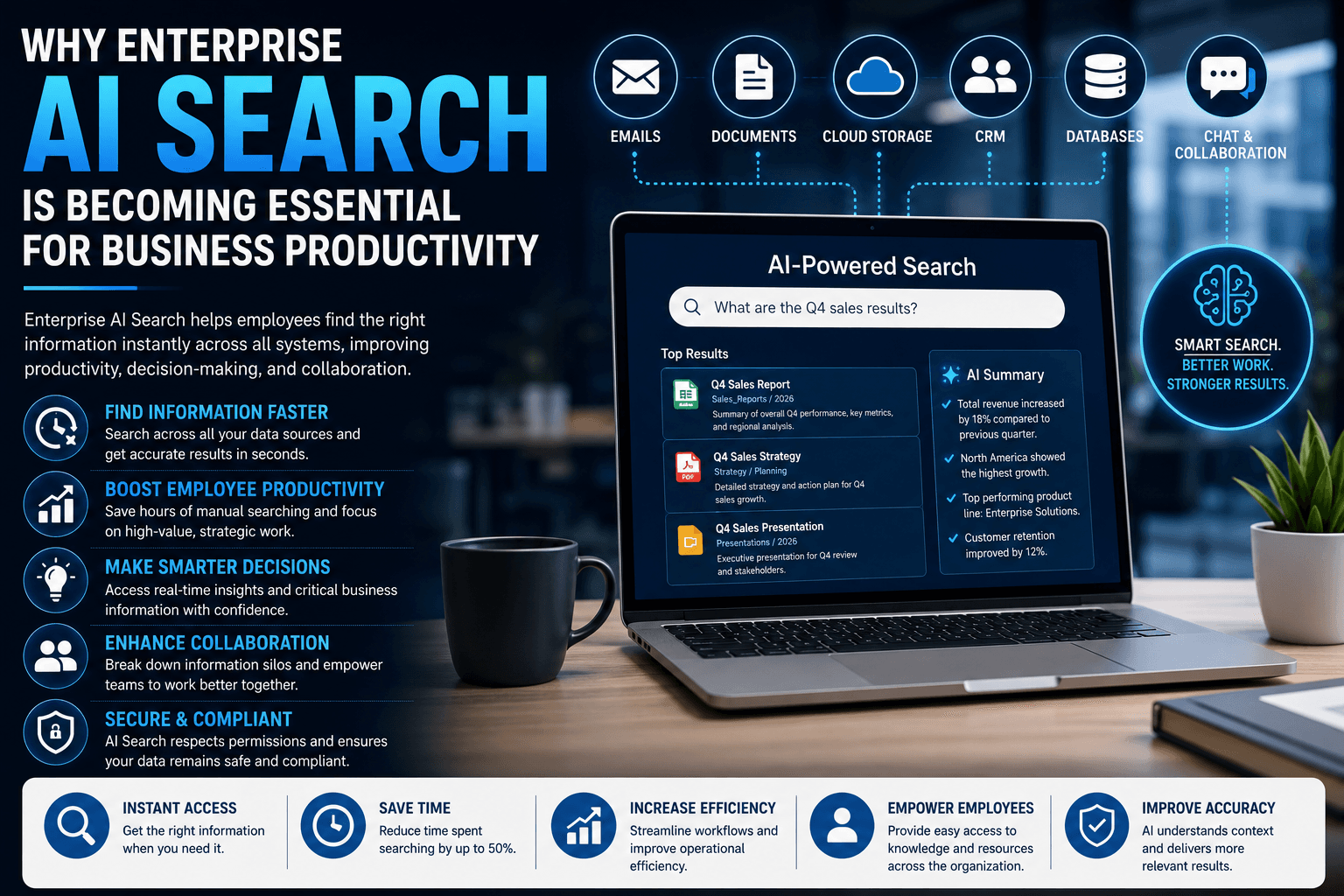

Businesses are generating more information than ever before. Emails, documents, presentations, customer records, project files, internal knowledge bases, meeting notes, and databases are constantly expanding. While this information can provide enormous value, finding the right information at the right time has become increasingly difficult.
Traditional enterprise search tools were designed primarily around keywords, filters, and file locations. They can help employees find documents containing specific terms, but they often struggle to understand context, intent, relationships, and natural-language questions.
Enterprise AI search is changing this model.
Powered by artificial intelligence, natural-language processing, semantic search, machine learning, and increasingly generative AI, enterprise AI search allows employees to interact with organizational knowledge more naturally. Instead of searching for individual keywords, employees can ask questions in everyday language and receive relevant answers, summaries, documents, and sources.
As companies prioritize productivity and efficiency, AI-powered search is becoming an increasingly important component of the modern digital workplace.
The Enterprise Information Problem
The amount of information businesses manage has grown dramatically.
Employees may need to search across cloud storage, communication platforms, CRM systems, project management tools, HR systems, knowledge bases, and internal websites. Information may also exist in different formats, including PDFs, spreadsheets, presentations, emails, databases, and video transcripts.
The problem is no longer simply storing information.
The challenge is finding and understanding it.
Employees can spend significant amounts of time looking for information that already exists somewhere inside the organization. This creates hidden productivity costs and can slow decision-making.
Enterprise AI search aims to reduce this friction.
What Is Enterprise AI Search?
Enterprise AI search is an intelligent search system designed to help employees discover and understand information across an organization's digital environment.
Unlike traditional search engines that primarily match keywords, AI search can analyze the meaning and context of a query.
For example, instead of searching for:
"Q3 customer retention report"
an employee might ask:
"What were the main reasons customer retention declined in Q3?"
An AI-powered enterprise search system can potentially identify relevant reports, meeting notes, customer research, and internal documents and use them to provide a contextual response.
This changes search from a document-finding activity into a knowledge-discovery experience.
Semantic Search Improves Relevance
One of the key technologies behind enterprise AI search is semantic search.
Traditional keyword search focuses on matching words. Semantic search attempts to understand the meaning behind those words.
If an employee searches for "employee turnover," an intelligent system may also identify relevant content discussing staff retention, employee departures, workforce stability, or resignation trends.
This can improve search relevance because employees do not always use the exact terminology contained in internal documents.
Semantic search helps bridge that gap.
Natural-Language Questions Make Search Easier
Employees should not need to learn complicated search syntax to access company knowledge.
AI search enables natural-language interaction.
Employees can ask questions such as:
"What is our refund policy?"
"Which customers are affected by the latest product issue?"
"Summarize the results of last quarter's marketing campaign."
"What did the product team decide during last week's meeting?"
This makes enterprise information more accessible to employees who may not know where a specific document is stored.
AI Search Can Reduce Information Retrieval Time
One of the biggest productivity benefits of enterprise AI search is faster information retrieval.
Employees frequently switch between applications to find information. They may search email, open cloud storage, check project management software, and message colleagues before finding the answer they need.
An AI search layer can potentially connect these information sources and provide a unified discovery experience.
Reducing the time required to locate information can create meaningful productivity improvements across large organizations.
Enterprise AI Search Supports Better Decision-Making
Business decisions depend on information.
Executives, managers, analysts, sales teams, marketers, engineers, and customer-support professionals all need access to accurate information to make effective decisions.
AI-powered search can help employees locate relevant reports, policies, historical decisions, customer feedback, and operational data more quickly.
When employees spend less time searching and more time analyzing information, organizations can potentially make decisions faster.
AI Summaries Can Make Knowledge More Accessible
Finding information is only the first step.
Employees may discover dozens of relevant documents but still need to read them individually to understand the bigger picture.
Generative AI can summarize relevant information and present key points in a more accessible format.
For example, an employee researching a product launch could receive a summary of customer feedback, internal project updates, sales results, and relevant meeting notes.
However, AI-generated summaries should be grounded in reliable organizational sources and provide citations or references where appropriate.
Enterprise Search Can Improve Collaboration
Organizations often struggle with knowledge silos.
A team may have important information that another department does not know exists.
Marketing may have customer research that could help product teams. Sales may possess feedback that could improve product development. Support teams may identify recurring issues that engineering teams need to understand.
Enterprise AI search can help make relevant information easier to discover across organizational boundaries, subject to appropriate access permissions.
This can encourage better collaboration and reduce duplicated work.
AI Search and Knowledge Management
Knowledge management has traditionally depended on carefully organized folders, internal websites, documentation systems, and employee training.
These systems remain useful, but they can become difficult to maintain as organizations grow.
AI search provides another layer of knowledge management.
Rather than requiring employees to understand the exact organizational structure, AI systems can help them navigate information based on meaning and context.
This does not eliminate the need for good documentation. Instead, it increases the value of well-maintained organizational knowledge.
Security and Permissions Are Essential
Enterprise AI search introduces an important requirement: security.
An AI system should not provide an employee with information they are not authorized to access.
Permission-aware search is therefore critical.
Access controls should remain connected to the underlying systems so that search results and AI-generated answers respect existing organizational permissions.
Businesses should also consider data encryption, identity management, audit logs, data retention, and compliance requirements when implementing AI search.
Reducing Knowledge Loss
Employee turnover can create significant knowledge gaps.
When experienced employees leave, they take years of accumulated knowledge with them unless that knowledge has been properly documented.
Enterprise AI search can help employees discover existing documentation, project histories, decisions, and other institutional knowledge.
Combined with strong documentation practices, this can help organizations preserve and distribute knowledge more effectively.
AI Search Can Support Different Departments
Enterprise AI search is not limited to a single department.
Sales
Sales teams can quickly find product information, customer histories, pricing documents, proposals, and relevant case studies.
Customer Support
Support representatives can locate troubleshooting guides, policies, previous solutions, and product documentation.
Human Resources
HR teams can make internal policies and employee resources easier to discover.
Engineering
Engineering teams can search technical documentation, incident reports, code-related knowledge, and previous project decisions.
Marketing
Marketing teams can access campaign results, customer research, brand guidelines, and previous content.
Leadership
Executives can use AI search to locate reports, strategic documents, performance information, and historical decisions.
Enterprise AI Search Is Becoming an AI Interface
The future of enterprise search may go beyond traditional search boxes.
AI assistants can become interfaces through which employees interact with organizational knowledge.
Instead of opening several applications, employees could ask an AI system to locate information, compare documents, summarize findings, or identify relevant internal resources.
This could make enterprise software feel more conversational and interconnected.
The Rise of Agentic Enterprise Search
The next stage may involve AI agents.
Instead of simply answering a question, an AI agent could potentially search multiple systems, analyze information, perform calculations, generate a report, and present the result.
For example, a manager could ask:
"Analyze this quarter's customer churn and identify the main factors."
An AI system could potentially retrieve relevant data, analyze patterns, summarize findings, and provide links to supporting sources.
This moves enterprise search from information retrieval toward knowledge work assistance.
Challenges Businesses Need to Address
Despite its potential, enterprise AI search is not a magic solution.
Poor-quality or outdated data can produce poor results. Disconnected systems can make integration difficult. Incorrect AI-generated answers can create risks. Security and privacy requirements can also make implementation complex.
Businesses should therefore begin with clear use cases and high-value information sources.
They should also establish governance policies and evaluate AI outputs carefully.
The Future of Enterprise Productivity
Enterprise AI search is becoming important because modern organizations cannot afford to leave valuable knowledge buried across disconnected systems.
As businesses adopt more AI tools, the ability to find, understand, and use organizational information will become increasingly important.
The most effective enterprise AI search systems will not simply return documents. They will help employees understand information, connect knowledge, answer questions, and make better decisions while maintaining strong security and governance.
Ultimately, the goal is simple: help employees spend less time searching for information and more time using it.
FAQs
1. What is enterprise AI search?
Enterprise AI search is an intelligent search technology designed to help employees find and understand information across an organization's internal systems. It uses technologies such as semantic search, natural-language processing, machine learning, and generative AI to provide more contextually relevant results.
2. How is enterprise AI search different from traditional search?
Traditional enterprise search primarily relies on keywords, filters, and metadata to locate documents. AI search can understand natural-language questions, context, and the meaning behind a query, allowing employees to find relevant information even when their search terms do not exactly match the wording in company documents.
3. How can AI search improve employee productivity?
AI search can reduce the time employees spend looking for documents, policies, reports, customer information, and other resources. By providing faster access to relevant information and summaries, it allows employees to spend more time on analysis, problem-solving, customer service, and other high-value activities.
4. Can enterprise AI search connect multiple business systems?
Yes. Depending on the platform and integrations available, enterprise AI search can connect information from systems such as cloud storage, communication tools, CRM platforms, project management applications, knowledge bases, and internal databases. The system should maintain each source's existing access permissions.
5. Is enterprise AI search secure?
Security depends on how the system is designed and implemented. Enterprise AI search should use permission-aware access controls so employees only receive information they are authorized to access. Organizations should also evaluate encryption, authentication, audit logging, data retention, and compliance requirements.
6. Can enterprise AI search answer questions using company data?
Yes. Modern systems can retrieve relevant internal information and use it to provide contextual answers. However, businesses should prioritize systems that ground AI responses in trusted company sources and provide citations or references so employees can verify important information.
7. Which departments can benefit from enterprise AI search?
Almost every department can benefit. Sales can find customer and product information, support teams can locate troubleshooting resources, HR can access policies, engineering can search technical documentation, marketing can find campaign information, and executives can quickly locate strategic and operational reports.
8. Does enterprise AI search replace knowledge management?
No. AI search works best when organizations already maintain accurate, structured, and up-to-date information. It can make existing knowledge easier to discover, but businesses still need effective documentation, governance, content ownership, and knowledge-management processes.
9. What are the biggest challenges of implementing enterprise AI search?
Common challenges include data quality, system integration, security, privacy, access control, outdated documentation, AI accuracy, governance, and employee adoption. Organizations should start with clearly defined use cases and gradually expand as they understand the technology's performance and risks.
10. What is the future of enterprise AI search?
Enterprise AI search is likely to evolve into a broader AI-powered workplace interface. Future systems may combine search, summarization, analysis, automation, and AI agents that can perform multi-step knowledge tasks across different business applications while maintaining organizational security and permissions.