
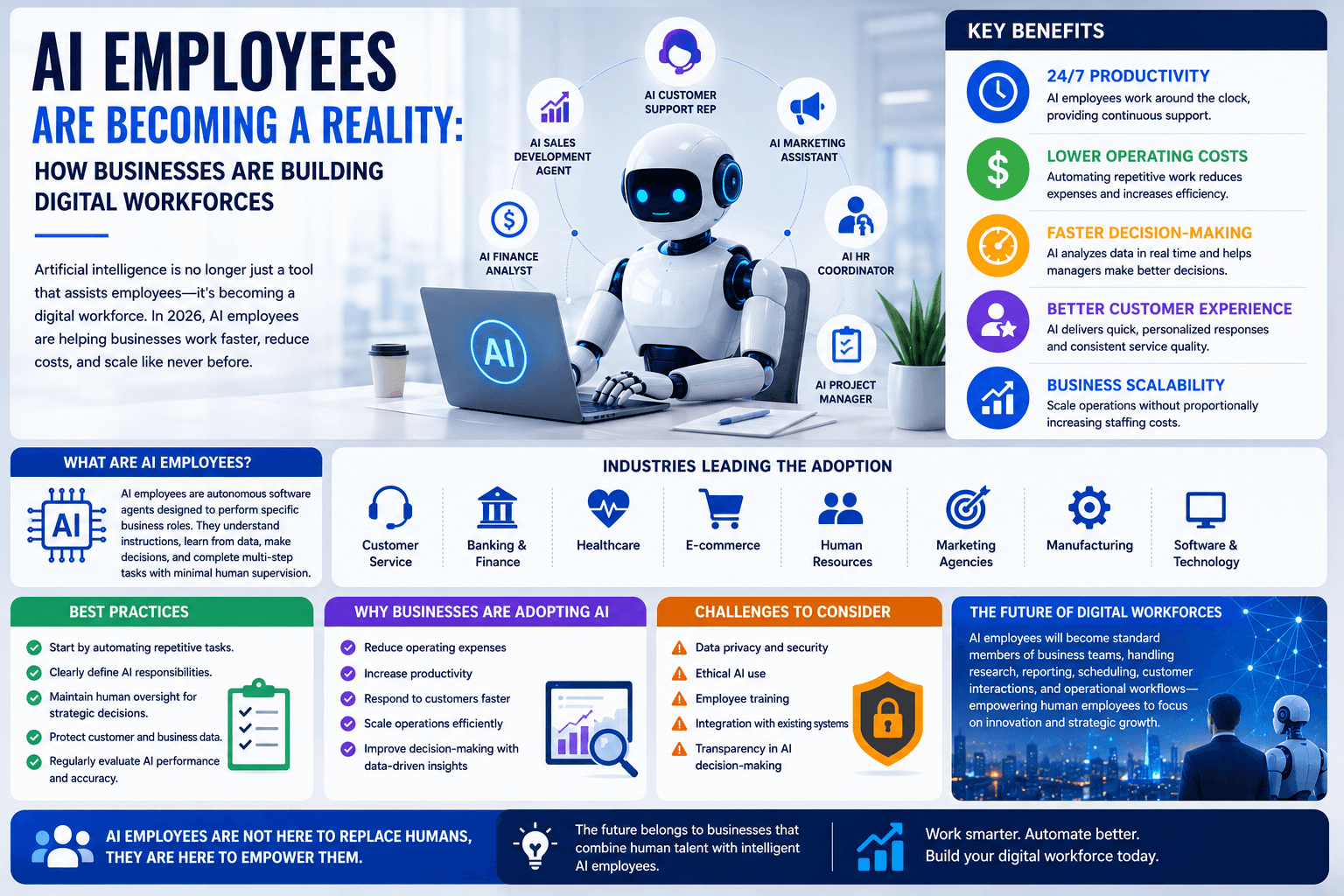

Artificial intelligence is no longer just a tool that assists employees—it is becoming a digital workforce capable of performing business tasks independently. In 2026, companies around the world are deploying AI employees to manage customer service, sales, marketing, finance, HR, and administrative operations.
Rather than replacing human workers entirely, AI employees are taking over repetitive, time-consuming tasks, allowing teams to focus on creativity, strategy, and decision-making. Businesses that embrace this shift are improving efficiency while reducing operational costs.
What Are AI Employees?
AI employees are autonomous software agents designed to perform specific business roles. Unlike traditional automation, these systems can understand instructions, learn from data, make decisions, and complete multi-step tasks with minimal human supervision.
Examples include:
AI customer support representatives
AI sales development agents
AI marketing assistants
AI finance analysts
AI HR coordinators
AI research assistants
AI project managers
These digital workers operate around the clock, delivering consistent performance without fatigue.
Why Businesses Are Adopting AI Employees
Organizations are under increasing pressure to improve productivity while controlling costs. AI employees help companies automate routine work without sacrificing quality or speed.
Businesses are investing in AI because it enables them to:
Reduce operating expenses
Increase productivity
Respond to customers faster
Scale operations efficiently
Improve decision-making with data-driven insights
Key Benefits
1. 24/7 Productivity
AI employees work continuously, providing uninterrupted support and completing tasks at any time.
2. Lower Operating Costs
Automating repetitive work reduces administrative expenses and allows businesses to allocate resources more effectively.
3. Faster Decision-Making
AI analyzes large volumes of business data within seconds, helping managers make informed decisions.
4. Better Customer Experience
AI employees provide quick, personalized responses and ensure consistent service quality.
5. Business Scalability
Companies can expand operations without proportionally increasing staffing costs.
Industries Leading the Adoption
AI employees are making a significant impact across:
Customer Service
Banking and Finance
Healthcare
E-commerce
Human Resources
Marketing Agencies
Manufacturing
Software and Technology
Nearly every industry can benefit from intelligent digital workers.
Best Practices for Implementation
Businesses should:
Start by automating repetitive tasks.
Clearly define AI responsibilities.
Maintain human oversight for strategic decisions.
Protect customer and business data.
Regularly evaluate AI performance and accuracy.
Successful organizations use AI to support employees, not replace human expertise.
Challenges to Consider
Companies should prepare for:
Data privacy and security
Ethical AI use
Employee training
Integration with existing systems
Transparency in AI decision-making
A balanced approach ensures AI delivers value while maintaining trust.
The Future of Digital Workforces
Industry experts believe AI employees will become standard members of business teams. Human employees will increasingly collaborate with AI agents that handle research, reporting, scheduling, customer interactions, and operational workflows.
Organizations that invest in AI workforces today will gain a competitive advantage through greater efficiency, faster innovation, and improved customer experiences.
Final Thoughts
AI employees are reshaping the future of work by helping businesses automate routine operations while empowering human teams to focus on innovation and strategic growth.
The companies that successfully combine human talent with intelligent AI employees will be best positioned to thrive in the AI-driven economy.
Artificial intelligence is no longer just a tool that assists employees—it is becoming a digital workforce capable of performing business tasks independently. In 2026, companies around the world are deploying AI employees to manage customer service, sales, marketing, finance, HR, and administrative operations.
Rather than replacing human workers entirely, AI employees are taking over repetitive, time-consuming tasks, allowing teams to focus on creativity, strategy, and decision-making. Businesses that embrace this shift are improving efficiency while reducing operational costs.
What Are AI Employees?
AI employees are autonomous software agents designed to perform specific business roles. Unlike traditional automation, these systems can understand instructions, learn from data, make decisions, and complete multi-step tasks with minimal human supervision.
Examples include:
AI customer support representatives
AI sales development agents
AI marketing assistants
AI finance analysts
AI HR coordinators
AI research assistants
AI project managers
These digital workers operate around the clock, delivering consistent performance without fatigue.
Why Businesses Are Adopting AI Employees
Organizations are under increasing pressure to improve productivity while controlling costs. AI employees help companies automate routine work without sacrificing quality or speed.
Businesses are investing in AI because it enables them to:
Reduce operating expenses
Increase productivity
Respond to customers faster
Scale operations efficiently
Improve decision-making with data-driven insights
Key Benefits
1. 24/7 Productivity
AI employees work continuously, providing uninterrupted support and completing tasks at any time.
2. Lower Operating Costs
Automating repetitive work reduces administrative expenses and allows businesses to allocate resources more effectively.
3. Faster Decision-Making
AI analyzes large volumes of business data within seconds, helping managers make informed decisions.
4. Better Customer Experience
AI employees provide quick, personalized responses and ensure consistent service quality.
5. Business Scalability
Companies can expand operations without proportionally increasing staffing costs.
Industries Leading the Adoption
AI employees are making a significant impact across:
Customer Service
Banking and Finance
Healthcare
E-commerce
Human Resources
Marketing Agencies
Manufacturing
Software and Technology
Nearly every industry can benefit from intelligent digital workers.
Best Practices for Implementation
Businesses should:
Start by automating repetitive tasks.
Clearly define AI responsibilities.
Maintain human oversight for strategic decisions.
Protect customer and business data.
Regularly evaluate AI performance and accuracy.
Successful organizations use AI to support employees, not replace human expertise.
Challenges to Consider
Companies should prepare for:
Data privacy and security
Ethical AI use
Employee training
Integration with existing systems
Transparency in AI decision-making
A balanced approach ensures AI delivers value while maintaining trust.
The Future of Digital Workforces
Industry experts believe AI employees will become standard members of business teams. Human employees will increasingly collaborate with AI agents that handle research, reporting, scheduling, customer interactions, and operational workflows.
Organizations that invest in AI workforces today will gain a competitive advantage through greater efficiency, faster innovation, and improved customer experiences.
Final Thoughts
AI employees are reshaping the future of work by helping businesses automate routine operations while empowering human teams to focus on innovation and strategic growth.
The companies that successfully combine human talent with intelligent AI employees will be best positioned to thrive in the AI-driven economy.
FAQs: AI Employees Are Becoming a Reality: How Businesses Are Building Digital Workforces
1. What are AI employees?
AI employees are digital AI agents designed to perform specific business tasks with limited human intervention. They can handle responsibilities such as customer support, sales assistance, research, scheduling, data analysis, and administrative work. Unlike basic AI tools that respond to individual prompts, AI employees can follow workflows, use connected software, and complete multiple steps to achieve a business objective.
2. Why are businesses adopting AI employees?
Businesses are adopting AI employees to automate repetitive tasks, improve productivity, reduce operational costs, and provide faster services. Digital workers can operate continuously and handle large volumes of routine work. This allows human employees to spend more time on creative thinking, customer relationships, strategy, and complex decision-making while AI handles predictable processes.
3. Which business tasks can AI employees perform?
AI employees can perform many digital tasks, including answering customer questions, qualifying leads, preparing reports, analyzing information, scheduling appointments, processing routine requests, and assisting with internal operations. Their effectiveness depends on the quality of business data, integrations, instructions, and permissions provided to them.
4. What are the benefits of building a digital workforce?
A digital workforce can help businesses scale operations without increasing manual workloads at the same rate. AI agents can work continuously, respond quickly, and automate repetitive processes. They can also help standardize workflows and reduce some human errors. When properly managed, digital employees can complement human teams and improve overall operational efficiency.
5. Will AI employees replace human workers?
AI employees are more likely to change and support human jobs than completely replace workers. AI can handle repetitive and predictable responsibilities, while humans remain important for leadership, creativity, emotional intelligence, complex judgment, and relationship-building. The future workplace will likely combine human employees with AI agents, creating hybrid teams where each handles the tasks they are best suited to perform