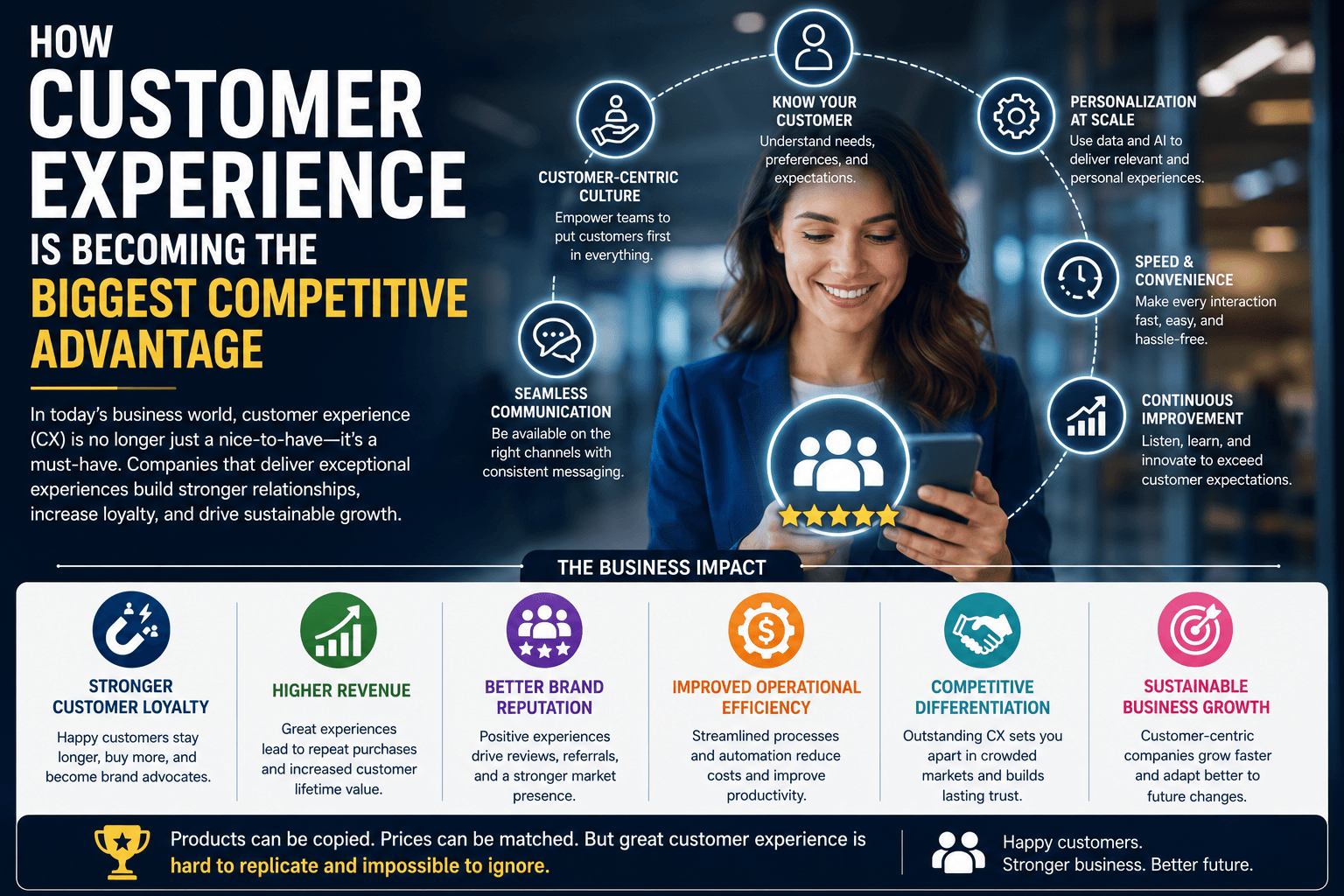
In today's highly competitive business environment, products and pricing alone are no longer enough to guarantee success. Customers have more choices than ever before, and their expectations continue to rise. As a result, customer experience (CX) has become one of the most important factors influencing business growth, customer loyalty, and long-term profitability.
In 2026, organizations across every industry are investing in personalized experiences, digital transformation, Artificial Intelligence, and customer-focused strategies to build stronger relationships with their audiences. Businesses that consistently deliver exceptional customer experiences are gaining a significant competitive advantage in an increasingly crowded marketplace.
Understanding Customer Experience
Customer experience refers to every interaction a customer has with a business throughout the entire journey.
This includes:
Website browsing
Product research
Customer support
Purchasing
Delivery
After-sales service
Social media engagement
Every touchpoint shapes how customers perceive a brand and influences whether they return in the future.
Why Customer Experience Matters More Than Ever
Modern consumers expect fast, convenient, and personalized service.
Customers are more likely to remain loyal to companies that:
Respond quickly
Solve problems efficiently
Provide personalized recommendations
Offer seamless digital experiences
Maintain transparent communication
Positive experiences increase customer satisfaction while encouraging repeat business and referrals.
Personalization Is Driving Customer Loyalty
Personalization has become one of the strongest drivers of customer engagement.
Businesses use Artificial Intelligence and data analytics to:
Recommend products
Personalize marketing campaigns
Customize website content
Deliver targeted promotions
Improve email communication
Customers appreciate experiences that feel relevant to their individual needs and preferences.
Artificial Intelligence Is Enhancing Customer Service
AI-powered customer support has transformed how businesses interact with customers.
Modern AI solutions provide:
24/7 customer assistance
Intelligent chatbots
Automated responses
Faster issue resolution
Personalized recommendations
Multilingual support
Human representatives remain essential for handling complex issues, while AI improves efficiency for routine inquiries.
Omnichannel Experiences Build Trust
Customers interact with businesses through multiple channels.
Successful companies provide consistent experiences across:
Websites
Mobile apps
Social media
Email
Physical stores
Customer support centers
An integrated omnichannel strategy ensures customers receive the same quality of service regardless of how they engage with the business.
Speed Is a Competitive Advantage
Customers increasingly value speed and convenience.
Businesses can improve customer experience by:
Reducing website loading times
Simplifying checkout processes
Providing faster delivery
Responding quickly to inquiries
Resolving issues efficiently
Faster service often leads to higher customer satisfaction and stronger brand loyalty.
Customer Feedback Drives Improvement
Listening to customers is essential for continuous improvement.
Businesses collect feedback through:
Online reviews
Surveys
Social media
Customer interviews
Support interactions
Analyzing customer feedback helps organizations identify strengths, address weaknesses, and improve products and services.
Employee Experience Influences Customer Experience
Employees play a vital role in delivering exceptional customer service.
Organizations that invest in:
Employee training
Professional development
Workplace culture
Digital tools
Collaboration
often create better customer experiences because engaged employees are more motivated to deliver excellent service.
Digital Transformation Supports Better CX
Technology continues improving customer interactions.
Businesses increasingly use:
Cloud computing
Mobile applications
CRM systems
Automation
AI-powered analytics
Self-service portals
These technologies help organizations deliver faster, more personalized, and more efficient customer experiences.
Building Long-Term Customer Relationships
Acquiring new customers is important, but retaining existing customers is often more cost-effective.
Businesses strengthen relationships by:
Rewarding loyal customers
Communicating regularly
Providing proactive support
Offering personalized experiences
Resolving issues quickly
Long-term relationships contribute to sustainable business growth.
Measuring Customer Experience
Organizations monitor customer satisfaction using several key performance indicators.
Common metrics include:
Customer Satisfaction (CSAT)
Net Promoter Score (NPS)
Customer Retention Rate
Customer Lifetime Value
First Response Time
Customer Effort Score
These insights help businesses continuously improve service quality.
Challenges Businesses Must Overcome
Despite significant opportunities, improving customer experience presents several challenges.
These include:
Rising customer expectations
Data privacy concerns
Integration of digital systems
Maintaining consistent service
Employee training
Managing multiple communication channels
Businesses must remain adaptable while continuously investing in customer-focused innovation.
The Future of Customer Experience
Future customer experiences will increasingly include:
AI-powered personalization
Predictive customer support
Voice assistants
Augmented Reality shopping
Hyper-personalized recommendations
Intelligent automation
Organizations that adopt these technologies responsibly will be better positioned to meet evolving customer expectations.
Conclusion
Customer experience has become one of the most powerful competitive advantages in modern business. Organizations that prioritize customer satisfaction, personalization, digital innovation, and responsive service build stronger relationships, improve brand loyalty, and achieve sustainable growth.
As technology continues advancing, customer expectations will continue rising. Businesses that consistently deliver seamless, personalized, and meaningful experiences will differentiate themselves from competitors and create lasting value.
In the digital economy, exceptional customer experience is no longer simply a service strategy—it is a fundamental driver of business success, long-term profitability, and competitive advantage.
FAQs: How Customer Experience Is Becoming the Biggest Competitive Advantage
1. Why is customer experience considered a competitive advantage?
Customer experience (CX) influences customer satisfaction, loyalty, and retention, helping businesses differentiate themselves in increasingly competitive markets.
2. What is customer experience (CX)?
Customer experience is the overall impression customers have of a brand based on every interaction before, during, and after a purchase.
3. Why is customer experience more important than price?
Many customers are willing to pay more for faster service, personalized experiences, and reliable support rather than choosing the lowest price.
4. How does personalization improve customer experience?
Personalization uses customer data to deliver relevant recommendations, tailored offers, and customized communication, increasing engagement and satisfaction.
5. How does AI enhance customer experience?
AI powers intelligent chatbots, personalized recommendations, predictive support, sentiment analysis, and faster response times.
6. What role does customer feedback play in improving CX?
Customer feedback helps businesses identify pain points, improve products, optimize services, and build stronger customer relationships.
7. How does omnichannel support improve customer experience?
Omnichannel support ensures customers receive consistent service across websites, mobile apps, email, social media, and physical stores.
8. Why is customer retention more valuable than customer acquisition?
Retaining existing customers is generally more cost-effective than acquiring new ones and often leads to higher lifetime value.
9. How can businesses measure customer experience?
Common metrics include Customer Satisfaction (CSAT), Net Promoter Score (NPS), Customer Effort Score (CES), retention rate, and customer lifetime value.
10. How does fast customer support impact business success?
Quick response times improve customer trust, reduce frustration, increase satisfaction, and strengthen brand reputation.
11. What is predictive customer service?
Predictive customer service uses AI and analytics to anticipate customer needs and resolve issues before they become problems.
12. How does employee experience affect customer experience?
Satisfied and well-trained employees are more likely to deliver exceptional customer service and create positive customer interactions.
13. Why is customer trust essential for business growth?
Trust encourages repeat purchases, positive reviews, referrals, and long-term brand loyalty.
14. How do businesses create memorable customer experiences?
By providing personalized service, proactive support, seamless digital experiences, transparent communication, and consistent quality.
15. What technologies are driving customer experience innovation?
Artificial intelligence, CRM platforms, automation, cloud computing, predictive analytics, voice assistants, and data analytics.
16. How does customer experience influence brand loyalty?
Positive experiences build emotional connections, encouraging customers to remain loyal and recommend the brand to others.
17. What are the biggest customer experience trends in 2026?
AI-powered personalization, conversational AI, self-service portals, predictive support, hyper-personalization, and unified omnichannel engagement.
18. How can small businesses compete through customer experience?
Small businesses can focus on personalized interactions, responsive communication, local engagement, and exceptional service quality.
19. What are common customer experience mistakes businesses should avoid?
Ignoring customer feedback, slow response times, inconsistent service, poor communication, and complicated purchasing processes.
20. What is the future of customer experience?
Customer experience will become increasingly AI-driven, personalized, proactive, and data-powered, making it one of the most important drivers of sustainable business growth.