
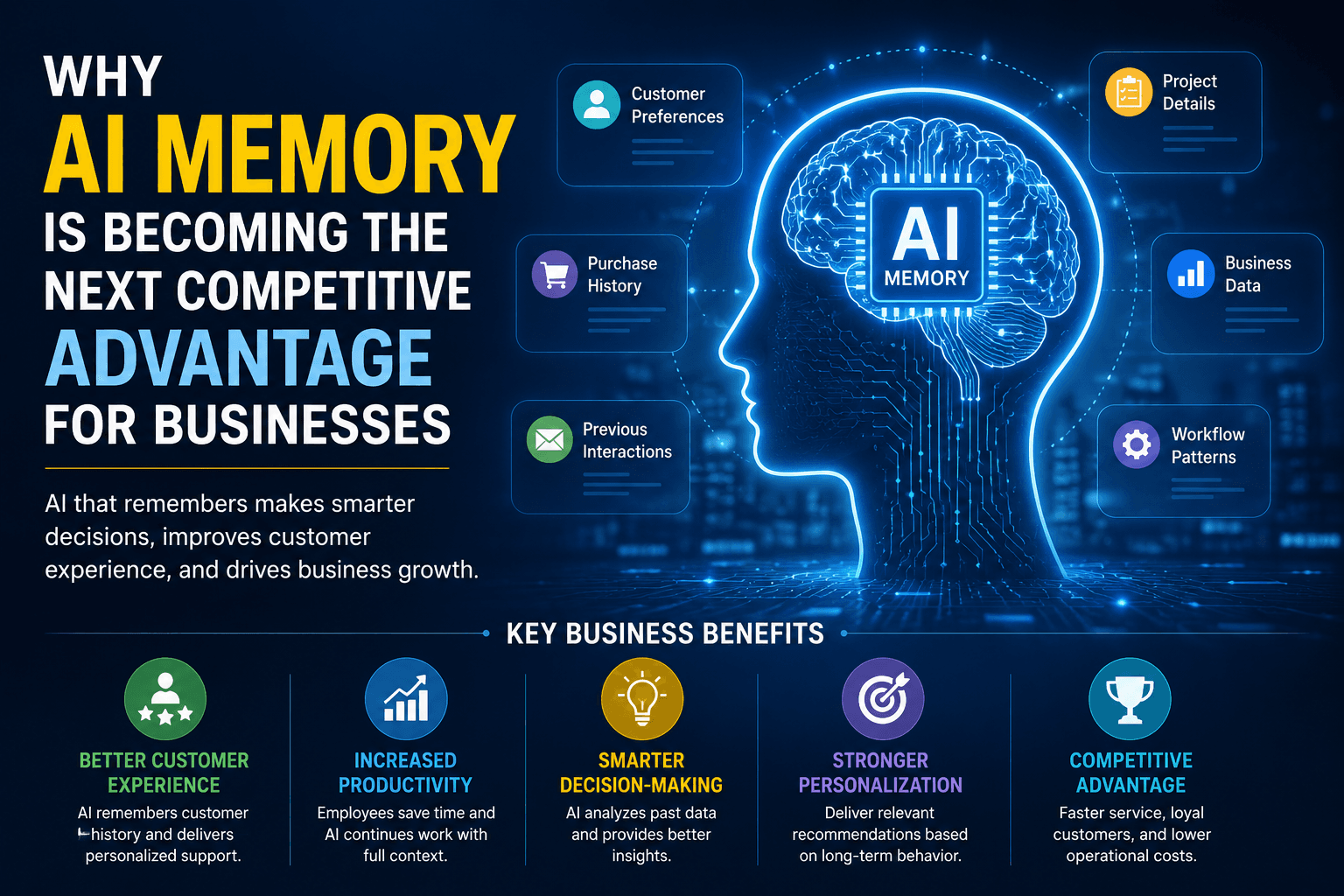

Artificial intelligence is evolving beyond simple chatbots and automation. In 2026, one of the biggest innovations is AI memory—the ability of AI systems to remember past conversations, preferences, business processes, and customer interactions. This advancement is helping businesses deliver more personalized experiences, improve productivity, and build stronger customer relationships.
Companies that invest in AI memory are gaining a significant advantage over competitors relying on traditional AI tools that forget every interaction.
What Is AI Memory?
AI memory enables AI systems to retain useful information from previous interactions. Instead of starting from scratch every time, AI can remember customer preferences, project details, purchase history, and workflow patterns.
This creates more natural, efficient, and personalized experiences for both customers and employees.
Why AI Memory Matters
Traditional AI responds only to the current prompt. AI with memory can understand long-term context, making it more useful for real business operations.
For example:
A customer support AI remembers previous issues and offers faster solutions.
A sales assistant recalls client preferences before meetings.
A marketing AI remembers successful campaigns and recommends improvements.
An HR assistant tracks employee onboarding and training progress.
Key Business Benefits
1. Better Customer Experience
Customers no longer need to repeat the same information during every interaction. AI remembers preferences and provides more personalized support.
2. Increased Productivity
Employees spend less time explaining context to AI tools. Memory allows AI to continue projects, summarize previous work, and automate repetitive tasks.
3. Smarter Decision-Making
AI analyzes historical business data and identifies trends that help managers make informed decisions.
4. Stronger Personalization
Businesses can recommend products, services, and content based on long-term customer behavior instead of one-time interactions.
5. Competitive Advantage
Organizations using AI memory can deliver faster service, improve customer loyalty, and reduce operational costs.
Industries Benefiting Most
AI memory is transforming many sectors, including:
E-commerce
Healthcare
Banking
Education
Real Estate
Customer Support
Marketing Agencies
Software Development
Challenges to Consider
While AI memory offers major advantages, businesses should also focus on:
Data privacy and security
Customer consent
Accurate information management
Regular memory updates
Compliance with data protection regulations
Responsible AI practices are essential for building trust.
The Future of AI Memory
Experts predict AI memory will become a standard feature across business software. Instead of using multiple disconnected tools, companies will rely on AI systems that understand business history, remember workflows, and provide intelligent recommendations over time.
Businesses that adopt AI memory early will be better positioned to improve efficiency, reduce costs, and deliver exceptional customer experiences.
Final Thoughts
AI memory is more than a technological upgrade—it represents the next phase of business intelligence. As AI becomes increasingly capable of remembering context and learning from ongoing interactions, companies that embrace this technology will gain a lasting competitive advantage.
Investing in AI memory today can help businesses prepare for a future where intelligent, personalized, and context-aware AI becomes the foundation of everyday operations.
FAQs: Why AI Memory Is Becoming the Next Competitive Advantage for Businesses
1. What is AI memory?
AI memory refers to an AI system’s ability to retain and use relevant information from previous interactions, tasks, or business processes. Instead of treating every conversation as completely new, memory can help AI understand customer preferences, business context, past decisions, and ongoing workflows.
2. Why is AI memory becoming important for businesses?
AI memory can make AI systems more personalized, consistent, and useful. Businesses can use remembered context to improve customer experiences, automate recurring tasks, and help employees access relevant information without repeatedly providing the same instructions or background.
3. How can AI memory improve customer experiences?
AI memory can allow customer-facing systems to remember preferences, previous interactions, product interests, and support history where appropriate. This can create more personalized conversations and reduce the frustration of customers having to repeatedly explain their needs.
4. Can AI memory improve employee productivity?
Yes. AI systems with useful memory can retain project context, recurring instructions, workflows, and relevant organizational information. Employees may spend less time searching for information or repeating background details, allowing them to focus more on analysis, creativity, and decision-making.
5. How does AI memory create a competitive advantage?
Businesses that use AI memory effectively can potentially deliver more personalized services, faster support, better recommendations, and more efficient workflows. Over time, the accumulated context can become an important business asset that helps AI systems provide more relevant assistance.
6. Is AI memory the same as storing customer data?
Not necessarily. AI memory is a capability for retaining and using information, while data storage is the broader process of collecting and keeping information. Businesses need clear policies governing what information AI is allowed to remember, how long it is retained, and how it can be used.
7. What types of information can businesses use with AI memory?
Depending on the application, AI memory may include customer preferences, previous support conversations, project details, employee workflows, product interests, business instructions, or recurring tasks. Companies should only retain information that is necessary, appropriate, and permitted under applicable requirements.
8. Can AI memory help with customer service?
Yes. AI memory can help customer-service systems understand previous interactions and maintain continuity across conversations. This can reduce repetitive questions, improve response relevance, and help support teams understand a customer's history more quickly.
9. How can AI memory benefit sales teams?
AI memory can help sales systems retain information about prospects, previous conversations, product interests, customer requirements, and follow-up activities. Sales professionals can use this context to personalize communication and identify more relevant opportunities.
10. Can AI memory improve personalization?
Personalization is one of its biggest potential advantages. By remembering relevant preferences and interactions, AI systems can tailor recommendations, communications, and services more effectively than systems that only consider the current interaction.
11. What are the privacy risks of AI memory?
AI memory can create privacy risks if sensitive information is stored unnecessarily, accessed by unauthorized people, retained for too long, or used for purposes customers did not expect. Businesses should establish appropriate privacy, access, retention, and deletion controls.
12. How should businesses manage AI memory securely?
Companies should define what AI systems are permitted to remember, restrict access to sensitive information, monitor data usage, establish retention periods, and provide appropriate deletion mechanisms. Security controls should also be applied to the systems and databases supporting AI memory.
13. Does AI memory require human oversight?
Human oversight remains important, particularly when remembered information could influence significant business or customer decisions. Employees should be able to review, correct, or override AI-generated conclusions when necessary.
14. Can AI memory help businesses build stronger customer relationships?
Potentially, yes. When used responsibly, memory can make interactions more consistent and personalized. Customers may feel better understood when an AI assistant can appropriately remember their preferences and previous requests rather than starting from zero every time.
15. How can AI memory support business knowledge management?
AI memory can help preserve useful organizational context from projects, processes, and interactions. It can make information easier to retrieve and apply, potentially reducing knowledge loss when employees change roles or leave an organization.
16. What happens if AI remembers incorrect information?
Incorrect memory can lead to inaccurate recommendations or repeated mistakes. Businesses should therefore provide mechanisms for reviewing, correcting, updating, and deleting remembered information. AI memory should not automatically be treated as accurate simply because it was stored previously.
17. Can AI memory reduce repetitive work?
Yes. If an AI system can retain recurring instructions, preferences, and workflow context, employees may not need to repeatedly provide the same information. This can make AI assistants more useful for ongoing projects and routine business processes.
18. Will AI memory replace traditional business databases?
Probably not. Traditional databases remain important for structured, authoritative business records. AI memory is more likely to complement existing databases by helping AI systems understand and use relevant context from those systems and from interactions.
19. What should businesses consider before adopting AI memory?
Companies should evaluate privacy, security, accuracy, data retention, access controls, regulatory requirements, integration capabilities, and business value. They should also determine exactly what information the AI should remember and establish clear rules for correcting or deleting it.
20. Why could AI memory become a major business advantage?
As AI becomes more common, simply having access to an AI assistant may no longer provide a significant competitive advantage. Businesses could differentiate themselves through AI systems that understand their customers, employees, processes, and historical context more effectively. When managed responsibly, AI memory could make business AI more personalized, efficient, and valuable.