
Introduction
The global economy in 2026 is entering a new phase shaped by artificial intelligence, digital transformation, geopolitical shifts, evolving trade relationships, and changing consumer expectations. Business leaders are making strategic decisions in an environment where resilience, innovation, and operational efficiency are just as important as revenue growth.
Organizations across industries are adapting to rapid technological change while navigating inflation, cybersecurity risks, workforce transformation, and increasingly complex global supply chains. Companies that can respond quickly to these challenges are better positioned to seize new opportunities and maintain a competitive edge.
This article explores the most important economic trends influencing businesses worldwide in 2026 and explains how organizations can prepare for long-term success.
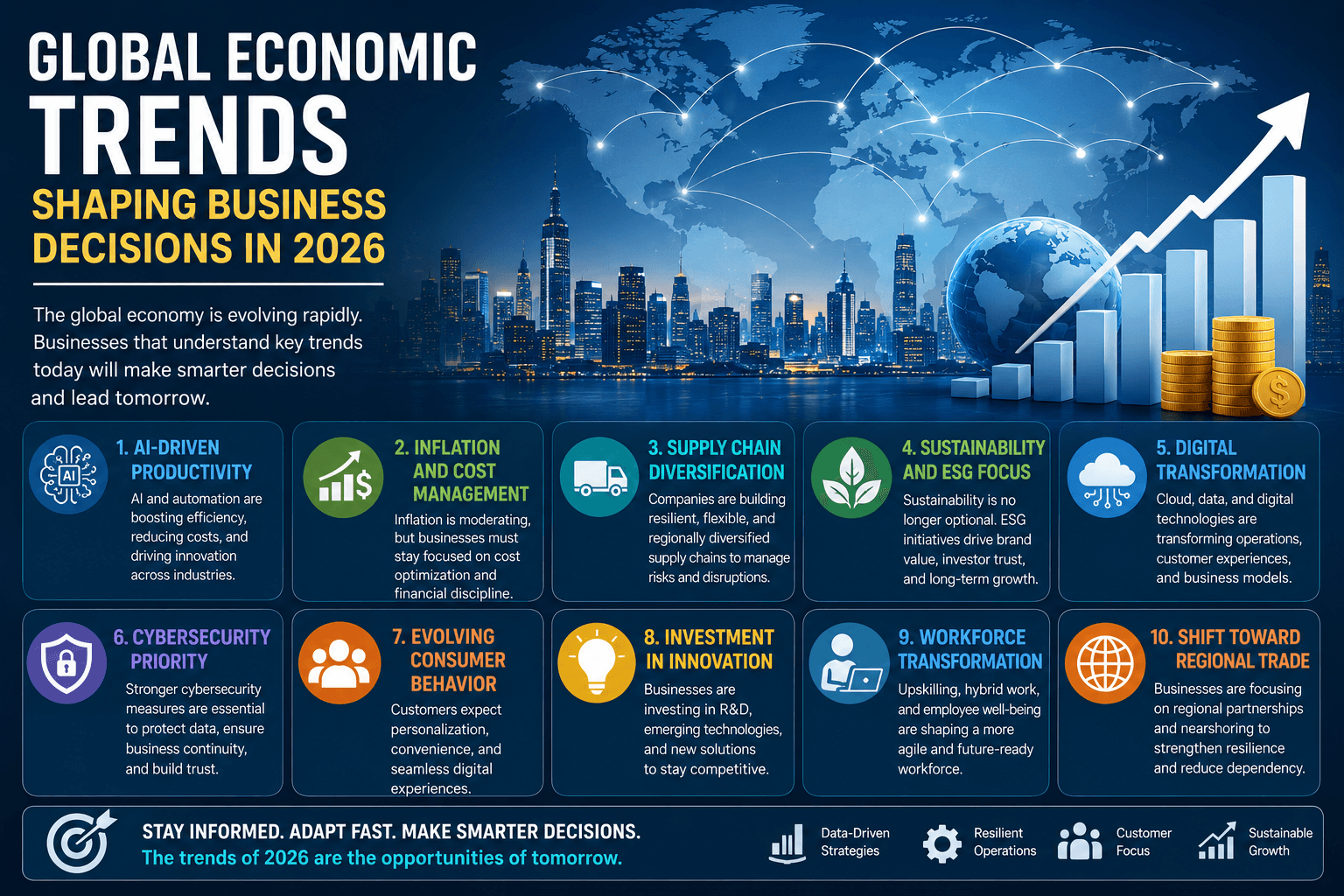
1. Artificial Intelligence Is Transforming Business Operations
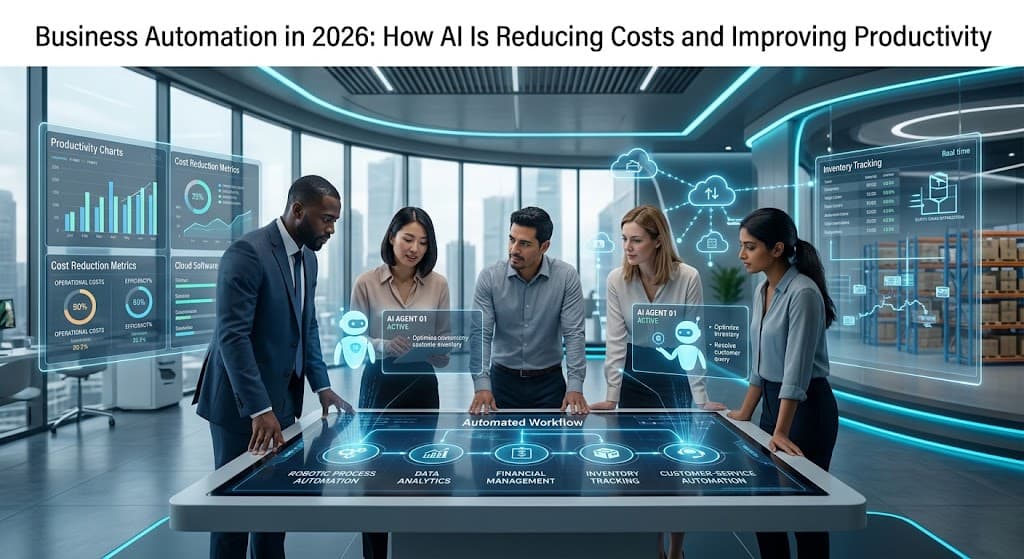
Artificial intelligence has evolved from an emerging technology into a core business capability. Companies are integrating AI into customer service, finance, marketing, manufacturing, logistics, and decision-making processes to improve productivity and reduce costs.
Beyond automating repetitive tasks, AI is helping organizations forecast demand, optimize pricing, personalize customer experiences, and uncover valuable insights from large datasets. Businesses that adopt AI strategically are creating faster workflows, improving operational efficiency, and gaining a competitive advantage.
2. Inflation Is Easing, but Cost Discipline Remains Essential
While inflation has moderated in many economies compared with previous years, businesses continue to face pressure from labor costs, transportation expenses, energy prices, and raw material volatility.
Rather than relying solely on price increases, organizations are focusing on productivity improvements, supply chain optimization, and automation to protect profitability while maintaining product quality and customer satisfaction.
3. Supply Chain Resilience Is a Competitive Advantage
Recent global disruptions have encouraged companies to rethink their supply chain strategies. Instead of depending on a single supplier or manufacturing location, businesses are diversifying suppliers, expanding regional sourcing, and adopting digital tools that provide greater visibility across logistics networks.
A resilient supply chain helps reduce delays, minimize operational risks, and improve responsiveness during periods of economic uncertainty.
4. Sustainability Is Becoming a Core Business Strategy
Environmental sustainability is increasingly influencing investment decisions, consumer preferences, and regulatory expectations. Businesses are incorporating renewable energy, energy-efficient operations, recyclable packaging, and responsible sourcing into their long-term strategies.
Beyond meeting environmental goals, sustainability initiatives often reduce operating costs, strengthen brand reputation, and enhance customer loyalty.
5. Digital Transformation Continues to Accelerate
Organizations are investing heavily in cloud computing, automation, cybersecurity, data analytics, and digital collaboration platforms to modernize operations and improve customer experiences.
Digital transformation enables businesses to respond faster to market changes, improve decision-making, and deliver more personalized products and services.
6. Cybersecurity Has Become a Business Imperative
As digital adoption grows, cybersecurity is now a strategic priority rather than solely an IT responsibility. Organizations are investing in:
Advanced threat detection systems
Multi-factor authentication
Employee cybersecurity awareness training
Data encryption
Secure cloud infrastructure
Incident response and recovery planning
Strong cybersecurity protects critical business assets, reduces operational risk, and reinforces customer trust.
7. Consumer Expectations Continue to Evolve
Modern consumers increasingly value convenience, personalization, transparency, and seamless digital experiences. Businesses are responding by offering:
Personalized product recommendations
Flexible payment solutions
Subscription-based services
Faster delivery options
Omnichannel customer experiences
Improved customer support
Companies that continuously adapt to changing consumer behavior are better positioned to build long-term customer loyalty.
8. Investment in Innovation Is Driving Growth
Despite economic uncertainty, many organizations are increasing investment in technologies such as artificial intelligence, robotics, financial technology, clean energy, biotechnology, and advanced manufacturing.
Innovation enables businesses to improve efficiency, develop new revenue streams, and remain competitive in rapidly changing markets.
9. Workforce Transformation Continues
Hybrid work, digital collaboration, and continuous learning are reshaping modern organizations. Businesses are investing in employee development to strengthen skills in AI, cybersecurity, cloud computing, and data analytics.
A well-trained workforce enables companies to adapt more effectively to technological change and evolving business requirements.
10. Regional Trade Is Reshaping Global Commerce
Businesses are increasingly expanding within regional markets while reducing dependence on distant supply chains. Localized production and regional trade partnerships improve delivery times, reduce transportation costs, and strengthen supply chain resilience.
This strategy allows organizations to respond more effectively to geopolitical uncertainty and changing customer demand.
Key Challenges Facing Businesses in 2026
Despite new opportunities, organizations continue to face several significant challenges:
Economic uncertainty
Cybersecurity threats
Talent shortages
Regulatory compliance
Climate-related risks
Rising customer expectations
Increasing global competition
Businesses that remain agile, data-driven, and customer-focused are more likely to overcome these challenges successfully.
Strategic Priorities for Business Leaders
To remain competitive in today's evolving economy, organizations should prioritize:
Investing in artificial intelligence and automation
Strengthening cybersecurity
Building resilient supply chains
Accelerating digital transformation
Developing workforce skills
Improving customer experiences
Advancing sustainability initiatives
Using data and analytics to support decision-making
Conclusion
The global economy in 2026 is being reshaped by technological innovation, evolving consumer expectations, sustainability, and shifting trade dynamics. Success increasingly depends on an organization's ability to embrace change, invest in innovation, and respond quickly to emerging challenges.
Businesses that combine artificial intelligence, digital transformation, resilient operations, and customer-centric strategies will be better positioned to achieve sustainable growth. By understanding these economic trends and adapting proactively, organizations can strengthen their competitive position and create long-term value in an increasingly dynamic global marketplace.
FAQs: Global Economic Trends Shaping Business Decisions in 2026
1. What are the major global economic trends shaping business decisions in 2026?
Key trends include changing interest rates, inflation pressures, geopolitical uncertainty, shifting trade policies, AI-driven productivity, supply-chain restructuring, energy-market changes, and evolving consumer behavior.
2. How is inflation affecting businesses in 2026?
Inflation can increase costs for labor, materials, transportation, and energy. Businesses are responding through pricing strategies, cost optimization, supplier diversification, and greater operational efficiency.
3. Are interest rates influencing business investment decisions?
Yes. Interest rates affect borrowing costs, investment returns, expansion plans, mergers and acquisitions, and consumer spending. Companies are carefully evaluating financing costs before making major capital investments.
4. How is AI influencing the global economy?
AI is changing productivity, employment, customer experiences, software development, and business operations. Companies are investing in AI to automate processes, improve decision-making, and create new products and services.
5. Why is geopolitical uncertainty important for businesses?
Geopolitical tensions can affect trade, investment, energy supplies, regulations, and supply chains. Businesses are increasingly incorporating geopolitical risk into strategic planning.
6. How are global supply chains changing in 2026?
Many companies are focusing on supply-chain resilience by diversifying suppliers, increasing regional sourcing, improving inventory visibility, and reducing dependence on single markets or suppliers.
7. What role does energy pricing play in business decisions?
Energy costs directly influence operating expenses, transportation, manufacturing, and data-center operations. Businesses are increasingly considering energy efficiency and alternative energy sources as part of long-term strategy.
8. How are changing trade policies affecting businesses?
Tariffs, trade restrictions, export controls, and changing international agreements can increase costs and disrupt established supply chains. Companies may need to reconsider sourcing, manufacturing, and market-entry strategies.
9. Is consumer spending changing in 2026?
Consumer behavior continues to respond to inflation, employment conditions, interest rates, and economic confidence. Businesses are using pricing, personalization, and value-focused products to adapt to changing customer priorities.
10. How does currency volatility affect international businesses?
Currency fluctuations can affect revenues, import costs, profits, and international investments. Companies operating across multiple markets may use financial hedging and geographic diversification to manage currency risk.
11. Why is productivity becoming a major economic priority?
Slower workforce growth and rising costs are encouraging businesses to find ways to produce more with existing resources. Automation, AI, process optimization, and workforce upskilling are increasingly important productivity strategies.
12. How are businesses responding to economic uncertainty?
Companies are emphasizing financial flexibility, scenario planning, cost control, diversified supply chains, and investments that can generate measurable returns while avoiding unnecessary long-term commitments.
13. What industries are most affected by global economic changes?
Industries such as manufacturing, finance, retail, technology, energy, logistics, construction, and international trade can be particularly sensitive to changes in interest rates, consumer demand, energy prices, regulations, and geopolitical conditions.
14. How can businesses prepare for economic changes in 2026?
Businesses can prepare by monitoring economic indicators, developing multiple scenarios, strengthening cash-flow management, diversifying suppliers and markets, investing in productivity, and maintaining flexible operating strategies.
15. What will be the biggest economic challenge for businesses in 2026?
There is no single challenge for every organization. Businesses may need to balance economic uncertainty with the need to invest in growth, technology, AI, cybersecurity, talent, and infrastructure. The ability to adapt quickly will be a major competitive advantage.