
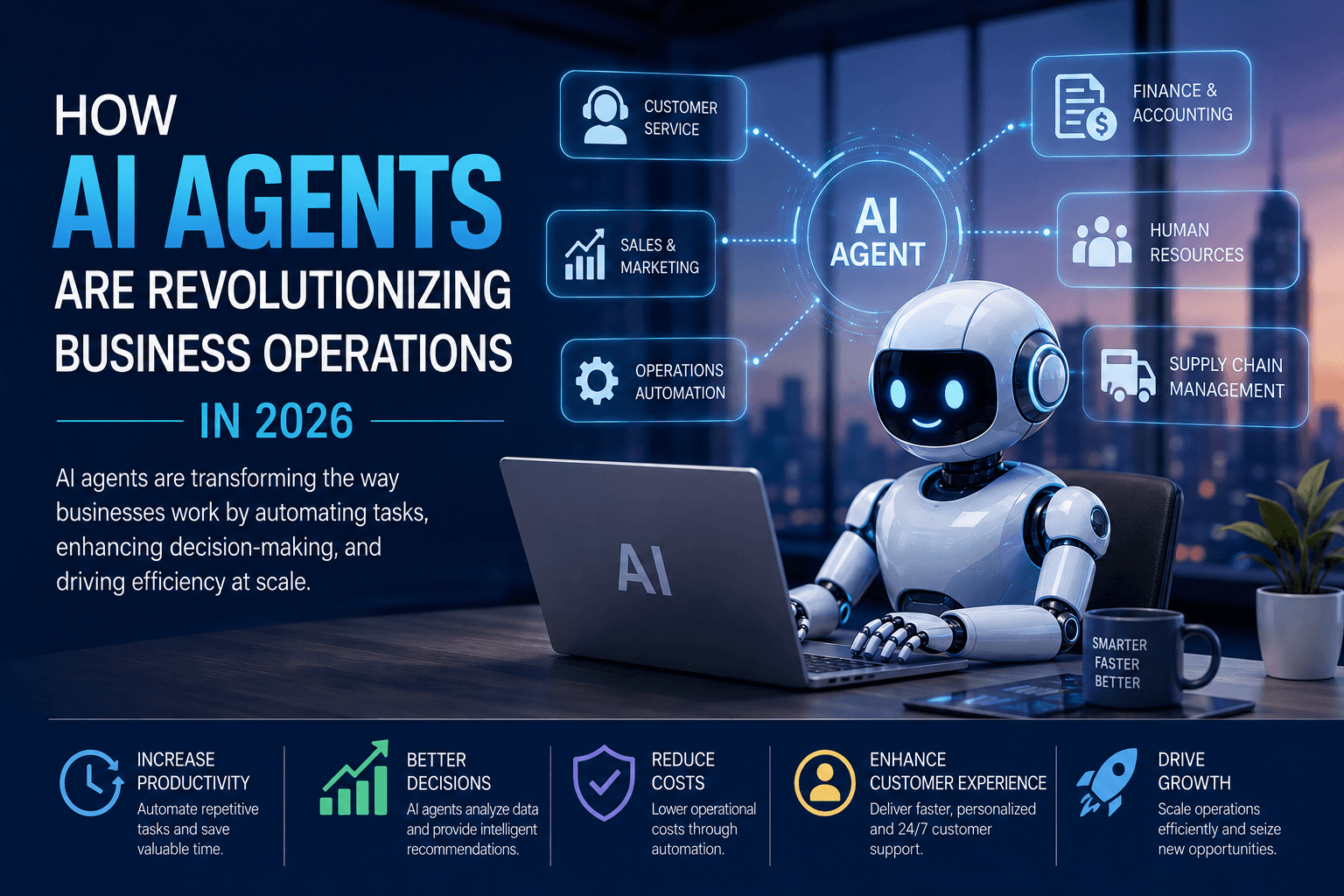

Artificial intelligence has moved beyond simple chatbots and automated tools. In 2026, AI agents are becoming active participants in business operations, capable of understanding goals, making decisions, using software, coordinating tasks, and completing multi-step workflows with limited human intervention.
From customer service and sales to finance, human resources, cybersecurity, and supply-chain management, AI agents are helping organizations work faster, reduce repetitive workloads, and make better use of their data.
What Are AI Agents?
AI agents are software systems designed to pursue a specific objective by observing information, reasoning about what needs to be done, using available tools, and taking actions.
Unlike traditional automation, which generally follows predefined rules, AI agents can handle more dynamic situations. For example, an AI agent supporting a sales team might:
Identify a potential customer.
Research relevant information.
Update the CRM.
Draft a personalized email.
Schedule a follow-up.
Analyze the customer's response.
Escalate the opportunity to a salesperson when human involvement is needed.
This ability to manage several connected steps is one of the reasons businesses are increasingly interested in agentic AI.
How AI Agents Are Changing Business Operations
1. Automating Repetitive Work
Employees spend significant amounts of time on repetitive administrative tasks such as data entry, document processing, scheduling, reporting, and email management.
AI agents can take over many of these activities and operate across multiple business applications. This allows employees to spend more time on strategic, creative, and relationship-focused work.
2. Transforming Customer Service
AI agents are making customer support more responsive and personalized.
They can answer routine questions, search knowledge bases, check order information, troubleshoot common problems, and route complex cases to human representatives. Because agents can operate around the clock, businesses can provide support outside traditional working hours.
The biggest shift is that AI is moving from simply answering questions toward taking action on behalf of customers.
3. Improving Sales and Marketing
Sales teams can use AI agents to identify prospects, research accounts, summarize customer interactions, prepare proposals, and recommend next steps.
Marketing teams can also use agents to analyze campaigns, segment audiences, generate content ideas, monitor performance, and identify opportunities for optimization.
Rather than replacing entire sales or marketing departments, AI agents can function as digital assistants that increase the capacity of existing teams.
4. Streamlining Finance and Accounting
Finance departments handle large volumes of structured information, making them well suited to AI-assisted workflows.
AI agents can help reconcile transactions, classify expenses, prepare reports, monitor unusual activity, collect information for audits, and assist with invoice processing.
Human oversight remains particularly important for financial decisions, compliance, and high-impact transactions, but agents can significantly reduce manual workload.
5. Supporting Human Resources
HR teams can use AI agents to assist with employee onboarding, answer policy questions, organize documentation, schedule interviews, and help employees find relevant internal resources.
For recruitment, AI can assist with administrative processes and candidate communication. However, organizations need strong safeguards when AI is involved in employment decisions to reduce bias and maintain fairness.
6. Optimizing Supply Chains
Supply-chain operations involve constantly changing information, including inventory levels, demand, supplier performance, transportation conditions, and delivery schedules.
AI agents can monitor these variables and recommend or initiate actions when predefined business rules and approval requirements are satisfied.
This can help companies respond more quickly to disruptions and improve coordination between different parts of the supply chain.
AI Agents and Decision-Making
One of the most important developments in 2026 is the increasing use of AI agents for decision support.
Agents can combine information from business systems, analyze patterns, compare alternatives, and provide recommendations. In some low-risk workflows, they can also execute approved actions automatically.
However, businesses should distinguish between decisions that can safely be automated and those that require human approval.
A useful approach is:
AI analyzes → AI recommends → human approves → AI executes.
As confidence and governance improve, organizations can gradually automate appropriate portions of the workflow.
Benefits of AI Agents for Businesses
Organizations adopting AI agents can potentially gain several advantages:
Higher productivity: Employees can delegate repetitive tasks to AI.
Faster operations: Agents can process information and perform tasks continuously.
Lower operational costs: Automation can reduce the amount of manual effort required for routine processes.
Improved customer experiences: Customers can receive faster and more personalized assistance.
Better use of data: Agents can connect information from multiple systems and help employees act on it.
Scalability: Businesses can handle growing workloads without increasing every operational resource proportionally.
24/7 availability: Digital agents can operate continuously.
Challenges Businesses Need to Consider
Despite their potential, AI agents are not a magic solution.
Security and Privacy
Agents may have access to sensitive company systems and information. Organizations therefore need strong authentication, access controls, monitoring, and data-protection policies.
Accuracy and Reliability
AI systems can still make incorrect assumptions or produce unreliable outputs. Critical workflows should include validation and human oversight.
Excessive Autonomy
Giving an AI agent unrestricted access to financial systems, customer records, or other sensitive infrastructure can create significant risks. Permissions should be limited according to the agent's responsibilities.
Integration
Many organizations rely on legacy software and disconnected systems. Connecting AI agents to these environments can require substantial technical work.
Governance
Companies need clear policies defining what agents are allowed to do, when they must request approval, how their actions are recorded, and who is responsible when something goes wrong.
How Companies Can Prepare for an Agentic Future
Businesses do not need to automate everything at once. A practical implementation strategy starts with identifying workflows that are repetitive, measurable, and relatively low risk.
Companies can then:
Identify a specific business problem.
Map the existing workflow.
Determine where an AI agent can add value.
Start with limited permissions.
Establish human-approval checkpoints.
Monitor performance and errors.
Measure business outcomes.
Expand gradually after successful testing.
The most successful organizations are likely to treat AI agents as part of their broader workforce and technology strategy rather than as isolated software experiments.
The Future of AI Agents in Business
AI agents are likely to become increasingly integrated into everyday business software. Instead of employees switching between numerous applications and manually coordinating tasks, agents may increasingly act as an intelligent layer connecting systems, information, and workflows.
The result could be a workplace where people focus more heavily on judgment, creativity, leadership, relationships, and complex problem-solving while AI handles a growing share of routine coordination and execution.
The key question for businesses in 2026 is therefore no longer simply “Can we use AI?” It is:
“Which business processes should AI agents handle, and where should humans remain in control?”
Companies that answer this question carefully can use agentic AI to improve efficiency while maintaining security, accountability, and human oversight.
Frequently Asked Questions
1. What is an AI agent?
An AI agent is a software system that can pursue a goal by interpreting information, reasoning about possible actions, using digital tools, and completing tasks with varying levels of autonomy.
2. How are AI agents different from chatbots?
Traditional chatbots primarily respond to user messages. AI agents can go further by planning multi-step tasks, interacting with software systems, retrieving information, and taking authorized actions.
3. Can AI agents replace employees?
AI agents are more commonly used to automate tasks and augment employees rather than replace entire jobs. Their impact will vary by industry and role, with repetitive activities generally being easier to automate than work requiring complex judgment or human relationships.
4. Which industries can benefit from AI agents?
Almost any information-intensive industry can benefit, including finance, healthcare administration, retail, manufacturing, logistics, education, professional services, telecommunications, and technology.
5. Are AI agents safe for business use?
They can be used safely when organizations implement appropriate access controls, monitoring, testing, data protection, and human oversight. High-impact actions should generally receive additional safeguards.
6. How much does it cost to implement AI agents?
Costs vary significantly depending on the AI technology, number of users, integrations, data requirements, security controls, and complexity of the workflow. Businesses should evaluate projects based on measurable business value rather than simply the cost of the AI system.
7. What is the best way to start using AI agents?
Start with one well-defined, repetitive workflow where success can be measured. Test the agent in a controlled environment, establish approval rules, monitor results, and expand only after demonstrating reliable performance.
Conclusion
AI agents are becoming an important component of business operations in 2026. Their ability to reason across tasks, interact with software, and execute workflows gives organizations new opportunities to improve productivity and responsiveness.
However, successful adoption depends on more than deploying an AI model. Businesses need thoughtful workflow design, secure integrations, reliable monitoring, clear governance, and appropriate human oversight.
The organizations that combine AI autonomy with human judgment will be best positioned to turn agentic AI from an emerging technology into a practical competitive advantage.