
For decades, businesses have depended on software applications to manage almost every part of their operations. Companies purchased CRM platforms for customer relationships, ERP systems for finance and operations, project-management tools for collaboration, help-desk platforms for customer support, and countless specialized applications for individual business functions.
That model is now changing.
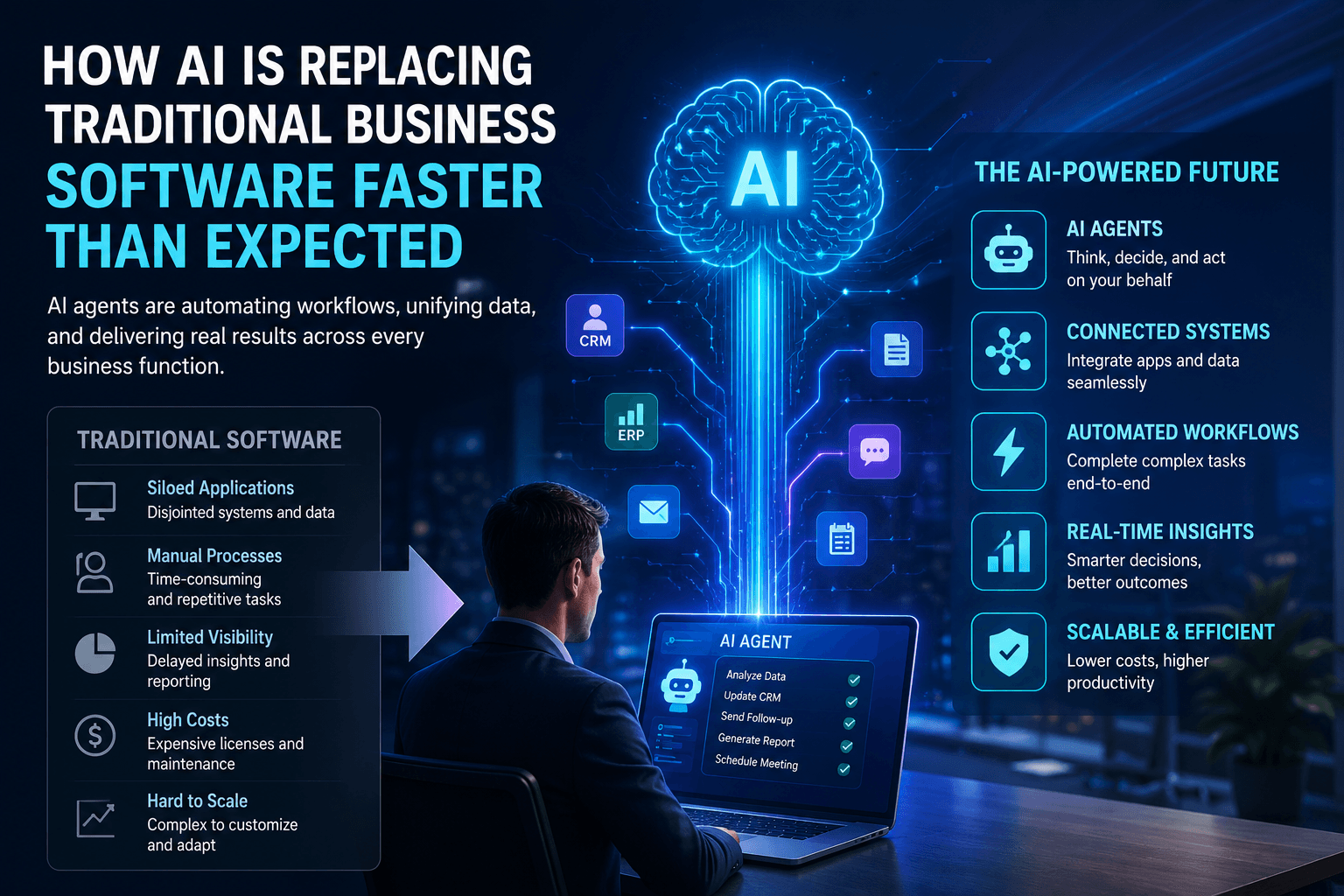
Artificial intelligence is moving beyond being a feature inside traditional software and becoming an execution layer that can perform work directly. Instead of employees opening an application, navigating dashboards, entering information, and clicking through workflows, AI agents can increasingly interpret instructions, access business data, use connected tools, and complete multi-step tasks.
This does not mean traditional software will disappear overnight. However, the economics and design of business software are changing faster than many enterprises expected.
From Software as a Tool to AI as an Operator
Traditional business software was designed around human interaction.
A typical workflow looks like this:
Employee → Software interface → Manual action → Result
An employee logs into a CRM, searches for a customer, updates a record, creates a task, sends an email, and checks a report.
The emerging AI model looks different:
Employee → AI agent → Connected systems → Completed outcome
Instead of telling an employee which buttons to click, the user can increasingly describe the desired result.
For example:
“Find our highest-value inactive customers, identify why they stopped purchasing, and prepare personalized follow-up actions.”
An AI agent can potentially analyze customer records, examine activity, identify patterns, and coordinate actions across multiple systems.
This represents a fundamental change in how businesses interact with software.
Why Traditional SaaS Is Under Pressure
Software-as-a-Service transformed enterprise computing by moving applications into the cloud and replacing many traditional licenses with recurring subscriptions.
But SaaS still largely assumes that humans are the primary users.
AI changes that assumption.
If an AI agent can perform a task directly through an API, the human may no longer need to interact with the application's graphical interface for every step.
This creates pressure on software companies to make their products agent-accessible, not just user-friendly.
Research into the changing economics of enterprise software argues that AI can make building certain applications internally more attractive, particularly for commodity functions and highly differentiated workflows, although regulated and mission-critical systems are likely to remain more dependent on established vendors. (arXiv)
AI Agents Are Becoming the New Software Interface
The rise of AI agents is changing the role of the traditional dashboard.
Instead of employees learning dozens of different interfaces, AI could become a common interaction layer across multiple applications.
For example, an employee might ask:
“Prepare this month's sales forecast and explain the three biggest risks.”
The agent could retrieve information from the CRM, analyze pipeline activity, compare historical performance, and produce the report without requiring the employee to manually open multiple applications.
Salesforce is already developing this type of agentic enterprise model, with its 2026 platform releases focused on multi-agent orchestration, real-time data activation, and AI-powered workflows. (Salesforce)
Microsoft is taking a similar approach. Its 2026 Business Central roadmap includes autonomous agents capable of automating processes such as accounts payable while maintaining human oversight. (Microsoft Learn)
CRM Software Is Becoming Agentic
Customer relationship management is one of the clearest examples.
Traditional CRM systems primarily store customer information and help salespeople manage relationships.
AI-powered CRM systems increasingly aim to act on that information.
An agent can potentially:
Research prospects
Update customer records
Identify sales opportunities
Draft communications
Schedule follow-ups
Analyze pipeline risks
Summarize meetings
Recommend next actions
Salesforce's 2026 research found that AI and AI agents were the top growth tactic identified by surveyed sales teams, with respondents expecting AI agents to significantly reduce time spent on research and content creation. (Salesforce)
The result is a transition from CRM as a database toward CRM as an active revenue system.
ERP Systems Are Also Getting AI Agents
Enterprise resource planning systems traditionally require employees to manually manage invoices, purchasing, inventory, accounting, and other operational processes.
AI agents are beginning to automate portions of these workflows.
Microsoft's Business Central documentation, for example, describes a Payables Agent that can read invoices, match vendors and accounts, and prepare invoices for approval with human oversight. (Microsoft Learn)
This illustrates an important distinction.
AI is not necessarily replacing the underlying ERP database.
Instead, it is increasingly replacing the manual work employees perform inside the ERP.
That distinction may become central to the future of enterprise software.
The Real Threat to Software Companies
The biggest threat may not be that businesses stop using software.
It may be that businesses stop using software directly.
A company could continue using a CRM, accounting platform, HR system, or ERP while employees interact primarily through AI agents.
In this scenario, the software remains important because it contains the data and business logic.
But its interface becomes less important.
This creates a new competitive question for software vendors:
Is your product designed only for humans, or can AI agents use it effectively too?
The Rise of Agent-Native Software
Traditional applications were designed around screens, forms, menus, dashboards, and workflows.
Agent-native applications need something different.
They must provide:
Reliable APIs
Structured business data
Clearly defined actions
Permission controls
Audit trails
Context for AI agents
Machine-readable workflows
Strong security boundaries
Salesforce has described the evolution of enterprise agents as requiring reliable execution, deterministic guardrails, and better context management. (Salesforce)
This means software companies increasingly need to design for machine interaction as well as human interaction.
AI Could Reduce the Number of Applications Employees Use
One of the most interesting consequences of agentic AI is application consolidation.
The average employee may currently use dozens of applications throughout a working day.
They may switch between:
Email
CRM
Project management
Spreadsheets
Analytics
Customer support
HR software
Communication platforms
Document management
Accounting systems
AI agents could increasingly sit above these systems and coordinate tasks between them.
Instead of employees learning every individual application, they could communicate with an AI assistant that understands the company's connected software environment.
This could reduce the number of interfaces employees need to use regularly.
The "SaaS Apocalypse" May Be More Complicated
The idea that AI will simply kill SaaS is attractive, but reality is more complicated.
Businesses still need reliable databases, security, compliance, integrations, infrastructure, and specialized business logic.
A bank cannot simply replace its core banking system with a chatbot.
A hospital cannot hand complete operational control to an uncontrolled AI agent.
Large enterprises also need systems with established reliability, support, compliance, and auditability.
Recent research on the changing buy-versus-build economics of enterprise software argues that predictions of a complete SaaS collapse are overstated. AI may make internal development more attractive for certain commodity or highly differentiated applications, while mission-critical and regulated systems continue to favor established software vendors. (arXiv)
The likely future is therefore not “AI replaces all software.”
It is:
AI changes what businesses expect software to do.
From Seat-Based Pricing to Outcome-Based Pricing
Another major change could involve software pricing.
Traditional SaaS often charges based on the number of users or seats.
But if AI agents perform tasks instead of employees, the number of human users becomes a less useful measure of software consumption.
This is already creating pressure for alternative pricing models.
Recent reporting on AI-native legal technology shows companies experimenting with usage-based pricing because AI workloads can vary significantly between customers. (Business Insider)
The industry could increasingly move toward pricing based on:
Tasks completed
Transactions processed
AI usage
Compute consumption
Outcomes achieved
Revenue generated
That could fundamentally change the economics of enterprise software.
AI Is Also Changing Software Development
AI is not only replacing software usage; it is also changing how software itself is built.
AI coding agents can generate applications, modify existing code, test systems, and automate portions of software development.
This creates another challenge for traditional SaaS companies.
If businesses can build specialized internal tools more quickly and cheaply with AI, some organizations may choose to develop software themselves rather than purchasing another subscription.
Academic research published in 2026 describes this as a fundamental shift in the economics of the enterprise software "make-or-buy" decision. (arXiv)
However, this does not mean every company will become a software company.
Building reliable enterprise software still requires security, governance, maintenance, integrations, domain expertise, and infrastructure.
What Happens to Traditional Software Vendors?
Software companies have several possible responses.
1. Add AI Features
The simplest approach is to add AI assistants to existing products.
2. Build Autonomous Agents
Vendors can allow AI agents to perform complete workflows instead of merely providing recommendations.
3. Become an Agent Platform
Companies can provide infrastructure that allows customers and developers to build, manage, and govern multiple AI agents.
4. Become the System of Record
Software vendors can focus on protecting the underlying data and business logic that AI agents depend on.
The companies that successfully combine these approaches may be better positioned for the transition.
Human Oversight Will Remain Important
Autonomous software does not mean businesses should remove humans from important decisions.
AI agents can make mistakes, misunderstand context, or act on incomplete information.
For high-impact processes, companies will still need:
Approval workflows
Human escalation
Access controls
Monitoring
Audit logs
Data governance
Security policies
Microsoft's enterprise-agent approach, for example, emphasizes responsible AI and human oversight for autonomous business processes. (Microsoft Learn)
The future is therefore likely to involve human-directed autonomy, rather than completely uncontrolled automation.
What Businesses Should Do Now
Companies should not immediately abandon their existing software.
Instead, they should evaluate how AI can change the way those systems are used.
A practical strategy includes:
Identify repetitive software-based tasks.
Determine which workflows can safely be handled by AI.
Improve the quality of business data.
Connect important systems through secure APIs.
Establish AI permissions and approval processes.
Test agents on low-risk workflows.
Measure cost savings and productivity improvements.
Gradually expand autonomous capabilities.
The objective should be to build an AI-native operating model, not simply add another chatbot to an existing software stack.
The Future: Software Becomes Infrastructure for AI
The most important change may be conceptual.
For decades, software was designed primarily for humans.
Increasingly, software is becoming infrastructure that AI agents operate.
The database remains.
The business rules remain.
The APIs remain.
The security layer remains.
But the primary interface may shift from a human clicking through screens to an AI system interpreting goals and executing tasks.
That could make software dramatically more powerful.
It could also make traditional application categories less distinct.
A single AI agent could potentially perform activities that previously required separate CRM, analytics, communication, project-management, and research applications.
Conclusion
AI is not simply adding another feature to traditional business software. It is changing the relationship between businesses and software itself.
The traditional model was built around employees using applications.
The emerging model is increasingly built around AI agents using applications on behalf of employees.
That distinction could reshape the enterprise software market over the next several years.
CRM, ERP, customer service, project management, analytics, and other software categories are unlikely to disappear overnight. Instead, their interfaces, pricing models, workflows, and competitive advantages are likely to change as AI becomes a more capable execution layer.
The winners may not necessarily be the companies that eliminate software.
They may be the companies that make software easier for AI to use, easier for humans to control, and more valuable when both work together.
The transition has already begun. Salesforce is building multi-agent enterprise workflows, Microsoft is embedding autonomous agents into business applications, and researchers are examining how AI is changing the economics of building and buying enterprise software. (Salesforce)
The next generation of business software may therefore look less like a collection of applications and more like an intelligent operating layer for the entire enterprise.
FAQs
1. Is AI really replacing traditional business software?
AI is not replacing all traditional software, but it is increasingly replacing some of the manual work people perform inside software applications. AI agents can interact with business systems and execute multi-step workflows.
2. What is an AI agent in business software?
An AI agent is a goal-oriented system capable of interpreting instructions, accessing relevant information, performing tasks, and taking actions within defined permissions and guardrails. (Salesforce)
3. Will SaaS disappear because of AI?
A complete disappearance of SaaS is unlikely. AI is more likely to transform SaaS by changing interfaces, pricing, workflows, and how users interact with applications.
4. Which business software is most vulnerable to AI disruption?
Software built around repetitive, rules-based workflows and simple information retrieval may face stronger AI-driven disruption than highly specialized, regulated, or mission-critical systems.
5. Will employees still use business applications?
Yes, but employees may increasingly interact with applications through AI agents rather than manually navigating every feature.
6. How will AI change CRM software?
AI can turn CRM systems from passive databases into active systems that research prospects, update records, identify opportunities, summarize interactions, and recommend or execute next actions.
7. Will AI make companies build their own software?
In some cases, yes. AI-assisted development can reduce the cost and time required to create customized applications, particularly for internal workflows. However, complex and regulated systems will still require significant expertise and infrastructure.
8. Will software pricing change because of AI?
Potentially. AI may accelerate the shift from traditional per-user pricing toward usage-based, task-based, or outcome-based pricing because AI agents can perform work without requiring a separate human software seat.
9. What is agent-native software?
Agent-native software is designed to be used effectively by AI agents as well as humans. It typically emphasizes APIs, structured data, machine-readable actions, permissions, context, and reliable execution.
10. What should businesses do about the AI software shift?
Businesses should begin by identifying repetitive workflows, improving data quality, testing AI agents in controlled environments, establishing governance, and gradually increasing automation where the business case and risk profile make sense.