
Press releases have been part of digital marketing and public relations for decades. Businesses use them to announce new products, partnerships, company milestones, investments, events, executive appointments, research findings, and other developments.
But as search engines have become more sophisticated, an important question has emerged: Do press releases still provide SEO value in 2026?
The answer is more nuanced than a simple yes or no.
A press release should not be viewed as a shortcut for rankings or a way to manufacture backlinks. Its strongest value comes from communicating genuine news, increasing visibility, supporting brand awareness, and potentially attracting independent coverage from journalists and publishers.
Google's search systems continue to emphasize helpful, original, trustworthy content rather than content created primarily to manipulate rankings. That makes the quality, purpose, and distribution of a press release more important than the number of links it contains.
What Is a Press Release?
A press release is an official announcement issued by a company, organization, government body, or other entity to communicate newsworthy information.
Common examples include:
Product launches
Business expansions
Company acquisitions
New partnerships
Funding announcements
Executive appointments
Industry research
Major events
Awards and achievements
New services
Corporate milestones
Traditional press releases were primarily designed for journalists and news organizations. Today, they are also distributed through digital newswire platforms and company websites.
Do Press Releases Help SEO in 2026?
Press releases can contribute to an overall SEO and digital marketing strategy, but their value should not be measured simply by how many backlinks they generate.
A well-written release can help people discover a company and its news. If journalists, bloggers, industry publications, or other independent websites find the announcement useful, they may choose to cover the story themselves.
That independent coverage can produce valuable exposure and, where appropriate, editorial links.
The important distinction is between earning attention and trying to manipulate search rankings through press-release links.
Press Release Links Are Not a Ranking Shortcut
One of the biggest misconceptions about online press releases is that publishing the same release across many websites automatically creates powerful SEO backlinks.
Search engines are designed to identify attempts to manipulate rankings through artificial or low-quality linking practices.
Links included in press releases distributed across multiple sites generally should not be treated as equivalent to independently earned editorial links.
The purpose of a press release should therefore be communication and publicity rather than link manipulation.
Why Original News Matters
A press release has greater potential value when it contains something genuinely newsworthy.
For example, a company announcing a significant product launch may attract attention because the information is new.
By contrast, a generic announcement containing exaggerated claims and repetitive keywords is unlikely to provide meaningful value to readers.
Businesses should ask:
“Why would a journalist, customer, or industry reader care about this announcement?”
If the answer is clear, the release has a stronger foundation.
Press Releases and Brand Visibility
Brand visibility is one of the most important benefits of digital PR.
A press release can place a company's name, product, executives, or research in front of audiences that may not discover the business through traditional search alone.
Repeated exposure can contribute to brand recognition.
For example, someone who sees a company mentioned in an industry publication may later search for that company by name. This type of branded discovery can be valuable even when the original press release does not directly improve rankings.
Press Releases Can Support E-E-A-T Signals Indirectly
Google's systems consider signals related to experience, expertise, authoritativeness, and trustworthiness.
A press release does not automatically create these signals. However, legitimate media coverage and references to a company's expertise can contribute to a broader online reputation.
This is especially relevant for businesses operating in industries where credibility matters, such as finance, healthcare, technology, professional services, and education.
The key is that reputation should be earned through genuine activity and credible coverage rather than manufactured through large volumes of promotional content.
The Difference Between Press Releases and Editorial Coverage
There is an important difference between publishing a company announcement and earning independent media coverage.
A press release represents the company's own statement.
Editorial coverage is created independently by a journalist or publisher who decides that the story is relevant to their audience.
The second type of coverage can be especially valuable because it may provide:
Independent visibility
Brand mentions
Referral traffic
Industry credibility
Potential editorial links
New audiences
A strong PR campaign therefore aims to use the press release as a starting point for broader media outreach.
How Google Updates Affect Press Release SEO
Google regularly improves its search systems to better identify useful content and reduce manipulative SEO practices.
These changes do not mean that legitimate public relations has become irrelevant.
Instead, they reinforce the importance of creating content for people rather than search engines.
A press release stuffed with keywords, copied repeatedly across websites, or created solely to obtain links is unlikely to be a strong SEO strategy.
A factual announcement about a real company development is a different matter.
Keyword Stuffing Can Reduce Content Quality
Businesses sometimes attempt to optimize press releases by repeating the same keyword throughout the headline, introduction, subheadings, and body.
This can make the announcement difficult to read.
Modern SEO focuses much more on relevance and usefulness than simply repeating exact-match keywords.
A better approach is to write naturally and explain the news clearly.
Relevant terminology can appear naturally where it helps readers understand the announcement.
Duplicate Distribution Is Not the Same as Multiple Editorial Stories
Press releases are frequently distributed to multiple newswire websites.
This can create many copies of essentially the same announcement.
However, having the same release appear on numerous websites does not necessarily mean that a business has earned dozens of independent editorial references.
Search engines can recognize that syndicated material may originate from the same source.
Businesses should therefore avoid assuming that every syndicated copy represents a separate SEO victory.
When Press Releases Are Worth Using
Press releases can be particularly useful when a company has genuinely significant news.
Examples include:
Major Product Launches
A new product with meaningful market relevance can provide a strong reason for a press release.
Business Partnerships
Strategic partnerships can be newsworthy when they create a meaningful development for customers or an industry.
Funding and Investment
Significant funding announcements may attract attention from business and financial publications.
Expansion
Entering a new market, opening a major facility, or expanding operations can provide legitimate news value.
Research and Data
Original research can attract journalists and publishers when the findings provide useful or interesting information.
Major Corporate Milestones
Important company milestones may be suitable for public announcements when they have genuine relevance to an audience.
When a Press Release Is Probably Not Worth It
Not every company update needs a press release.
Minor internal announcements, routine website changes, generic marketing claims, and weak promotional messages may not provide enough news value.
Publishing large numbers of low-value releases can also make a PR strategy appear repetitive.
Quality is generally more useful than volume.
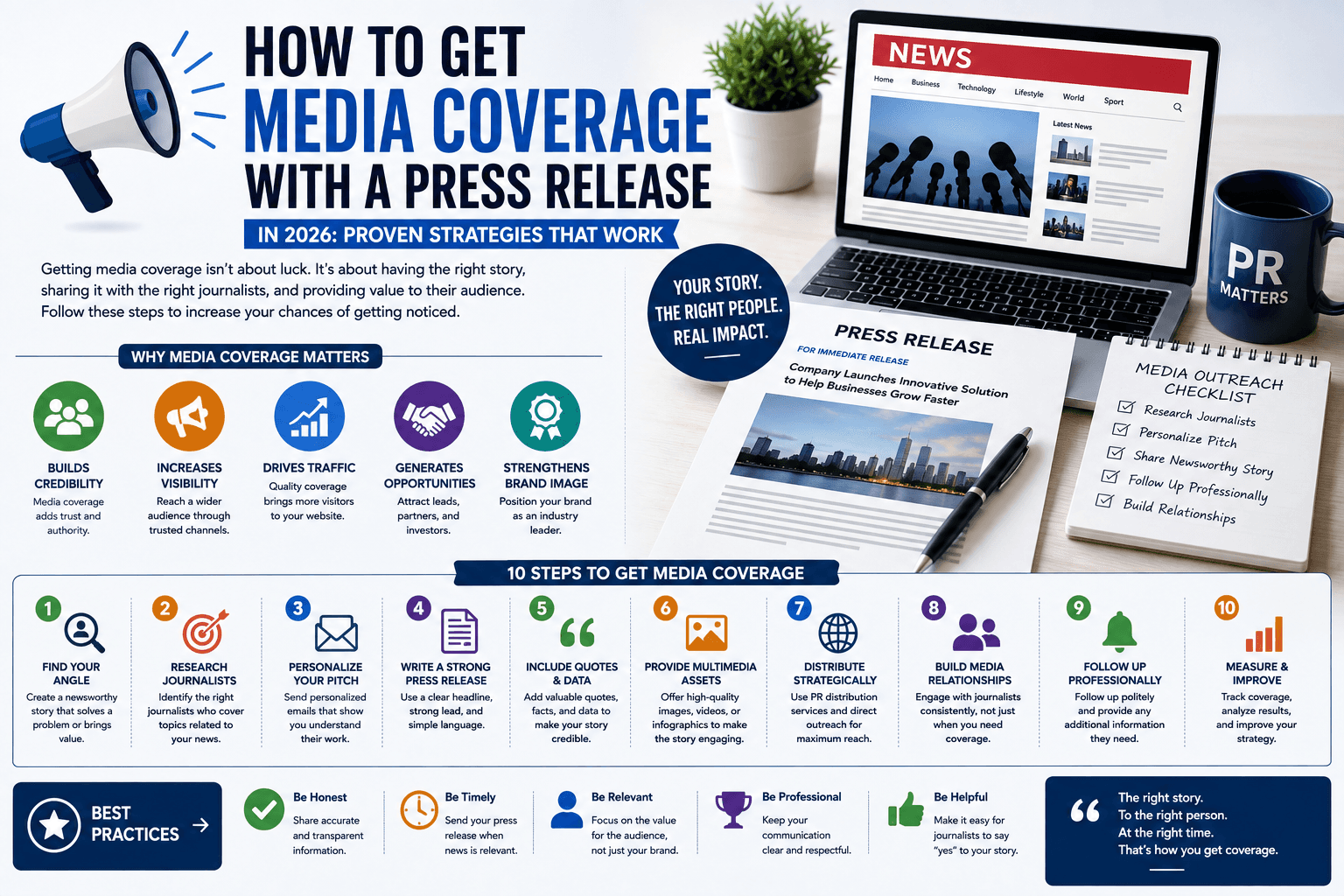
How to Write an SEO-Friendly Press Release in 2026
An effective press release should prioritize readers first.
1. Start With Genuine News
Lead with the most important development.
2. Write a Clear Headline
The headline should communicate what happened without exaggerated language.
3. Keep the Introduction Informative
Answer the basic questions: who, what, when, where, and why.
4. Use Natural Language
Avoid excessive keyword repetition.
5. Include Supporting Information
Add relevant facts, data, quotes, and context.
6. Provide a Clear Company Description
A short boilerplate can explain what the organization does.
7. Make the Announcement Easy to Verify
Include relevant dates, names, figures, and official information where appropriate.
8. Think Beyond Backlinks
The objective should be visibility, credibility, and media interest—not simply link acquisition.
Can Press Releases Drive Referral Traffic?
Yes, depending on the quality of the distribution and audience.
A release published through a relevant publication or discovered by interested readers can send visitors to a company's website.
Referral traffic may be particularly valuable when the audience is closely related to the company's products or services.
Traffic quality matters more than raw visitor numbers.
Press Releases and Digital PR
Digital PR has expanded far beyond traditional press releases.
Modern campaigns can include:
Journalist outreach
Expert commentary
Original research
Industry reports
Data-driven stories
Interviews
Thought leadership
Newsworthy announcements
Media relationship building
A press release can be one component of this larger strategy.
Should Businesses Stop Using Press Releases for SEO?
Not necessarily.
Businesses should stop treating press releases as a direct link-building shortcut.
Instead, they can use them as part of a broader communications and digital PR strategy.
A genuine announcement can create awareness, encourage journalists to investigate a story, increase branded searches, generate referral traffic, and potentially lead to independent coverage.
The Future of Press Releases and SEO
Press releases are likely to remain useful as long as businesses have real news to communicate.
Their role in SEO, however, is changing.
The strongest strategy is increasingly based on newsworthiness, credibility, originality, and independent media attention.
Companies that focus exclusively on publishing large quantities of keyword-heavy releases may see limited value.
Those that combine high-quality announcements with genuine PR outreach have a better opportunity to turn company news into broader visibility.
Best Practices for Press Releases in 2026
Businesses can follow several practical guidelines:
Publish only when there is meaningful news.
Write primarily for readers and journalists.
Avoid keyword stuffing.
Avoid exaggerated claims.
Use accurate facts and figures.
Keep the headline clear.
Provide useful context.
Build relationships with relevant journalists.
Treat backlinks as a secondary consideration.
Focus on earning independent coverage.
Measure referral traffic and brand visibility.
Connect PR activity with broader content marketing.
Frequently Asked Questions
1. Do press releases still help SEO in 2026?
Press releases can support SEO indirectly through brand visibility, referral traffic, and potential independent media coverage. They should not be treated as a guaranteed method for improving search rankings.
2. Do press release backlinks improve Google rankings?
Links distributed through syndicated press releases should not be viewed as a reliable ranking shortcut. The greater SEO opportunity comes from earning independent editorial coverage because of genuinely newsworthy information.
3. Are press releases still useful for digital marketing?
Yes. They can help companies announce important developments, reach journalists, increase brand awareness, and generate attention around significant business events.
4. Does Google penalize all press releases?
No. Publishing a legitimate press release is not inherently a problem. The concern is using content or links primarily to manipulate search rankings.
5. Should keywords be included in a press release?
Relevant keywords can be used naturally, but excessive repetition can make the content unnatural. The release should prioritize clear communication rather than keyword density.
6. How often should a company publish press releases?
There is no universal ideal frequency. Companies should publish when they have legitimate news worth announcing rather than following an arbitrary publishing schedule.
7. Are syndicated press releases considered duplicate content?
A syndicated release may appear in substantially similar form across multiple websites. Search engines can understand that such copies may originate from the same source, so businesses should not assume that every copy creates a separate SEO advantage.
8. What makes a press release newsworthy?
Major product launches, significant partnerships, research findings, funding events, expansions, acquisitions, major appointments, and other meaningful developments can be newsworthy.
9. Can a press release generate backlinks?
It can lead to links indirectly when journalists or publishers discover the announcement and independently cover the story. That is different from publishing a release solely to create backlinks.
10. Are press release distribution services useful?
They can be useful for distributing legitimate announcements to relevant media and business audiences. Their value depends on the quality of distribution, relevance, audience, and the news itself.
11. Should every business use press releases?
No. A press release is most useful when there is meaningful information to communicate. Businesses without genuine news may benefit more from other content or PR activities.
12. Can press releases increase website traffic?
They can generate referral traffic when readers discover the announcement through relevant media or distribution channels. Results depend heavily on the news, audience, and distribution quality.
13. Are press releases a form of link building?
They are primarily a public relations tool. Treating them solely as a link-building technique can lead to poor-quality campaigns and unrealistic SEO expectations.
14. What is the difference between a press release and a news article?
A press release is an organization's official announcement. A news article is independently produced by a journalist or publisher and may provide additional reporting, analysis, and context.
15. Can press releases help a new company build awareness?
Yes. A legitimate announcement can introduce a new company, product, service, or development to journalists and potential customers.
16. Should a press release contain a lot of promotional language?
Generally, no. Excessive promotional language can reduce credibility. Strong releases focus on facts, relevance, and useful information.
17. What metrics should businesses use to measure press release performance?
Useful metrics can include media mentions, referral traffic, branded searches, audience reach, journalist interest, social engagement, and independent editorial coverage.
18. Can AI-generated press releases be used for SEO?
AI can assist with drafting and organization, but the final release should contain accurate, original, human-reviewed information. Publishing large amounts of low-value automated content is unlikely to provide meaningful long-term value.
19. Are press releases still relevant for small businesses?
Yes, particularly when a small business has a genuinely interesting local, regional, or industry development. Targeted PR can sometimes be more effective than broad distribution.
20. What is the biggest mistake businesses make with press releases?
One of the biggest mistakes is treating a press release as a guaranteed SEO or backlink strategy. Its primary purpose should be communicating real news and generating legitimate public interest.
Conclusion
Press releases are not obsolete in 2026, but their role in SEO has become more sophisticated.
The strongest value comes from real news, useful information, brand visibility, referral traffic, and independent media coverage rather than from mass-distributed links.
Businesses that approach press releases as part of a wider digital PR strategy can still benefit from them. The key is to create announcements that people actually have a reason to read and journalists have a reason to cover.
In modern SEO, credibility and genuine relevance matter far more than simply publishing more links.