Getting media coverage can help businesses, startups, organizations, and individuals reach a wider audience. A strong press release can introduce an important story to journalists and media outlets, but simply sending a press release does not guarantee coverage.
In 2026, journalists receive a large number of pitches and announcements. To stand out, businesses need a genuinely newsworthy story, relevant targeting, and a clear communication strategy.
This guide explains how to improve your chances of getting media coverage with a press release.
What Is Media Coverage?
Media coverage occurs when a journalist, publication, news website, television channel, podcast, or other media outlet chooses to report on your story.
Coverage may include:
News articles
Interviews
Product features
Industry stories
Television segments
Podcast discussions
Online publications
Local news reports
The goal is not simply to send information to as many people as possible. The goal is to present a relevant story to the right media audience.
Start with a Newsworthy Story
The most important factor in gaining media attention is having something genuinely worth reporting.
Journalists are generally interested in stories that are:
Timely
Relevant
New
Useful
Unique
Significant
Connected to current events
Potentially newsworthy announcements include:
A major product launch
Important company funding
A significant business partnership
New research or data
A major event
A community initiative
An innovative development
Before sending a press release, ask yourself:
Why should the public care about this story?
If you cannot clearly answer this question, the announcement may need a stronger angle.
Write a Strong Headline
Your headline is one of the first things a journalist will see.
A good headline should be:
Clear
Specific
Concise
Informative
For example:
Technology Startup Launches AI Platform to Help Small Businesses Improve Customer Support
This is more informative than:
Exciting News from Our Company
The headline should explain the main story immediately.
Make the Opening Paragraph Strong
The first paragraph should explain the most important information.
Try to answer:
Who is involved?
What happened?
When did it happen?
Where is it happening?
Why does it matter?
Journalists should not need to search through several paragraphs to understand the announcement.
Target the Right Journalists
Sending the same press release to thousands of irrelevant contacts is unlikely to produce strong results.
Research journalists who regularly cover topics related to your announcement.
For example:
Technology announcements → Technology journalists
Local events → Local reporters
Healthcare news → Healthcare publications
Financial news → Business and finance journalists
Relevant targeting is often more valuable than sending a message to the largest possible list.
Personalize Your Media Pitch
When contacting a journalist directly, avoid sending a completely generic message.
A short, personalized introduction can explain why your story may be relevant to their work.
For example:
Hello [Name], I noticed that you frequently cover small business technology. We recently launched a new platform that helps small businesses automate routine customer support tasks. I thought this announcement might be relevant to your audience.
Keep the message professional and concise.
Provide a Clear Media Angle
A press release should not simply promote your company.
Think about the broader story.
For example, instead of focusing only on:
Our company launched a new product.
You might connect the announcement to a larger issue:
How small businesses are using AI to improve customer support.
A broader and relevant angle can make the story more useful to journalists and readers.
Include Reliable Data and Evidence
Facts and supporting information can make a story stronger.
Depending on the announcement, include:
Research data
Industry statistics
Survey findings
Expert insights
Customer results
Relevant trends
Always verify your information and clearly identify reliable sources.
Do not exaggerate claims or use unsupported statistics.
Include an Effective Quote
A meaningful quote can provide context and a human perspective.
The quote should add something new rather than repeat the headline.
For example:
“Small businesses are under increasing pressure to provide faster customer support,” said Sarah Khan, CEO of ABC Technology. “Our new platform is designed to help small teams manage routine questions more efficiently.”
Make sure all quotes are approved and accurate.
Make Your Press Release Easy to Read
Journalists are busy, so your press release should be easy to scan.
Use:
Short paragraphs
Clear headings
Simple language
Relevant bullet points
Avoid unnecessary marketing language and complicated sentences.
Add Multimedia When Relevant
Visual content can help make a story more engaging.
Depending on your announcement, you may include:
High-quality images
Product screenshots
Videos
Infographics
Executive photographs
Only use relevant and professional media assets.
Make it easy for journalists to access approved images and information.
Create a Professional Online Newsroom
An online newsroom can make it easier for journalists to learn about your organization.
Your newsroom may include:
Recent press releases
Company information
Leadership biographies
High-quality images
Contact details
Media resources
Keep the information updated and easy to find.
Build Relationships Before You Need Coverage
Media relationships are more valuable when they are built over time.
Follow journalists and publications relevant to your industry. Understand the topics they cover and communicate professionally.
Avoid contacting journalists only when you want something.
Long-term relationships can create better communication and trust.
Follow Up Carefully
A short follow-up message may be appropriate, but avoid repeatedly contacting journalists.
Keep your follow-up polite and relevant.
For example:
Hello [Name], I wanted to briefly follow up on the press release I shared earlier regarding [topic]. Please let me know if you would like any additional information or an interview with our spokesperson.
If there is no response, respect the journalist's time.
Use Press Release Distribution Strategically
Distribution services can help organizations share announcements with broader media networks.
However, distribution alone does not guarantee media coverage.
Combine distribution with:
Direct media outreach
Journalist research
Personalized pitching
Strong storytelling
Relevant targeting
Measure Your Results
Track the outcome of your media efforts.
Possible metrics include:
Media mentions
Publication coverage
Website traffic
Referral traffic
Brand mentions
Social engagement
Journalist responses
Analyzing results can help you improve future campaigns.
Common Mistakes to Avoid
Sending Irrelevant Pitches
Always consider whether your story matches the journalist's area of coverage.
Being Too Promotional
Journalists are looking for stories, not advertisements.
Writing Long and Complicated Releases
Keep the most important information clear and easy to find.
Following Up Too Often
Repeated messages can damage professional relationships.
Making Unsupported Claims
Always verify facts and avoid exaggeration.
Ignoring Local Media
Local publications can be highly valuable for businesses and community-based announcements.
Best Practices for Media Coverage in 2026
To improve your chances of receiving coverage:
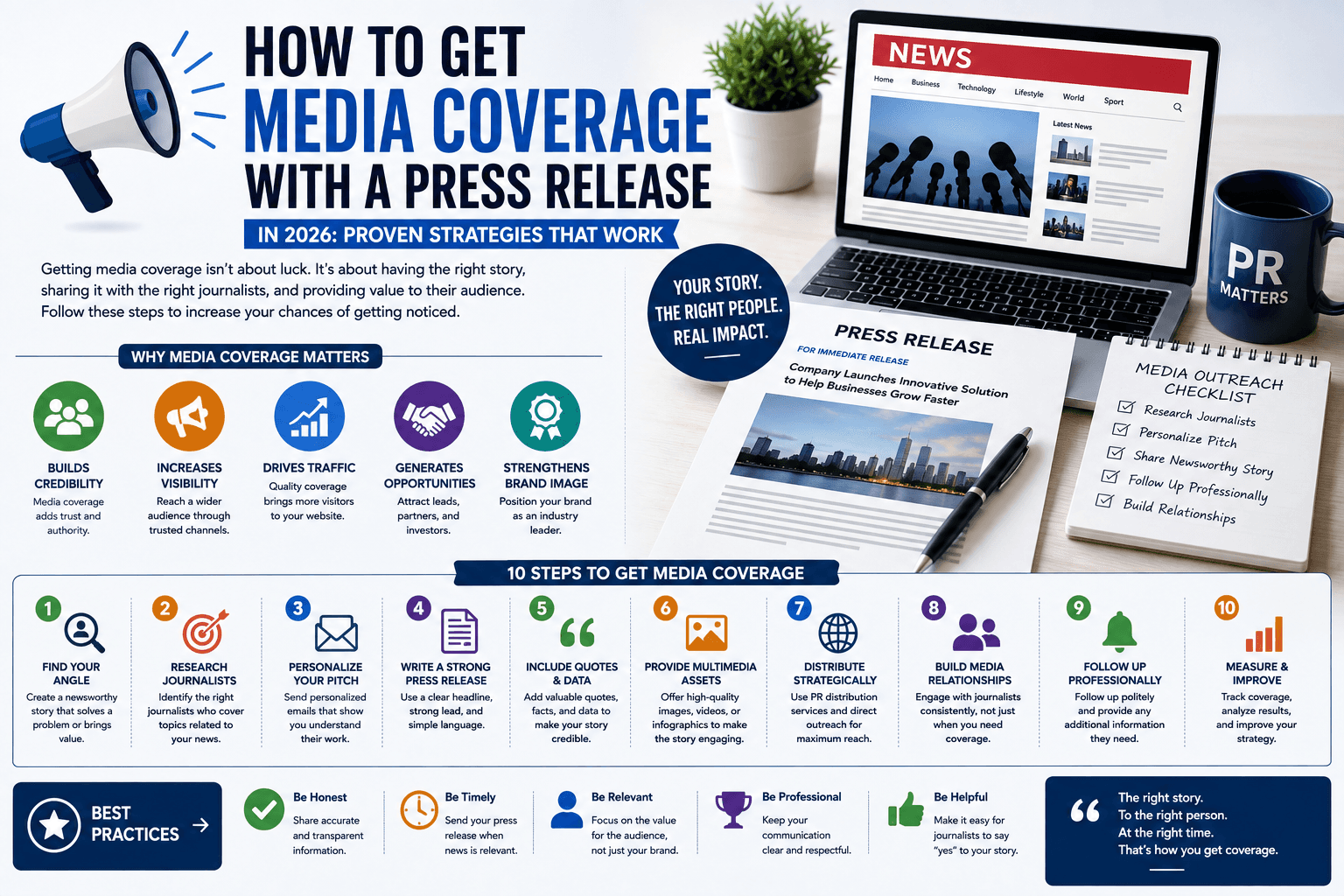
Create a genuinely newsworthy story.
Write a clear and informative headline.
Explain the main news immediately.
Research relevant journalists.
Personalize your media outreach.
Provide facts and supporting evidence.
Include approved quotes.
Make multimedia assets available.
Build long-term media relationships.
Track and improve your results.
Final Thoughts
Getting media coverage with a press release requires more than writing a professional announcement. You need a strong story, a relevant audience, accurate information, and thoughtful outreach.
The most successful PR strategies focus on building relationships and providing journalists with stories that are genuinely useful to their audiences.
By focusing on relevance rather than simply sending more emails, businesses can improve their chances of earning meaningful media attention in 2026.
Frequently Asked Questions
1. Does sending a press release guarantee media coverage?
No. Journalists and publications independently decide whether a story is relevant to their audience.
2. How can I make my press release more newsworthy?
Focus on what is new, relevant, timely, useful, or significant about your announcement.
3. Should I send my press release to every journalist?
No. Target journalists who cover topics relevant to your announcement.
4. How important is the headline?
The headline is extremely important because it helps journalists quickly understand the main story.
5. Should I personalize my media pitch?
Yes. A concise and relevant personalized message can improve the quality of your outreach.
6. Can multimedia improve media coverage?
Relevant images, videos, and other media assets can make a story easier for journalists to understand and use.
7. How often should I follow up with a journalist?
Follow up carefully and respectfully. Avoid repeatedly contacting journalists if they do not respond.
8. Are local journalists important?
Yes. Local media can be highly relevant, especially for local businesses, events, and community stories.
9. What is the best time to send a press release?
The best timing depends on your industry, audience, news cycle, and the nature of the announcement.
10. What is the most important factor for getting media coverage?
Having a genuinely relevant and newsworthy story is one of the most important factors.