
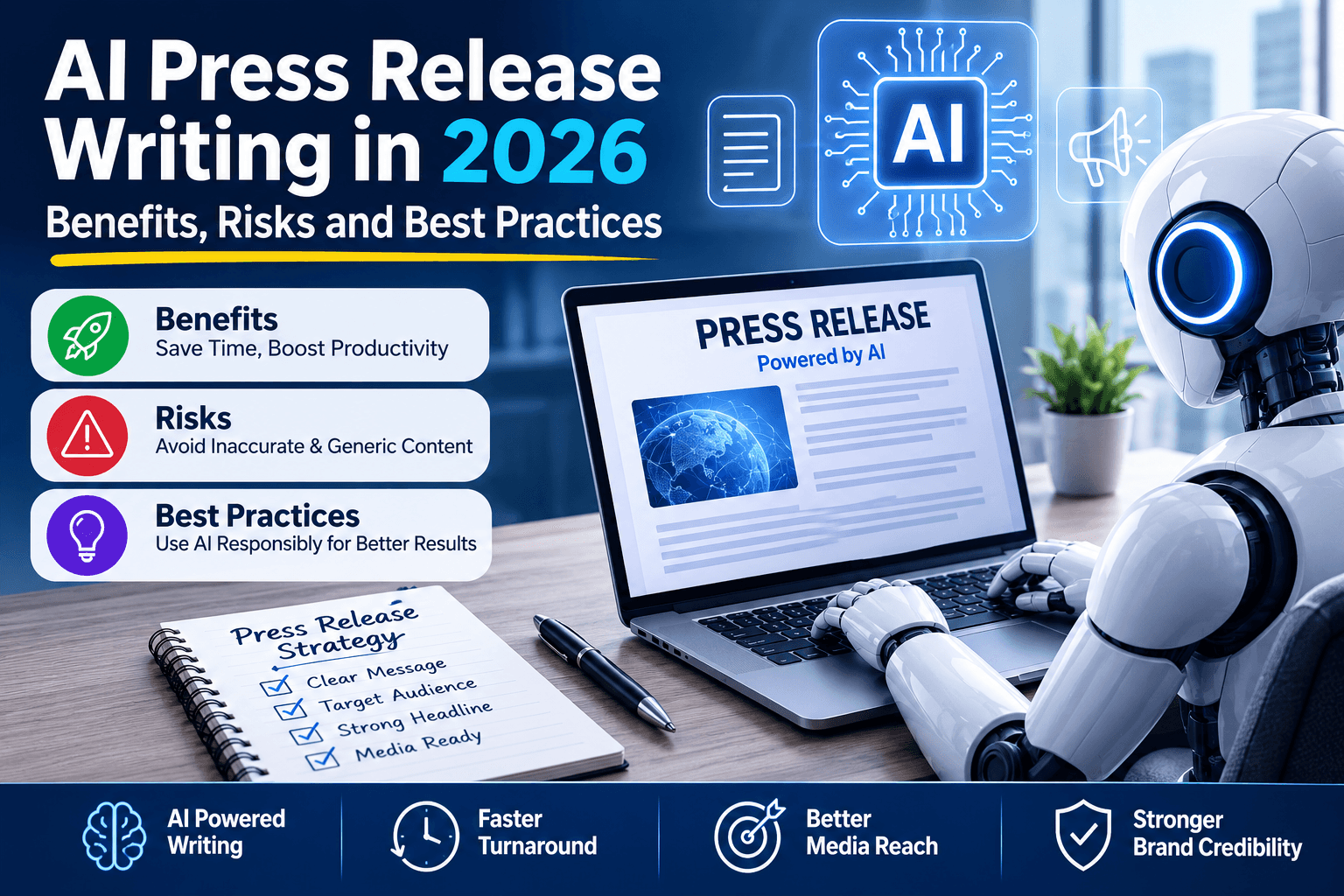
Artificial intelligence has transformed the way businesses create content, communicate with audiences, and manage public relations. In 2026, AI tools are increasingly being used to help businesses draft press releases, generate headlines, organize information, and improve writing.
However, using AI for press release writing also comes with important risks. AI-generated content can contain errors, inaccurate information, generic language, or statements that have not been properly verified.
This guide explores the benefits, risks, and best practices of using AI to write press releases in 2026.
What Is AI Press Release Writing?
AI press release writing involves using artificial intelligence tools to assist with creating, editing, or improving a press release.
AI can help users with tasks such as:
Generating press release ideas
Creating headlines
Writing first drafts
Improving grammar and readability
Summarizing company information
Suggesting press release structures
Creating multiple versions for different audiences
Identifying repetitive language
AI should generally be viewed as a writing assistant rather than a complete replacement for human judgment.
Why Are Businesses Using AI for Press Releases?
Businesses often need to create content quickly. AI can help marketing and PR teams save time during the early stages of the writing process.
For example, a business can provide AI with basic information about a product launch and ask for a structured first draft.
This can make the writing process faster, especially for:
Small businesses
Startups
Marketing teams
PR agencies
Entrepreneurs
Content creators
However, speed should never be more important than accuracy.
Benefits of Using AI for Press Release Writing
1. Saves Time
One of the biggest benefits of AI is speed. AI can quickly create a draft based on the information provided.
Instead of starting with a blank page, writers can use AI to develop an initial structure and then improve it.
2. Helps Generate Ideas
AI can assist with brainstorming different angles for a press release.
For example, it can suggest:
Headline ideas
Opening paragraphs
Questions journalists may ask
Relevant supporting points
Different audience angles
This can be especially useful when planning a new PR campaign.
3. Improves Writing Efficiency
AI can help identify grammar issues, simplify complicated sentences, and make content easier to read.
It can also help rewrite content in different tones, depending on the audience.
4. Creates Multiple Drafts
A PR professional may want to test several headline options or announcement styles.
AI can quickly generate alternative versions, allowing writers to compare ideas before choosing the best one.
5. Supports Small Teams
Small businesses may not have a large public relations department. AI tools can provide additional writing support when resources are limited.
However, important announcements should still receive professional human review.
Risks of AI-Generated Press Releases
Although AI can be useful, there are several important risks.
1. Inaccurate Information
AI can generate information that sounds convincing but is incorrect.
This is one of the biggest risks when using AI for press releases.
Never assume that AI-generated facts are accurate. Always verify:
Names
Dates
Statistics
Product details
Company information
Quotes
Research findings
Publishing inaccurate information can damage a company's reputation.
2. Generic or Repetitive Writing
AI-generated content can sometimes sound generic or repetitive.
A press release needs a clear and specific reason for existing. If the content sounds like a general advertisement, journalists may not find it useful.
Human editing can help make the announcement more specific and meaningful.
3. Fake or Incorrect Quotes
AI should never be allowed to invent quotes from executives, customers, experts, or other individuals.
Every quote included in a press release should be approved by the person being quoted or authorized by the organization.
4. Privacy and Confidentiality Concerns
Businesses should be careful about the information they provide to AI tools.
Avoid sharing confidential information unless the organization understands how the selected AI service handles data.
Sensitive information may include:
Private business plans
Customer data
Financial information
Unannounced product details
Internal communications
Always follow your organization's privacy and security policies.
5. Loss of Brand Voice
If a company relies too heavily on AI-generated content, its communication may begin to sound generic.
Every organization has its own:
Brand voice
Values
Communication style
Audience expectations
Human editors should ensure that the final press release reflects the company's authentic voice.
Best Practices for Using AI in Press Release Writing
Use AI for the First Draft
AI can be excellent for creating an initial draft.
Provide accurate information such as:
The main announcement
Company details
Important dates
Product information
Approved quotes
Target audience
The better the information provided, the more useful the draft is likely to be.
Verify Every Fact
Fact-checking is essential.
Before publishing, confirm all:
Names
Numbers
Dates
Claims
Statistics
Quotes
Links
Never publish information simply because an AI tool generated it.
Keep Human Editors Involved
The best approach is often a combination of AI efficiency and human expertise.
Human editors can determine whether:
The announcement is genuinely newsworthy
The message is accurate
The tone is appropriate
The press release reflects the brand
Important information is missing
Provide Clear Instructions
AI performs better when given clear information and instructions.
For example, instead of asking:
Write a press release about our company.
Try providing:
Write a professional press release announcing our new customer support platform. Use only the facts provided below. Do not invent statistics, quotes, dates, or company information.
Clear instructions can improve the quality of the draft.
Do Not Use AI to Invent Information
AI should organize and improve verified information rather than create fictional facts.
Never ask AI to invent:
Customer testimonials
Executive quotes
Research statistics
Awards
Business achievements
Trust and credibility are essential in public relations.
A Simple AI Workflow for Press Release Writing
Here is a practical step-by-step process.
Step 1: Gather Verified Information
Before using AI, collect all relevant and confirmed information.
This may include:
What happened?
Why is it important?
Who is involved?
When did it happen?
Where is it happening?
What supporting information is available?
Step 2: Create a Clear Brief
Prepare a short brief explaining the purpose of the press release.
For example:
Announcement: Launch of a new AI customer support platform.
Audience: Technology journalists and small business owners.
Key Message: The platform helps businesses automate routine customer service tasks.
Step 3: Use AI to Create a Draft
Ask AI to organize the information into a standard press release structure.
The draft should include:
Headline
Opening paragraph
Supporting details
Approved quote
Company information
Contact details
Step 4: Review the Content
A human should carefully review the entire draft.
Check for:
Accuracy
Clarity
Grammar
Brand voice
Repetition
Unsupported claims
Step 5: Get Approval
Important announcements may need approval from relevant company leaders, legal teams, or PR professionals.
Never skip internal approval procedures simply because AI made the writing process faster.
Step 6: Publish and Distribute
Once the press release has been reviewed and approved, it can be published on appropriate channels.
These may include:
Company websites
Newsrooms
Media outreach platforms
PR distribution services
Direct journalist outreach
Can AI Replace PR Professionals?
AI can automate certain writing tasks, but it cannot fully replace experienced public relations professionals.
PR involves much more than writing.
Professionals also handle:
Media relationships
Crisis communication
Brand strategy
Reputation management
Audience understanding
Message development
Strategic decision-making
AI can support these professionals, but human judgment remains essential.
The Future of AI and Press Releases
AI is likely to become an increasingly common part of PR workflows.
Future AI tools may help businesses:
Analyze media trends
Identify relevant journalists
Improve content personalization
Monitor brand mentions
Analyze public sentiment
Create content more efficiently
However, the importance of trust, accuracy, and transparency will continue to grow.
The companies that use AI responsibly are more likely to benefit from the technology while protecting their credibility.
Common Mistakes to Avoid
Avoid these mistakes when using AI to write a press release:
Publishing AI content without human review
Trusting unverified statistics
Using fake quotes
Sharing confidential information carelessly
Writing overly promotional content
Allowing AI to invent company details
Ignoring the company's brand voice
Failing to check spelling, names, and dates
Final Thoughts
AI press release writing can save time, improve productivity, and help businesses overcome the difficulty of starting from a blank page. However, AI should not replace human judgment.
The best strategy in 2026 is to combine AI technology with careful human review.
Use AI to brainstorm, organize information, create initial drafts, and improve writing. Then verify every important detail before publishing.
A successful press release should always be accurate, clear, relevant, and genuinely newsworthy.
Frequently Asked Questions
1. Can AI write a press release?
Yes. AI can help create drafts, headlines, and content structures, but the final press release should be reviewed by a human.
2. Is AI-generated press release content accurate?
Not always. AI can make mistakes, so all facts and information should be independently verified.
3. Can AI create quotes for a press release?
AI should not invent quotes. Quotes should come from authorized individuals and be approved before publication.
4. What are the benefits of using AI for press releases?
Benefits include faster drafting, idea generation, improved productivity, and assistance with grammar and structure.
5. What are the risks of AI press release writing?
Risks include inaccurate information, generic writing, privacy concerns, invented facts, and loss of brand voice.
6. Should businesses disclose that AI helped write a press release?
The answer may depend on company policies, legal requirements, industry standards, and the specific use of AI. Organizations should follow relevant guidelines.
7. Can AI replace a PR professional?
AI can assist with writing tasks but cannot fully replace the strategic judgment and relationship-building skills of experienced PR professionals.
8. How can I make AI-generated content more accurate?
Provide verified information, give clear instructions, and carefully fact-check the final content.
9. Is AI useful for small businesses?
Yes. AI can help small businesses create drafts and improve writing when they have limited resources.
10. What is the best way to use AI for press releases?
Use AI as an assistant for brainstorming, drafting, and editing while keeping humans responsible for accuracy, strategy, approval, and final publication.