
For the past two decades, the playbook for enterprise efficiency was simple: identify a business problem, buy a Software-as-a-Service (SaaS) solution, and hire human beings to sit in front of screens to operate it. This model created a trillion-dollar industry, minted tech giants, and turned the "per-seat" subscription fee into the most coveted business model on Wall Street.
But a profound shift is underway. The arrival of highly capable autonomous AI agents, advanced large language models, and cognitive architectures has triggered a foundational existential crisis in the tech ecosystem. Prominent venture capitalists have openly questioned whether SaaS is dead, while startups promise to replace entire human workflows with a single prompt.
This has left enterprise leaders, developers, and investors asking a critical question: Is traditional business software becoming obsolete?
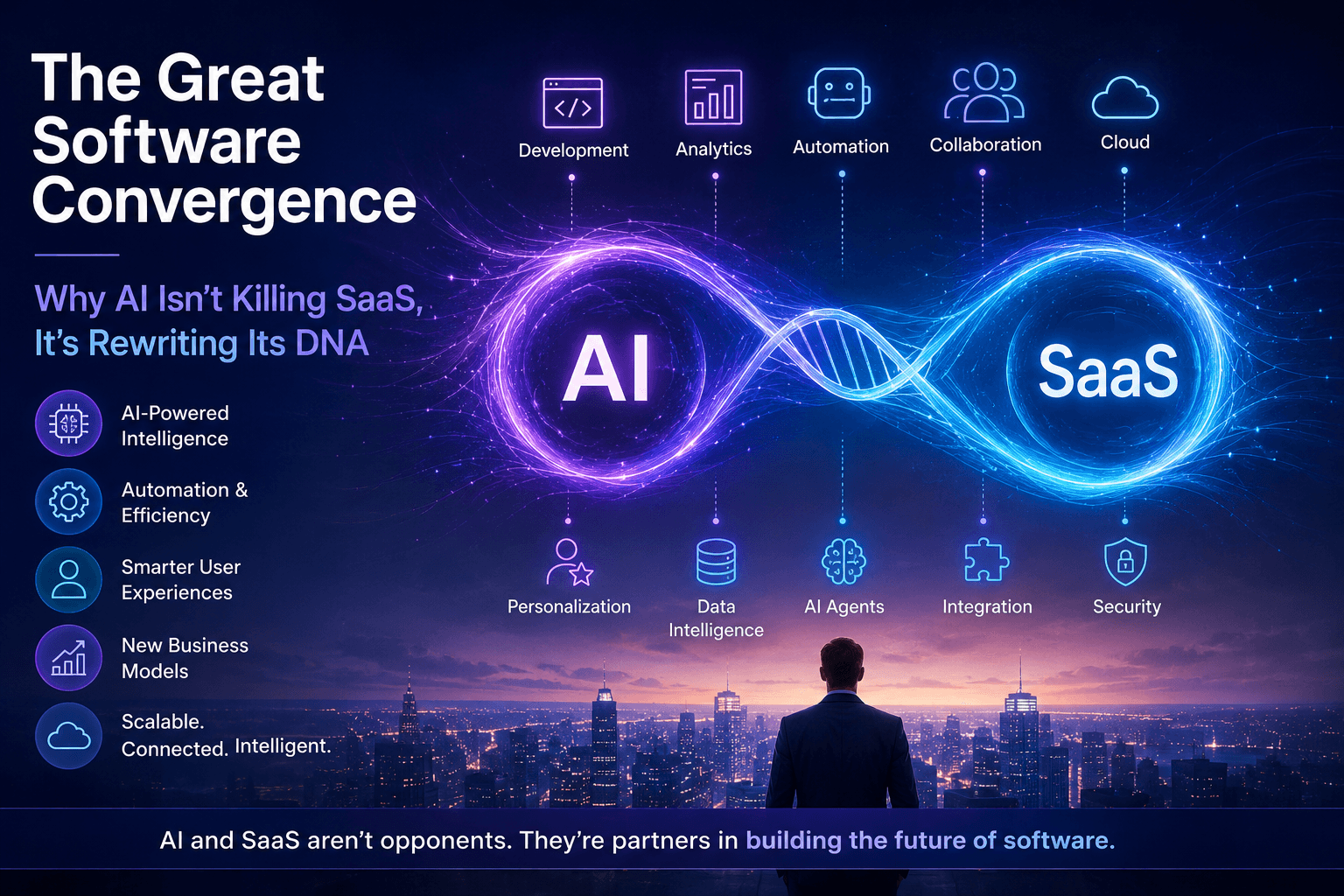
The short answer is no. Traditional software isn't dying—but it is undergoing a massive genetic rewrite. We are not witnessing the death of SaaS; we are witnessing the death of the "dumb interface." The era of software acting as a passive digital filing cabinet where humans do all the manual typing, clicking, and thinking is drawing to a close. In its place, a new paradigm is emerging: the transformation of software from a tool you work with into a colleague that works for you.
The Paradigm Shift: From "Software-as-a-Service" to "Service-as-a-Software"
To understand why this shift feels so disruptive, we have to look at what traditional SaaS actually sells. Historically, SaaS vendors sold organizations a digital workbench. If you bought a Customer Relationship Management (CRM) platform, you were purchasing an incredibly sophisticated database with a nice user interface. The software itself didn't close deals, log support tickets, or write marketing emails. You had to hire people, train them on the software's specific quirks, and pay them to input data manually.
AI fundamentally flips this dynamic. It shifts the value proposition from selling a tool to selling the completed outcome. This transition is frequently described as the move from Software-as-a-Service to Service-as-a-Software.
[Traditional SaaS] ---> User inputs data ---> System records data ---> Human extracts value
[AI-Native SaaS]  ---> AI ingests context ---> AI executes workflow ---> Human reviews outcome
When software can autonomously write code, handle customer complaints, reconcile invoices, or draft legal briefs, the economic and operational foundations of traditional software begin to fracture.
The Collapse of the Seat-Based Pricing Model
For years, the financial health of a SaaS company was measured by how many "seats" or user licenses it could sell into an enterprise. But if an AI agent can do the work of a five-person team in minutes, an enterprise no longer needs to buy dozens of user seats.
This is forcing a massive migration toward outcome-based or consumption-based pricing. Instead of paying $80 per user per month, companies are increasingly paying for results—such as a flat fee per successfully resolved customer service ticket, per automated tax filing, or per optimized marketing campaign. For traditional SaaS vendors slow to adapt, this shift represents an immediate threat to their recurring revenue streams.
The Three Anchors: Why Traditional SaaS Remains Essential
Despite the rapid rise of autonomous AI, the narrative that nimble AI startups will completely wipe out legacy enterprise software overnight ignores the brutal realities of enterprise architecture. Pure AI agents cannot operate in a vacuum. They are analytical engines, but they require a chassis, wheels, and a road to drive on.
Traditional SaaS platforms provide three critical anchors that AI cannot easily replicate.
1. The System of Record
An enterprise cannot run on probabilistic guesses. It requires an absolute, deterministic, and legally compliant source of truth. If a chief financial officer needs to know the exact quarterly revenue down to the cent, they cannot rely on a large language model that might hallucinate a digit. They rely on the structured databases of enterprise resource planning (ERP) systems like Workday, SAP, or Oracle.
Traditional software is built on rigid, structured data infrastructure (tables, rows, keys, and relational databases). AI excels at processing unstructured data (emails, audio, PDFs), but it ultimately needs to read from and write to a rock-solid system of record to execute meaningful business actions safely.
2. Complex Permissions and Governance
In a large enterprise, data access is tightly guarded. A mid-level manager should not see the executive team's salary data; a customer service representative should not have access to unreleased product source code.
Traditional SaaS platforms have spent decades perfecting hyper-complex authorization matrices, compliance guardrails (like SOC2, HIPAA, and GDPR), and multi-tenant security frameworks. Building an AI agent that can navigate a company's data is relatively simple; ensuring that the AI agent strictly obeys thousands of nuanced, overlapping corporate security policies without making a mistake is an incredibly difficult challenge. Traditional software provides the safety cage that makes AI deployment viable in regulated environments.
3. Human-in-the-Loop Orchestration
Even the most advanced AI systems require human oversight. When an AI agent drafts a million-dollar procurement contract or designs an enterprise architecture plan, a human expert must review, tweak, and sign off on that work.
AI agents do not inherently possess a natural medium for this collaboration. They require user interfaces—dashboards, review queues, notifications, and version control systems. Traditional SaaS companies are masters of UI and UX design. They own the real estate where corporate work happens, making them the natural interface through which humans govern AI agents.
The Battlefield: Incumbents vs. AI-Native Point Solutions
The current tech landscape is divided into a fascinating battle between two opposing forces: established software giants integrating AI, and young startups attempting to build entirely new AI-first platforms.
The Incumbent Advantage
Right now, traditional SaaS vendors hold a distinct advantage: distribution and data gravity. It is far easier for an established player like Salesforce, Hubspot, or ServiceNow to integrate advanced AI models into their existing pipelines than it is for a brand-new AI startup to build an enterprise-grade system of record from scratch.
When a company like Microsoft introduces an AI assistant directly into Excel or Teams, hundreds of millions of users get access to AI capabilities overnight without having to sign a new vendor contract, clear a new security review, or migrate their data to a new platform.
The Vulnerability of "Thin Wrapper" Point Solutions
The software companies facing true obsolescence are those that offer basic point solutions. During the initial wave of the generative AI boom, hundreds of tools emerged offering single features: AI copywriters, simple slide-deck builders, or basic scheduling assistants.
If a software application's core value proposition can be replicated by a user typing a clever prompt into a standard, out-of-the-box LLM, that application does not possess a sustainable competitive advantage. These tools are rapidly being swallowed up by broader platforms or rendered obsolete by foundational model upgrades.
The Hybrid Future: What the New Software Era Looks Like
Traditional software isn't disappearing; it is changing form. The future of enterprise tech belongs to hybrid architectures that seamlessly combine the reliability of traditional systems of record with the cognitive capabilities of AI.
We can map this evolution across three clear generations of business software:
Era | Core Interface | Primary Action | Value Metric |
On-Premise / Early SaaS (1990s-2010s) | Command line / Complex Forms | Manual Data Entry | System Availability |
Modern SaaS (2010s-2020s) | Web Dashboards / Mobile Apps | Clicking, Sorting, Toggling | Efficiency & Collaboration |
Cognitive SaaS (Present & Beyond) | Natural Language / Autonomous Agents | Reviewing, Approving, Orchestrating | Outcomes & Business Value |
In this new era, the metric of a software company's success will no longer be how many hours a user spends inside their app ("stickiness"). Instead, the best software will be measured by how little a human has to interact with it to get the desired result. The software will run quietly in the background, monitoring data streams, identifying anomalies, executing routine workflows, and surfacing to the human UI only when a critical decision or creative input is required.
Conclusion: The Horizon of Cognitive Software
Traditional business software is not on the brink of extinction, but its role as a passive tool is entirely obsolete. The market no longer tolerates software that forces humans to act like data-entry robots.
For businesses purchasing software, the mandate is clear: stop buying tools based purely on features, and start evaluating them based on their capacity for autonomous execution and integration. For the software industry itself, the message is equally stark: adapt your pricing models, open up your data silos to agentic workflows, and lean heavily into your strengths as secure systems of record.
The future of tech isn't a war where AI eradicates software. It is a massive convergence where software becomes intelligent, and AI becomes structured. The platforms that survive will be those that realize software is no longer just a place where work is recorded—it is the entity doing the work.