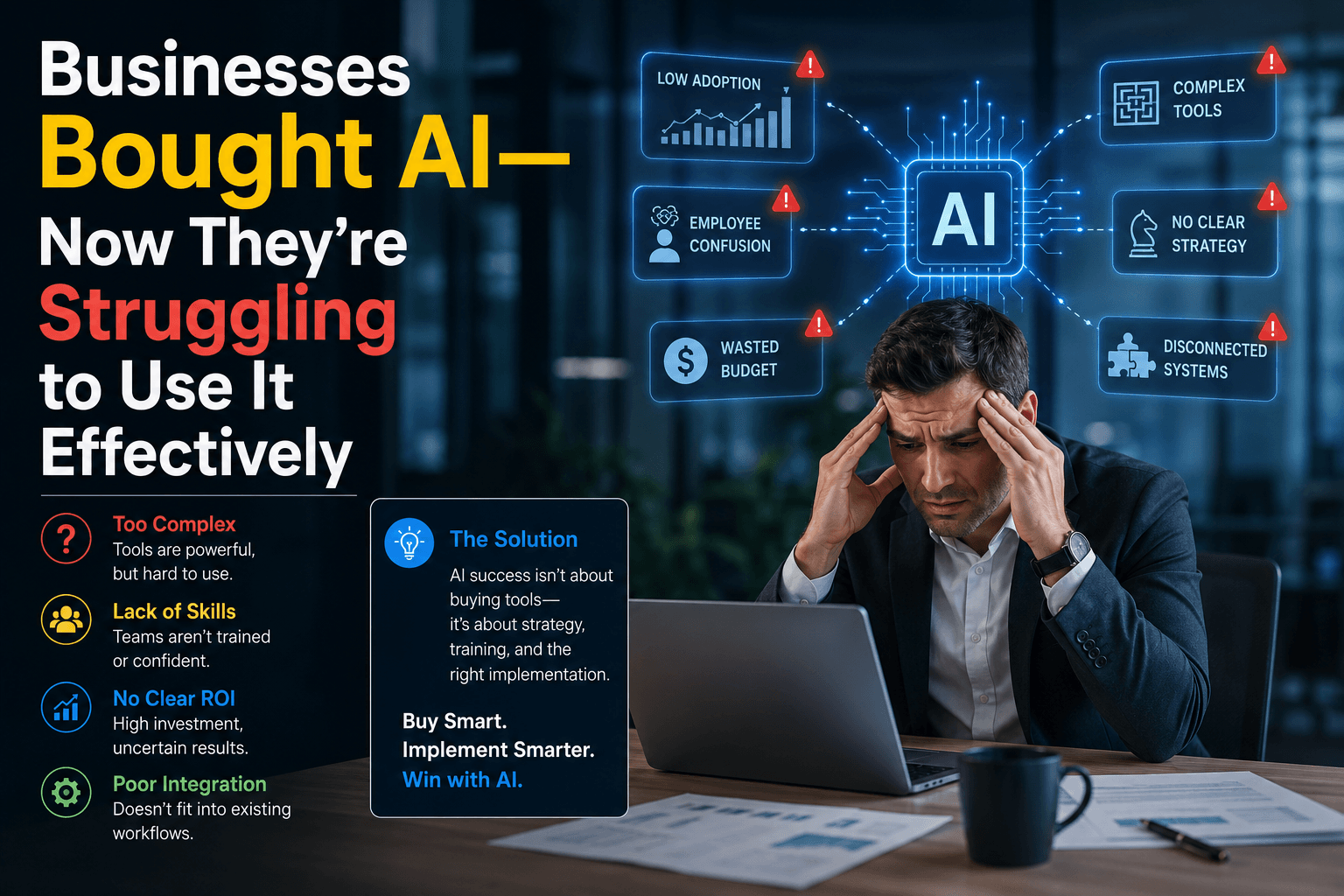

Businesses have invested heavily in artificial intelligence, but purchasing AI technology is proving much easier than turning it into measurable business value.
From generative AI platforms and copilots to automation tools and AI agents, organizations now have access to powerful capabilities. Yet many companies are discovering a difficult reality: owning AI does not automatically mean knowing how to use it effectively.
The challenge is shifting from AI adoption to AI implementation, integration, governance, and organizational change.
The AI Adoption Gap
Over the past few years, businesses have rushed to adopt AI.
Companies have purchased enterprise AI subscriptions, integrated generative AI tools, launched pilot projects, and experimented with AI assistants.
But adoption at scale remains difficult.
Employees may have access to AI tools without knowing:
Which tasks AI should handle
How to verify AI-generated results
Which data can safely be shared
How AI fits into existing workflows
When human judgment is required
This creates an AI adoption gap between having technology and generating business value from it.
Buying AI Is Not the Same as Transforming the Business
AI can be purchased like software, but meaningful AI transformation requires changes to how work is performed.
For example, a company may deploy an AI customer-service assistant.
Simply giving employees access to the tool does not guarantee productivity gains.
The organization may also need to redesign workflows, integrate customer data, establish approval processes, train employees, and define performance metrics.
Without these changes, AI may become another disconnected application rather than a strategic capability.
Too Many AI Tools
Another challenge is the rapid growth of AI products.
Businesses may end up with separate tools for:
Writing
Coding
Marketing
Customer service
Analytics
Research
Meeting summaries
Automation
Sales
When every department chooses its own AI tools, organizations can create technology fragmentation.
This can increase costs, security risks, and operational complexity.
A stronger strategy is to identify the organization's most valuable use cases and establish a clear AI technology framework.
Employees Need More Than AI Access
Giving employees AI tools without training can produce disappointing results.
Workers need to understand how to:
Write effective instructions
Provide appropriate context
Evaluate AI outputs
Detect errors
Protect confidential information
Combine AI with human judgment
AI literacy should therefore become part of workforce development.
The goal is not to make every employee an AI engineer.
It is to make employees effective users and supervisors of AI systems.
Poor Data Is Holding AI Back
AI applications depend on data.
Businesses may have large amounts of information, but that does not necessarily mean their data is ready for AI.
Common problems include:
Data silos
Duplicate records
Outdated information
Inconsistent formats
Missing metadata
Poor data governance
An AI system built on fragmented or unreliable data may produce unreliable results.
For many organizations, improving data foundations may be more important than buying another AI tool.
AI Needs Workflow Integration
One of the biggest mistakes businesses make is treating AI as a standalone application.
The greatest value often comes when AI is integrated directly into existing workflows.
For example, instead of asking employees to manually copy information into an AI tool, an organization could integrate AI with its CRM, document systems, customer-support platform, or internal knowledge base.
This allows AI to become part of the workflow rather than an additional step.
The Rise of AI Agents
AI agents may help businesses address some of these challenges by connecting intelligence with action.
Instead of simply generating text, an AI agent can potentially:
Understand a business objective
Gather relevant information
Analyze data
Use connected tools
Complete multiple steps
Request human approval when needed
Monitor outcomes
This could make AI more deeply integrated into business processes.
However, agents also require stronger governance because they can potentially take actions rather than simply provide information.
Measuring AI ROI
Many companies struggle to determine whether their AI investments are actually delivering value.
Counting the number of employees using an AI tool is not enough.
Businesses should measure outcomes such as:
Time saved
Revenue generated
Costs reduced
Customer satisfaction
Productivity
Error reduction
Faster decision-making
Employee experience
An AI initiative should have a clear business objective and measurable success criteria.
The Importance of Change Management
AI implementation is not only a technology project.
It is an organizational change project.
Employees may be uncertain about how AI will affect their roles. Managers may not know how to redesign processes. Teams may resist tools that appear to threaten existing responsibilities.
Strong leadership can help by explaining:
Why AI is being introduced
What problems it is expected to solve
Which tasks will change
What employees are expected to learn
Where humans remain responsible
Effective communication can significantly influence adoption.
AI Governance Is Becoming Essential
As organizations use AI more extensively, governance becomes increasingly important.
Businesses need clear policies covering:
Data privacy
Security
AI usage
Intellectual property
Model evaluation
Human oversight
Regulatory compliance
Accountability
Governance should not simply prevent employees from using AI.
Its goal should be to create a safe framework in which employees can use AI productively.
Shadow AI Is a Growing Problem
When employees cannot access approved AI tools that meet their needs, they may use consumer AI applications independently.
This can create shadow AI—unapproved AI usage outside organizational oversight.
Shadow AI can expose businesses to data leakage, compliance, security, and intellectual-property risks.
Companies should therefore provide secure, useful AI alternatives rather than relying only on restrictive policies.
From AI Pilots to Production
Many organizations have completed AI pilots but struggle to move successful experiments into production.
This can happen because of:
Integration challenges
Security requirements
Data quality
Lack of ownership
Unclear ROI
Infrastructure limitations
Governance concerns
Businesses need a clear path from experimentation to deployment.
Successful pilots should have a defined owner, measurable outcomes, technical requirements, and a plan for scaling.
What Businesses Should Do Next
Organizations struggling with AI adoption can take a more focused approach.
1. Prioritize High-Value Use Cases
Identify business problems where AI can deliver measurable improvements.
2. Reduce Tool Fragmentation
Establish a manageable set of approved AI platforms and applications.
3. Improve Data Foundations
Make important business data accurate, accessible, secure, and well-governed.
4. Train Employees
Develop practical AI literacy across departments.
5. Redesign Workflows
Integrate AI directly into business processes instead of adding disconnected tools.
6. Establish Governance
Create clear rules for security, privacy, oversight, and responsible AI use.
7. Measure Outcomes
Track business results rather than simply counting AI usage.
The Future of Business AI
The next stage of enterprise AI will be less about buying AI and more about operationalizing AI.
Businesses will increasingly focus on building AI-enabled workflows, integrating agents with enterprise systems, improving data foundations, and training employees to work effectively alongside AI.
The organizations that succeed will not necessarily be those with the largest number of AI tools.
They will be the ones that know where AI creates value, how to integrate it into work, and how to manage it responsibly.
Conclusion
Businesses have already made significant investments in artificial intelligence. The challenge now is turning those investments into measurable results.
AI adoption requires more than software licenses. It requires good data, employee training, workflow redesign, strong governance, technical integration, and clear business objectives.
The companies that close this gap will move from AI experimentation to AI-powered operations.
In the next phase of enterprise AI, competitive advantage will not come from simply having access to the technology.
It will come from knowing how to use it effectively at scale.