Businesses today depend on an increasingly complex network of vendors, suppliers, contractors, cloud providers, technology platforms, and service partners. While these relationships help organizations scale faster and access specialized capabilities, they also introduce significant risks.
A security weakness at a third-party provider can expose sensitive information. A supplier disruption can interrupt operations. Regulatory failures can create financial penalties and reputational damage. As vendor ecosystems continue to expand, traditional approaches to vendor risk management are becoming harder to maintain.
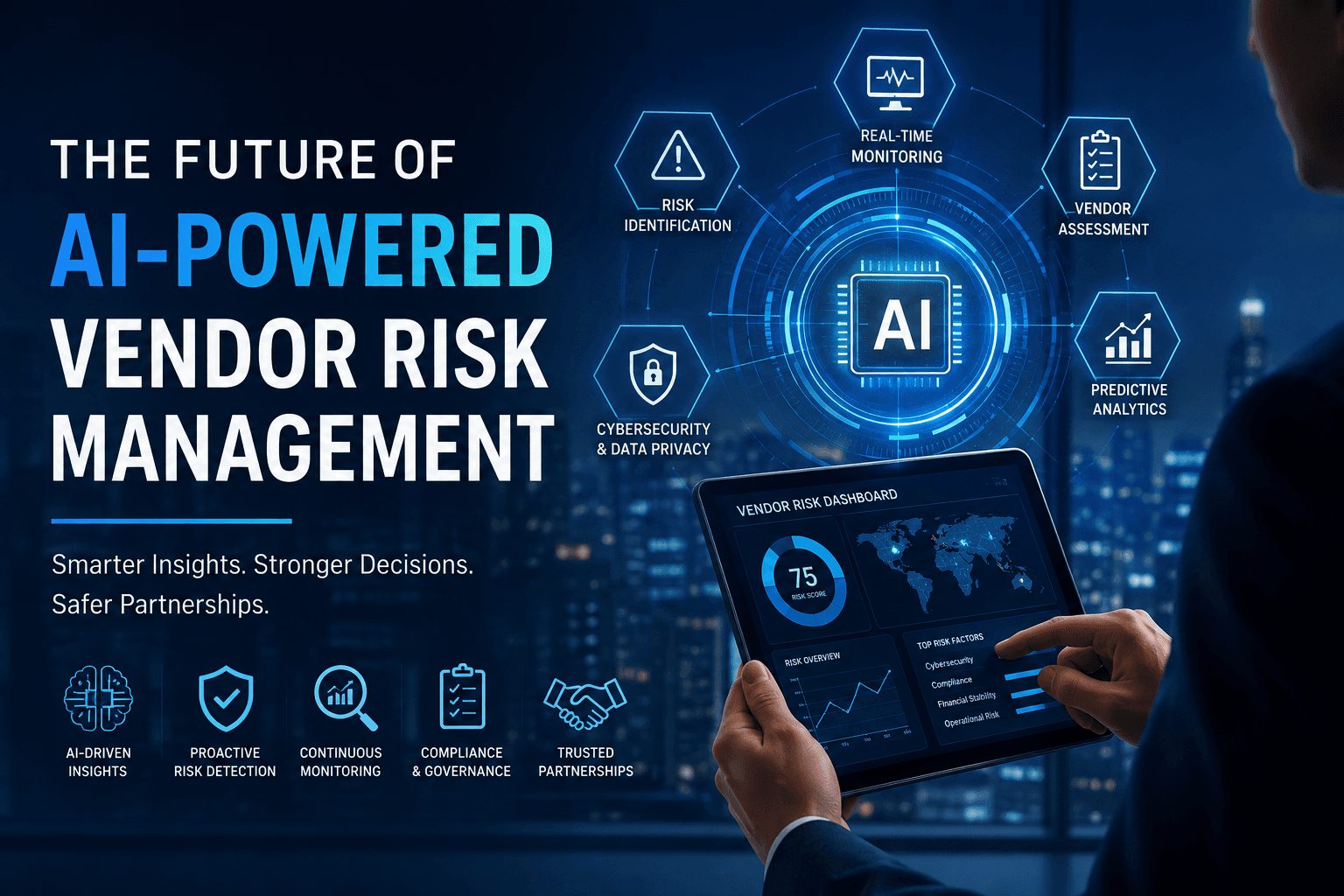
AI-powered vendor risk management is emerging as a powerful solution. By combining artificial intelligence, automation, data analysis, and continuous monitoring, organizations can identify potential vendor risks faster and make more informed decisions.
What Is AI-Powered Vendor Risk Management?
Vendor risk management (VRM) is the process of identifying, assessing, monitoring, and managing risks associated with third-party organizations.
Traditional VRM often relies on questionnaires, spreadsheets, periodic audits, emails, and manually collected documents. Although these methods remain useful, they can be slow and difficult to scale.
AI-powered VRM introduces intelligent systems that can analyze large amounts of vendor information, identify patterns, summarize security documentation, detect anomalies, and support risk-based decision-making.
Instead of reviewing every vendor in exactly the same way, AI can help organizations prioritize vendors according to factors such as data access, business criticality, security posture, regulatory exposure, and potential financial impact.
Why Traditional Vendor Risk Management Is Changing
Vendor ecosystems are becoming more complicated. A single organization may work with hundreds or thousands of third parties, while some critical vendors may rely on their own subcontractors.
At the same time, cyber threats are becoming more sophisticated. A vendor that appears low-risk during an annual assessment could experience a security incident months later.
Periodic assessments therefore provide only a snapshot of vendor risk.
AI can help move organizations toward continuous and dynamic risk management. Instead of asking, "Was this vendor secure when we reviewed it last year?" organizations can increasingly ask, "What is this vendor's risk profile today?"
How AI Is Transforming Vendor Risk Management
1. Automated Vendor Assessments
AI can accelerate the initial assessment of vendors by analyzing questionnaires, policies, certifications, security reports, contracts, and other documentation.
Natural language processing can help extract relevant information from large document collections and identify areas that require additional review.
This does not necessarily eliminate human assessment. Instead, it allows risk professionals to spend less time searching through documents and more time evaluating important findings.
2. Continuous Risk Monitoring
One of the biggest advantages of AI-powered VRM is the ability to support continuous monitoring.
AI systems can analyze changing information and identify signals that could indicate increased risk. Depending on the organization's tools and data sources, these signals may include security events, changes in certifications, public disclosures, technology changes, financial indicators, or other relevant information.
Continuous monitoring can help organizations identify potential issues earlier than periodic manual reviews.
3. Intelligent Risk Scoring
Not every vendor presents the same level of risk.
A cloud provider handling sensitive customer information should generally receive more scrutiny than a supplier providing low-impact office products.
AI can combine multiple factors to create more dynamic risk profiles. These may include:
Type and sensitivity of data accessed
Business criticality
Geographic exposure
Regulatory requirements
Cybersecurity posture
Financial stability
Contractual obligations
Incident history
Fourth-party dependencies
This can help organizations direct limited risk-management resources toward their most important vendors.
4. Faster Document Analysis
Vendor risk teams often need to review lengthy security documents, including SOC reports, policies, certifications, questionnaires, penetration-testing summaries, and contractual materials.
AI can help summarize these documents and identify relevant sections.
For example, an AI system could flag missing security controls, expired certifications, unusual contractual language, or answers that require additional clarification.
Human reviewers can then focus on validating important findings rather than manually reviewing every page.
5. Better Third-Party Cybersecurity Monitoring
Cybersecurity is one of the most important components of modern vendor risk management.
AI can help security and risk teams identify potential vulnerabilities and unusual patterns across vendor ecosystems. When combined with appropriate external intelligence and internal security information, AI can provide a broader view of third-party exposure.
Organizations can also use AI to help prioritize security alerts according to vendor criticality, reducing the risk of teams becoming overwhelmed by large numbers of low-priority notifications.
AI and Fourth-Party Risk
Modern vendor relationships frequently involve subcontractors and other indirect providers.
This creates fourth-party risk.
For example, a company may hire a software provider, while that provider relies on another cloud infrastructure company. A weakness in the underlying service provider could eventually affect the original organization.
AI can help organizations map relationships and analyze dependencies across complex vendor ecosystems. This can provide a clearer picture of where critical risks may exist beyond direct suppliers.
Improving Compliance and Regulatory Readiness
Regulatory requirements increasingly require organizations to understand and manage third-party risks.
AI-powered systems can help maintain records, organize evidence, track assessments, identify missing documentation, and monitor compliance-related requirements.
Automation can also improve audit readiness by making it easier to demonstrate how vendors were assessed, what risks were identified, which controls were reviewed, and how remediation activities were handled.
However, organizations should not assume that AI automatically guarantees compliance. Regulatory obligations vary by industry and jurisdiction, and human expertise remains essential.
The Role of Generative AI
Generative AI is adding another dimension to vendor risk management.
Risk teams can use generative AI to summarize vendor assessments, draft follow-up questions, explain complex security findings, create executive reports, and help compare vendor responses.
For example, instead of manually reviewing dozens of assessment responses, an analyst could ask an AI system to identify the most significant unresolved risks and explain why they matter.
The quality of these capabilities depends heavily on the underlying data, system design, security controls, and human validation.
Human Oversight Remains Essential
AI can improve vendor risk management, but it should not be treated as an infallible decision-maker.
A vendor's risk profile can involve business context that an automated system does not fully understand. A security finding that appears serious in isolation may have limited practical impact, while a seemingly minor issue could become significant when combined with other factors.
Human experts should therefore remain involved in high-impact decisions such as vendor approval, contract exceptions, risk acceptance, and remediation escalation.
The strongest model is often AI-assisted risk management, where AI performs analysis and automation while humans provide judgment and accountability.
Challenges of AI-Powered Vendor Risk Management
Despite its benefits, implementing AI in VRM creates new challenges.
Data Quality
AI systems require reliable and relevant data. Inaccurate, outdated, or incomplete vendor information can produce misleading results.
Explainability
Risk professionals need to understand why an AI system assigned a particular risk score or recommendation. Explainable processes are especially important for regulated organizations.
Privacy and Security
Vendor information can contain sensitive business, financial, and security data. Organizations must ensure that AI systems are properly secured and that information is handled according to applicable policies.
False Positives
AI monitoring can identify many potential issues, but not every alert represents a genuine business risk. Poorly tuned systems can create unnecessary workloads.
Integration
AI-powered VRM platforms may need to connect with procurement systems, governance platforms, security tools, contract-management systems, ticketing platforms, and other enterprise applications.
The Future of AI-Powered Vendor Risk Management
The future of VRM is likely to become increasingly predictive, continuous, and automated.
Instead of relying primarily on annual assessments, organizations will increasingly use real-time information and AI-supported analysis to understand changing vendor risk.
AI systems may increasingly recommend specific actions based on risk levels. For example, a system could recommend additional security reviews for a high-risk vendor, request updated documentation, initiate remediation workflows, or notify appropriate stakeholders.
Over time, vendor risk management may become less about collecting information and more about continuously understanding what that information means.
Building an AI-Ready Vendor Risk Strategy
Organizations looking to adopt AI-powered VRM should begin with clear business objectives.
A practical strategy includes:
Identify critical vendors: Determine which third parties have the greatest operational, financial, regulatory, or security impact.
Improve vendor data: Create accurate and consistent vendor records.
Automate repetitive processes: Begin with document analysis, questionnaires, reporting, and monitoring.
Define risk thresholds: Establish clear criteria for escalation and human review.
Integrate systems: Connect VRM with procurement, security, compliance, and contract-management workflows.
Monitor AI performance: Regularly evaluate accuracy, false positives, and missed risks.
Maintain human oversight: Keep people responsible for significant risk decisions.
Conclusion
AI-powered vendor risk management represents a major evolution in how organizations manage third-party relationships. By combining automation, continuous monitoring, intelligent analysis, and risk-based prioritization, AI can help businesses understand vendor risks more efficiently and respond to emerging issues faster.
However, successful implementation requires more than deploying an AI platform. Organizations need high-quality data, strong cybersecurity controls, clear governance, appropriate integrations, and knowledgeable human oversight.
The future of vendor risk management will not simply be about using AI to process more information. It will be about using AI to turn complex third-party information into timely, actionable intelligence.
Businesses that successfully combine AI capabilities with human expertise will be better positioned to build resilient vendor ecosystems and manage third-party risks in an increasingly interconnected economy.
Frequently Asked Questions
1. What is AI-powered vendor risk management?
AI-powered vendor risk management uses artificial intelligence, automation, and data analysis to assess, monitor, prioritize, and manage risks associated with third-party vendors.
2. How does AI improve vendor risk management?
AI can automate repetitive assessments, analyze large volumes of documentation, monitor changing risk signals, identify patterns, and help organizations prioritize high-risk vendors.
3. Can AI replace vendor risk professionals?
AI is more effective as an assistant than a complete replacement for risk professionals. Humans should remain responsible for complex judgments, risk acceptance, exceptions, and high-impact decisions.
4. What types of vendor risks can AI help identify?
Depending on available data and integrations, AI can support the identification of cybersecurity, operational, financial, compliance, privacy, supply-chain, and third-party dependency risks.
5. What is continuous vendor risk monitoring?
Continuous monitoring involves regularly or continuously evaluating relevant information about vendors rather than relying only on periodic assessments. It can help organizations identify changes in vendor risk sooner.
6. Can AI help with fourth-party risk?
Yes. AI can help map relationships between organizations and their vendors' suppliers or service providers, helping risk teams understand indirect dependencies and potential exposure.
7. Is AI-powered vendor risk management secure?
It can be secure when implemented with appropriate access controls, encryption, data governance, monitoring, and privacy safeguards. Organizations should carefully evaluate how vendor data is processed and stored.
8. What is the biggest benefit of AI-powered VRM?
One of the biggest benefits is the ability to process large amounts of vendor information efficiently and help risk teams focus their attention on the vendors and issues that matter most.
9. How should companies start using AI for vendor risk management?
Companies should begin with a specific, measurable use case such as automated document analysis, questionnaire processing, vendor risk scoring, or continuous monitoring. They can expand after validating performance and establishing governance.
10. What is the future of vendor risk management?
Vendor risk management is likely to become more continuous, predictive, automated, and data-driven. AI will increasingly support risk identification and prioritization while human professionals retain responsibility for important business decisions.
