
Artificial intelligence has become one of the most transformative technologies for businesses worldwide. Organizations are using AI to automate workflows, improve customer experiences, analyze data, and accelerate innovation. However, as AI capabilities continue to grow, cybercriminals are also leveraging the technology to launch more advanced, scalable, and difficult-to-detect attacks.
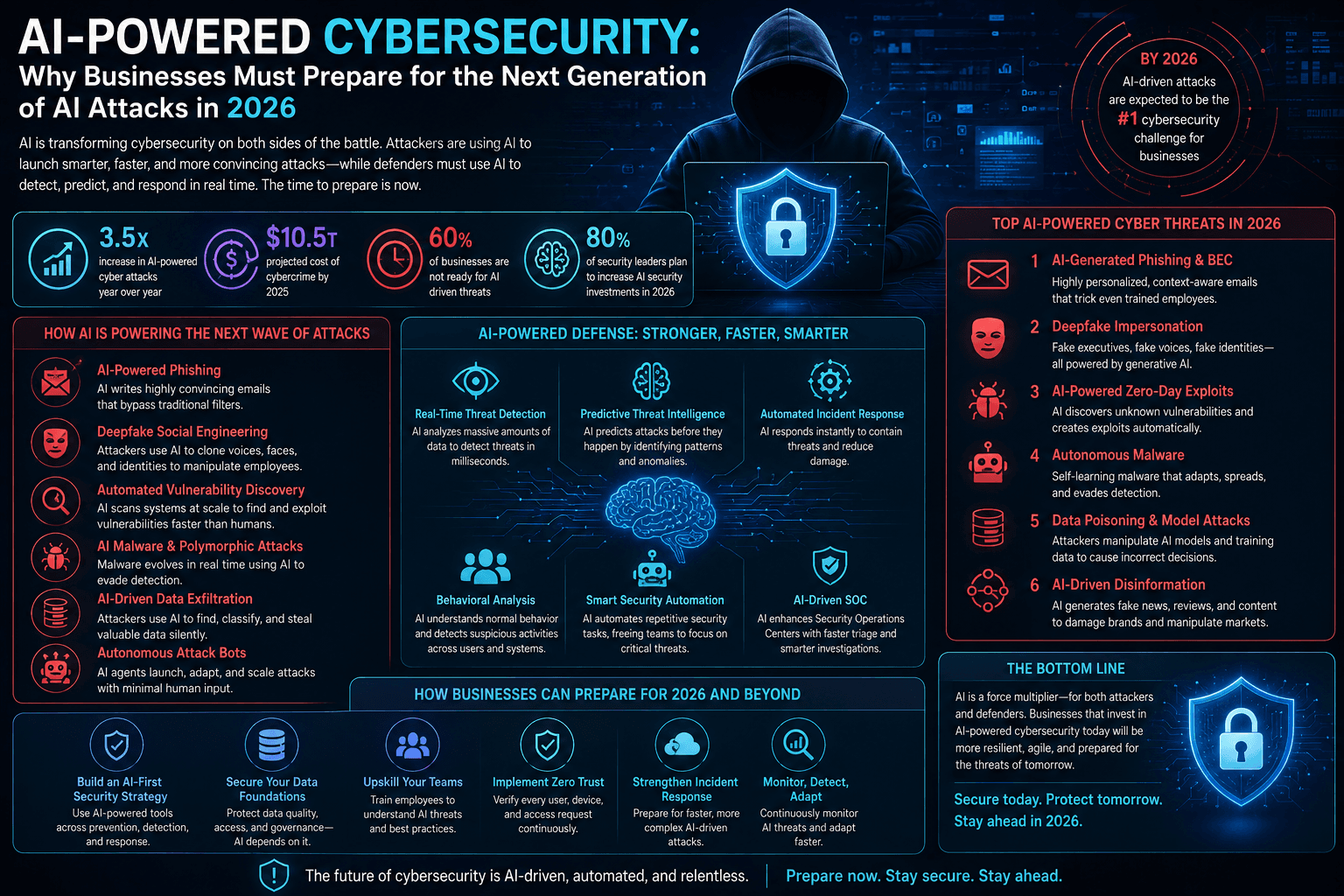
Traditional cybersecurity solutions were designed to combat human-driven threats. Today's landscape is different. AI can generate convincing phishing emails, automate malware creation, bypass traditional defenses, and identify system vulnerabilities within minutes. As a result, businesses must rethink how they protect their digital assets.
AI-powered cybersecurity is no longer an optional investment—it has become a business necessity.
The Rise of AI-Driven Cyber Threats
Cybercrime has evolved dramatically over the past decade. While hackers once relied heavily on manual techniques, they now use artificial intelligence to increase the speed, accuracy, and scale of their attacks.
AI enables attackers to:
Create realistic phishing campaigns
Develop adaptive malware
Scan networks for vulnerabilities automatically
Generate convincing fake identities
Launch sophisticated social engineering attacks
Crack passwords more efficiently
Evade traditional antivirus software
This evolution means businesses face threats that learn and adapt faster than ever before.
Why Traditional Cybersecurity Is No Longer Enough
Conventional cybersecurity systems rely on predefined rules and known attack signatures. While these methods still play an important role, they struggle against AI-generated attacks because many of these threats constantly evolve.
Traditional systems often:
Detect attacks after damage occurs
Miss previously unseen threats
Require frequent manual updates
Generate excessive false positives
Respond too slowly to automated attacks
Modern businesses require security solutions capable of identifying suspicious behavior before attackers achieve their objectives.
What Is AI-Powered Cybersecurity?
AI-powered cybersecurity uses artificial intelligence and machine learning to detect, analyze, and respond to cyber threats automatically.
Instead of depending solely on known malware signatures, AI continuously studies network behavior and identifies unusual activities that may indicate an attack.
Core capabilities include:
Real-Time Threat Detection
AI analyzes millions of events every second to identify abnormal patterns instantly.
Behavioral Analytics
Rather than focusing only on software signatures, AI studies user behavior, devices, applications, and network activity.
Automated Incident Response
AI can isolate infected systems, block malicious traffic, and notify security teams within seconds.
Predictive Risk Analysis
Machine learning predicts vulnerabilities before attackers exploit them, allowing organizations to strengthen defenses proactively.
Common AI-Powered Cyber Attacks
AI-Generated Phishing Emails
Generative AI enables attackers to create highly personalized phishing messages with perfect grammar and convincing business language.
Employees often struggle to distinguish these emails from legitimate communications.
Deepfake Fraud
AI-generated voices and videos can impersonate executives, customers, or business partners.
Attackers use deepfakes to authorize fraudulent payments or gain access to sensitive information.
Intelligent Malware
Modern malware can modify its own behavior to avoid detection.
Instead of following predictable patterns, AI-driven malware learns from security defenses and adapts accordingly.
Automated Credential Attacks
Machine learning improves password guessing and credential stuffing attacks by identifying common user habits.
AI-Powered Social Engineering
Attackers analyze publicly available information to create highly targeted scams against employees.
Industries Facing the Highest Risk
Every industry faces cybersecurity challenges, but some sectors are particularly vulnerable.
Financial Services
Banks and financial institutions process enormous amounts of sensitive customer information, making them prime targets.
Healthcare
Medical organizations store valuable patient records that criminals can sell or exploit.
Manufacturing
Smart factories increasingly depend on connected devices, creating new attack surfaces.
Retail
E-commerce businesses collect payment information that attracts cybercriminals.
Government
Public institutions remain constant targets for espionage, ransomware, and infrastructure attacks.
Benefits of AI-Powered Cybersecurity
Faster Threat Detection
AI identifies attacks within seconds rather than hours or days.
Reduced Human Error
Automation minimizes the likelihood of missed alerts caused by analyst fatigue.
Lower Response Times
Automated systems isolate threats immediately.
Improved Accuracy
Machine learning continuously improves detection capabilities while reducing false alarms.
Better Scalability
AI protects thousands of devices simultaneously without requiring proportional increases in security staff.
Zero Trust and AI
Many organizations are adopting Zero Trust Security alongside AI-powered cybersecurity.
Zero Trust assumes no user or device should automatically receive access, even inside the corporate network.
AI strengthens Zero Trust by:
Monitoring user behavior
Detecting unusual access requests
Identifying compromised accounts
Continuously verifying identities
Limiting suspicious activity
Together, AI and Zero Trust create a stronger security framework.
Best Practices for Businesses
Train Employees
Human error remains one of the leading causes of security breaches.
Provide regular awareness training covering phishing, password hygiene, and social engineering.
Use Multi-Factor Authentication
Even if passwords are stolen, MFA significantly reduces unauthorized access.
Monitor Continuously
AI-driven monitoring allows organizations to detect unusual activity around the clock.
Update Software Regularly
Outdated software remains a common entry point for attackers.
Protect Endpoints
Secure laptops, mobile devices, servers, and IoT devices using AI-enabled endpoint protection.
Backup Critical Data
Maintain secure offline and cloud backups to reduce ransomware impact.
Conduct Security Audits
Regular penetration testing and vulnerability assessments help identify weaknesses before attackers do.
Challenges of AI in Cybersecurity
Although AI offers powerful protection, organizations should also understand its limitations.
Cost
Advanced AI platforms require significant investment.
Skills Gap
Many businesses struggle to hire qualified cybersecurity professionals.
False Positives
While AI improves accuracy, no system is perfect.
Adversarial AI
Attackers also use AI to bypass defensive algorithms.
Continuous improvement remains essential.
The Future of AI Cybersecurity
Cybersecurity is entering an era where AI will defend against AI.
Future technologies are expected to include:
Autonomous security operations
Predictive cyber defense
AI-powered vulnerability management
Self-healing networks
Advanced identity verification
Real-time global threat intelligence sharing
Organizations that invest early in AI-powered cybersecurity will be better prepared for evolving threats and regulatory requirements.
Conclusion
Artificial intelligence has fundamentally changed the cybersecurity landscape. While it empowers businesses with smarter defenses, it also equips cybercriminals with more sophisticated attack methods. Traditional security approaches alone are no longer enough to protect modern organizations.
Businesses should combine AI-powered cybersecurity, employee education, Zero Trust principles, continuous monitoring, and proactive risk management to build a resilient security strategy. By embracing these technologies today, organizations can better safeguard their data, maintain customer trust, and stay ahead of the next generation of AI-driven cyber threats.
Frequently Asked Questions
What is AI-powered cybersecurity?
AI-powered cybersecurity uses Artificial Intelligence and machine learning to detect, prevent, and respond to cyber threats automatically.
Why are AI cyberattacks increasing?
Cybercriminals use AI to automate phishing, malware creation, credential attacks, and social engineering, making attacks faster and more sophisticated.
Can AI replace cybersecurity professionals?
No. AI enhances security operations by automating repetitive tasks, but human expertise remains essential for strategy, investigation, and decision-making.
What industries benefit most from AI-powered cybersecurity?
Financial services, healthcare, manufacturing, retail, government, and any organization handling sensitive data can benefit significantly.
How can small businesses improve cybersecurity?
Small businesses should implement multi-factor authentication, employee training, AI-based endpoint protection, regular software updates, secure backups, and continuous monitoring to reduce cyber risks.