
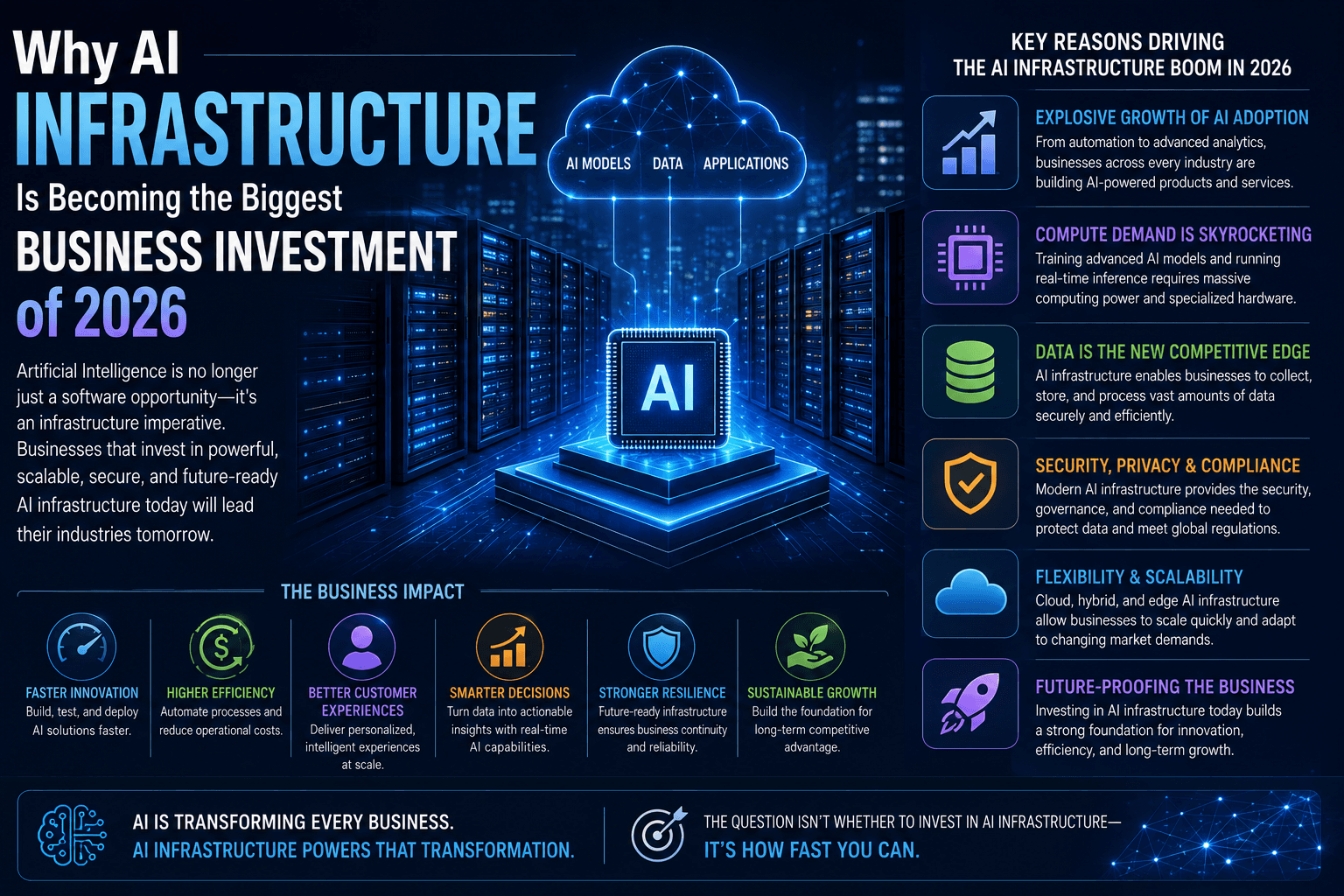

Introduction
Artificial intelligence has evolved from an experimental technology into a critical business asset. Companies across every industry are integrating AI into their operations to automate processes, enhance customer experiences, improve decision-making, and accelerate innovation. However, successful AI adoption depends on more than advanced software—it requires a powerful and scalable infrastructure capable of supporting increasingly demanding workloads.
In 2026, AI infrastructure has become one of the largest technology investments for enterprises worldwide. Organizations are spending billions on cloud platforms, AI-ready data centers, high-performance processors, advanced networking, and storage systems to support the next generation of intelligent applications.
Businesses that invest in modern AI infrastructure today are positioning themselves to remain competitive in a rapidly evolving digital economy.
What Is AI Infrastructure?
AI infrastructure refers to the collection of hardware, software, networking, cloud services, and storage technologies required to develop, train, deploy, and manage artificial intelligence applications.
Unlike traditional IT infrastructure, AI environments must process massive volumes of data while delivering high-performance computing capabilities.
A complete AI infrastructure typically includes:
High-performance GPUs
AI servers
Cloud computing platforms
AI data centers
High-speed networking
Scalable storage systems
Machine learning frameworks
AI security solutions
Data management platforms
These components work together to support modern AI workloads efficiently.
Why AI Infrastructure Investment Is Growing
Businesses are investing heavily in AI infrastructure for several reasons.
Explosion of AI Applications
Organizations now use AI across departments including:
Customer service
Marketing
Sales
Healthcare
Manufacturing
Finance
Human resources
Supply chain management
The growing number of AI-powered applications requires scalable computing resources.
Generative AI Adoption
Generative AI tools have dramatically increased computing requirements.
Large language models, image generation systems, and AI assistants require enormous processing power for both training and inference.
Data Growth
Modern enterprises generate terabytes of structured and unstructured data every day.
AI systems rely on this data to improve accuracy, making scalable storage and processing capabilities essential.
The Core Components of AI Infrastructure
High-Performance GPUs
Graphics Processing Units (GPUs) are the foundation of modern AI computing.
Unlike traditional CPUs, GPUs process thousands of operations simultaneously, making them ideal for machine learning and deep learning workloads.
Businesses continue investing heavily in GPU clusters to support AI training and inference.
AI Data Centers
Modern AI data centers are designed specifically for intensive computational workloads.
Features include:
Advanced cooling systems
High-density server racks
Energy-efficient architecture
High-speed storage
AI networking
Automated management
These facilities provide the performance required for enterprise-scale AI applications.
Cloud AI Platforms
Cloud computing has become a preferred choice for many organizations because it offers flexibility and scalability without requiring large upfront investments.
Cloud AI platforms provide:
On-demand computing
AI development tools
Scalable storage
Machine learning services
Security management
Global accessibility
This allows businesses to deploy AI faster while reducing infrastructure complexity.
High-Speed Networking
AI systems require extremely fast communication between servers, storage devices, and processors.
Modern AI infrastructure depends on:
High-bandwidth networking
Low-latency connections
Intelligent traffic management
Advanced switching technologies
Efficient networking significantly improves AI performance.
Benefits of Investing in AI Infrastructure
Faster Innovation
Powerful infrastructure enables businesses to train AI models more quickly and bring new products to market faster.
Improved Productivity
Employees spend less time on repetitive tasks and more time focusing on strategic work.
Better Decision-Making
AI processes massive datasets to deliver actionable business insights.
Enhanced Customer Experience
AI infrastructure supports intelligent chatbots, recommendation engines, personalization, and predictive customer service.
Competitive Advantage
Organizations with advanced AI infrastructure can respond more quickly to market changes and customer demands.
AI Infrastructure Across Industries
Healthcare
Hospitals use AI infrastructure for medical imaging, diagnostics, patient monitoring, and drug discovery.
Financial Services
Banks rely on AI to detect fraud, assess risk, automate compliance, and improve customer support.
Manufacturing
Manufacturers deploy AI-powered robotics, predictive maintenance, and quality inspection systems.
Retail
Retailers use AI for inventory optimization, personalized recommendations, pricing strategies, and demand forecasting.
Logistics
Supply chain companies leverage AI to optimize routing, warehouse operations, and delivery planning.
Challenges of Building AI Infrastructure
Although AI infrastructure provides significant benefits, implementation presents several challenges.
High Initial Costs
Building AI-ready infrastructure requires investment in servers, GPUs, networking equipment, and software licenses.
Energy Consumption
AI workloads consume substantial electricity, increasing operational costs.
Businesses increasingly invest in energy-efficient data centers and renewable energy sources.
Skills Shortage
Deploying and managing AI infrastructure requires experienced engineers, cloud architects, and data scientists.
Security Risks
AI environments often process sensitive business information, making cybersecurity essential.
Organizations must implement encryption, identity management, continuous monitoring, and Zero Trust architectures.
Cloud vs On-Premises AI Infrastructure
Businesses typically choose between cloud-based and on-premises AI infrastructure.
Cloud AI
Advantages:
Lower upfront costs
Rapid deployment
Scalability
Global accessibility
Automatic updates
Best suited for organizations seeking flexibility.
On-Premises AI
Advantages:
Greater control
Enhanced data privacy
Custom configurations
Lower long-term costs for predictable workloads
Preferred by organizations with strict regulatory requirements.
Many enterprises now adopt hybrid AI infrastructure, combining both approaches.
Sustainability in AI Infrastructure
Environmental sustainability has become an important consideration.
Companies are investing in:
Energy-efficient processors
Liquid cooling technologies
Renewable-powered data centers
Carbon-neutral cloud services
Intelligent workload optimization
Green AI infrastructure helps reduce operational costs while supporting corporate sustainability goals.
Future Trends
Several emerging technologies will shape AI infrastructure over the coming years.
Edge AI
Processing data closer to where it is generated reduces latency and improves real-time decision-making.
AI-Specific Chips
Specialized processors designed for AI workloads deliver higher efficiency than general-purpose hardware.
Autonomous Infrastructure
AI will increasingly manage and optimize infrastructure automatically.
Quantum Computing
Although still emerging, quantum technologies could dramatically accelerate AI model training in the future.
AI Infrastructure as a Service (AIaaS)
More organizations will consume AI infrastructure through subscription-based cloud platforms instead of building their own.
Best Practices for Businesses
Organizations planning AI infrastructure investments should:
Develop a long-term AI strategy
Assess business objectives
Invest in scalable cloud solutions
Strengthen cybersecurity
Prioritize data quality
Train employees
Optimize infrastructure performance
Monitor operational costs
Adopt sustainable technologies
A well-planned infrastructure strategy maximizes return on investment while supporting future innovation.
Conclusion
AI infrastructure has become the backbone of digital transformation in 2026. As organizations expand their use of artificial intelligence, the demand for high-performance computing, scalable cloud platforms, AI-ready data centers, and intelligent networking continues to grow.
Businesses investing in modern AI infrastructure gain faster innovation, improved productivity, stronger security, and greater competitive advantage. While challenges such as cost, energy consumption, and skills shortages remain, the long-term value of AI infrastructure far outweighs the initial investment.
Organizations that build scalable, secure, and sustainable AI infrastructure today will be better prepared to lead tomorrow's AI-driven economy.
Frequently Asked Questions
What is AI infrastructure?
AI infrastructure includes the hardware, software, cloud platforms, networking, and storage systems required to develop, train, and deploy artificial intelligence applications.
Why are businesses investing in AI infrastructure?
Businesses invest in AI infrastructure to support generative AI, improve operational efficiency, process large datasets, and remain competitive in a rapidly evolving digital landscape.
What are the key components of AI infrastructure?
The main components include GPUs, AI servers, cloud computing platforms, data centers, high-speed networking, scalable storage, AI software frameworks, and cybersecurity solutions.
Is cloud AI infrastructure better than on-premises?
Cloud infrastructure offers flexibility and scalability, while on-premises infrastructure provides greater control and security. Many organizations adopt a hybrid approach to combine the benefits of both.
What industries benefit most from AI infrastructure?
Healthcare, finance, manufacturing, retail, logistics, and technology companies all benefit significantly from modern AI infrastructure due to their reliance on data-intensive applications.