
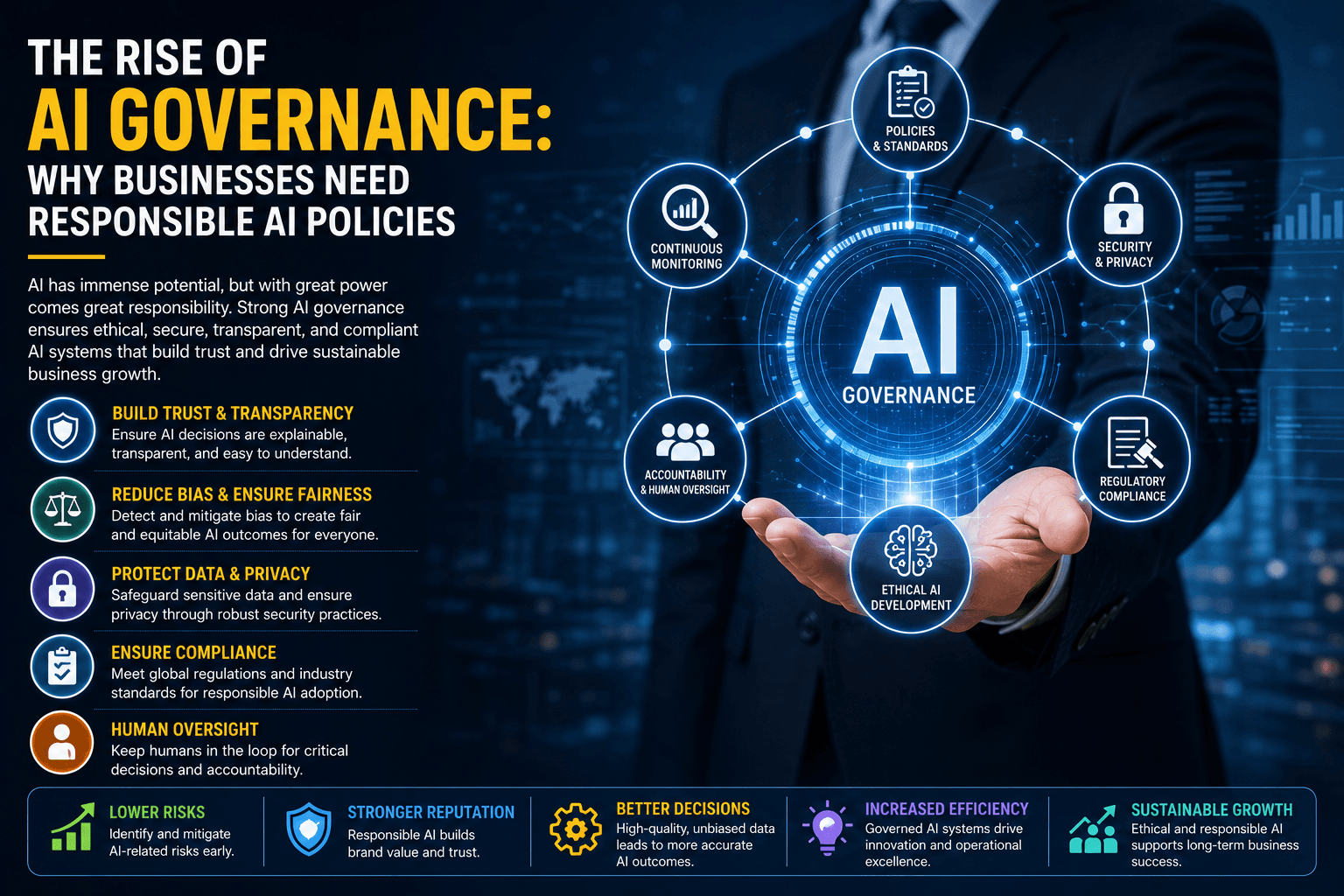

Artificial intelligence is rapidly becoming part of everyday business operations. Companies are using AI for customer service, marketing, finance, recruitment, cybersecurity, software development, analytics, and decision-making.
As AI adoption grows, businesses face a new challenge: how to make sure AI is used safely, responsibly, and consistently.
This is driving the rise of AI governance.
Responsible AI policies are becoming an essential part of enterprise strategy because organizations need to manage risks involving privacy, security, accuracy, bias, transparency, compliance, and accountability.
What Is AI Governance?
AI governance is the framework businesses use to manage how artificial intelligence is developed, purchased, deployed, monitored, and used.
An AI governance program can include:
Responsible AI policies
Data protection requirements
Security controls
Model testing
Risk assessments
Human oversight
Employee training
AI usage guidelines
Monitoring and auditing
Regulatory compliance
The goal is not to prevent businesses from using AI. Instead, governance creates a framework that allows organizations to adopt AI while managing its risks.
Why AI Governance Is Becoming a Business Priority
AI is moving from experimentation into critical business processes.
An AI system that generates a marketing email presents relatively limited risk. An AI system that influences lending, hiring, healthcare, fraud detection, or financial decisions can have much greater consequences.
As AI becomes more deeply connected to business operations, organizations need clearer rules about where and how it can be used.
The Problem With Uncontrolled AI Adoption
Employees can easily access AI tools, sometimes without formal approval from their organizations.
This can create shadow AI, where employees use external AI applications to process company information without proper security or governance.
Potential risks include:
Sensitive data exposure
Intellectual-property leakage
Incorrect AI-generated information
Compliance violations
Security vulnerabilities
Inconsistent business practices
Responsible AI policies help employees understand what they can and cannot do with AI.
Data Privacy and AI
Privacy is one of the most important areas of AI governance.
AI systems may process customer records, employee information, financial data, documents, and other sensitive information.
Businesses should establish policies covering:
What data can be used with AI
Where data can be processed
Who can access AI systems
How long information is retained
How sensitive information is protected
Privacy requirements should be considered before an AI application is deployed rather than after a problem occurs.
AI Security Risks
AI introduces new security challenges.
Generative AI applications can be targeted through techniques such as prompt injection, malicious inputs, unauthorized access, and data-extraction attempts.
AI agents create additional risks because they may be able to interact with business systems and perform actions.
Organizations therefore need strong controls around:
Identity
Authentication
Permissions
API access
Data security
Monitoring
Audit logs
AI systems should have only the access they actually need.
Accuracy and Hallucinations
AI systems can generate convincing but incorrect information.
This is particularly important when AI is used for business decisions.
Responsible AI policies should establish when AI-generated information requires human verification.
For high-impact applications, businesses may need formal testing and approval processes before AI outputs can be used operationally.
Bias and Fairness
AI systems can sometimes reproduce or amplify biases present in their training data or design.
This can create problems in areas such as:
Recruitment
Credit decisions
Customer segmentation
Pricing
Fraud detection
Performance evaluation
Organizations should test AI systems for potentially unfair outcomes and establish processes for addressing identified problems.
Transparency and Explainability
Employees and customers may need to understand when AI is being used.
For important decisions, organizations may also need to explain the factors behind an AI recommendation.
Transparency can increase trust and make it easier to identify errors.
Businesses should therefore document important AI systems and clearly define their intended purpose and limitations.
Human Oversight Is Essential
Responsible AI does not mean removing humans from every process.
Instead, organizations can determine where human review is necessary.
For example, low-risk tasks can potentially be automated, while high-impact decisions can require human approval.
A practical framework could include:
Low risk: Automated AI action within defined limits.
Medium risk: AI recommendation followed by employee review.
High risk: Human decision with AI used only as supporting analysis.
This approach allows businesses to benefit from automation without surrendering accountability.
AI Governance and AI Agents
The rise of agentic AI makes governance even more important.
Traditional AI applications may provide information, while AI agents can potentially take actions using connected tools.
An enterprise AI agent might be able to:
Send messages
Update records
Create documents
Access databases
Trigger workflows
Purchase services
Execute approved transactions
Businesses therefore need clear policies defining what agents are allowed to access and which actions require human authorization.
Creating Responsible AI Policies
An effective AI policy should be practical and easy for employees to understand.
It can address:
Approved AI Tools
Identify which AI applications employees are authorized to use.
Data Restrictions
Define what company information can and cannot be entered into AI systems.
Human Review
Specify which AI outputs require verification.
Security Requirements
Establish rules for authentication, access, and sensitive information.
Acceptable Use
Define appropriate and inappropriate AI applications.
Accountability
Assign responsibility for AI systems and their outcomes.
Incident Reporting
Create a process for reporting AI-related errors, security issues, or unexpected behavior.
AI Governance Requires Employee Training
Policies alone are not enough.
Employees need practical training that explains how to use AI safely and effectively.
Training can cover:
Prompting techniques
Fact-checking AI outputs
Data privacy
Security risks
Responsible AI usage
Bias awareness
Human oversight
AI literacy should become an ongoing business capability rather than a one-time training session.
Monitoring AI Systems
AI governance should continue after deployment.
Organizations can monitor systems for:
Accuracy
Performance
Security incidents
Unusual behavior
Data quality
User feedback
Bias
Cost
Continuous monitoring allows businesses to identify problems and update controls as systems evolve.
AI Governance Can Create Competitive Advantage
Responsible AI policies are not simply about avoiding risks.
Good governance can actually help businesses move faster.
When employees understand which tools they can use and how they should use them, they can experiment with greater confidence.
Clear governance can also improve customer trust and make enterprise AI adoption easier.
Companies with mature governance frameworks may therefore be better positioned to scale AI than organizations that rely on informal rules.
Preparing for the Future
Businesses should treat AI governance as an evolving capability.
AI technology is changing quickly, and new models, applications, agents, and regulations will continue to emerge.
Organizations should regularly review:
AI policies
Risk classifications
Security controls
Vendor relationships
Employee training
Model performance
Compliance requirements
Governance frameworks need to evolve alongside the technology.
Conclusion
The rise of AI governance reflects a simple reality: the more businesses depend on artificial intelligence, the more important responsible management becomes.
AI can create significant productivity and competitive advantages, but unmanaged AI can introduce privacy, security, compliance, and operational risks.
Responsible AI policies give organizations a structured way to balance innovation with accountability.
The companies that succeed in the next phase of AI adoption will not simply be those that deploy the most powerful systems.
They will be those that know how to use AI responsibly, securely, and strategically at scale.
FAQs
1. What is AI governance?
AI governance is the set of policies, processes, controls, and responsibilities used to manage artificial intelligence throughout its lifecycle.
2. Why do businesses need responsible AI policies?
Responsible AI policies help businesses manage risks related to privacy, security, accuracy, bias, compliance, and inappropriate AI use.
3. What should an AI policy include?
An AI policy can cover approved tools, data usage, security, human oversight, acceptable use, accountability, employee training, and incident reporting.
4. What is shadow AI?
Shadow AI refers to employees using AI tools without formal organizational approval or oversight, potentially creating security, privacy, and compliance risks.
5. How can businesses prevent AI-related data leaks?
Organizations can establish approved AI tools, restrict sensitive data usage, implement access controls, provide employee training, and monitor AI activity.
6. Does responsible AI slow down innovation?
It does not have to. Well-designed governance can give employees clear boundaries that allow them to experiment and adopt AI more confidently.
7. Why is AI governance important for AI agents?
AI agents can potentially access systems and perform actions. Governance helps control their permissions, define approval requirements, monitor activity, and maintain accountability.