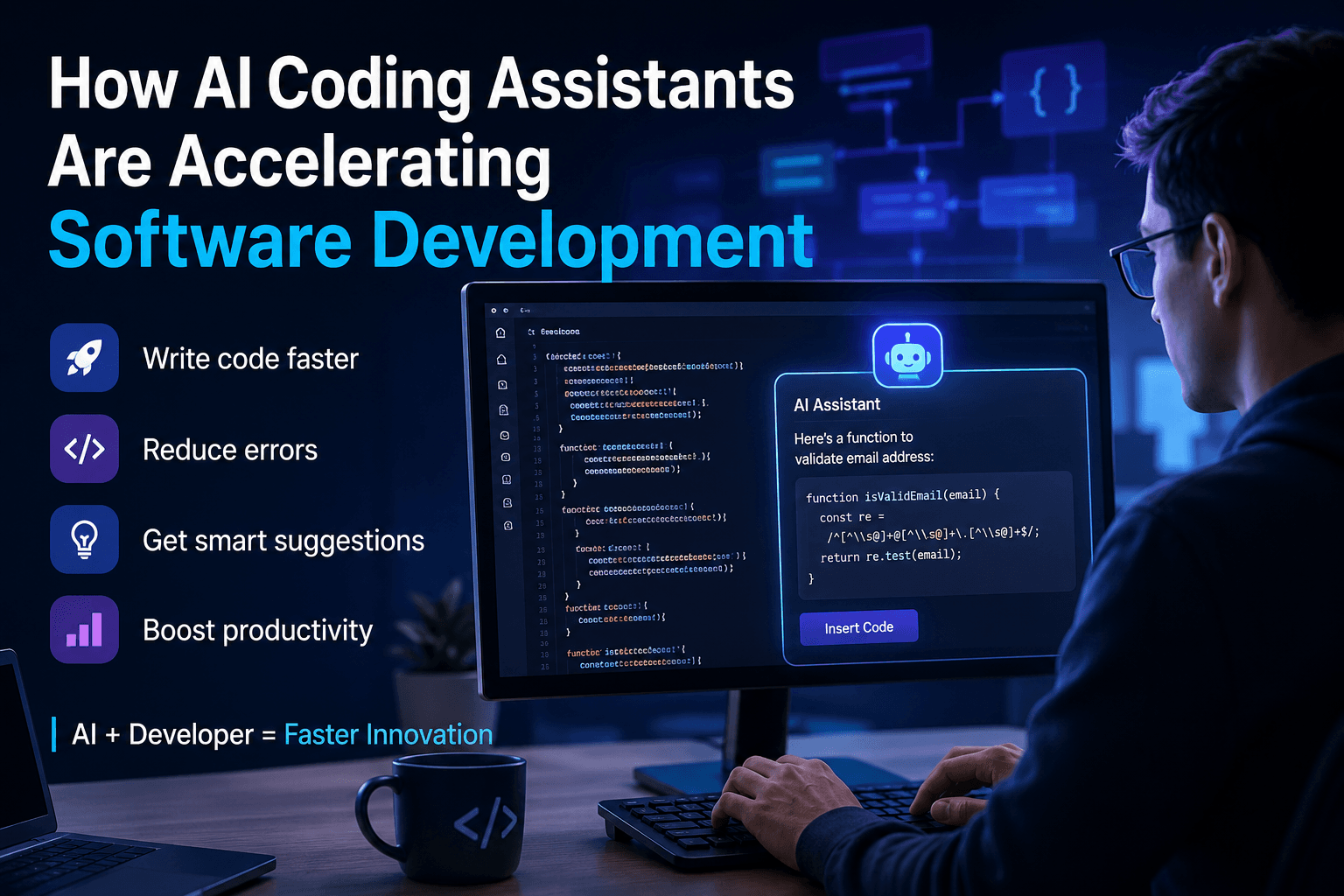

Software development is becoming increasingly AI-assisted. AI coding assistants can now help developers write code, explain unfamiliar systems, identify bugs, generate tests, refactor applications, and work through complex programming tasks.
Rather than replacing software engineers, these tools are changing how developers spend their time. Routine coding work can be accelerated, allowing teams to focus more attention on architecture, product requirements, security, and problem-solving.
What Are AI Coding Assistants?
AI coding assistants are software development tools powered by artificial intelligence models trained to understand programming languages and software-development patterns.
They can assist with tasks such as:
Code generation
Code completion
Debugging
Refactoring
Documentation
Test generation
Code explanation
Code review
API integration
Technical research
Developers can interact with these tools using natural-language instructions or directly within integrated development environments (IDEs).
Faster Code Generation
One of the most obvious benefits of AI coding assistants is faster code generation.
Instead of manually writing repetitive functions, developers can describe what they need and allow an AI assistant to generate an initial implementation.
For example, a developer might request:
“Create a Python function that validates user registration data and returns clear error messages.”
The assistant can generate a starting point that the developer can review, modify, and test.
This can significantly reduce the time spent on repetitive programming tasks.
Improving Developer Productivity
AI coding assistants can help developers move through the software-development lifecycle more quickly.
A typical workflow might look like:
Requirement → Code → Testing → Debugging → Documentation → Deployment
AI can contribute at several stages.
Developers can use AI to translate requirements into code, generate tests, explain errors, suggest fixes, and produce documentation.
The productivity gain comes from reducing the amount of manual work required for routine tasks.
AI-Powered Code Completion
Modern coding assistants can predict what a developer is likely to write next.
Instead of completing only a single line, advanced systems can suggest larger blocks of code based on the surrounding context.
This can help developers write common patterns faster and reduce repetitive typing.
For experienced programmers, the benefit is often less about generating entire applications and more about eliminating small interruptions throughout the development process.
Debugging and Error Resolution
Debugging can consume a significant portion of software development time.
AI assistants can analyze error messages, stack traces, and relevant code to suggest possible causes and solutions.
A developer might provide an error such as:
“Why does this API request return a 401 error?”
The AI can examine the code and suggest potential authentication, token, header, or permission problems.
Developers still need to verify the recommendation, but AI can reduce the time spent investigating common issues.
Generating Automated Tests
Testing is essential for reliable software, but writing comprehensive tests can be time-consuming.
AI coding assistants can generate unit tests, integration-test templates, edge cases, and test data based on existing code.
For example, an assistant can analyze a function and identify potential test scenarios involving:
Valid inputs
Invalid inputs
Empty values
Boundary conditions
Unexpected data types
Error conditions
This can encourage developers to test more thoroughly.
Refactoring Existing Code
As software systems grow, code can become difficult to maintain.
AI assistants can identify opportunities to simplify functions, remove repetitive code, improve naming, and restructure components.
Developers can ask an assistant to explain what a complicated function does before deciding how to refactor it.
This is particularly useful when working with legacy systems that contain code written by previous teams.
Understanding Large Codebases
One of the biggest challenges for developers joining an existing project is understanding the codebase.
AI coding assistants can help explain relationships between files, functions, modules, and dependencies.
A developer might ask:
“Where is user authentication handled, and which services depend on it?”
An AI system with appropriate codebase context can help identify relevant components and explain how they interact.
This can reduce onboarding time and make large software projects easier to navigate.
Supporting Multiple Programming Languages
AI coding assistants can work across many programming languages and frameworks.
Developers may use them for:
Python
JavaScript
TypeScript
Java
C#
C++
Go
Rust
SQL
HTML and CSS
This makes AI especially useful for developers working across different technologies.
It can also help programmers understand unfamiliar languages or frameworks by explaining syntax and providing examples.
AI-Assisted Documentation
Documentation is often neglected because developers prioritize building features.
AI assistants can generate documentation from existing code, including:
Function descriptions
API documentation
README files
Technical explanations
Inline comments
Usage examples
This can make documentation easier to maintain and improve knowledge sharing across development teams.
Faster Prototyping
AI coding assistants are particularly valuable during the early stages of software development.
Developers can quickly create prototypes, experiment with interfaces, test ideas, and validate technical concepts.
Instead of spending days building a basic proof of concept, a developer may be able to create an initial version within hours.
This allows product teams to test more ideas before committing significant engineering resources.
AI Coding Agents
The evolution from coding assistants to AI coding agents represents another major development.
Traditional coding assistants generally respond to individual requests.
Coding agents can perform multi-step development tasks.
For example, an agent might:
Inspect a repository
Identify relevant files
Modify the code
Generate tests
Run the test suite
Analyze failures
Fix issues
Prepare a code change for review
This creates a more autonomous software-development workflow.
Human developers can remain responsible for reviewing and approving important changes.
Improving Collaboration Between Developers and AI
The most effective use of AI coding tools is often collaborative.
Developers provide:
Requirements
Context
Architecture
Constraints
Business logic
Security expectations
AI provides:
Code suggestions
Analysis
Alternatives
Explanations
Automation
The developer remains responsible for evaluating whether the generated solution is correct and appropriate.
This creates a human-AI development partnership rather than a simple automation model.
Security and Code Quality Risks
AI-generated code is not automatically secure or correct.
AI assistants can produce:
Incorrect logic
Vulnerable code
Outdated approaches
Dependency problems
Poor error handling
Inappropriate assumptions
Developers should therefore use code review, automated testing, static analysis, dependency scanning, and security testing.
Sensitive source code and proprietary information also need appropriate protection when using external AI tools.
Impact on Junior Developers
AI coding assistants are creating both opportunities and challenges for junior developers.
On one hand, AI can help beginners understand unfamiliar concepts, explain errors, and provide examples.
On the other hand, excessive dependence on AI-generated code could prevent developers from developing strong foundational skills.
Junior developers should therefore learn the principles behind the code they use rather than simply accepting AI-generated solutions.
Changing the Role of Software Engineers
As AI handles more routine programming tasks, software engineers may spend more time on higher-level responsibilities.
These can include:
System architecture
Product design
Security
Performance
Technical strategy
Business requirements
Complex debugging
Code review
The value of software engineers is shifting from simply writing code toward designing, evaluating, and directing software systems.
How Businesses Can Adopt AI Coding Assistants
Organizations can introduce AI coding tools gradually.
1. Start With Low-Risk Tasks
Use AI for documentation, code explanations, test generation, and repetitive coding.
2. Establish Security Policies
Define what code and data developers can provide to AI systems.
3. Maintain Human Review
Require developers to review generated code before it reaches production.
4. Measure Productivity
Track development speed, defect rates, testing coverage, and developer satisfaction.
5. Train Developers
Teach teams how to use AI effectively while maintaining strong programming fundamentals.
The Future of AI-Assisted Development
AI coding assistants are likely to become increasingly integrated into development environments.
Future systems may understand entire repositories, product requirements, deployment environments, and organizational coding standards.
Developers may increasingly describe desired outcomes while AI handles more of the implementation process.
The result could be a shift from code-centric development toward intent-driven software development.
Conclusion
AI coding assistants are accelerating software development by reducing repetitive programming work and helping developers write, test, debug, document, and understand software more efficiently.
Their biggest impact may not be simply generating more code. It may be allowing developers to spend more time on the parts of software engineering that require creativity, judgment, architecture, and deep problem-solving.
As AI coding assistants evolve into more capable coding agents, software development will become increasingly collaborative between humans and AI.
The developers and organizations that learn how to combine AI speed with strong engineering judgment will be best positioned to build software faster without sacrificing quality or security.