
The digital transformation era changed how businesses operate. Companies moved their processes online, adopted cloud computing, built mobile applications, and used data analytics to improve customer experiences.
Now, a new transformation is underway: the shift from digital-first to AI-first business models.
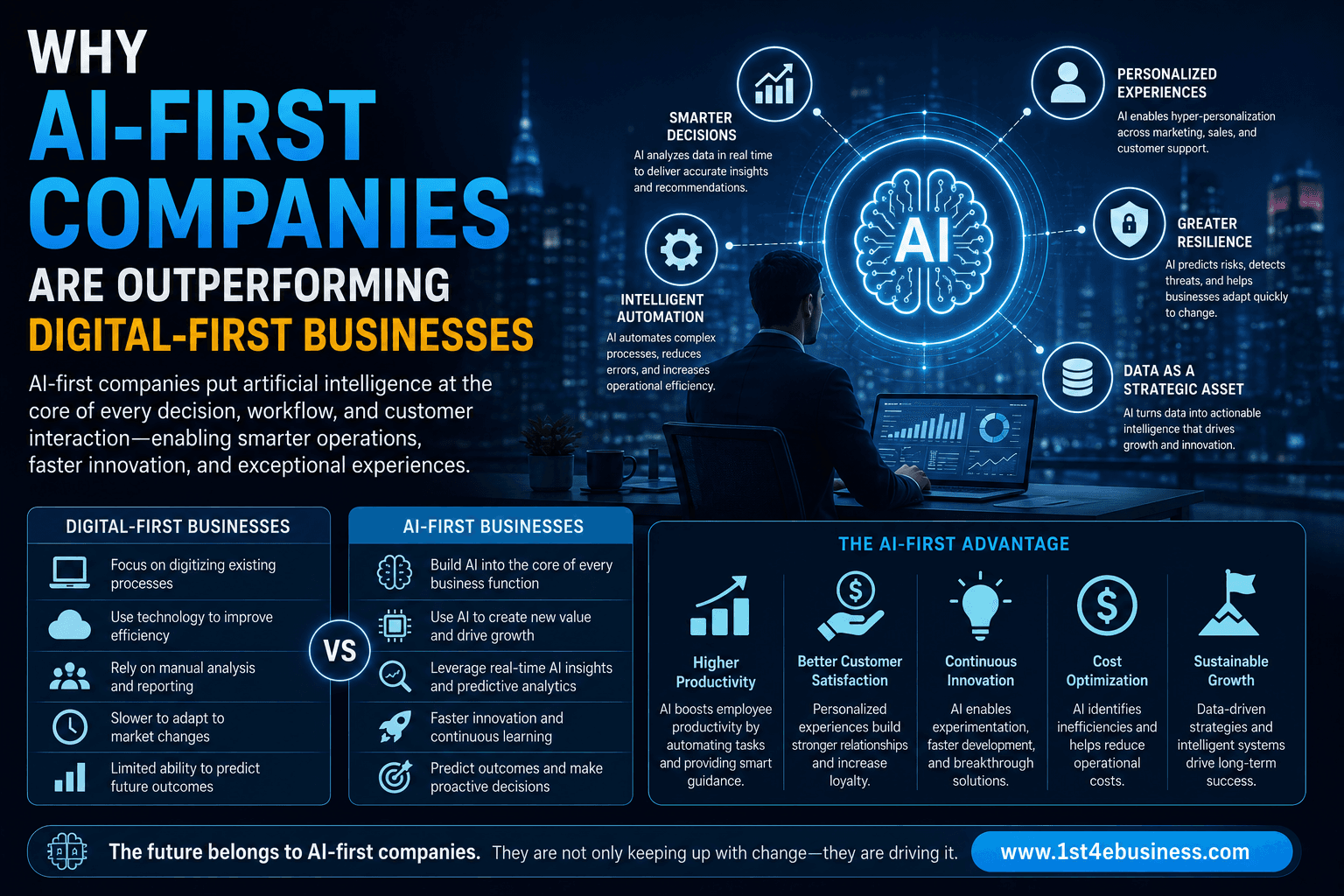
Digital-first companies use technology to improve existing processes. AI-first companies go further by designing products, operations, decision-making, and customer experiences around artificial intelligence from the beginning.
In 2026, this distinction is becoming increasingly important. Businesses that integrate AI into their core operating models can move faster, automate more work, personalize experiences, and make decisions at greater scale.
What Does AI-First Mean?
An AI-first company treats artificial intelligence as a fundamental part of its business architecture rather than simply another software feature.
A digital-first organization might use:
Cloud applications
E-commerce platforms
Digital marketing
Customer relationship management systems
Business intelligence dashboards
Mobile applications
An AI-first company may use these technologies too, but AI becomes the layer connecting them.
AI agents can analyze information, automate workflows, interact with customers, generate content, identify risks, and support decisions.
The difference is strategic.
Digital-first asks: “How can technology digitize this process?”
AI-first asks: “How can intelligent systems redesign this process?”
AI Is Changing Business Operations
One of the biggest advantages of AI-first organizations is their ability to automate complex workflows.
Traditional digital systems often require employees to move information between different applications. For example, a sales employee might review customer information in a CRM, analyze data in another platform, prepare a report, and then send recommendations to management.
AI-powered systems can increasingly connect these steps.
An AI agent can gather relevant information, analyze it, generate recommendations, and initiate approved actions.
This reduces manual work and allows employees to focus on higher-value activities.
Faster Decision-Making
Digital-first businesses have access to large amounts of data, but having data does not automatically mean making better decisions.
AI-first organizations can use machine learning and intelligent agents to analyze information continuously.
For example, an AI-powered retail system can monitor:
Customer demand
Inventory levels
Pricing changes
Competitor activity
Sales performance
Marketing campaigns
Instead of waiting for a monthly report, managers can receive real-time insights and recommendations.
Faster decision-making can become a major competitive advantage in rapidly changing markets.
AI-First Companies Can Scale More Efficiently
Traditional growth often requires businesses to add employees as their customer base increases.
AI-first companies can automate many repetitive processes, allowing them to scale without increasing headcount at the same rate.
Customer support is a good example.
A digital-first company may provide customers with an online help center and chatbot. An AI-first company can deploy intelligent agents capable of understanding customer requests, retrieving information, resolving common problems, and escalating complex cases to human employees.
This creates greater operational capacity without simply adding more staff.
Personalization at Scale
Digital businesses have used personalization for years, but AI can make personalization significantly more sophisticated.
Traditional personalization might recommend products based on previous purchases or browsing history.
AI-first systems can analyze a wider range of signals and adapt interactions dynamically.
For example, an AI shopping assistant could understand a customer's preferences, budget, previous interactions, and current needs before recommending products.
This can create more relevant experiences while reducing the effort customers need to find what they want.
AI Agents Are Becoming a New Business Layer
One of the most important developments in AI-first companies is the emergence of AI agents.
Unlike conventional software that follows fixed workflows, AI agents can interpret objectives, use tools, analyze information, and complete multi-step tasks within defined boundaries.
Businesses can deploy agents across functions such as:
Sales
Marketing
Finance
Human resources
Customer service
Procurement
IT operations
Risk management
This creates an increasingly agentic business environment where AI systems participate directly in operational workflows.
Product Development Is Changing
AI-first companies are also approaching product development differently.
Digital-first businesses often digitize an existing product or service.
AI-first businesses can create entirely new experiences that would not be practical without AI.
Examples include intelligent research assistants, autonomous workflow platforms, AI-powered design tools, predictive maintenance systems, and conversational business applications.
This can create new revenue opportunities and new categories of products.
Lower Cost of Experimentation
AI can reduce the cost and time required to test new ideas.
Businesses can use AI to generate prototypes, analyze customer feedback, create marketing variations, automate research, and assist software development.
This allows teams to experiment more frequently.
An organization that can test ten ideas while competitors test two may discover successful products and strategies faster.
The advantage is not simply AI automation—it is organizational speed.
AI-First Companies Are Building Data Feedback Loops
Another advantage comes from continuous learning.
AI-first organizations can create feedback loops in which business activities generate data, data improves AI models or decision systems, and improved systems create better business outcomes.
For example:
Customer interaction → data → AI analysis → improved recommendation → customer response → new data
Over time, these feedback loops can strengthen products and services.
Companies that build strong data and AI infrastructure early may therefore accumulate advantages that are difficult for competitors to replicate.
Digital-First Businesses Still Have an Important Role
The rise of AI-first companies does not mean digital-first businesses are obsolete.
Digital transformation created the infrastructure needed for AI adoption.
Cloud computing, APIs, digital databases, software platforms, and online customer channels are all important foundations for AI systems.
The challenge is that companies that stop at digital transformation may eventually struggle to compete with organizations that use AI to redesign those same processes.
The next stage is therefore not necessarily digital versus AI.
It is:
Digital foundation + AI intelligence + automation.
Challenges of Becoming AI-First
Moving toward an AI-first model requires more than purchasing AI software.
Organizations need reliable data, strong cybersecurity, governance frameworks, employee training, and clear business objectives.
AI-generated decisions also need appropriate oversight.
Businesses should determine which decisions can be automated and which require human approval.
Trust, explainability, privacy, and regulatory compliance are particularly important when AI systems influence financial, employment, healthcare, or customer decisions.
The Role of Employees in AI-First Organizations
AI-first companies are not necessarily companies without employees.
Instead, employee roles are evolving.
Workers may increasingly collaborate with AI systems that handle repetitive research, analysis, documentation, and administrative work.
This can allow employees to spend more time on:
Strategy
Creativity
Relationship management
Problem-solving
Innovation
Complex decision-making
Organizations that successfully combine human expertise with AI capabilities can create powerful hybrid teams.
Why AI-First Companies May Outperform
The biggest advantage of AI-first organizations is not any individual AI tool.
It is the ability to integrate intelligence throughout the business.
AI can influence how a company:
Develops products
Serves customers
Makes decisions
Manages employees
Controls costs
Identifies opportunities
Responds to risks
Automates operations
This creates an organization that can potentially operate faster and adapt more efficiently than businesses relying primarily on traditional digital workflows.
The Future of Business Is AI-Native
The transition from digital-first to AI-first is likely to define the next phase of enterprise technology.
Digital transformation taught companies how to operate online. AI transformation is teaching them how to operate intelligently.
Companies that treat AI as an isolated tool may gain incremental benefits. Companies that redesign their operating models around AI can potentially unlock much larger gains in productivity, scalability, personalization, and innovation.
The winners of the next business cycle may therefore be organizations that do more than adopt AI.
They will be companies that build their businesses around what AI makes possible.
FAQs
1. What is an AI-first company?
An AI-first company designs its products, operations, workflows, and decision-making around artificial intelligence rather than treating AI as an optional technology layer.
2. How is AI-first different from digital-first?
Digital-first businesses use technology to digitize and improve existing processes. AI-first businesses use AI to redesign processes, automate decisions, and create new ways of delivering products and services.
3. Why can AI-first companies scale faster?
AI can automate repetitive and complex workflows, allowing organizations to increase their operational capacity without increasing resources at the same rate.
4. Are AI-first companies replacing human workers?
AI is more commonly being used to augment employees and automate specific tasks. Human judgment, creativity, leadership, and relationship-building remain important.
5. What role do AI agents play in AI-first companies?
AI agents can perform multi-step tasks, interact with business systems, analyze information, and execute approved actions, making them an important component of AI-native operations.
6. What does a business need to become AI-first?
Businesses generally need quality data, scalable technology infrastructure, AI capabilities, governance, cybersecurity, employee training, and a clear strategy for integrating AI into core workflows.