Online shopping is entering a new phase in 2026. For years, consumers relied on traditional e-commerce search bars to find products by entering keywords such as “best wireless headphones,” “running shoes under $100,” or “laptop for college.” Today, AI shopping agents are changing that experience by allowing shoppers to describe what they actually want and receive personalized recommendations, comparisons, and purchasing assistance.
Instead of simply matching keywords to product listings, AI shopping agents can understand intent, evaluate multiple options, compare prices and features, and help shoppers make decisions. This shift is transforming how consumers discover products and how meta tags retailers compete for visibility.
What Are AI Shopping Agents?
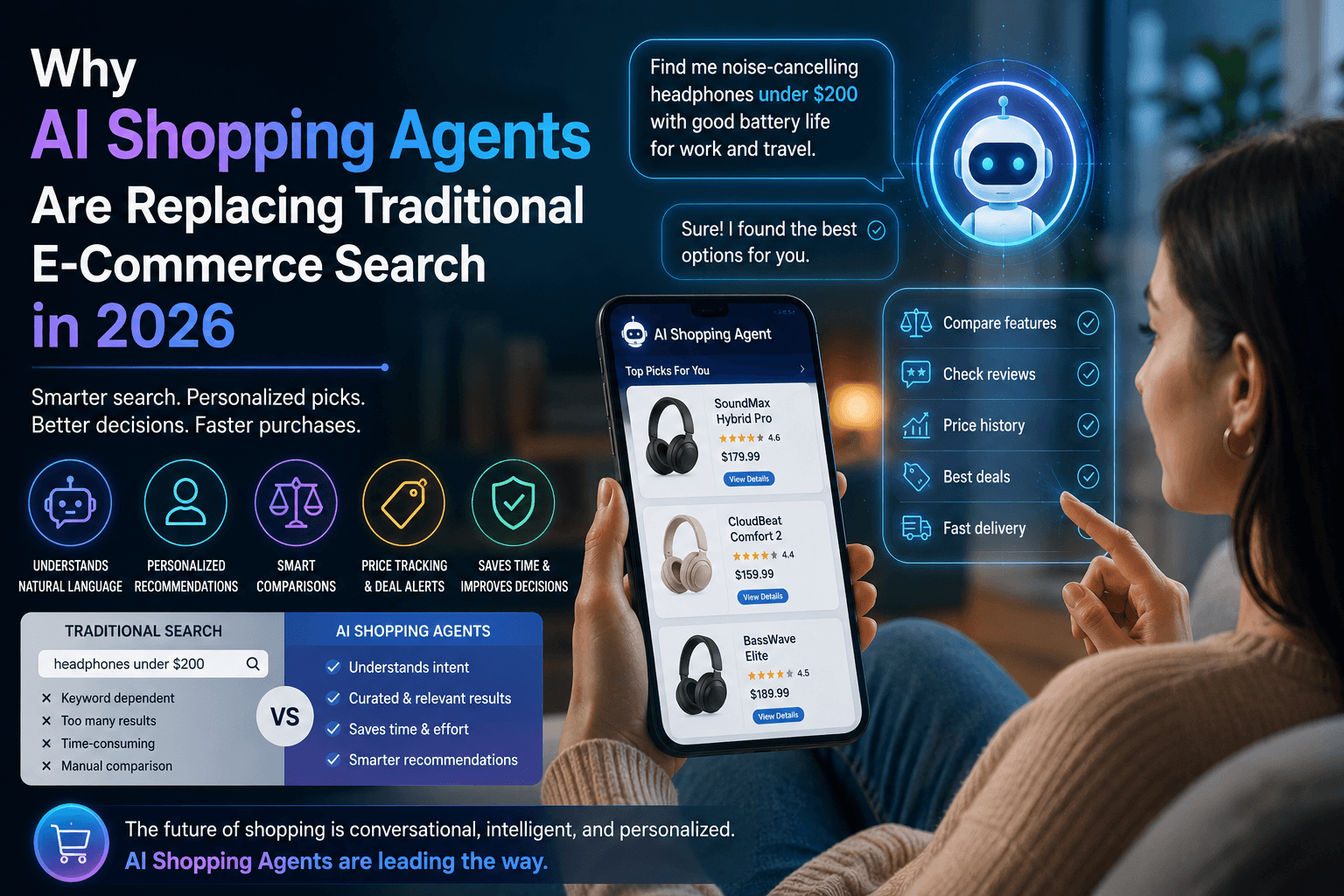
AI shopping agents are intelligent software systems that use artificial intelligence to assist consumers throughout the purchasing journey. They can understand natural-language requests, analyze product information, compare alternatives, and provide recommendations based on a shopper’s preferences.
For example, instead of searching for:
“4K TV under $800”
a shopper could ask:
“Find me a 4K TV under $800 for a bright living room, preferably with strong gaming performance and low input lag.”
An AI shopping agent can interpret these requirements and narrow down relevant products rather than presenting hundreds of search results.
Some advanced agents can also monitor prices, identify promotions, check product availability, summarize reviews, and assist with checkout.
Why Traditional E-Commerce Search Is Changing
Traditional search engines are largely based on keywords, filters, rankings, and product catalogs. While these tools remain useful, they often require shoppers to know exactly what to search for.
AI agents offer a more conversational approach.
1. Natural-Language Shopping
Consumers can communicate with AI shopping agents in the same way they would speak to a human shopping assistant.
They can provide multiple requirements in a single request, including:
Budget
Brand preferences
Product features
Intended use
Size or compatibility
Delivery requirements
Personal preferences
The AI can then process these requirements together and recommend products that fit the overall shopping goal.
2. Personalized Recommendations
Traditional e-commerce search generally provides similar results to shoppers entering the same query, although personalization may influence rankings.
AI shopping agents can go much further by considering a shopper's stated preferences and shopping context.
For example, two people searching for “laptops for work” may receive completely different recommendations. One may need a lightweight laptop with long battery life, while another may prioritize performance, storage, and a large display.
This makes product discovery more personalized and relevant.
3. Product Comparison Becomes Easier
Consumers often spend significant time opening multiple product pages and comparing specifications.
AI shopping agents can simplify this process by comparing products across factors such as:
Price
Features
Performance
Customer ratings
Warranty
Compatibility
Shipping options
Pros and cons
Instead of forcing shoppers to perform the research themselves, AI can summarize the differences and explain which option best matches their requirements.
AI Shopping Agents Can Understand Intent
One of the biggest advantages of AI-powered shopping is intent recognition.
A traditional search system may interpret “comfortable shoes for travel” primarily as a keyword query. An AI agent can understand that the shopper may need lightweight shoes suitable for walking long distances, potentially with good cushioning and durability.
This distinction is important because shoppers do not always know the exact product specifications they need.
AI can translate vague goals into practical product requirements.
That creates a more human-centered shopping experience.
The Rise of Agentic Commerce
In 2026, AI shopping is moving beyond recommendations toward agentic commerce.
An agentic shopping system can potentially perform multiple steps on behalf of the consumer. Depending on the platform and permissions available, an agent may:
Understand the shopper's request.
Search multiple product sources.
Compare available products.
Evaluate prices and promotions.
Check reviews and specifications.
Monitor price changes.
Recommend the best option.
Complete or assist with the purchase.
This means the shopping journey can shift from search → browse → compare → purchase to a more streamlined request → evaluate → approve model.
AI Is Changing Product Discovery for Retailers
The impact is not limited to consumers.
Retailers and brands must also adapt to a world where AI agents increasingly influence purchasing decisions.
Traditional e-commerce optimization focuses heavily on search rankings, keywords, product descriptions, advertising, and conversion rates.
With AI shopping agents, businesses may need to optimize product information for machine understanding as well.
Accurate specifications, structured product data, transparent pricing, availability information, return policies, and trustworthy reviews can become increasingly important.
A product that is easy for an AI system to understand and evaluate may have an advantage in agent-driven shopping environments.
Reviews and Trust Become More Important
AI shopping agents can summarize thousands of customer reviews and identify recurring themes.
Instead of reading hundreds of reviews, a shopper might receive a summary such as:
Customers frequently praise battery life.
Several buyers mention that the product runs slightly small.
Long-term users report good durability.
Some customers experienced connectivity issues.
This can save time while providing a more balanced understanding of a product.
However, trust will remain a major issue. AI systems need reliable product information and safeguards against misleading reviews, manipulated ratings, inaccurate specifications, and biased recommendations.
Price Tracking and Deal Hunting
Another reason AI shopping agents are gaining popularity is their ability to assist with price discovery.
Consumers increasingly expect AI tools to identify competitive prices and potentially notify them when prices change.
Instead of manually checking multiple websites, a shopper could ask an AI agent to find the best available deal for a particular product and monitor its price.
This could make price comparison significantly more efficient.
For retailers, however, it may increase price competition because consumers can compare alternatives more easily.
What This Means for E-Commerce SEO
AI shopping agents could significantly change e-commerce SEO.
Traditional optimization often focuses on ranking product pages for search queries. As AI agents become more influential, brands may also need to focus on making product information understandable, accurate, complete, and machine-readable.
Important areas may include:
High-quality product descriptions
Structured product data
Accurate specifications
Updated inventory information
Transparent pricing
Detailed FAQs
Reliable customer reviews
Clear shipping and return policies
Strong brand reputation
The goal is no longer only to rank highly in a search results page. Businesses may increasingly need to become the product that AI systems confidently recommend.
The Benefits of AI Shopping Agents
AI shopping agents can provide several advantages.
Faster Product Discovery
Consumers can describe their needs and quickly receive a curated selection instead of browsing dozens of pages.
Better Personalization
Recommendations can be tailored to individual requirements and preferences.
Reduced Research Time
AI can summarize specifications, reviews, comparisons, and buying considerations.
More Informed Decisions
Consumers can receive explanations rather than simply product links.
Continuous Assistance
AI agents can potentially monitor prices, availability, and product changes after the initial search.
Challenges and Risks
Despite their advantages, AI shopping agents also introduce challenges.
Accuracy
AI recommendations are only as reliable as the information available to the system. Incorrect product data can result in poor purchasing decisions.
Bias
An AI agent could potentially favor certain products because of ranking algorithms, commercial relationships, or incomplete information.
Privacy
Personalized shopping requires data. Consumers and businesses must consider how shopping preferences, purchase histories, and behavioral information are collected and used.
Retailer Visibility
If AI agents present only a few recommended products, many retailers may struggle to gain visibility. This could make competition for AI recommendations extremely important.
Over-Automation
Consumers may not want AI to make every purchasing decision. Human approval and transparency will remain important, particularly for expensive or high-risk purchases.
The Future of AI-Powered Shopping
AI shopping agents are unlikely to eliminate traditional e-commerce search overnight. Search bars, filters, categories, and product pages will continue to play important roles.
However, the shopping experience is becoming increasingly conversational and intelligent.
The biggest change is that consumers are moving from searching for products to describing outcomes.
Instead of asking, “Which products contain these keywords?” shoppers can ask, “Which product is best for my specific situation?”
That represents a fundamental change in e-commerce.
As AI agents become more capable, shopping could become less about navigating massive catalogs and more about receiving personalized, context-aware assistance. Retailers that provide accurate information, competitive products, strong customer experiences, and trustworthy data will be better positioned for this new environment.
Conclusion
AI shopping agents are reshaping e-commerce in 2026 by turning traditional product search into an intelligent, conversational experience. They can understand natural-language requests, personalize recommendations, compare products, summarize reviews, monitor prices, and potentially assist with transactions.
For consumers, this means less time searching and more time making informed decisions. For retailers, it means adapting product data, SEO strategies, and customer experiences for an increasingly AI-driven marketplace.
Traditional search is not disappearing completely, but its role is changing. The future of e-commerce may belong to platforms where consumers don't simply search for what they want—they tell an AI agent what they need and let intelligent technology help them find it.
FAQs
1. What is an AI shopping agent?
An AI shopping agent is an artificial intelligence system that helps consumers discover, compare, evaluate, and sometimes purchase products based on natural-language requests and personal preferences.
2. How are AI shopping agents different from traditional e-commerce search?
Traditional search primarily matches keywords with product listings. AI shopping agents can understand intent, context, preferences, and multiple requirements to provide more personalized recommendations.
3. Will AI shopping agents replace Google and traditional search?
They are more likely to complement and reshape traditional search than immediately replace it. However, consumers may increasingly use AI agents for product research and purchasing decisions.
4. Can AI shopping agents compare prices?
Yes. Depending on the platform and available data, AI shopping agents can compare prices across products or retailers and may also help users identify discounts and price changes.
5. How do AI shopping agents personalize recommendations?
They can consider information such as budget, preferred features, intended use, compatibility requirements, and preferences provided by the shopper.
6. What does AI shopping mean for e-commerce SEO?
Businesses may need to optimize not only for traditional search rankings but also for accurate, structured, comprehensive product information that AI systems can easily understand and evaluate.
7. Are AI shopping recommendations always accurate?
No. AI recommendations can be affected by incomplete, outdated, or incorrect product information. Consumers should verify important specifications, prices, availability, and policies before purchasing.
8. Why are AI shopping agents becoming popular in 2026?
They reduce the time and effort required to research products while offering conversational interaction, personalized recommendations, comparisons, and increasingly automated shopping assistance.
9. Can AI shopping agents complete purchases?
Some AI-powered platforms may support purchasing or transaction assistance, but capabilities vary by platform. Users should retain control over important purchases and verify transaction details before approving them.
10. What is the future of AI in e-commerce?
AI is expected to make e-commerce more conversational, personalized, predictive, and automated. Shopping may increasingly shift from browsing large product catalogs toward interacting with intelligent agents that understand individual needs.