TFThe Future of Smart Homes in 2026: AI, Automation & Connected Living
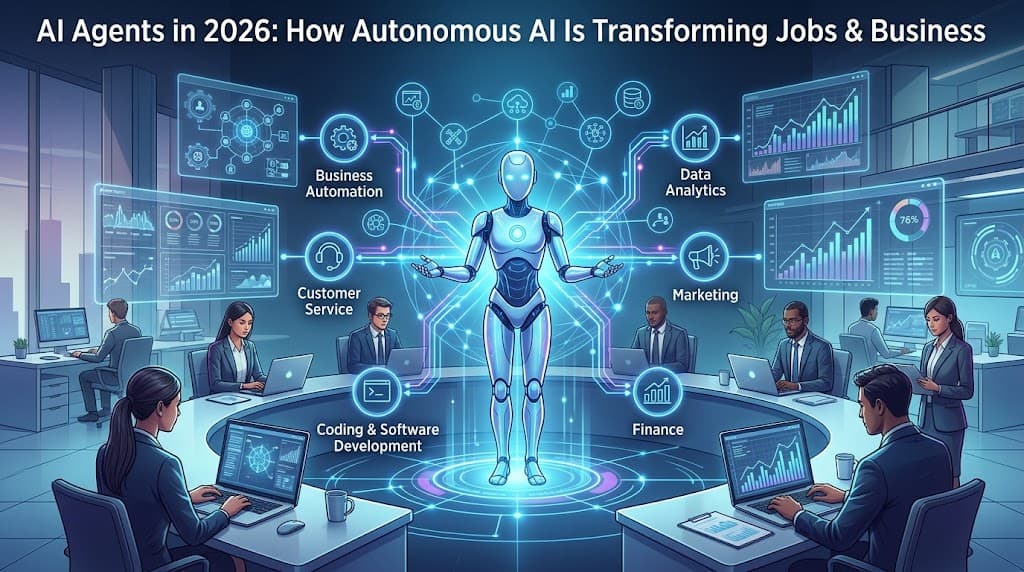
Artificial Intelligence has evolved far beyond simple automation and chatbots. In 2026, a new generation of intelligent systems—known as autonomous AI agents—is transforming the workplace. Unlike traditional AI tools that require continuous human input, autonomous AI agents can perform complex tasks, make decisions within defined boundaries, collaborate with other software, and adapt to changing business conditions.
From customer service and software development to finance, marketing, and supply chain management, AI agents are becoming valuable digital coworkers that help organizations improve efficiency, reduce costs, and accelerate innovation. While human oversight remains essential, businesses are increasingly exploring how autonomous AI can reshape the future of work.
What Are Autonomous AI Agents?
Autonomous AI agents are intelligent software systems capable of completing multi-step tasks with minimal human intervention.
Instead of responding to a single command, these systems can:
Analyze information
Develop action plans
Execute assigned tasks
Monitor results
Learn from feedback
Adapt to changing conditions
They combine artificial intelligence, machine learning, automation, and advanced reasoning to accomplish business objectives more independently than traditional software.
Why Businesses Are Adopting AI Agents
Organizations face increasing pressure to improve productivity while managing costs.
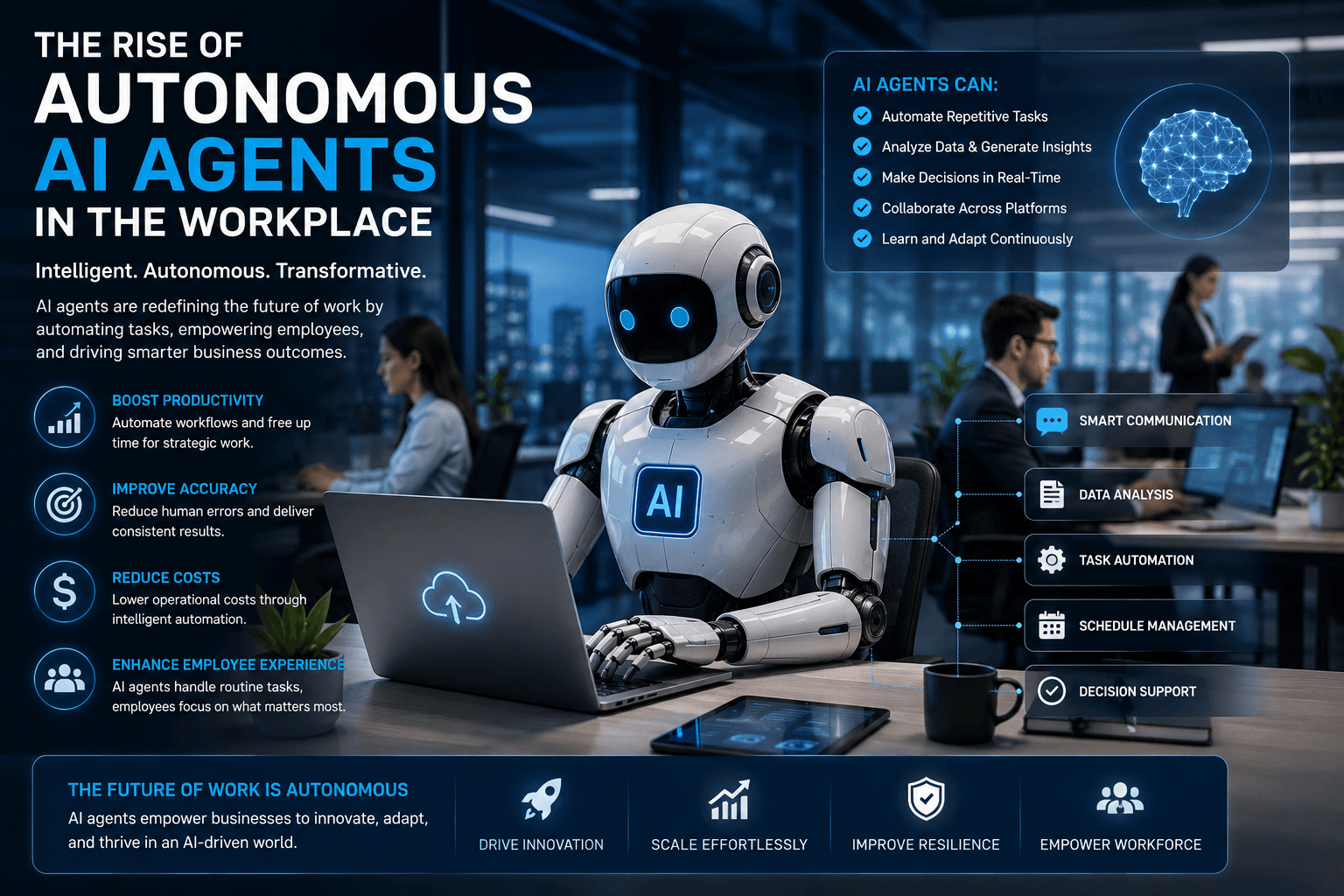
Autonomous AI agents help businesses by:
Automating repetitive workflows
Reducing manual errors
Improving response times
Supporting decision-making
Operating around the clock
Scaling operations efficiently
Rather than replacing employees, AI agents allow teams to focus on strategic work, creativity, and customer relationships.
Customer Service Is Becoming Smarter
Customer support is one of the fastest-growing applications for AI agents.
Modern AI systems can:
Answer customer questions
Resolve common issues
Process returns
Schedule appointments
Recommend products
Escalate complex cases to human representatives
This improves customer satisfaction while reducing operational costs.
AI Agents in Marketing
Marketing teams increasingly use autonomous AI to manage campaigns and optimize performance.
AI agents assist with:
Content creation
Market research
Social media scheduling
Audience segmentation
Campaign optimization
Performance reporting
By analyzing customer behavior in real time, AI helps businesses deliver more personalized marketing experiences.
Finance and Accounting Automation
Financial departments are using AI agents to automate routine administrative work.
Applications include:
Invoice processing
Expense management
Financial forecasting
Fraud detection
Compliance monitoring
Budget analysis
Automation improves accuracy while allowing finance professionals to focus on strategic planning.
Human Resources Transformation
Human Resources teams also benefit from AI-powered assistants.
AI agents help with:
Resume screening
Interview scheduling
Employee onboarding
Training recommendations
Performance tracking
Internal support requests
These capabilities streamline HR operations while improving employee experiences.
Supporting Software Development
Technology companies increasingly rely on AI agents to assist software engineers.
AI systems can:
Generate code
Identify software bugs
Recommend improvements
Perform testing
Create documentation
Monitor application performance
Developers remain responsible for oversight, but AI significantly accelerates the development process.
Improving Business Decision-Making
Autonomous AI agents continuously analyze business data and identify patterns that support better decision-making.
Executives use AI-generated insights to improve:
Sales forecasting
Inventory planning
Customer retention
Pricing strategies
Risk management
Operational efficiency
Real-time intelligence enables organizations to respond more quickly to changing market conditions.
The Importance of Human Oversight
Although AI agents are becoming increasingly capable, human supervision remains essential.
Businesses should establish clear governance policies that define:
Decision-making authority
Ethical guidelines
Security requirements
Data privacy standards
Performance monitoring
Accountability
AI should support human expertise rather than replace responsible leadership.
Challenges Businesses Must Address
Organizations adopting autonomous AI agents should prepare for several challenges.
These include:
Data security
Privacy protection
Bias in AI systems
Regulatory compliance
Employee training
Integration with existing software
Careful planning helps organizations maximize AI benefits while minimizing risks.
Preparing Employees for AI Collaboration
The future workplace will likely combine human expertise with intelligent digital assistants.
Employees should develop skills such as:
Critical thinking
Problem-solving
Creativity
Emotional intelligence
AI literacy
Strategic decision-making
These uniquely human capabilities will remain highly valuable in an AI-powered workplace.
The Future of Work
Autonomous AI agents are expected to become increasingly common across nearly every industry.
Future developments may include:
Multi-agent collaboration
Industry-specific AI assistants
Fully automated business workflows
Smarter virtual employees
Advanced business analytics
Improved enterprise decision-making
Businesses that adopt AI responsibly will likely gain significant competitive advantages.
Conclusion
Autonomous AI agents represent the next major evolution in workplace technology. By automating complex tasks, improving operational efficiency, enhancing customer service, and supporting better decision-making, these intelligent systems are changing how organizations operate.
While challenges related to governance, security, and workforce adaptation remain, the potential benefits are substantial. Companies that invest in responsible AI adoption, employee training, and strong oversight will be better positioned to thrive in the rapidly evolving digital economy.
The future of work is not about humans competing with AI—it is about humans and intelligent AI agents working together to achieve greater productivity, innovation, and long-term business success.
1. What are autonomous AI agents?
Autonomous AI agents are intelligent software systems that can perform tasks, make decisions, and adapt to changing conditions with minimal human intervention.
2. How do autonomous AI agents work?
They use machine learning, natural language processing, and data analysis to understand tasks, make decisions, and execute workflows automatically.
3. How are AI agents transforming the workplace?
AI agents automate repetitive tasks, improve productivity, assist employees, analyse data, and support faster business decisions.
4. Which industries benefit the most from autonomous AI agents?
Industries such as healthcare, finance, retail, manufacturing, logistics, customer service, and technology are rapidly adopting AI agents.
5. Can autonomous AI agents replace human employees?
AI agents are designed to automate repetitive work and support employees rather than completely replace human expertise and creativity.
6. What are the benefits of AI agents in business?
They improve efficiency, reduce operational costs, minimise errors, provide 24/7 support, and increase productivity.
7. Are autonomous AI agents secure?
When implemented with strong cybersecurity measures and proper governance, AI agents can operate securely while protecting sensitive business data.
8. What challenges come with adopting AI agents?
Common challenges include data privacy concerns, integration with existing systems, employee training, implementation costs, and ethical considerations.
9. How do AI agents improve customer service?
They provide instant responses, personalise interactions, automate support tickets, and operate around the clock to improve customer satisfaction.
10. What is the difference between AI chatbots and autonomous AI agents?
Chatbots mainly respond to conversations, while autonomous AI agents can plan tasks, make decisions, interact with multiple systems, and complete complex workflows.
11. Can small businesses use autonomous AI agents?
Yes. Many affordable cloud-based AI agent platforms enable small businesses to automate workflows without major infrastructure investments.
12. How do AI agents help remote teams?
AI agents manage schedules, automate reporting, organise tasks, share information, and improve collaboration across distributed teams.
13. What skills are needed to work with AI agents?
Employees benefit from digital literacy, critical thinking, problem-solving, AI tool management, and data interpretation skills.
14. Do AI agents learn over time?
Many AI agents continuously improve by learning from data, user interactions, and business processes through machine learning models.
15. What role do AI agents play in decision-making?
They analyse large datasets, identify trends, generate recommendations, and provide actionable insights that support better business decisions.
16. How do businesses implement autonomous AI agents?
Businesses typically identify repetitive processes, select suitable AI platforms, integrate systems, train employees, and monitor performance.
17. Are autonomous AI agents expensive to deploy?
Costs vary depending on business size and requirements, but many subscription-based AI platforms make adoption affordable.
18. How do AI agents support cybersecurity?
AI agents monitor networks, detect unusual behaviour, identify threats, and respond to security incidents more quickly than manual processes.
19. What is the future of autonomous AI agents?
Future AI agents will become more collaborative, industry-specific, capable of handling complex workflows, and better integrated with enterprise systems.
20. Why should businesses invest in autonomous AI agents?
Businesses that adopt AI agents can improve operational efficiency, reduce costs, enhance customer experiences, and remain competitive in an increasingly AI-driven economy.