

Introduction
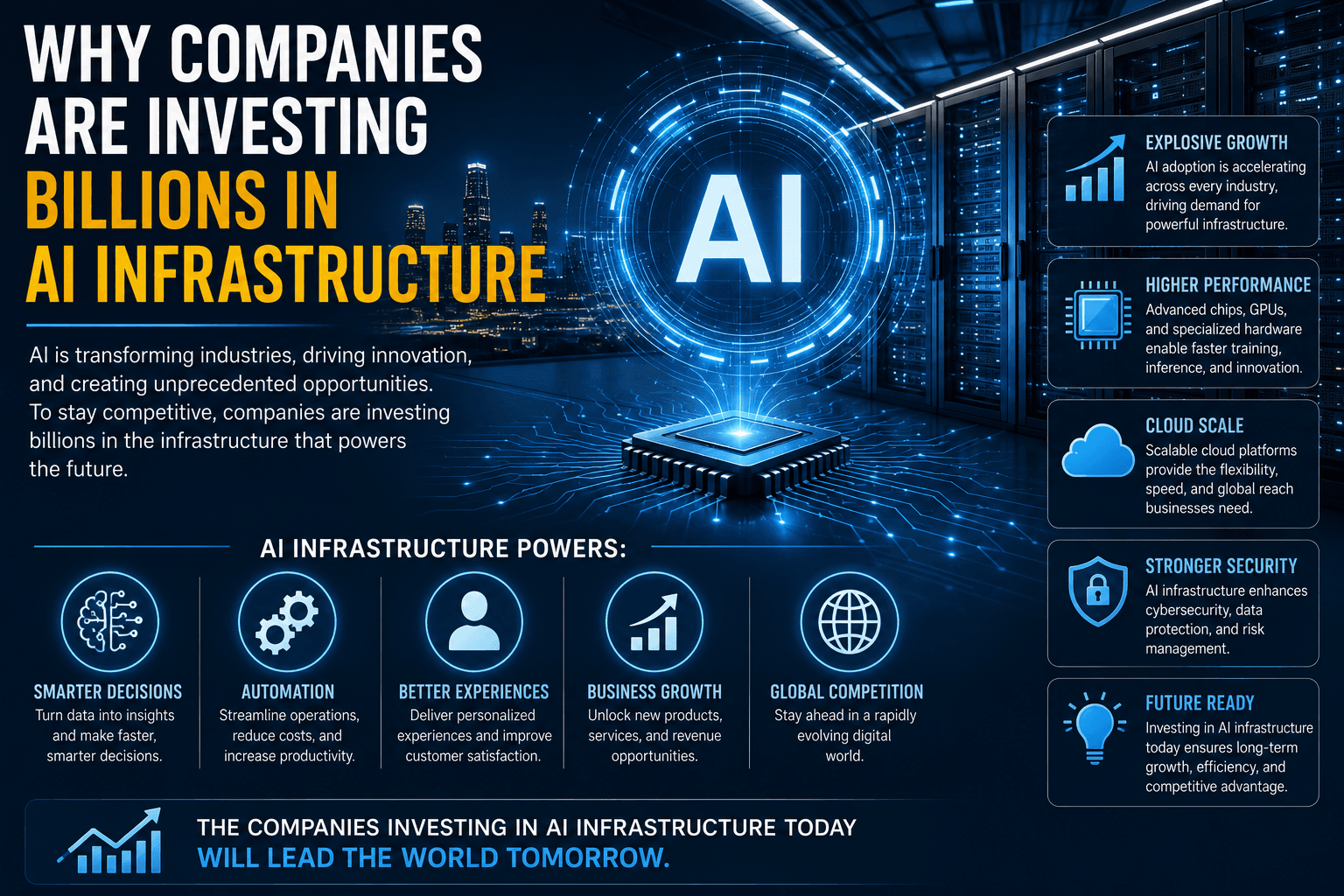
Artificial intelligence (AI)has rapidly evolved from a promising innovation into one of the world's most valuable business technologies. In 2026, organizations across nearly every industry are investing billions of dollars in AI infrastructure to accelerate digital transformation, improve operational efficiency, and gain a competitive advantage.
From advanced data centers and high-performance chips to cloud computing platforms and AI-powered software, companies are building the foundation needed to support increasingly powerful AI applications. Global investment in AI infrastructure continues to grow as businesses recognize that future success depends on their ability to process massive amounts of data, train sophisticated AI models, and deliver intelligent services at scale.
The AI Revolution Is Driving Infrastructure Demand
The widespread adoption of generative AI, machine learning, automation, and predictive analytics has dramatically increased computing requirements.
Modern AI models require enormous processing power to analyze data, generate insights, and deliver real-time responses. Traditional IT infrastructure is often insufficient for these demanding workloads.
As a result, businesses are investing in advanced computing environments capable of supporting AI-driven innovation for years to come.
High-Performance Data Centers
Data centers have become the backbone of AI infrastructure.
Unlike traditional facilities, AI-focused data centers are designed to handle complex workloads that require significant processing power and storage capacity.
Modern AI data centers feature:
High-performance GPUs
Advanced cooling technologies
Large-scale cloud connectivity
High-speed networking
Massive storage systems
Energy-efficient designs
Technology companies are expanding their global data center networks to meet the growing demand for AI services.
The Growing Importance of AI Chips
Specialized processors have become one of the most important components of AI infrastructure.
Graphics Processing Units (GPUs), AI accelerators, and custom-designed chips can perform billions of calculations simultaneously, dramatically reducing the time needed to train AI models.
Demand for these advanced processors continues to exceed supply as businesses race to expand their AI capabilities.
Industries including healthcare, finance, manufacturing, logistics, and education increasingly depend on AI hardware to support mission-critical applications.
Cloud Computing Powers AI Growth
Cloud computing has made AI more accessible than ever.
Rather than investing heavily in their own physical infrastructure, many organizations use cloud-based AI platforms that provide scalable computing resources on demand.
Cloud providers enable businesses to:
Train AI models
Store massive datasets
Deploy machine learning applications
Process real-time analytics
Improve cybersecurity
Scale AI workloads globally
This flexibility allows organizations to innovate more quickly while reducing infrastructure management costs.
AI Is Transforming Every Industry
The rapid expansion of AI infrastructure is driven by widespread adoption across multiple industries.
Healthcare
Hospitals use AI to assist with medical imaging, disease detection, patient monitoring, and personalized treatment recommendations.
Financial Services
Banks rely on AI for fraud detection, risk analysis, customer support, and automated investment strategies.
Manufacturing
Manufacturers deploy AI to optimize production lines, predict equipment failures, improve quality control, and reduce operational costs.
Retail
Retailers use AI to personalize shopping experiences, forecast demand, manage inventory, and optimize pricing strategies.
Transportation and Logistics
AI improves route planning, warehouse automation, supply chain visibility, and delivery efficiency.
The Rise of Enterprise AI
Businesses are increasingly integrating AI into everyday operations.
Enterprise AI applications now support:
Customer service
Human resources
Finance
Marketing
Sales
Procurement
Product development
Cybersecurity
As organizations deploy AI across multiple departments, the need for reliable infrastructure continues to grow.
Cybersecurity Requires Stronger AI Infrastructure
As cyber threats become more sophisticated, AI has become an essential tool for protecting digital assets.
Modern security platforms analyze millions of events every second, identify suspicious behavior, detect malware, and respond to attacks in real time.
This level of intelligent protection requires powerful computing infrastructure capable of processing enormous volumes of security data.
Supporting Generative AI
Generative AI has become one of the primary drivers of infrastructure investment.
Applications that generate text, images, videos, software code, and business insights require advanced computing environments capable of handling billions of calculations.
Organizations deploying generative AI internally must invest in:
Powerful servers
Large storage systems
High-speed networking
AI development platforms
Secure data management
These investments allow businesses to deliver faster and more accurate AI services.
Sustainability Is Becoming a Priority
While AI infrastructure offers tremendous benefits, it also consumes significant amounts of electricity.
Technology companies are increasingly investing in renewable energy, advanced cooling technologies, and energy-efficient hardware to reduce environmental impact.
Many organizations now consider sustainability an important factor when designing next-generation AI infrastructure.
Challenges Businesses Must Overcome
Despite strong investment, organizations face several challenges.
These include:
High infrastructure costs
Limited availability of AI hardware
Rising energy consumption
Data privacy requirements
Cybersecurity risks
Shortage of skilled AI professionals
Addressing these challenges requires careful planning, responsible governance, and long-term investment strategies.
Why Early Investment Matters
Companies investing in AI infrastructure today are preparing for tomorrow's opportunities.
Strong AI infrastructure enables businesses to:
Accelerate innovation
Improve customer experiences
Reduce operating costs
Increase productivity
Strengthen cybersecurity
Develop new products and services
Make faster, data-driven decisions
Organizations that delay investment may struggle to compete as AI becomes increasingly integrated into business operations.
The Future of AI Infrastructure
Over the coming years, AI infrastructure will continue evolving alongside advances in computing, networking, and software.
Emerging technologies such as edge computing, quantum computing, autonomous AI agents, and next-generation semiconductor technologies are expected to further expand AI capabilities.
Businesses will increasingly adopt hybrid infrastructure models that combine cloud computing, private data centers, and edge devices to support diverse AI workloads.
Conclusion
Artificial Intelligence is transforming the global business landscape, and robust infrastructure is the foundation that makes this transformation possible.
Companies are investing billions in AI infrastructure because they recognize that computing power, cloud platforms, advanced processors, and secure data management are essential for future growth.
Organizations that invest strategically in AI infrastructure today will be better positioned to innovate, improve efficiency, strengthen cybersecurity, and remain competitive in an increasingly digital economy.
As AI adoption continues to accelerate, infrastructure will remain one of the most valuable long-term investments businesses can make, enabling sustainable innovation and driving the next generation of global economic growth.
20 FAQs
1. What is AI infrastructure?
AI infrastructure refers to the hardware, software, networking, storage, and cloud resources required to develop, train, deploy, and manage artificial intelligence applications.
2. Why are companies investing billions in AI infrastructure?
Businesses are investing heavily to support growing AI workloads, improve productivity, accelerate innovation, and remain competitive in the rapidly evolving digital economy.
3. What are the main components of AI infrastructure?
AI infrastructure includes GPUs, AI chips, data centres, cloud computing platforms, networking equipment, storage systems, AI software frameworks, and security solutions.
4. Why are GPUs important for AI?
Graphics Processing Units (GPUs) provide the massive parallel processing power needed to train and run advanced AI and machine learning models efficiently.
5. How do data centres support AI?
Data centres provide the computing power, networking, storage, and energy resources required to process and manage large-scale AI workloads.
6. What role does cloud computing play in AI infrastructure?
Cloud platforms offer scalable computing resources, AI services, storage, and deployment tools that allow organisations to build AI applications without investing in large on-premises systems.
7. What are AI accelerators?
AI accelerators are specialised hardware components, such as GPUs, TPUs, and custom AI chips, designed to improve AI processing speed and efficiency.
8. Why is networking critical for AI infrastructure?
High-speed networking enables rapid communication between servers, storage systems, and AI processors, reducing latency and improving performance.
9. What industries are investing the most in AI infrastructure?
Technology, healthcare, finance, manufacturing, retail, telecommunications, automotive, and government sectors are among the largest investors.
10. How does AI infrastructure improve business performance?
It enables faster data analysis, real-time decision-making, automation, predictive analytics, and scalable AI applications that increase operational efficiency.
11. What challenges come with AI infrastructure investments?
Common challenges include high costs, energy consumption, cybersecurity risks, hardware shortages, data management complexity, and skilled workforce requirements.
12. How does AI infrastructure support generative AI?
Generative AI requires powerful computing resources, high-performance storage, fast networking, and specialised AI hardware to train and operate large language models.
13. What is edge AI infrastructure?
Edge AI infrastructure processes data closer to where it is generated, reducing latency, improving response times, and supporting real-time AI applications.
14. Why is AI infrastructure important for cybersecurity?
Modern AI infrastructure supports advanced threat detection, automated security monitoring, anomaly detection, and faster incident response.
15. How are AI chips different from traditional processors?
AI chips are specifically designed to perform AI and machine learning calculations more efficiently than general-purpose CPUs.
16. Can small businesses benefit from AI infrastructure?
Yes. Small businesses can access enterprise-grade AI infrastructure through cloud-based AI services without significant upfront investment.
17. What is the relationship between AI infrastructure and sustainability?
Companies are investing in energy-efficient data centres, advanced cooling systems, renewable energy, and optimised AI hardware to reduce environmental impact.
18. How does AI infrastructure support digital transformation?
It provides the foundation for automation, intelligent analytics, cloud services, and AI-powered applications that modernise business operations.
19. What trends are shaping AI infrastructure in 2026?
Major trends include AI factories, custom AI chips, liquid cooling, edge AI, hybrid cloud deployments, high-bandwidth networking, and sustainable data centres.
20. What is the future of AI infrastructure?
The future includes more powerful AI processors, autonomous data centres, faster networking, quantum-ready technologies, energy-efficient computing, and globally distributed AI platforms supporting next-generation intelligent applications.