
Introduction
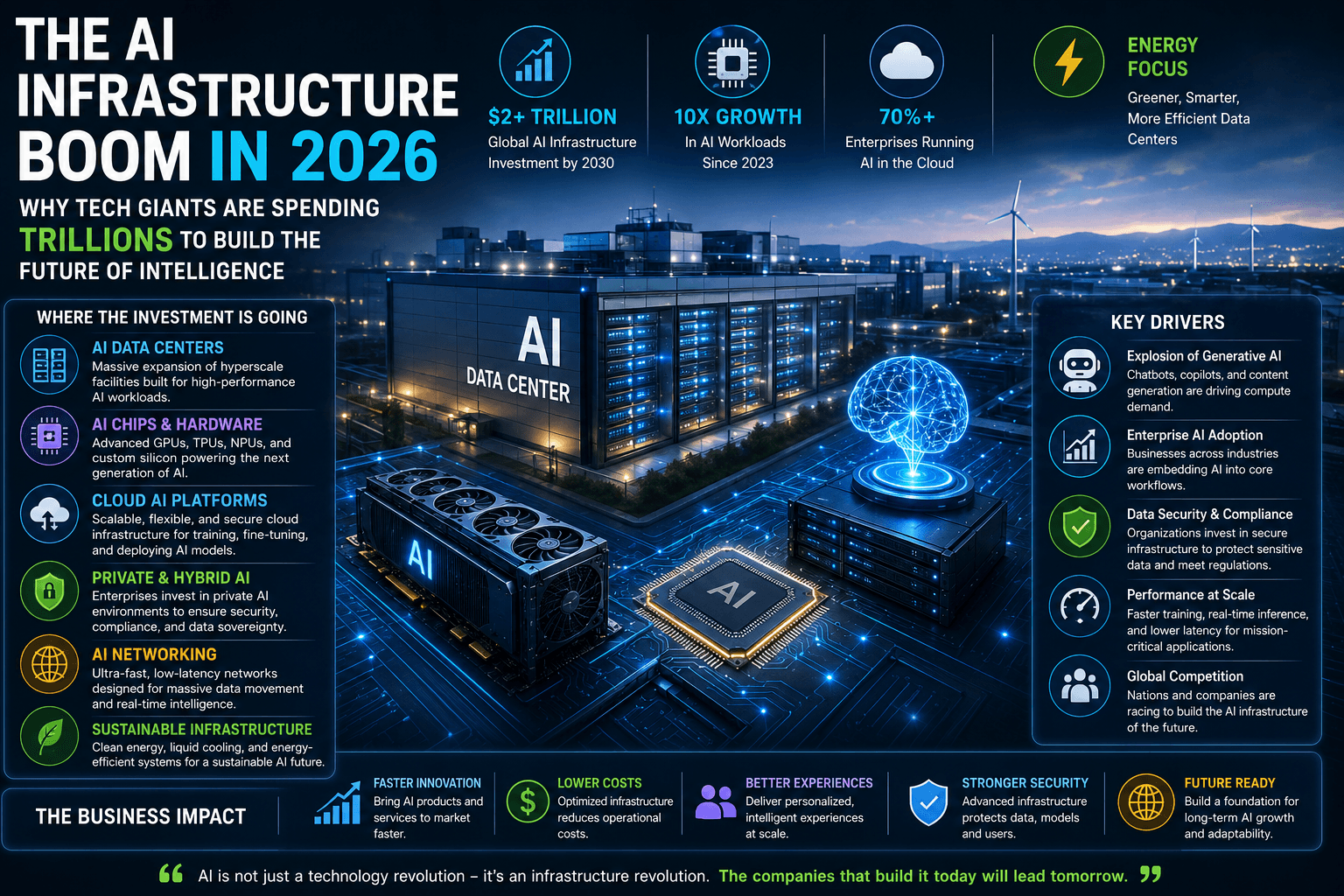
Artificial intelligence has entered a new era. In 2026, the conversation is no longer centered on whether AI will transform businesses—it is about who has the infrastructure to support the next generation of intelligent applications. Across the globe, technology giants are investing unprecedented amounts in AI infrastructure, including hyperscale data centers, advanced GPUs, AI networking equipment, energy-efficient cooling systems, cloud platforms, and private AI environments.
The rapid adoption of generative AI, autonomous AI agents, multimodal models, and enterprise automation has created an enormous demand for computing power. Every AI-powered chatbot, recommendation engine, predictive analytics platform, or virtual assistant depends on a sophisticated infrastructure capable of processing billions of calculations every second.
According to industry analysts, global AI infrastructure spending is expected to reach record-breaking levels over the next few years as organizations compete to build faster, more reliable, and scalable AI platforms. Cloud providers are expanding their data center footprints, semiconductor manufacturers are accelerating AI chip production, and enterprises are increasingly deploying private AI environments to protect sensitive business data.
For businesses, this infrastructure boom represents more than a technology trend—it is a strategic shift that will determine competitiveness, innovation, and long-term growth. Organizations that understand and invest in modern AI infrastructure will be better equipped to reduce costs, improve efficiency, and deliver superior customer experiences.
Why AI Infrastructure Has Become the World's Biggest Technology Investment
Artificial intelligence models are significantly more resource-intensive than traditional software applications. Training and running large language models require thousands of specialized processors, high-speed storage systems, advanced networking, and enormous amounts of electricity.
Unlike conventional business software, AI systems continuously process vast datasets, learn from interactions, and generate complex outputs in real time. This level of performance requires a modern infrastructure designed specifically for AI workloads.
Several factors are driving this investment surge:
Explosive growth in generative AI adoption
Rising demand for AI copilots and autonomous agents
Enterprise automation initiatives
Real-time analytics and decision-making
AI-powered cybersecurity solutions
Personalized customer experiences
Industry-specific AI applications in healthcare, finance, retail, manufacturing, and education
As organizations deploy AI across more business functions, infrastructure has become the foundation of digital transformation.
The Massive Expansion of AI Data Centers
Data centers are evolving into AI factories. Instead of simply storing information, modern facilities are optimized to train, deploy, and operate advanced AI models around the clock.
Today's AI data centers include:
Thousands of AI accelerators
High-bandwidth memory systems
Ultra-fast networking fabrics
Liquid cooling technologies
AI-optimized storage
Automated workload management
Advanced cybersecurity systems
Hyperscale cloud providers are investing billions to build new AI-ready facilities capable of supporting enterprise-scale AI applications.
Modern AI data centers prioritize:
Higher processing density
Lower energy consumption
Reduced latency
Faster model deployment
Improved reliability
These facilities are becoming essential infrastructure for the global digital economy.
AI Chips: The Engine Behind Intelligent Computing
The rapid advancement of AI would not be possible without specialized processors designed specifically for machine learning.
Traditional CPUs remain important, but AI workloads increasingly depend on:
Graphics Processing Units (GPUs)
AI accelerators
Tensor processors
Neural processing units (NPUs)
Custom AI chips
These processors perform parallel computations far more efficiently than conventional hardware.
As AI models become larger and more sophisticated, demand for high-performance chips continues to outpace supply. Technology companies are investing heavily in custom silicon to reduce dependence on third-party hardware and improve performance for specific workloads.
Future AI chips are expected to deliver:
Greater computational efficiency
Lower power consumption
Faster inference
Enhanced security
Improved scalability
Cloud AI Continues to Dominate Enterprise Adoption
Cloud computing remains the fastest way for businesses to access AI capabilities without investing in expensive hardware.
Cloud AI platforms provide:
Scalable computing resources
Managed AI services
Machine learning tools
Data storage
AI model deployment
Security and compliance features
Organizations can scale resources based on demand, significantly reducing upfront investment while accelerating innovation.
Cloud AI also enables global collaboration by allowing distributed teams to build, train, and deploy AI applications from virtually anywhere.
Why Private AI Is Growing Rapidly
While public cloud platforms remain popular, many organizations are shifting sensitive workloads to private AI environments.
Private AI offers several advantages:
Enhanced Data Privacy
Sensitive information remains within the organization's infrastructure.
Regulatory Compliance
Industries such as healthcare, banking, and government can better meet strict compliance requirements.
Greater Control
Businesses maintain full ownership of AI models, datasets, and infrastructure.
Lower Long-Term Costs
For organizations with heavy AI workloads, private infrastructure may reduce operational expenses over time.
Hybrid AI strategies that combine public cloud and private infrastructure are becoming increasingly common.
Networking Is the Hidden Hero of AI Infrastructure
AI systems generate enormous amounts of data that must move rapidly between processors, storage systems, and cloud environments.
Modern AI infrastructure relies on:
Ultra-high-speed networking
Low-latency communication
Intelligent traffic management
AI-optimized switches
High-bandwidth interconnects
Without advanced networking, even the most powerful AI processors cannot perform efficiently.
As AI workloads expand, networking technology has become just as important as computing power itself.
Energy Challenges and Sustainable AI
One of the biggest concerns surrounding AI infrastructure is energy consumption.
Training advanced AI models requires substantial electricity, leading companies to invest in:
Renewable energy
Energy-efficient processors
Liquid cooling
Smart power management
Carbon reduction initiatives
Sustainability is becoming a major competitive advantage. Organizations that build greener AI infrastructure not only reduce costs but also strengthen their environmental commitments.
AI Infrastructure and Cybersecurity
As AI systems become business-critical, infrastructure security is more important than ever.
Modern AI environments require:
Zero Trust architecture
Identity and access management
AI-driven threat detection
Encryption for data in transit and at rest
Continuous monitoring
Secure model deployment
Supply chain security
Cybercriminals are increasingly targeting AI systems, making resilient infrastructure essential for protecting valuable data and intellectual property.
Industry Applications Driving Infrastructure Demand
Nearly every sector is accelerating AI adoption.
Healthcare
Hospitals use AI for diagnostics, patient monitoring, medical imaging, and drug discovery.
Finance
Banks rely on AI for fraud detection, risk assessment, trading, and customer service.
Retail
Retailers improve inventory management, demand forecasting, and personalized shopping experiences.
Manufacturing
Factories deploy AI for predictive maintenance, quality control, robotics, and supply chain optimization.
Education
Educational institutions use AI tutors, adaptive learning platforms, and automated administrative systems.
Each industry requires scalable infrastructure capable of supporting real-time AI applications.
Emerging Trends Shaping AI Infrastructure
Several innovations are expected to define the next phase of AI infrastructure.
Edge AI
Processing data closer to users reduces latency and supports real-time applications such as autonomous vehicles and smart factories.
AI-Native Data Centers
Future facilities will be purpose-built for AI rather than traditional computing.
Composable Infrastructure
Organizations will dynamically allocate compute, storage, and networking resources based on workload requirements.
Autonomous Infrastructure Management
AI will increasingly manage AI infrastructure by predicting failures, optimizing workloads, and automating maintenance.
Quantum-AI Integration
Although still emerging, quantum computing may eventually accelerate certain AI workloads beyond today's capabilities.
Challenges Businesses Must Overcome
Despite enormous opportunities, organizations face several obstacles.
High infrastructure costs
Shortage of AI talent
Rapid hardware obsolescence
Complex integration
Data governance issues
Security risks
Regulatory uncertainty
Energy limitations
Successful organizations will address these challenges through strategic planning, phased implementation, and continuous investment in skills and innovation.
Best Practices for Building an AI-Ready Infrastructure
To prepare for the future, businesses should:
Develop a long-term AI infrastructure roadmap.
Adopt hybrid cloud strategies where appropriate.
Invest in scalable storage and networking.
Prioritize cybersecurity from the beginning.
Implement structured data governance.
Monitor infrastructure performance continuously.
Choose energy-efficient technologies.
Train IT teams on AI operations and automation.
Regularly evaluate new hardware and software advancements.
A flexible and scalable infrastructure ensures businesses can adapt as AI technologies evolve.
Conclusion
The AI infrastructure boom of 2026 marks one of the most significant technology investment cycles in history. Enterprises are no longer viewing infrastructure as a background IT function—it has become the foundation of competitive advantage. High-performance data centers, advanced AI chips, cloud platforms, private AI environments, intelligent networking, and sustainable energy solutions are collectively shaping the future of business innovation.
Organizations that invest wisely in AI infrastructure will gain the ability to deploy smarter applications, automate complex workflows, enhance cybersecurity, and deliver better customer experiences at scale. Meanwhile, businesses that delay modernization risk falling behind competitors that are building AI-ready operations today.
The future of artificial intelligence will not be determined solely by the quality of AI models, but by the strength, efficiency, and scalability of the infrastructure supporting them. As AI adoption accelerates across every industry, investing in resilient and future-proof infrastructure is no longer optional—it is a strategic necessity. Companies that embrace this transformation today will be the leaders of tomorrow's AI-driven economy.