Introduction
The way people search for information online is changing faster than at any point since Google became the world's dominant search engine. In 2026, artificial intelligence is no longer just helping users find information—it is increasingly delivering complete answers without requiring them to visit multiple websites. AI-powered browsers and conversational search experiences are reshaping how businesses attract visitors, generate leads, and build their online presence.
Instead of typing keywords into a traditional search engine and clicking through a list of blue links, users now ask complex questions and receive intelligent, summarized responses in seconds. AI browsers combine web browsing, research, productivity, and content generation into a single experience, making information more accessible than ever.
For businesses, however, this shift introduces both opportunities and challenges. While AI can improve user experience, it also reduces traditional click-through rates and changes how websites earn visibility. Companies that rely solely on conventional SEO strategies risk losing valuable traffic if they fail to adapt.
Understanding the rise of AI browsers is essential for marketers, publishers, e-commerce brands, and enterprise organizations that depend on organic search. The future of online visibility will belong to businesses that optimize not only for search engines but also for AI systems capable of interpreting, summarizing, and recommending content.
What Are AI Browsers?
AI browsers integrate large language models directly into the browsing experience. Instead of acting only as tools for displaying webpages, they analyze information, answer questions, summarize articles, compare products, write emails, translate content, and assist users throughout their online activities.
Unlike traditional browsers, AI browsers function as intelligent assistants that understand context and user intent.
Common capabilities include:
Instant summaries of lengthy articles
Conversational web searches
Research assistance
AI-generated writing
Automatic comparison of products and services
Smart workflow automation
Personalized recommendations
These capabilities significantly reduce the time users spend searching through multiple websites.
Why Traditional Search Is Changing
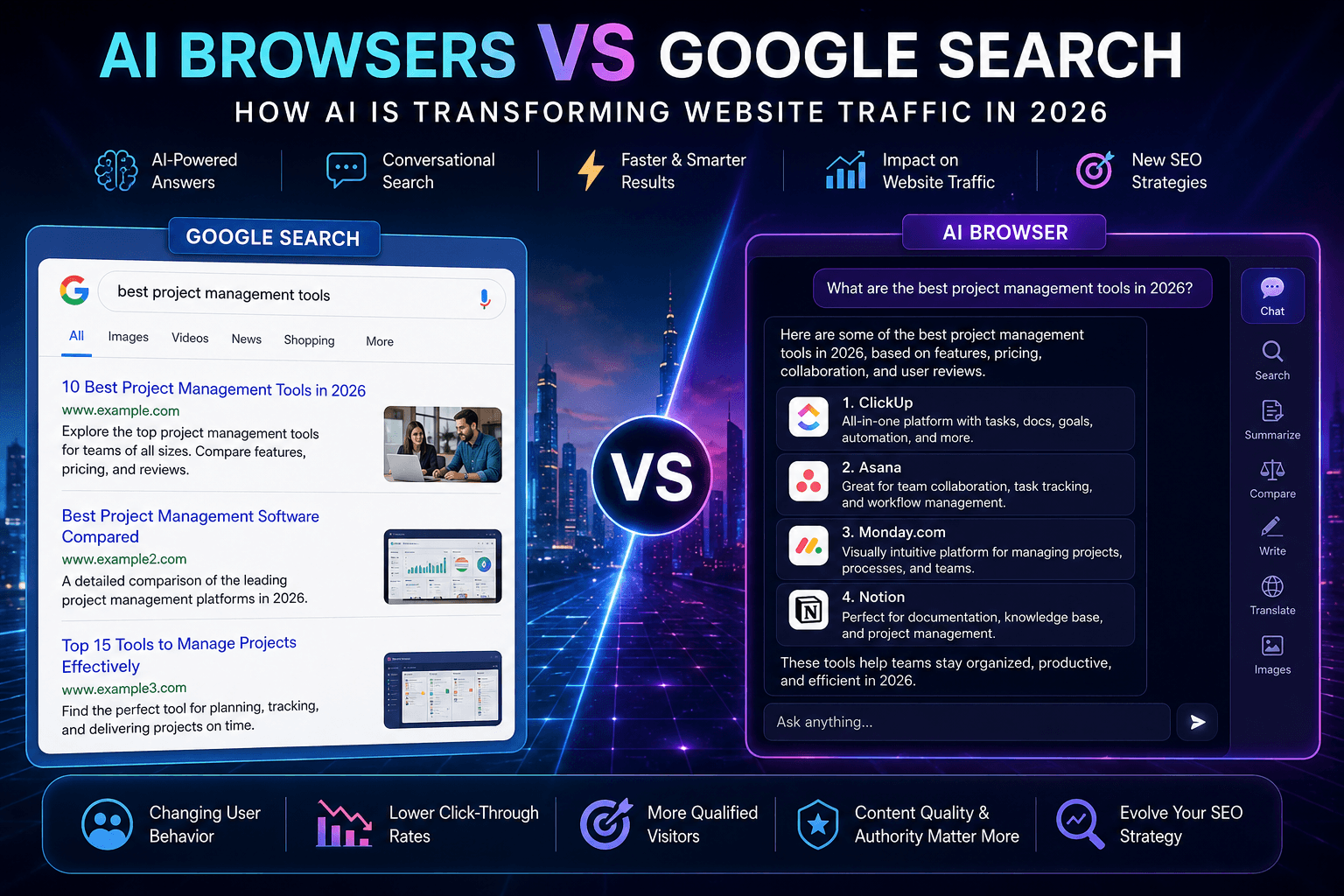
For decades, search engines followed a familiar process:
User enters keywords.
Search engine displays ranked webpages.
User clicks one or more results.
Website gains traffic.
AI has transformed this process into:
User asks a natural-language question.
AI gathers information from multiple sources.
AI provides a direct answer.
User may never need to visit the original websites.
This evolution creates a new challenge for publishers because valuable information may be consumed without generating a website visit.
How AI Browsers Affect Website Traffic
Many businesses are already noticing changes in user behavior. While impressions may remain strong, click-through rates can decline because AI answers satisfy users immediately.
Some of the biggest impacts include:
Lower Organic Clicks
AI-generated summaries reduce the need for users to open multiple webpages.
More Qualified Visitors
Users who do click often have stronger purchase intent because they have already completed preliminary research.
Higher Competition
Only the most authoritative content is likely to be referenced or summarized by AI systems.
Increased Importance of Expertise
Content demonstrating first-hand knowledge, accurate data, and expert analysis is more likely to earn visibility.
The New Rules of SEO
Search engine optimization is not disappearing—it is evolving.
Businesses now need to optimize content for both traditional search algorithms and AI-driven answer engines.
Important priorities include:
1. High-Quality Original Content
Artificial Intelligence increasingly favor unique research, expert insights, original statistics, and practical examples over generic articles.
2. Clear Content Structure
Use:
H2 and H3 headings
Bullet lists
Tables
FAQs
Short paragraphs
Structured content helps AI systems understand information more effectively.
3. Strong E-E-A-T Signals
Google continues emphasizing:
Experience
Expertise
Authoritativeness
Trustworthiness
Businesses should include author profiles, credible references, and accurate information.
4. Schema Markup
Structured data helps AI understand:
Articles
FAQs
Products
Organizations
Reviews
Events
Proper schema improves machine readability.
Why Long-Form Content Still Matters
Some marketers believe AI will eliminate long-form articles.
The opposite is happening.
AI systems need authoritative sources containing detailed explanations. Comprehensive articles remain valuable because they provide the depth AI cannot create independently without reliable source material.
Well-researched guides continue attracting backlinks, citations, and long-term authority.
AI Search Optimization (AISO)
A new discipline is emerging alongside SEO:ai search optimization AISO focuses on making content easier for AI systems to discover, understand, and reference.
Key practices include:
Answer common questions directly.
Use natural language.
Add definitions and examples.
Keep facts current.
Update content regularly.
Include trustworthy data and citations.
Write concise summaries at the beginning of articles.
The Importance of Brand Authority
As AI summarizes information from many sources, brand recognition becomes increasingly important.
Users are more likely to trust businesses they already know.
To strengthen authority:
Publish consistently.
Share thought leadership.
Earn backlinks from reputable websites.
Be active on professional platforms like LinkedIn.
Build a recognizable voice across channels.
Content Formats That Perform Well
Diversifying content helps businesses reach users across AI and traditional search.
Effective formats include:
In-depth guides
Case studies
Industry reports
Research papers
White papers
Videos
Podcasts
Infographics
Interactive tools
FAQs
These assets increase the likelihood of being cited or recommended by AI systems.
Common SEO Mistakes in the AI Era
Businesses should avoid:
Publishing thin or repetitive content
Relying heavily on AI-generated text without editing
Ignoring user intent
Neglecting technical SEO
Failing to update older articles
Overusing keywords
Omitting structured data
Creating content without original insights
High-quality, user-focused content remains the foundation of successful SEO.
Preparing Your Business for the Future
Organizations should begin adapting now by:
Conducting regular content audits
Updating evergreen articles
Investing in expert-written content
Improving page speed and mobile performance
Implementing structured data
Tracking AI-driven traffic where possible
Building brand authority through digital PR
Expanding into video and multimedia
Monitoring changes in search behavior
Businesses that embrace these changes early will be better positioned as AI-driven search continues to grow.
The Future of Search
The future is not about AI replacing search engines—it is about search becoming more conversational, contextual, and intelligent. Traditional search results will continue to exist, but AI-generated answers, personalized recommendations, and integrated browsing assistants will increasingly shape how people discover information.
Success in this new environment will depend on creating trustworthy, original, and user-focused content that serves both human readers and AI systems. Organizations that prioritize expertise, transparency, and technical optimization will remain competitive as the search landscape evolves.
Rather than viewing AI browsers as a threat, businesses should see them as an opportunity to reach audiences in new ways. By combining strong SEO fundamentals with AI-ready content strategies, companies can continue to grow their visibility, attract qualified visitors, and build lasting digital authority.
Conclusion
AI browsers represent one of the most significant shifts in the digital landscape since the rise of traditional search engines. They are redefining how people access information, compare products, and interact with online content. For businesses, this means that success is no longer measured solely by ranking on the first page of search results. Instead, companies must focus on creating authoritative, structured, and genuinely valuable content that AI systems can understand, trust, and recommend.
The future of SEO lies in combining traditional optimization techniques with AI Search Optimization (AISO). Businesses should invest in original research, demonstrate real expertise, use structured data, and continually update their content to stay relevant. At the same time, building a recognizable brand through digital PR, social media, and thought leadership will become increasingly important as AI favors trusted sources.
Ai browser are not eliminating opportunities for website growth—they are changing the rules of engagement. Organizations that adapt early, prioritize quality over quantity, and embrace AI as a partner rather than a competitor will be well-positioned to thrive. As search continues to evolve, the businesses that innovate today will become the trusted digital leaders of tomorrow.