
Introduction
Artificial intelligence has become a strategic priority for organizations across every industry. From customer service chatbots and AI-powered analytics to software development assistants and intelligent automation, businesses are rapidly integrating AI into their daily operations. However, one of the most important decisions enterprises face in 2026 is whether to adopt open-source AI models or rely on closed (proprietary) AI models.
This decision goes beyond technology. It affects infrastructure costs, cybersecurity, regulatory compliance, scalability, innovation, and long-term competitiveness. Open-source AI models provide organizations with greater flexibility, transparency, and customization, while closed AI models often deliver premium performance, managed services, and enterprise-grade support.
As AI adoption accelerates, there is no universal answer. The best choice depends on business goals, technical expertise, available resources, and regulatory requirements. Understanding the strengths and weaknesses of both approaches is essential for making an informed investment.
In this article, we'll explore the differences between open-source and closed AI models, compare their advantages and limitations, examine real-world enterprise use cases, and discuss which approach is likely to shape the future of enterprise AI.
What Are Open-Source AI Models?
Open-source AI models are artificial intelligence systems whose model weights, architecture, or source code are publicly available for developers and organizations to inspect, modify, and deploy.
Businesses can download these models, customize them for their own needs, and run them on cloud infrastructure or private servers.
Key Characteristics
High customization
Greater transparency
Community-driven development
Flexible deployment
No mandatory vendor lock-in
Suitable for private AI environments
Because organizations have greater control, open-source AI is becoming increasingly attractive for enterprises seeking long-term flexibility.
What Are Closed AI Models?
Closed AI models are proprietary systems developed and maintained by commercial AI providers. Users access them through APIs, cloud platforms, or managed enterprise services.
The provider controls model development, updates, infrastructure, and security.
Key Characteristics
Managed infrastructure
Enterprise support
Continuous updates
High performance
Easy deployment
Limited customization
These models allow businesses to adopt AI quickly without managing complex infrastructure.
Why Enterprises Are Re-Evaluating Their AI Strategy
The rapid evolution of AI has created new business challenges.
Organizations are asking:
How can we reduce AI costs?
Should sensitive data remain inside our company?
Can we customize AI for our industry?
Will vendor pricing increase over time?
How do we comply with global AI regulations?
These questions are driving renewed interest in open-source AI while maintaining demand for enterprise-grade proprietary solutions.
Advantages of Open-Source AI
1. Greater Customization
Organizations can fine-tune models for:
Healthcare
Banking
Legal services
Manufacturing
Customer support
Research
This level of flexibility allows AI systems to better understand industry-specific terminology and workflows.
2. Lower Long-Term Costs
Although infrastructure investment is required, businesses avoid recurring API charges associated with many proprietary services.
Over time, organizations with heavy AI workloads may significantly reduce operational costs.
3. Improved Data Privacy
Sensitive business information remains under company control.
This is especially valuable for:
Financial institutions
Government agencies
Healthcare providers
Defense organizations
Private deployment reduces the risk of exposing confidential information to external platforms.
4. Vendor Independence
Organizations are not tied to a single AI provider.
This flexibility reduces business risk and allows companies to adopt new technologies as the AI market evolves.
5. Community Innovation
Thousands of developers worldwide contribute improvements, security fixes, and optimization techniques.
Open collaboration often accelerates innovation.
Advantages of Closed AI Models
1. Superior User Experience
Closed AI providers often deliver polished interfaces, optimized performance, and enterprise-ready features.
Businesses can deploy solutions much faster.
2. Enterprise Support
Commercial providers offer:
Technical support
Documentation
Security updates
Service-level agreements (SLAs)
Compliance certifications
This reduces operational complexity for IT teams.
3. Continuous Improvements
Providers regularly enhance models with better reasoning, multimodal capabilities, and improved accuracy without requiring customer intervention.
4. Faster Deployment
Organizations can begin using AI almost immediately through cloud APIs without purchasing expensive infrastructure.
This makes proprietary AI attractive for startups and small businesses.
5. Global Scalability
Enterprise AI platforms automatically scale to support millions of users, reducing infrastructure management requirements.
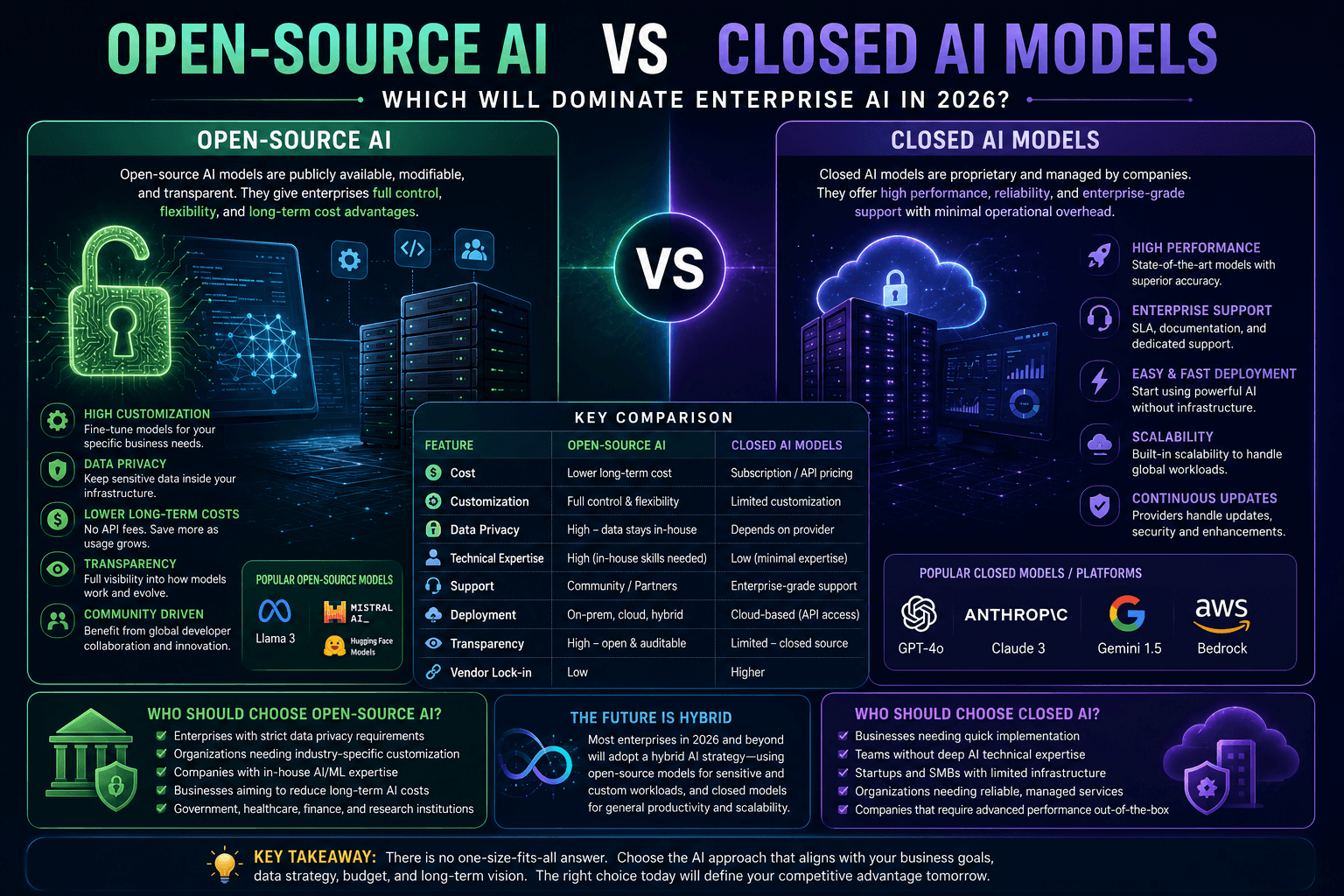
Comparing Open-Source and Closed AI Models
Feature | Open-Source AI | Closed AI |
|---|---|---|
Cost | Lower long-term | Subscription/API fees |
Customization | Excellent | Limited |
Data Privacy | High | Depends on provider |
Deployment | Flexible | Cloud-based |
Technical Expertise | Required | Minimal |
Enterprise Support | Community or vendor | Dedicated support |
Scalability | Business-managed | Provider-managed |
Vendor Lock-in | Low | Higher |
Transparency | High | Limited |
Innovation | Community-driven | Provider-driven |
Security Considerations
Security is one of the biggest factors influencing enterprise AI adoption.
Open-Source Security
Advantages:
Full visibility
Internal security controls
Private deployment
Custom compliance policies
Challenges:
Requires skilled security teams
Infrastructure management responsibility
Regular patching and monitoring
Closed AI Security
Advantages:
Managed security
Regular updates
Built-in compliance features
Enterprise certifications
Challenges:
Less transparency
Limited control over infrastructure
Potential concerns about external data processing
AI Infrastructure Requirements
Open-source AI typically requires organizations to invest in:
GPUs
AI servers
High-speed networking
Data storage
Security systems
Model management tools
Closed AI largely eliminates these infrastructure requirements because the provider manages them.
However, organizations remain dependent on provider pricing and service availability.
Which Industries Prefer Open-Source AI?
Several industries increasingly favor open-source deployment.
Healthcare
Protecting patient records while customizing diagnostic AI.
Banking
Keeping financial information inside secure infrastructure.
Manufacturing
Developing AI optimized for industrial operations.
Government
Maintaining sovereignty over sensitive national data.
Telecommunications
Building AI tailored for large-scale network operations.
Which Businesses Prefer Closed AI?
Closed AI is particularly attractive for:
Startups
Small businesses
Marketing agencies
Customer support teams
Content creators
SaaS companies
These organizations benefit from rapid deployment and minimal infrastructure investment.
The Rise of Hybrid AI
Rather than choosing one approach exclusively, many enterprises are adopting hybrid AI strategies.
Examples include:
Closed AI for general productivity
Open-source AI for confidential projects
Public cloud for development
Private AI for production workloads
Hybrid environments combine flexibility with enterprise-grade performance.
AI Governance and Compliance
Governments worldwide are introducing AI regulations focused on:
Data privacy
Transparency
Risk management
Intellectual property
Responsible AI development
Open-source AI allows organizations greater control over compliance implementation, while proprietary providers often offer built-in compliance tools.
Businesses should carefully evaluate legal obligations before selecting an AI platform.
Future Trends in Enterprise AI
Several trends are expected to shape enterprise AI over the coming years.
Smaller Specialized Models
Businesses are increasingly adopting compact AI models optimized for specific industries instead of relying solely on massive general-purpose systems.
AI Agents
Autonomous AI agents capable of completing complex business workflows will drive demand for flexible deployment options.
Edge AI
Running AI closer to users will improve speed, privacy, and reliability.
Private AI Expansion
More enterprises will invest in secure, in-house AI environments to protect sensitive data and reduce long-term operating costs.
Multi-Model Strategies
Organizations will combine multiple AI models instead of relying on a single provider, improving resilience and flexibility.
How to Choose the Right AI Model for Your Business
When deciding between open-source and closed AI, consider the following questions:
Do you need complete control over your data?
How important is customization?
What is your long-term AI budget?
Does your organization have AI engineering expertise?
Are there strict regulatory or compliance requirements?
Do you need rapid deployment or long-term flexibility?
Will your AI workloads grow significantly in the next few years?
Answering these questions will help determine which approach best aligns with your business goals.
Conclusion
The debate between open-source AI and closed AI models is not about determining a single winner—it is about selecting the right solution for the right business scenario. Open-source AI offers unmatched flexibility, transparency, and long-term cost efficiency, making it an excellent choice for organizations that require customization, strong data privacy, and full control over their AI infrastructure. On the other hand, closed AI models provide simplicity, enterprise-grade support, rapid deployment, and consistent performance, making them ideal for businesses that want to adopt AI quickly without managing complex systems.
Looking ahead, the future of enterprise AI is likely to be hybrid rather than exclusive. Many organizations will combine proprietary AI services for general productivity with open-source models for sensitive or industry-specific applications. This balanced strategy enables businesses to maximize innovation while maintaining security, compliance, and cost efficiency.
As AI continues to evolve, the organizations that build flexible AI strategies today will be best positioned to adapt to new technologies, changing regulations, and increasing customer expectations. The future belongs not to businesses that choose one model over another, but to those that use both strategically to create secure, scalable, and intelligent digital ecosystems.