Introduction
Search engine optimisation has undergone numerous transformations over the past two decades, from keyword stuffing and backlink-focused strategies to mobile-first indexing and user experience optimisation. However, no development has changed the search landscape as dramatically as artificial intelligence. In 2026, AI-powered search experiences and zero-click search results are redefining how people discover information online, forcing businesses to rethink their digital marketing strategies.
Search engines are no longer simply displaying a list of blue links. Instead, they are generating direct answers, summarising web pages, recommending products, and providing contextual responses directly on the results page. As a result, many users receive the information they need without ever clicking through to a website.
While this presents new challenges for businesses that rely on organic traffic, it also creates opportunities for organisations willing to adapt. Companies that understand how AI search works and optimise their content accordingly will remain visible, build authority, and continue attracting valuable customers in an increasingly competitive digital environment.
What Is AI Search?
AI search uses artificial intelligence, machine learning, and large language models to understand user intent and deliver more accurate, conversational, and personalised search results.
Unlike traditional search engines that primarily matched keywords, AI search focuses on context and meaning. Instead of simply finding pages containing specific phrases, AI analyses multiple sources, understands relationships between topics, and produces comprehensive answers.
Modern AI search platforms can:
Answer complex questions instantly.
Summarise multiple sources.
Understand conversational language.
Recommend relevant products and services.
Personalise search experiences.
Generate follow-up questions.
This shift has fundamentally changed how users interact with search engines.
Understanding Zero-Click Search
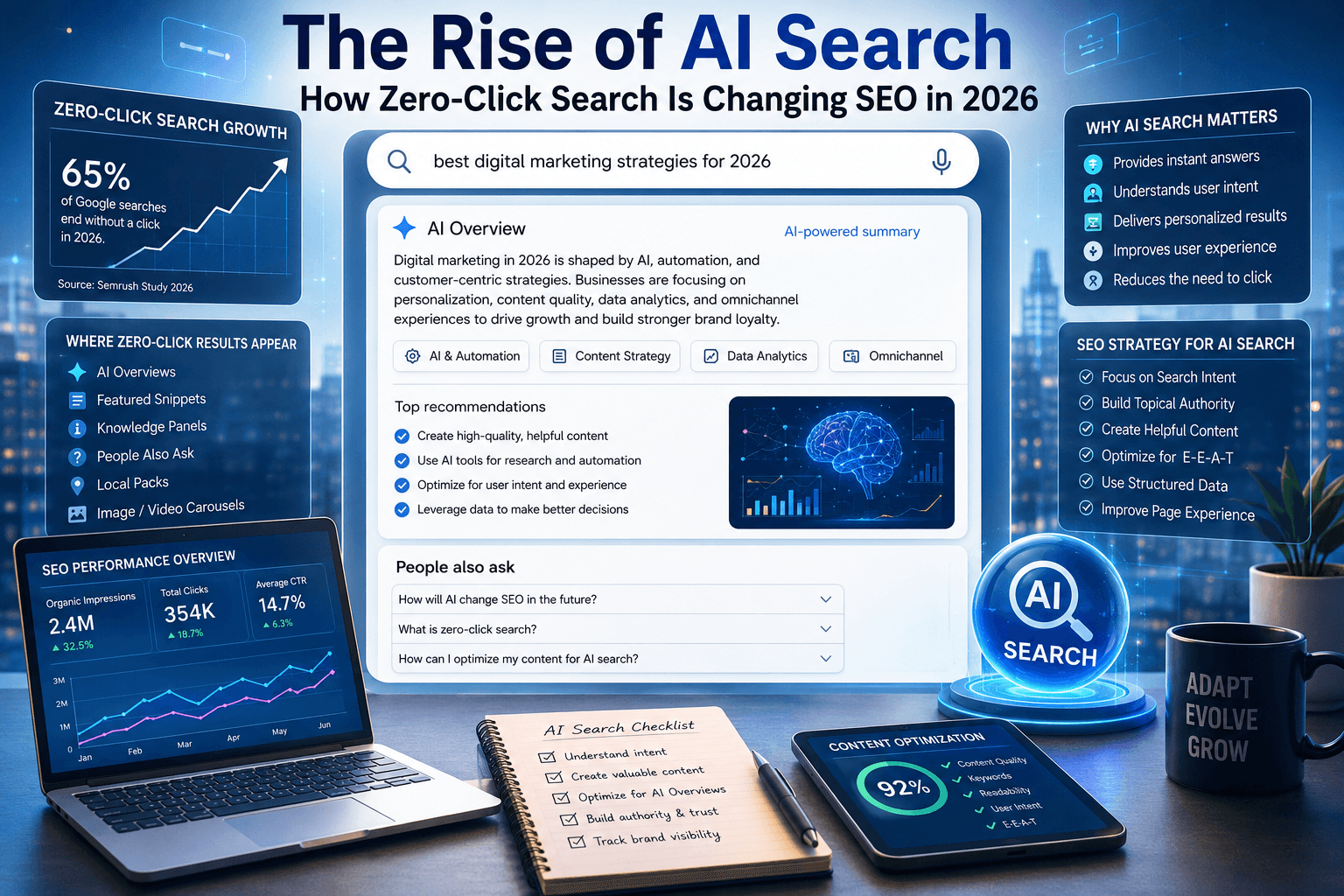
Zero-click search occurs when users receive the information they need directly from the search results page without visiting another website.
Examples include:
AI-generated summaries
Featured snippets
Knowledge panels
Weather forecasts
Currency conversions
Sports scores
Business information
Maps
Frequently asked questions
In many cases, users never need to click a result because the answer is already available.
Although this may reduce traditional website traffic, it also increases the importance of becoming the trusted source that AI systems reference.
Why AI Search Matters More Than Ever
Artificial intelligence is changing search behaviour across every industry.
Today's users expect:
Faster answers
More personalised experiences
Conversational interactions
Higher-quality information
Accurate recommendations
Minimal effort
Businesses that continue optimising only for traditional search rankings risk losing visibility as AI-powered search continues to expand.
Forward-thinking organisations are now optimising for AI-generated answers rather than focusing solely on page-one rankings.
How AI Is Changing SEO
Search engine optimisation is no longer centred around keywords alone.
Instead, successful SEO strategies now focus on delivering expertise, authority, trustworthiness, and comprehensive content.
Several important changes include:
1. Search Intent Is More Important Than Keywords
AI understands why users perform a search rather than simply matching keywords.
Instead of creating dozens of articles targeting slight keyword variations, businesses should develop comprehensive resources that fully answer users' questions.
2. Topical Authority Matters More
Search engines increasingly reward websites that consistently publish expert content within a particular subject area.
Rather than producing isolated articles, businesses should build content clusters around core topics to establish credibility.
For example, a technology website covering AI should also publish related content on automation, machine learning, cybersecurity, cloud computing, and digital transformation.
3. Content Quality Has Become the Biggest Ranking Factor
AI systems evaluate content based on usefulness, originality, structure, and credibility.
High-performing content typically includes:
Original insights
Clear headings
Practical examples
Reliable information
Updated statistics
Easy-to-read formatting
Businesses should prioritise solving user problems instead of writing solely for search engines.
The Impact on Organic Traffic
Many organisations have noticed declining click-through rates despite maintaining high search rankings.
This happens because users often obtain answers directly within AI-generated search results.
However, fewer clicks do not necessarily mean reduced visibility.
Businesses appearing in AI summaries often gain stronger brand recognition and increased credibility, influencing purchasing decisions even before users visit a website.
As search behaviour evolves, success should be measured through brand visibility, engagement, lead generation, and conversions rather than page views alone.
Why High-Quality Content Wins
As AI search becomes more sophisticated, low-value content is rapidly disappearing from search results.
Generic articles written solely to target keywords offer little value when AI can generate similar summaries instantly.
Businesses that publish original research, expert opinions, detailed case studies, industry analysis, and practical guidance are far more likely to be referenced by AI systems.
Creating genuinely helpful content is becoming one of the most effective long-term SEO strategies.
Optimising Content for AI Search
Businesses that want to remain competitive in 2026 must optimise their content not only for traditional search engines but also for AI-powered search experiences. This means creating content that is comprehensive, trustworthy, and structured in a way that AI systems can easily understand.
Several best practices include:
Answer questions clearly and directly.
Use descriptive headings and subheadings.
Organise information with bullet points and numbered lists.
Include frequently asked questions (FAQs).
Publish original insights and expert opinions.
Keep content regularly updated with current information.
Optimise for mobile devices and fast page speeds.
The goal is to become a reliable source that AI platforms reference when generating search responses.
The Growing Importance of E-E-A-T
Google continues to prioritise Experience, Expertise, Authoritativeness, and Trustworthiness (E-E-A-T) when evaluating content quality.
Businesses should demonstrate credibility by:
Publishing content written by knowledgeable professionals.
Providing accurate and verifiable information.
Citing reliable sources where appropriate.
Maintaining transparent business information.
Regularly updating outdated content.
Strong E-E-A-T signals increase the likelihood of appearing in AI-generated search summaries and featured results.
Voice Search and Conversational Queries
Voice assistants and AI-powered chatbots are making conversational search more common than ever.
Instead of typing short phrases like:
"best CRM software"
Users now ask:
"What is the best CRM software for a growing small business in 2026?"
This shift means businesses should optimise content for natural language by:
Answering complete questions.
Using conversational wording.
Including long-tail keywords.
Creating detailed FAQ sections.
Writing in a clear, easy-to-understand style.
Common SEO Mistakes Businesses Should Avoid
As AI search evolves, many outdated SEO practices are becoming ineffective or even harmful.
Common mistakes include:
Keyword stuffing.
Publishing thin or repetitive content.
Ignoring search intent.
Relying solely on AI-generated articles without human review.
Neglecting technical SEO.
Failing to update existing content.
Creating content only for rankings instead of users.
Businesses that focus on quality, relevance, and user value will achieve stronger long-term results.
Preparing for the Future of Search
The future of search will become increasingly intelligent, personalised, and conversational. AI systems will continue to understand context more accurately, provide richer answers, and integrate text, images, videos, and voice into a seamless search experience.
Future SEO strategies will rely on:
Topical authority.
First-hand experience.
AI-assisted content optimisation.
Structured data.
Interactive content.
Multimedia optimisation.
Brand credibility.
Rather than competing only for clicks, businesses will compete for visibility within AI-generated responses and trusted recommendations.
Conclusion
Artificial intelligence is transforming search engines faster than any previous technological advancement. While zero-click search has reduced traditional website traffic in many industries, it has also introduced a new opportunity for businesses to establish themselves as trusted sources of information. Organisations that produce valuable, well-structured, and authoritative content can still achieve exceptional visibility, even when users do not immediately click through to their websites.
The future of SEO is no longer about ranking for as many keywords as possible. Instead, success depends on understanding user intent, creating comprehensive content, demonstrating expertise, and embracing AI-powered search experiences. Businesses must focus on delivering genuine value, answering customer questions clearly, and continuously improving their digital presence to remain competitive.
As AI continues to reshape how people discover information, companies that adapt their SEO strategies today will be better positioned to build authority, attract qualified audiences, and generate sustainable long-term growth. The organisations that embrace innovation rather than resist it will become the trusted voices that both users and AI search engines rely upon in the years ahead.
Frequently Asked Questions (FAQs)
1. What is AI search?
AI search uses artificial intelligence to understand user intent and provide more accurate, conversational, and contextual search results.
2. What is zero-click search?
Zero-click search occurs when users receive answers directly on the search results page without visiting another website.
3. Why is zero-click search increasing?
AI-generated summaries, featured snippets, knowledge panels, and voice assistants provide instant answers, reducing the need for users to click links.
4. Does zero-click search hurt SEO?
While it may reduce clicks, it also increases the importance of creating authoritative content that AI systems reference.
5. How can businesses optimise for AI search?
Businesses should create comprehensive, trustworthy, well-structured, and user-focused content while improving technical SEO.
6. What is search intent?
Search intent is the reason behind a user's search query and the information they expect to find.
7. Why is E-E-A-T important?
E-E-A-T helps search engines evaluate the quality, expertise, authority, and trustworthiness of content.
8. How does AI affect keyword research?
AI places greater emphasis on context, topics, and user intent rather than exact keyword matching.
9. What role does structured data play?
Structured data helps search engines understand website content and improves eligibility for rich search results.
10. Why are FAQs important for SEO?
FAQs help answer user questions directly and increase the likelihood of appearing in AI-generated search responses.
11. How does voice search impact SEO?
Voice search encourages businesses to optimise for conversational language and long-tail search queries.
12. Can AI-generated content rank well?
Yes, if it is accurate, original, reviewed by humans, and provides genuine value to readers.
13. What is topical authority?
Topical authority is established by consistently publishing high-quality content covering all aspects of a subject.
14. How often should SEO content be updated?
Businesses should review and update important content regularly to maintain accuracy and relevance.
15. What metrics matter most in AI search?
Visibility, engagement, conversions, brand authority, and customer trust are becoming more important than page views alone.
16. Will traditional SEO disappear?
No. Traditional SEO principles remain important but are increasingly complemented by AI-focused optimisation strategies.
17. What industries are most affected by AI search?
Nearly every industry—including healthcare, finance, retail, technology, education, and professional services—is being impacted.
18. How does AI improve user experience?
AI delivers faster, more relevant, and personalised answers while simplifying the search process.
19. What is the future of AI search?
AI search will become increasingly conversational, personalised, multimodal, and integrated into everyday digital experiences.
20. Why should businesses prepare for AI-powered search?
Businesses that adapt early can improve online visibility, strengthen brand authority, attract qualified audiences, and remain competitive as search technology continues to evolve.