TFThe Future of Smart Homes in 2026: AI, Automation & Connected Living
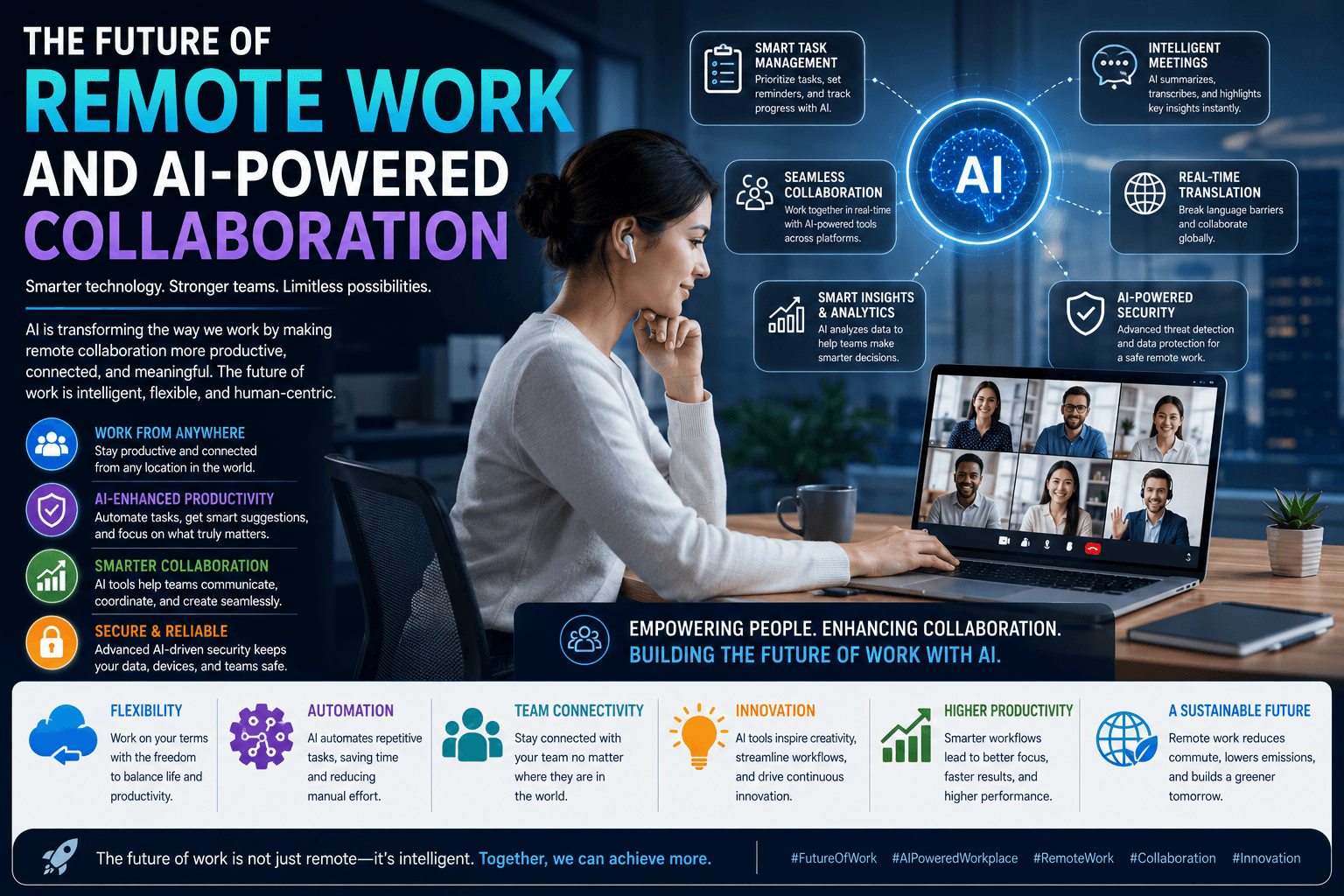
The workplace has undergone a dramatic transformation over the past few years, with remote and hybrid work becoming permanent features of modern business. As organizations continue embracing digital transformation, Artificial Intelligence (AI) is playing a crucial role in redefining how teams communicate, collaborate, and stay productive across different locations.
In 2026, AI-powered collaboration tools are helping businesses improve efficiency, automate routine tasks, enhance communication, and create more flexible work environments. Rather than replacing employees, AI is empowering teams to work smarter, make better decisions, and achieve higher productivity regardless of where they are located.
Remote Work Has Become a Long-Term Business Strategy
Remote work is no longer considered a temporary solution. Many organizations now operate with fully remote or hybrid workforces, allowing employees to balance flexibility with productivity.
Businesses benefit from:
Reduced operating costs
Access to global talent
Improved employee satisfaction
Greater business continuity
Increased workforce flexibility
These advantages have encouraged companies to invest in technologies that support distributed teams.
AI Is Transforming Workplace Collaboration
Artificial Intelligence is making collaboration faster and more efficient.
Modern AI tools can:
Summarize meetings
Generate reports
Translate conversations
Schedule appointments
Organize tasks
Answer workplace questions
These capabilities reduce administrative work and allow employees to focus on strategic activities.
Smarter Virtual Meetings
AI-powered meeting platforms now provide advanced features that improve communication.
These include:
Real-time transcription
Automatic meeting summaries
Action item generation
Language translation
Noise reduction
Intelligent scheduling
Employees spend less time taking notes and more time participating in discussions.
Intelligent Project Management
Project management software increasingly uses AI to improve team coordination.
AI helps organizations:
Prioritize tasks
Predict project risks
Allocate resources
Monitor deadlines
Track progress
Recommend workflow improvements
These insights improve productivity while reducing project delays.
Enhancing Communication Across Teams
Global organizations often manage teams across multiple time zones.
AI-powered communication platforms help by:
Translating messages instantly
Suggesting responses
Summarizing conversations
Organizing shared knowledge
Improving document search
This creates smoother collaboration between international teams.
Automation Reduces Repetitive Work
Many workplace tasks consume valuable employee time.
AI automates activities such as:
Data entry
Email sorting
Calendar management
Document organization
Workflow approvals
Report generation
Automation allows employees to dedicate more time to innovation and customer-focused work.
Supporting Better Decision-Making
Businesses generate enormous amounts of operational data.
AI analyzes this information to help managers:
Forecast business performance
Monitor employee productivity
Identify operational bottlenecks
Improve resource planning
Measure project success
Data-driven insights support faster and more informed business decisions.
Strengthening Cybersecurity
As remote work expands, cybersecurity has become increasingly important.
Businesses are investing in AI-powered security systems that provide:
Threat detection
Identity verification
Multi-factor authentication
Network monitoring
Fraud prevention
Automated incident response
These technologies help protect sensitive business information and remote employees.
Improving Employee Experience
Employee satisfaction plays a significant role in long-term business success.
AI helps improve the employee experience by:
Personalizing training
Providing virtual assistants
Supporting onboarding
Answering HR questions
Recommending learning resources
Employees receive faster support while organizations improve workforce engagement.
Challenges of AI-Powered Remote Work
Although AI offers many advantages, organizations must address several challenges.
These include:
Data privacy
Cybersecurity risks
Digital fatigue
Technology adoption
Employee training
Maintaining company culture
Successful organizations balance technological innovation with strong leadership and human connection.
Preparing for the Future Workplace
Businesses should prepare by investing in:
Cloud computing
AI collaboration platforms
Employee digital skills
Cybersecurity
Flexible work policies
Continuous learning programs
Organizations that embrace these strategies will be better positioned for long-term success.
Industries Leading Adoption
AI-powered collaboration is expanding across many sectors, including:
Technology
Financial services
Healthcare
Education
Manufacturing
Professional services
Retail
Government
As AI tools become more advanced, adoption is expected to accelerate across nearly every industry.
The Future of Work
The future workplace will combine human creativity with intelligent automation.
Employees will increasingly work alongside AI assistants that help:
Manage schedules
Analyze data
Generate content
Coordinate projects
Improve communication
Support decision-making
Rather than replacing jobs, AI is expected to enhance human productivity and create new opportunities for innovation.
Conclusion
Remote work and AI-powered collaboration are reshaping the modern workplace. Businesses that invest in intelligent collaboration tools, cloud computing, cybersecurity, and employee development are creating more productive, flexible, and resilient organizations.
Artificial Intelligence is enabling teams to communicate more effectively, automate repetitive work, improve decision-making, and strengthen collaboration across global workforces.
As digital transformation continues, companies that successfully combine technology with human expertise will gain a lasting competitive advantage. The future of work is not defined by location—it is defined by intelligent collaboration, continuous innovation, and the ability to adapt to an increasingly connected world.
Frequently Asked Questions (FAQs)
1. What is AI-powered collaboration?
AI-powered collaboration uses artificial intelligence to improve communication, automate tasks, and help teams work more efficiently in remote and hybrid environments.
2. Why is remote work important for modern businesses?
Remote work increases flexibility, reduces operating costs, expands access to global talent, and improves employee satisfaction.
3. How does AI improve remote work?
AI automates repetitive tasks, schedules meetings, summarizes conversations, translates languages, and enhances productivity for distributed teams.
4. What are the best AI tools for remote collaboration?
Popular AI collaboration tools include Microsoft Copilot, ChatGPT, Google Gemini, Zoom AI Companion, Slack AI, Notion AI, and Microsoft Teams AI features.
5. Can AI improve communication in remote teams?
Yes. AI can generate meeting summaries, transcribe conversations, translate languages, and provide real-time writing assistance.
6. How does AI increase employee productivity?
AI reduces manual work by automating workflows, organizing tasks, managing calendars, generating reports, and assisting with research.
7. What are the benefits of AI-powered collaboration?
Benefits include improved efficiency, faster decision-making, better communication, enhanced teamwork, lower operational costs, and increased productivity.
8. Is AI replacing remote workers?
No. AI is designed to support employees by automating repetitive tasks while allowing people to focus on creative, strategic, and relationship-driven work.
9. What is a hybrid workplace?
A hybrid workplace combines remote and in-office work, allowing employees to work from different locations while remaining connected through digital tools.
10. How does AI support virtual meetings?
AI can record meetings, create automatic transcripts, summarize discussions, identify action items, and schedule follow-up tasks.
11. Is AI-powered collaboration secure?
Most enterprise AI platforms include encryption, access controls, and compliance features, but businesses should also implement strong cybersecurity policies.
12. How does AI help project management?
AI assists with task prioritization, workflow automation, deadline tracking, resource allocation, and project performance analysis.
13. Can small businesses benefit from AI-powered collaboration?
Yes. Affordable AI solutions help small businesses improve teamwork, automate operations, and compete more effectively.
14. What challenges come with AI-powered remote work?
Common challenges include data privacy concerns, employee training, integration with existing systems, and maintaining human collaboration.
15. How does AI improve customer service for remote teams?
AI-powered chatbots, virtual assistants, and automated support systems enable faster response times and 24/7 customer assistance.
16. What role does cloud computing play in remote work?
Cloud computing enables secure access to files, applications, and collaboration tools from anywhere with an internet connection.
17. How can businesses prepare for the future of remote work?
Organizations should invest in AI tools, strengthen cybersecurity, provide employee training, optimize cloud infrastructure, and support flexible work policies.
18. What industries benefit most from AI-powered collaboration?
Technology, healthcare, finance, education, marketing, consulting, customer service, and manufacturing all benefit from AI-enhanced collaboration.
19. What is the future of AI in remote work?
AI will continue to automate workflows, personalize employee experiences, improve virtual collaboration, and support smarter business operations.
20. Why should businesses adopt AI-powered collaboration today?
Businesses that adopt AI-powered collaboration can improve efficiency, reduce costs, enhance employee engagement, strengthen communication, and remain competitive in the evolving digital workplace.