
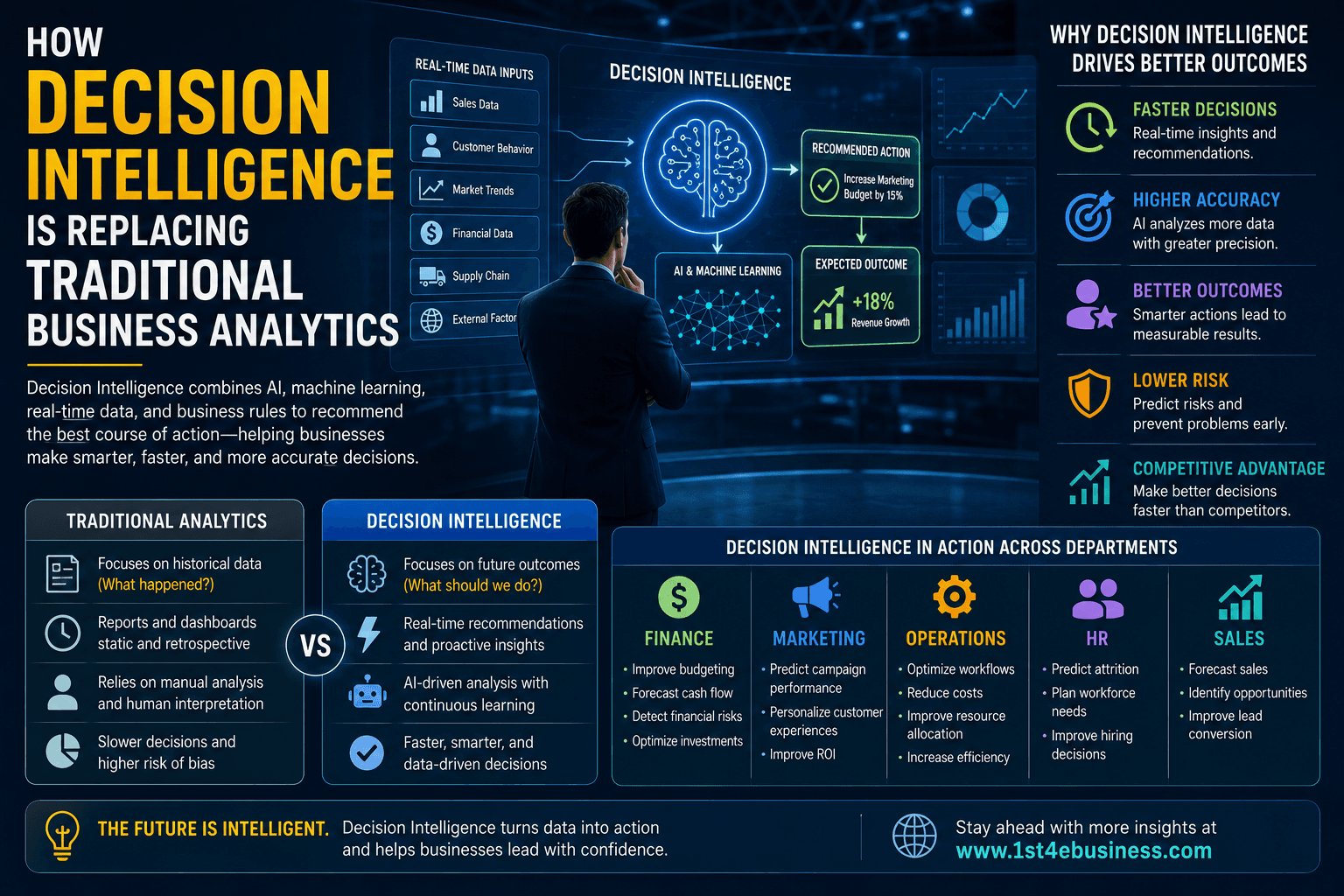

How Decision Intelligence Is Replacing Traditional Business Analytics
Business analytics has long been the foundation of data-driven decision-making. Companies have relied on dashboards, reports, spreadsheets, and historical data to understand performance and identify trends. But as businesses face faster markets, larger data volumes, and increasingly complex decisions, traditional analytics is no longer enough.
This is where Decision Intelligence (DI) is emerging. By combining artificial intelligence, machine learning, predictive analytics, business rules, and real-time data, decision intelligence helps organizations move beyond understanding what happened toward determining what should happen next.
What Is Decision Intelligence?
Decision Intelligence is an approach that uses data, AI, analytics, and contextual information to improve business decisions. Instead of simply presenting information to executives, DI systems analyze situations, evaluate possible outcomes, and recommend actions.
Traditional analytics typically answers questions such as:
What happened?
Why did it happen?
What trends are emerging?
Decision intelligence goes further:
What is likely to happen?
What options are available?
What would happen if we chose each option?
Which action is most likely to achieve the desired outcome?
This shift transforms analytics from a reporting function into an active decision-support capability.
The Limitations of Traditional Business Analytics
Traditional business intelligence remains valuable, but it often depends heavily on human interpretation.
For example, a sales dashboard might show that revenue decreased by 8% during the previous quarter. An analyst can investigate the data and identify potential causes. However, management still needs to determine what action to take.
This process can be slow and subjective.
Traditional analytics also tends to focus on historical or structured data. Modern organizations, meanwhile, generate information from customer interactions, social media, IoT devices, applications, supply chains, financial systems, and other sources.
Decision intelligence addresses these limitations by combining multiple data sources and applying AI-driven reasoning to support faster decisions.
From Descriptive Analytics to Prescriptive Decisions
One of the biggest differences between traditional analytics and decision intelligence is the move from descriptive to prescriptive analytics.
Descriptive analytics explains what has already happened. Predictive analytics estimates what could happen next. Prescriptive analytics recommends what an organization should do.
Decision intelligence brings these capabilities together.
For example, an e-commerce company might use traditional analytics to discover that customers are abandoning their shopping carts at a higher rate.
A decision intelligence platform could analyze customer behavior, pricing, inventory, promotions, and competitor activity. It could then recommend targeted discounts, changes to product recommendations, or adjustments to the checkout experience.
The goal is not simply to provide more data. It is to convert data into actionable decisions.
AI Is Accelerating the Shift
Artificial intelligence is one of the major technologies driving the adoption of decision intelligence.
Modern AI systems can process large datasets, recognize patterns, identify anomalies, generate forecasts, and evaluate multiple scenarios much faster than traditional analytical workflows.
Generative AI is adding another layer by allowing business users to interact with data using natural language.
Instead of asking an analyst to build a complex report, an executive could ask:
“Why did customer churn increase this month, and what actions could reduce it?”
An AI-powered decision intelligence system could analyze relevant information, identify key drivers, compare possible interventions, and present recommendations.
This makes advanced analytics more accessible to non-technical users.
Real-Time Decision-Making
Another major advantage of decision intelligence is its ability to support decisions in near real time.
Traditional business reports may be generated daily, weekly, or monthly. That delay can be problematic in industries where conditions change rapidly.
Financial institutions, retailers, logistics companies, manufacturers, and healthcare organizations often need to respond immediately to changing circumstances.
For example, a supply-chain decision intelligence system could monitor inventory levels, transportation disruptions, supplier performance, and customer demand. If a critical shipment is delayed, the system could evaluate alternative suppliers or transportation routes and recommend the best response.
This enables organizations to become more proactive rather than reactive.
Decision Intelligence Across Industries
Decision intelligence is already applicable across a wide range of business functions.
Retail
Retailers can use DI to optimize pricing, inventory, promotions, product recommendations, and customer engagement.
Finance
Financial organizations can use decision intelligence for fraud detection, credit assessment, risk management, portfolio optimization, and regulatory monitoring.
Manufacturing
Manufacturers can apply DI to predictive maintenance, production planning, quality control, and supply-chain optimization.
Healthcare
Healthcare organizations can use decision intelligence to improve resource allocation, patient scheduling, operational planning, and clinical decision support.
Logistics
Logistics companies can optimize delivery routes, warehouse operations, fleet utilization, and demand forecasting.
Decision Intelligence and Human Decision-Makers
Decision intelligence is not necessarily designed to replace human leadership. Instead, it can augment human expertise.
Executives and managers still need to consider factors that may not be fully represented in datasets, including organizational priorities, ethical considerations, customer relationships, and strategic goals.
DI provides decision-makers with stronger evidence and scenario analysis so they can make more informed choices.
The relationship can be summarized as:
Traditional analytics → information
Predictive analytics → forecasts
Decision intelligence → recommendations and actions
The Rise of Autonomous Decision-Making
As AI agents become more capable, decision intelligence is moving toward partially autonomous decision-making.
Organizations can define business objectives, policies, constraints, and approval requirements. AI systems can then monitor conditions and make or recommend decisions within those boundaries.
For example, an automated procurement system could monitor inventory and supplier prices. When stock reaches a predefined threshold, it could evaluate suppliers and recommend an order. In certain low-risk situations, the system could potentially execute the transaction automatically.
This creates a new model in which analytics, decision-making, and execution become increasingly connected.
Challenges Organizations Must Address
Despite its potential, decision intelligence introduces several challenges.
Data quality is critical. Poor or incomplete data can produce unreliable recommendations.
AI transparency is also important. Organizations need to understand why a system recommends a particular action, especially for high-impact decisions.
Governance and security must be established to prevent unauthorized or inappropriate automated decisions.
Organizations also need skilled professionals who understand both business processes and AI technologies.
Successful implementation therefore requires more than purchasing a new analytics platform. Companies must establish clear decision frameworks, reliable data pipelines, governance policies, and measurable business objectives.
The Future of Business Analytics
Traditional business analytics is unlikely to disappear completely. Dashboards, reports, KPIs, and historical analysis will remain important.
However, their role is changing.
The future is likely to combine business intelligence, predictive analytics, AI agents, automation, and decision intelligence into integrated platforms. Instead of requiring employees to search through multiple dashboards and manually interpret data, organizations will increasingly use intelligent systems that identify important developments and recommend appropriate actions.
The competitive advantage will belong to businesses that can make better decisions faster.
Conclusion
Decision intelligence represents a major evolution in business analytics. Traditional analytics helps organizations understand their past and present, while decision intelligence helps them determine what to do next.
By combining real-time data, AI, predictive models, scenario analysis, and business rules, DI can transform complex information into practical recommendations.
As organizations continue adopting AI-powered systems, decision intelligence is positioned to become a core component of modern business operations—turning analytics from a passive reporting function into an active engine for strategic decision-making.
FAQs
1. What is decision intelligence?
Decision intelligence combines AI, analytics, data, and business rules to help organizations make better and faster decisions.
2. How is decision intelligence different from business intelligence?
Business intelligence primarily helps organizations understand data and performance. Decision intelligence goes further by evaluating possible outcomes and recommending actions.
3. Can decision intelligence replace data analysts?
It is more likely to augment analysts by automating repetitive analysis and allowing them to focus on complex strategic questions.
4. What technologies power decision intelligence?
Common technologies include artificial intelligence, machine learning, predictive analytics, optimization, real-time data processing, knowledge graphs, and automation.
5. Why is decision intelligence becoming important in 2026?
Businesses are dealing with faster market changes, increasingly complex data, and growing demand for real-time decisions. DI helps organizations respond more quickly and systematically.
6. Is decision intelligence useful for small businesses?
Yes. Cloud-based AI and analytics platforms can make decision intelligence accessible to smaller organizations without requiring large internal data-science teams.