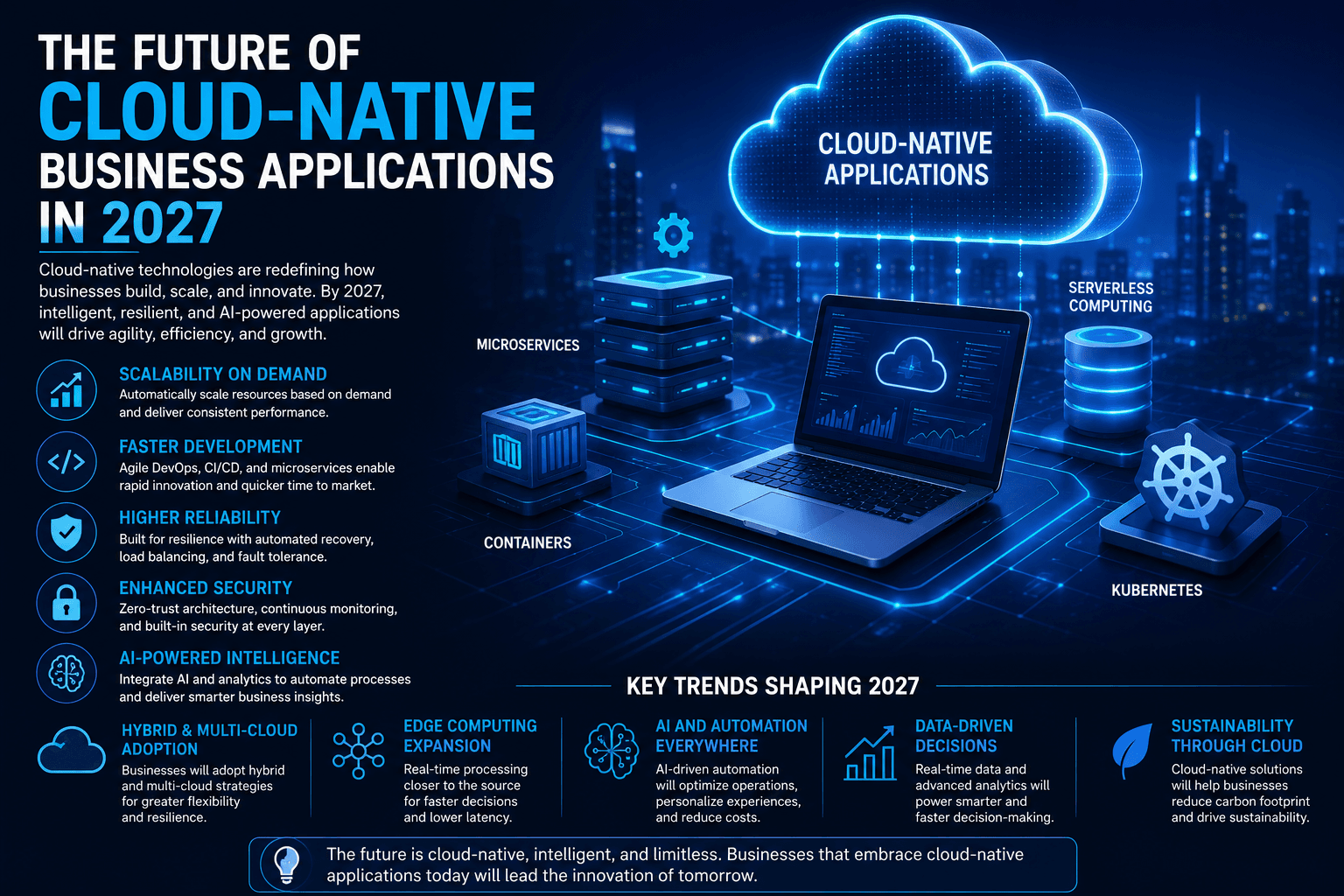

Cloud-native technology is becoming the foundation for the next generation of business applications. As organizations move deeper into digital transformation, cloud-native applications are evolving beyond simple cloud-hosted software into intelligent, scalable, automated platforms designed to adapt to changing business needs.
By 2027, businesses are expected to place greater emphasis on cloud-native architectures that combine containers, microservices, serverless computing, APIs, artificial intelligence, automation, and real-time data processing.
The result will be business applications that are more flexible, resilient, intelligent, and capable of responding to changing workloads and customer expectations.
What Are Cloud-Native Business Applications?
Cloud-native applications are software systems specifically designed to take advantage of cloud computing environments.
Unlike traditional applications that are simply moved from physical servers to the cloud, cloud-native applications are built around technologies and principles such as:
Microservices
Containers
Kubernetes and orchestration
Serverless computing
APIs
DevOps and CI/CD
Infrastructure as code
Automated monitoring
Cloud-based databases
AI and machine learning
These technologies allow applications to scale dynamically, deploy updates faster, and operate across distributed infrastructure.
Why Cloud-Native Applications Matter in 2027
Businesses are under pressure to innovate faster while controlling costs and maintaining reliable operations.
Traditional software architectures can make rapid innovation difficult because applications may depend on tightly connected systems and manual deployment processes.
Cloud-native architecture provides greater flexibility.
Organizations can develop, update, scale, and manage different components independently. This allows businesses to respond faster to customer needs and market changes.
By 2027, cloud-native design is likely to become less of a technology advantage and more of a standard requirement for many digital businesses.
AI Will Become Embedded in Business Applications
One of the biggest changes will be the integration of AI directly into cloud-native applications.
Instead of treating AI as a separate tool, businesses will increasingly embed intelligent capabilities into everyday applications.
Examples include:
AI-powered customer support
Predictive analytics
Automated document processing
Intelligent forecasting
Personalized recommendations
Fraud detection
Automated decision support
AI-powered business intelligence
Cloud infrastructure makes it easier to scale AI workloads and connect models with enterprise data and applications.
The Rise of AI-Native Applications
Cloud-native applications are increasingly evolving toward AI-native applications.
An AI-native business application is designed from the beginning to incorporate AI into its core workflows.
For example, a traditional CRM system may store customer information and sales activity. An AI-native CRM could analyze customer behavior, predict buying opportunities, summarize interactions, recommend next actions, and automatically update records.
This changes applications from passive systems of record into intelligent systems of action.
Multi-Agent AI and Cloud Applications
By 2027, multi-agent AI could become an important part of cloud-native business software.
Instead of one AI model performing every task, businesses can use specialized AI agents connected to cloud applications.
For example, an enterprise procurement platform could use separate agents for:
Supplier research
Price analysis
Contract review
Risk assessment
Purchase recommendations
Compliance verification
A coordinating agent could manage the workflow and escalate important decisions to human employees.
This could make cloud-native applications significantly more autonomous.
Serverless Computing Will Continue to Grow
Serverless computing allows developers to run application functions without managing traditional server infrastructure directly.
Businesses can benefit from serverless architecture because resources can scale automatically based on demand.
This can be particularly valuable for applications with unpredictable workloads.
By 2027, serverless technology is likely to become increasingly integrated with event-driven architectures, AI workloads, APIs, and automated business processes.
Microservices Will Enable Greater Flexibility
Microservices divide applications into smaller, independently deployable services.
This approach allows development teams to update individual components without redeploying an entire application.
For large businesses, this can improve:
Development speed
Scalability
System resilience
Deployment flexibility
Team productivity
However, microservices also introduce complexity. Organizations need effective monitoring, security, service management, and architecture governance to manage distributed systems successfully.
Real-Time Data Will Become More Important
Business applications increasingly need access to real-time information.
Customers expect immediate responses, while businesses need up-to-date information for decisions.
Cloud-native architectures can connect applications with streaming data platforms, APIs, IoT devices, transactional systems, and analytics platforms.
By 2027, real-time data could become a standard feature across applications in industries such as:
Finance
Retail
Manufacturing
Logistics
Healthcare
Telecommunications
Real-time intelligence can help businesses detect problems and respond faster.
Edge Computing and Cloud-Native Applications
Cloud computing will not eliminate the need for local processing.
In situations where latency, connectivity, or data volume is critical, businesses may process information closer to where it is generated.
This is known as edge computing.
Cloud-native applications can extend across centralized cloud environments and edge locations.
For example, a manufacturer could process machine data locally while sending selected information to the cloud for long-term analysis.
This hybrid approach can improve performance while maintaining centralized management and analytics.
Cloud-Native Security Will Become a Priority
As applications become more distributed, security becomes more complex.
Cloud-native environments may contain containers, APIs, microservices, databases, AI models, third-party integrations, and multiple cloud platforms.
Businesses will need security strategies that cover the entire application lifecycle.
Important areas include:
Identity and access management
Zero-trust security
API security
Container security
Data encryption
Secrets management
Runtime monitoring
Supply chain security
AI security
Security will increasingly need to be built into application development rather than added after deployment.
FinOps and Cloud Cost Optimization
Cloud-native applications can scale efficiently, but uncontrolled cloud usage can also create significant costs.
By 2027, businesses are likely to place greater emphasis on FinOps—the practice of managing cloud spending through collaboration between engineering, finance, and business teams.
AI can help identify:
Underused resources
Cost anomalies
Inefficient workloads
Scaling opportunities
Expensive services
Optimization opportunities
The goal is to balance performance, reliability, and innovation with financial efficiency.
Platform Engineering Will Become More Important
As cloud environments become more complex, developers increasingly need standardized internal platforms.
Platform engineering helps organizations create reusable infrastructure, development tools, security controls, deployment pipelines, and templates.
Instead of requiring every development team to build infrastructure independently, organizations can provide internal developer platforms that simplify application development.
This can improve developer productivity while maintaining organizational standards.
Industry-Specific Cloud Applications
Cloud-native applications will continue to become more specialized.
Financial Services
Banks and financial institutions can use cloud-native systems for real-time fraud detection, payments, risk analytics, and personalized financial services.
Healthcare
Healthcare organizations can use cloud-native platforms for patient data, analytics, remote monitoring, scheduling, and AI-assisted workflows.
Retail
Retailers can build scalable commerce platforms with real-time inventory, personalization, recommendation engines, and intelligent customer service.
Manufacturing
Manufacturers can combine cloud-native applications with IoT and edge computing to monitor equipment, production, and supply chains.
Logistics
Logistics companies can use cloud-native systems to optimize routes, track shipments, forecast demand, and coordinate transportation networks.
Challenges Businesses Must Address
Cloud-native transformation brings significant advantages, but organizations must also manage new challenges.
Complexity
Distributed applications can be difficult to monitor and troubleshoot.
Skills Gaps
Businesses need professionals with expertise in cloud architecture, DevOps, cybersecurity, AI, data engineering, and platform engineering.
Vendor Lock-In
Heavy dependence on a single cloud provider can make migration and negotiation more difficult.
Security Risks
More APIs, services, and integrations create additional attack surfaces.
Data Governance
Businesses must control how data moves between applications, clouds, regions, and AI systems.
Migration Costs
Modernizing legacy applications can require substantial investment and careful planning.
How Businesses Can Prepare for 2027
Organizations planning their cloud-native strategy should focus on business outcomes rather than adopting technology simply because it is new.
A practical roadmap includes:
Identify applications that would benefit most from modernization.
Evaluate existing architecture and dependencies.
Establish cloud security and governance standards.
Adopt automation and CI/CD practices.
Build internal developer platforms where appropriate.
Introduce AI into high-value workflows.
Monitor cloud performance and costs.
Develop skills across cloud, security, data, and AI.
Modernize gradually instead of attempting to transform everything simultaneously.
The Future of Cloud-Native Business Applications
By 2027, cloud-native applications are likely to become more intelligent, autonomous, modular, and adaptive.
The combination of cloud infrastructure, AI agents, real-time data, serverless computing, edge processing, and automation could create a new generation of business applications that continuously respond to changing conditions.
Applications may increasingly move beyond simply helping employees perform tasks. They may proactively identify opportunities, recommend actions, automate workflows, and coordinate processes across departments.
This could create a future where business software acts less like a static tool and more like an intelligent digital operating environment.
Conclusion
The future of cloud-native business applications in 2027 will be shaped by the convergence of cloud computing, AI, automation, real-time data, and modern software architecture.
Businesses that successfully adopt cloud-native strategies can gain greater scalability, faster innovation, improved resilience, and more intelligent workflows.
However, technology alone will not guarantee success. Organizations will need strong security, governance, cost management, skilled teams, and a clear modernization strategy.
As cloud-native applications become increasingly AI-powered and autonomous, the organizations that combine technical innovation with disciplined execution will be best positioned to compete in the next generation of digital business.
FAQs
1. What are cloud-native business applications?
Cloud-native business applications are software systems specifically designed to operate using cloud technologies such as containers, microservices, serverless computing, APIs, automation, and cloud-based infrastructure.
2. Why are cloud-native applications important for 2027?
They provide scalability, flexibility, faster development, automation, and the ability to integrate emerging technologies such as AI and real-time analytics.
3. How will AI change cloud-native applications?
AI will enable applications to provide predictive insights, automate decisions, personalize experiences, detect anomalies, and coordinate complex business workflows.
4. What is an AI-native application?
An AI-native application is designed with artificial intelligence as a core component rather than adding AI as an optional feature later.
5. Will cloud-native applications use AI agents?
Many applications are expected to incorporate AI agents that can perform specialized tasks, coordinate workflows, analyze information, and assist employees.
6. What are the biggest cloud-native challenges?
Key challenges include architecture complexity, cybersecurity, cloud costs, skills shortages, vendor lock-in, data governance, and legacy-system modernization.
7. What role will serverless computing play?
Serverless computing can help businesses build scalable applications without directly managing traditional server infrastructure, particularly for event-driven and variable workloads.
8. How does edge computing complement cloud-native applications?
Edge computing allows certain workloads to be processed closer to where data is generated, reducing latency and supporting applications that require rapid local responses.
9. How can businesses prepare for cloud-native transformation?
Businesses should prioritize high-value applications, modernize gradually, strengthen cloud governance and security, adopt automation, develop technical skills, and integrate AI where it provides measurable value.
10. What is the future of cloud-native business software?
Cloud-native business software is expected to become increasingly intelligent, automated, scalable, real-time, and autonomous, combining cloud infrastructure with AI and modern application architectures.