Risk management has always been essential to business, but the complexity of modern operations is making traditional approaches increasingly difficult to maintain. Organizations now face cybersecurity threats, financial volatility, supply chain disruptions, regulatory changes, fraud, operational failures, and rapidly changing market conditions.
Artificial intelligence is changing how businesses identify, assess, monitor, and respond to these risks. In 2026, AI-powered risk management is moving from periodic assessments toward continuous, data-driven risk intelligence.
Instead of waiting for problems to appear, organizations can use AI to detect warning signs, identify patterns, predict potential threats, and recommend actions before risks become major incidents.
What Is AI-Powered Risk Management?
AI-powered risk management uses technologies such as machine learning, predictive analytics, natural-language processing, automation, and intelligent agents to improve risk identification and decision-making.
Traditional risk management often depends on manual reviews, historical data, spreadsheets, questionnaires, and periodic audits. AI can analyze much larger volumes of information and continuously update risk assessments as new data becomes available.
For example, an AI system could monitor financial transactions, cybersecurity alerts, supplier activity, market conditions, and regulatory updates simultaneously.
This creates a more dynamic view of organizational risk.
Why Businesses Are Turning to AI for Risk Management
Modern organizations generate enormous amounts of data. The challenge is no longer simply collecting information—it is identifying which signals matter.
AI can process structured and unstructured information at high speed and identify relationships that may be difficult to detect manually.
Key advantages include:
Continuous risk monitoring
Faster threat detection
Predictive analytics
Automated risk assessments
Improved decision-making
Reduced manual workload
Better regulatory visibility
Earlier identification of emerging risks
The result is a shift from reactive risk management toward proactive risk intelligence.
AI in Financial Risk Management
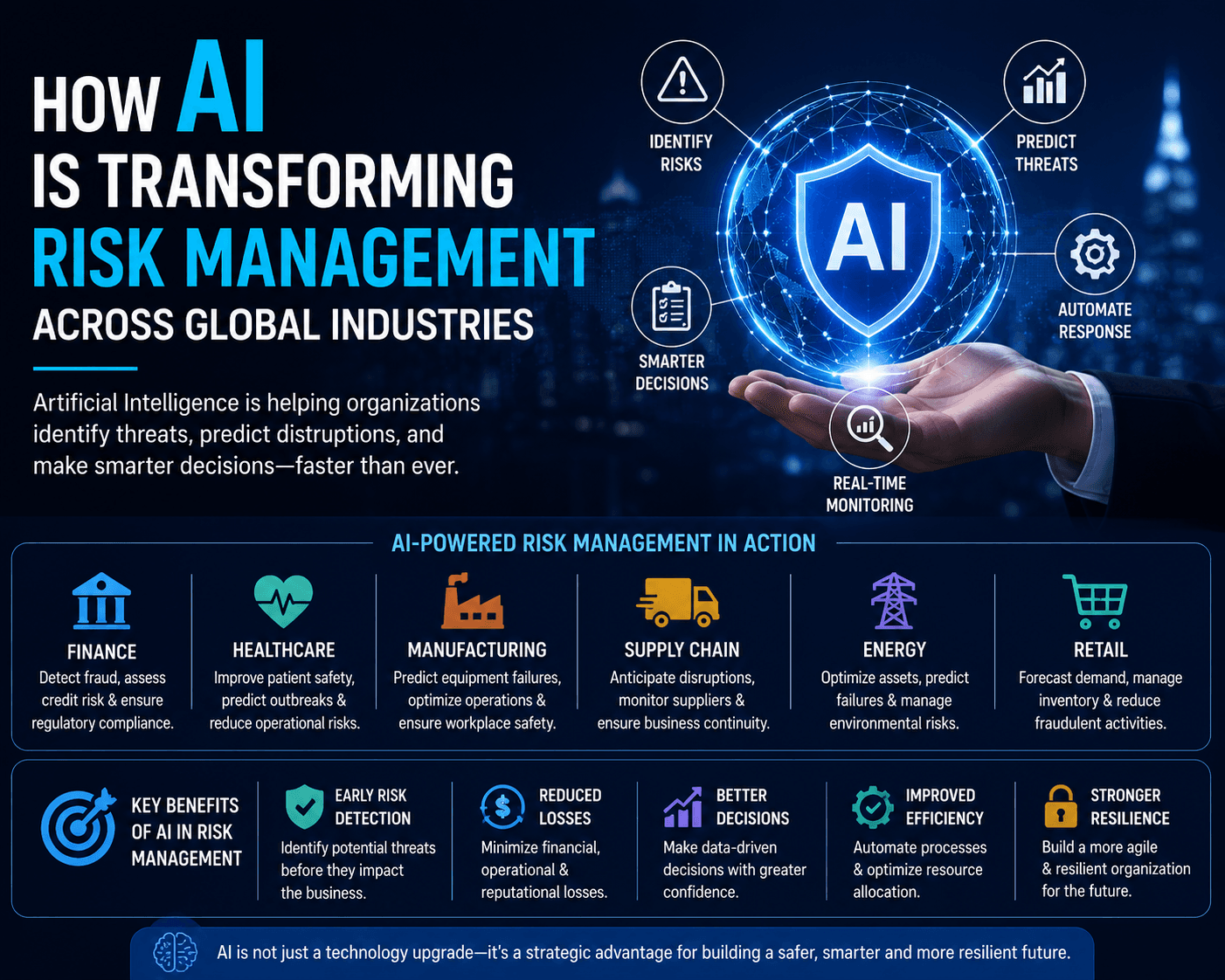
Financial institutions and businesses use AI to identify fraud, credit risk, market risk, and unusual transaction patterns.
Machine learning systems can analyze transaction histories and identify activity that differs from established behavioral patterns.
For example, an AI system may detect:
Unusual payment activity
Suspicious account behavior
Abnormal transaction volumes
Unexpected changes in spending patterns
Potential fraud indicators
AI can also support credit-risk analysis by evaluating multiple financial variables and identifying patterns associated with potential defaults.
This does not eliminate human judgment, but it can provide financial teams with faster and more comprehensive insights.
AI and Cybersecurity Risk
Cybersecurity has become one of the most important areas of AI-powered risk management.
Organizations face phishing attacks, ransomware, credential theft, insider threats, malware, and increasingly sophisticated attacks.
AI systems can continuously monitor networks, devices, applications, and user behavior to identify anomalies.
Instead of relying exclusively on predefined rules, AI can learn what normal behavior looks like and flag unusual activity.
For example, if an employee account suddenly accesses sensitive systems from an unusual location and begins downloading large volumes of data, an AI-powered security system can identify the combination of signals and trigger an alert.
AI can also help security teams prioritize threats, reducing the number of alerts that analysts need to investigate manually.
AI in Supply Chain Risk Management
Global supply chains are vulnerable to disruptions caused by geopolitical events, extreme weather, transportation delays, supplier failures, commodity price changes, and demand fluctuations.
AI can help businesses monitor these risks and identify potential disruptions earlier.
A supply chain risk platform can analyze:
Supplier performance
Inventory levels
Delivery data
Market conditions
Transportation activity
Weather information
Geographic risk
Demand forecasts
AI can then identify potential vulnerabilities and help organizations evaluate alternative suppliers or logistics strategies.
This makes supply chain management more resilient and responsive.
AI-Powered Vendor Risk Management
Third-party vendors can create significant operational, cybersecurity, compliance, and financial risks.
Organizations increasingly rely on AI to monitor vendor risk continuously rather than assessing suppliers only during onboarding or annual reviews.
AI can analyze vendor information, security assessments, certifications, financial indicators, incident reports, and other relevant data.
A risk engine can then assign risk scores and highlight vendors that require additional attention.
This enables risk teams to focus their resources on the suppliers presenting the greatest potential exposure.
AI in Healthcare Risk Management
Healthcare organizations face complex risks involving patient safety, cybersecurity, compliance, fraud, operational performance, and data privacy.
AI can analyze large datasets to identify patterns that may indicate potential risks.
Applications include:
Fraud detection
Patient safety monitoring
Cybersecurity threat detection
Medical supply risk analysis
Compliance monitoring
Operational risk assessment
However, healthcare AI requires strong governance because decisions can affect patient outcomes and sensitive personal information.
Human oversight remains critical.
AI and Insurance Risk
Insurance companies are using AI to improve underwriting, claims processing, fraud detection, and risk assessment.
Instead of relying only on historical averages, AI can evaluate a wider range of variables and identify patterns associated with different risk levels.
In claims management, AI can flag potentially suspicious claims for investigation while helping legitimate claims move through the process faster.
AI can also support dynamic risk modeling by continuously incorporating new information.
AI in Manufacturing
Manufacturers face operational risks involving equipment failures, quality problems, worker safety, supply shortages, and production interruptions.
Predictive AI can analyze sensor and equipment data to identify signs of potential failures before machines stop working.
This approach, known as predictive maintenance, can help organizations schedule maintenance before a critical breakdown occurs.
AI can also identify quality anomalies during production, helping manufacturers reduce defects and waste.
AI and Regulatory Compliance
Regulatory requirements continue to become more complex across industries and jurisdictions.
AI can help organizations monitor regulatory changes, analyze policies, identify compliance gaps, and automate portions of reporting.
Natural-language processing can be used to analyze large volumes of regulatory documents and identify requirements relevant to a specific organization.
This can reduce the amount of manual research required by compliance teams.
However, organizations should validate AI-generated interpretations before making important regulatory decisions.
AI for Operational Risk
Operational risk includes failures in processes, technology, people, and systems.
AI can monitor operational data and identify patterns that may indicate increasing risk.
For example, an organization could use AI to detect:
Increasing system failures
Employee workflow bottlenecks
Unusual error rates
Service disruptions
Process deviations
Resource shortages
By identifying these signals early, organizations can intervene before operational problems become significant business disruptions.
Predictive Risk Management
One of the most important changes introduced by AI is the ability to move from analyzing what has already happened to estimating what may happen next.
Predictive models can evaluate historical and real-time information to identify potential future outcomes.
For example, an organization could estimate the likelihood of:
Supplier disruption
Customer default
Equipment failure
Fraud
Cybersecurity incidents
Demand changes
Financial losses
Predictive analytics does not guarantee that a predicted event will occur. Instead, it gives decision-makers additional information for preparing and prioritizing action.
AI Agents Are Taking Risk Automation Further
In 2026, AI-powered risk management is increasingly incorporating intelligent agents.
An AI risk agent can potentially monitor a specific risk area, analyze new information, prepare reports, and escalate significant issues.
Multiple agents can also collaborate.
For example:
A monitoring agent identifies a potential supplier issue.
A research agent gathers additional information.
A financial agent evaluates the supplier's financial exposure.
A cybersecurity agent checks for security-related concerns.
A reporting agent prepares a risk summary.
A human manager reviews and approves the recommended action.
This creates a more automated and coordinated risk-management workflow.
Benefits of AI-Driven Risk Management
Faster Detection
AI can process information continuously and identify unusual activity quickly.
Better Risk Visibility
Organizations can combine data from multiple sources to create a more comprehensive risk picture.
Improved Efficiency
Automation reduces repetitive manual analysis and allows risk professionals to focus on complex decisions.
Proactive Decision-Making
Predictive analytics can help organizations prepare for potential problems before they occur.
Scalability
AI systems can analyze large numbers of transactions, suppliers, customers, and operational events simultaneously.
Consistency
Automated processes can apply standardized risk criteria across large datasets.
Challenges and Limitations
AI is not a replacement for effective risk governance.
Data Quality
Poor-quality or incomplete data can produce unreliable risk assessments.
False Positives
AI systems may incorrectly flag legitimate activities as risky, creating unnecessary investigations.
Model Bias
AI models can inherit biases from the data used to train them.
Explainability
Risk professionals may need to understand why an AI system assigned a particular risk score or recommendation.
Cybersecurity
AI systems themselves can become targets for attackers and therefore require strong security controls.
Human Oversight
High-impact risk decisions should include appropriate human review and accountability.
The Future of AI Risk Management
The future of risk management is likely to become increasingly continuous, predictive, and interconnected.
Organizations may move away from isolated risk assessments toward unified platforms that monitor financial, operational, cybersecurity, supplier, compliance, and market risks together.
AI agents may increasingly act as digital risk analysts, monitoring specific areas and escalating important events to human teams.
At the same time, governance will become more important. Organizations will need clear rules around AI permissions, data access, model monitoring, auditability, and human intervention.
The most effective organizations will not simply use AI to automate existing risk processes. They will redesign risk management around continuous intelligence and faster decision-making.
Conclusion
AI is transforming risk management across global industries by helping organizations detect threats faster, predict potential problems, automate analysis, and make more informed decisions.
From financial services and cybersecurity to healthcare, manufacturing, insurance, supply chains, and regulatory compliance, AI is becoming an important part of modern risk strategies.
The greatest opportunity lies in moving from reactive risk management to proactive risk intelligence. Instead of discovering problems after they occur, businesses can increasingly identify warning signals and take action earlier.
AI will not eliminate uncertainty or risk. But when combined with high-quality data, strong governance, expert judgment, and human oversight, it can give organizations a powerful new way to understand and manage an increasingly complex risk environment.
FAQs
1. How is AI transforming risk management?
AI transforms risk management by analyzing large volumes of data, identifying patterns, detecting anomalies, predicting potential risks, and automating repetitive assessment and monitoring tasks.
2. What industries use AI for risk management?
AI-powered risk management is being used across finance, banking, insurance, healthcare, manufacturing, cybersecurity, retail, logistics, supply chains, and other industries.
3. Can AI predict business risks?
AI can use historical and real-time data to identify patterns associated with potential future risks. However, predictions are probabilistic and should not be treated as guarantees.
4. How does AI help with cybersecurity risk?
AI can monitor network and user activity, detect unusual behavior, prioritize threats, identify potential attacks, and help security teams respond more quickly.
5. How does AI improve vendor risk management?
AI can continuously evaluate supplier information, security indicators, financial signals, compliance data, and other risk factors to identify high-risk vendors and emerging problems.
6. What are the biggest challenges of AI in risk management?
Important challenges include data quality, model bias, false positives, explainability, cybersecurity, privacy, regulatory requirements, and maintaining appropriate human oversight.
7. Can AI replace risk management professionals?
AI can automate many repetitive analytical tasks, but risk professionals remain essential for judgment, strategy, governance, investigation, and high-impact decisions.
8. What is predictive risk management?
Predictive risk management uses data and AI models to identify patterns that may indicate future risks, allowing organizations to prepare and respond proactively.
9. Are AI risk assessments always accurate?
No. AI assessments depend on data quality, model design, and context. Organizations should validate important AI-generated recommendations and maintain appropriate human review.
10. What is the future of AI-powered risk management?
Risk management is expected to become more continuous, predictive, automated, and interconnected, with AI agents increasingly monitoring risk areas and supporting human decision-makers.